SmarterEd

Aussie Maths & Science Teachers: Save your time with SmarterEd

  • Login
  • Get Help
  • About

HMS, HAG EQ-Bank 113

Analyse the relationship between changes in major causes of mortality and life expectancy trends in Australia over the past century.   (8 marks)

--- 24 WORK AREA LINES (style=lined) ---

Show Answers Only

Overview Statement

The interaction between declining infectious disease mortality and rising chronic disease prevalence has shaped Australia’s life expectancy patterns, with significant relationships emerging between disease transitions and population ageing trends.

Component Relationship 1

Infectious disease control directly contributed to dramatic life expectancy increases from the early 1900s to 1995. Public health measures, vaccination programmes and antibiotics effectively eliminated tuberculosis, pneumonia and other communicable diseases as leading causes of death. This transformation resulted in Australians living longer and reaching ages where chronic conditions become prevalent. The significance of this relationship demonstrates how medical advances enabled populations to survive infectious diseases but led to exposure to age-related chronic conditions like cardiovascular disease and cancer.

Component Relationship 2

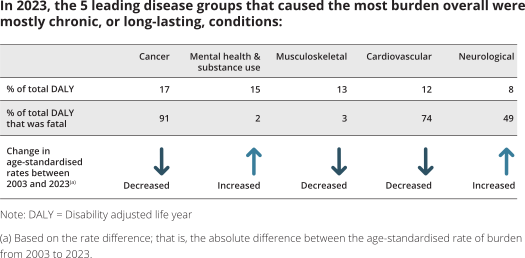
The epidemiological transition has created a paradoxical relationship where longer life expectancy coincides with increased chronic disease burden. Cancer, dementia and cardiovascular disease now dominate mortality statistics because people live long enough to develop these age-related conditions. Recent trends show life expectancy declining slightly due to COVID-19, illustrating how infectious diseases can still impact longevity patterns. This reveals that the relationship between disease patterns and life expectancy remains dynamic and influenced by emerging health threats.

Implications and Synthesis

These interconnected relationships demonstrate how disease transitions fundamentally reshape population health outcomes, requiring healthcare systems to adapt from acute care models to chronic disease management approaches for sustained life expectancy improvements.
Show Worked Solution

Overview Statement

The interaction between declining infectious disease mortality and rising chronic disease prevalence has shaped Australia’s life expectancy patterns, with significant relationships emerging between disease transitions and population ageing trends.

Component Relationship 1

Infectious disease control directly contributed to dramatic life expectancy increases from the early 1900s to 1995. Public health measures, vaccination programmes and antibiotics effectively eliminated tuberculosis, pneumonia and other communicable diseases as leading causes of death. This transformation resulted in Australians living longer and reaching ages where chronic conditions become prevalent. The significance of this relationship demonstrates how medical advances enabled populations to survive infectious diseases but led to exposure to age-related chronic conditions like cardiovascular disease and cancer.

Component Relationship 2

The epidemiological transition has created a paradoxical relationship where longer life expectancy coincides with increased chronic disease burden. Cancer, dementia and cardiovascular disease now dominate mortality statistics because people live long enough to develop these age-related conditions. Recent trends show life expectancy declining slightly due to COVID-19, illustrating how infectious diseases can still impact longevity patterns. This reveals that the relationship between disease patterns and life expectancy remains dynamic and influenced by emerging health threats.

Implications and Synthesis

These interconnected relationships demonstrate how disease transitions fundamentally reshape population health outcomes, requiring healthcare systems to adapt from acute care models to chronic disease management approaches for sustained life expectancy improvements.
Filed Under: Current Health Status Tagged With: Band 6, smc-5474-05-Major causes

HMS, HAG EQ-Bank 112

Discuss the differences in major causes of disease burden between males and females in Australia.   (6 marks)

--- 18 WORK AREA LINES (style=lined) ---

Show Answers Only

Benefits for males

  • [P] Males experience coronary heart disease as their leading cause of disease burden.
  • [E] This occurs because males have higher rates of cardiovascular disease and suicide as primary burden contributors, reflecting lifestyle and behavioural risk factors.
  • [Ev] The leading causes for males include coronary heart disease, back pain and problems, and suicide and self-inflicted injuries, demonstrating more fatal burden patterns.
  • [L] Therefore, males experience higher total disease burden overall compared to females.

Challenges for females

  • [P] Females experience dementia and anxiety disorders as their leading causes of disease burden.
  • [E] This demonstrates that mental health conditions and neurological conditions are prominent burden contributors for females, contrasting with the cardiovascular focus seen in males.
  • [Ev] The leading causes for females include dementia, anxiety disorders and back pain problems, showing different patterns of non-fatal burden and longer-term chronic conditions.
  • [L] Consequently, females experience different types of disease burden that require distinct healthcare approaches and interventions.
Show Worked Solution

Benefits for males

  • [P] Males experience coronary heart disease as their leading cause of disease burden.
  • [E] This occurs because males have higher rates of cardiovascular disease and suicide as primary burden contributors, reflecting lifestyle and behavioural risk factors.
  • [Ev] The leading causes for males include coronary heart disease, back pain and problems, and suicide and self-inflicted injuries, demonstrating more fatal burden patterns.
  • [L] Therefore, males experience higher total disease burden overall compared to females.

Challenges for females

  • [P] Females experience dementia and anxiety disorders as their leading causes of disease burden.
  • [E] This demonstrates that mental health conditions and neurological conditions are prominent burden contributors for females, contrasting with the cardiovascular focus seen in males.
  • [Ev] The leading causes for females include dementia, anxiety disorders and back pain problems, showing different patterns of non-fatal burden and longer-term chronic conditions.
  • [L] Consequently, females experience different types of disease burden that require distinct healthcare approaches and interventions.

Filed Under: Current Health Status Tagged With: Band 5, smc-5474-05-Major causes

HMS, HAG EQ-Bank 111

Explain how chronic conditions have become the dominant cause of disease burden in Australia, replacing infectious diseases as the primary health concern.   (5 marks)

--- 15 WORK AREA LINES (style=lined) ---

Show Answers Only
  • Chronic conditions have become the dominant cause of disease burden because Australia has experienced an epidemiological transition over the past century where deaths from infectious diseases declined dramatically while chronic conditions increased.
  • The reason for this is improved sanitation, vaccination programmes, antibiotics and public health measures have effectively controlled infectious diseases like tuberculosis and pneumonia.
  • As a result, Australians now live longer but develop age-related chronic conditions such as cardiovascular disease, cancer, dementia and diabetes that require long-term management.
  • This leads to chronic conditions now being responsible for the vast majority of deaths, with cancer, mental health conditions and musculoskeletal conditions emerging as the leading disease groups.
  • Consequently, the healthcare system has shifted focus from treating acute infectious episodes to managing long-term chronic diseases that cause substantial disability and premature death.
  • This demonstrates why modern Australia faces different health challenges compared to previous generations, requiring preventive strategies and lifestyle interventions rather than just medical treatments.
  • Therefore, understanding this transition helps explain current patterns of morbidity and mortality in Australian populations.

Show Worked Solution
  • Chronic conditions have become the dominant cause of disease burden because Australia has experienced an epidemiological transition over the past century where deaths from infectious diseases declined dramatically while chronic conditions increased.
  • The reason for this is improved sanitation, vaccination programmes, antibiotics and public health measures have effectively controlled infectious diseases like tuberculosis and pneumonia.
  • As a result, Australians now live longer but develop age-related chronic conditions such as cardiovascular disease, cancer, dementia and diabetes that require long-term management.
  • This leads to chronic conditions now being responsible for the vast majority of deaths, with cancer, mental health conditions and musculoskeletal conditions emerging as the leading disease groups.
  • Consequently, the healthcare system has shifted focus from treating acute infectious episodes to managing long-term chronic diseases that cause substantial disability and premature death.
  • This demonstrates why modern Australia faces different health challenges compared to previous generations, requiring preventive strategies and lifestyle interventions rather than just medical treatments.
  • Therefore, understanding this transition helps explain current patterns of morbidity and mortality in Australian populations.

Filed Under: Current Health Status Tagged With: Band 4, smc-5474-05-Major causes

HMS, HAG EQ-Bank 7 MC

When comparing the leading causes of disease burden with the leading causes of death in Australia, which statement BEST demonstrates the relationship between morbidity and mortality patterns?

  1. Conditions causing the highest disease burden may differ from those causing the most deaths
  2. Mental health conditions rank equally high in both disease burden and mortality statistics
  3. Cancer leads both disease burden and mortality as the primary health concern
  4. Cardiovascular diseases have minimal impact on both disease burden and mortality rates
Show Answers Only

\(A\)

Show Worked Solution
  • A is correct: Mental health ranks high in burden but not in top mortality causes.

Other Options:

  • B is incorrect: Mental health high in burden, not in top death causes.
  • C is incorrect: Cancer leads burden but coronary heart disease leads deaths.
  • D is incorrect: Cardiovascular diseases feature prominently in both measures.

Filed Under: Current Health Status Tagged With: Band 6, smc-5474-05-Major causes

HMS, HAG EQ-Bank 6 MC

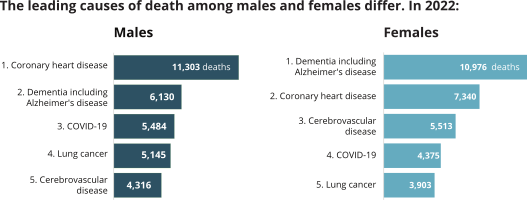
Based on Australia's Health 2024 mortality data, which statement BEST explains the pattern of leading causes of death between males and females in 2022?

  1. Males and females share identical top 5 causes of death in the same ranking order
  2. The same 5 conditions cause the most deaths but males have higher absolute numbers for coronary heart disease
  3. Infectious diseases rank higher for females than males in the top 5 causes
  4. Cancer-related deaths affect males significantly more than females across all types
Show Answers Only

\(B\)

Show Worked Solution
  • B is correct: Same 5 causes but males have 11,303 coronary deaths vs 10,976 females.

Other Options:

  • A is incorrect: Same causes but different ranking order between genders.
  • C is incorrect: COVID-19 ranks similarly for both genders.
  • D is incorrect: Lung cancer affects both genders in top 5.

Filed Under: Current Health Status Tagged With: Band 5, smc-5474-05-Major causes

HMS, HAG EQ-Bank 5 MC

According to Australia's Health 2024 data, which statement BEST describes the differences in leading causes of disease burden between males and females?

  1. Both males and females have identical leading causes of disease burden
  2. Males experience higher rates of anxiety disorders whilst females experience higher rates of suicide
  3. Coronary heart disease is the leading cause for males whilst dementia is the leading cause for females
  4. Back pain and problems affects females more than males across all age groups
Show Answers Only

\(C\)

Show Worked Solution
  • C is correct: Data shows coronary heart disease leads for males, dementia for females.

Other Options:

  • A is incorrect: Leading causes differ significantly between genders.
  • B is incorrect: Anxiety disorders lead for females, suicide for males.
  • D is incorrect: Back pain ranks similarly for both genders.

Filed Under: Current Health Status Tagged With: Band 4, smc-5474-05-Major causes

HMS, HAG 2018 HSC 15 MC

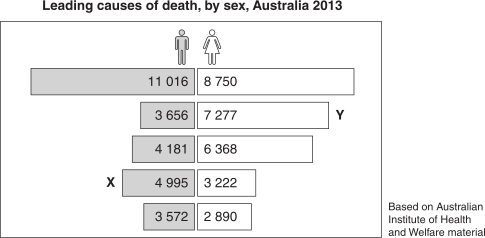
The table shows the data related to leading causes of death, by sex, in Australia in 2013.
 

What are the causes labelled by X and Y?
 

  X Y
A.   Coronary heart disease Cerebrovascular disease
B. Cerebrovascular disease Coronary heart disease
C. Dementia/Alzheimer’s disease Lung cancer
D. Lung cancer Dementia/Alzheimer’s disease
Show Answers Only

\(D\)

Show Worked Solution

  • D is correct: X represents lung cancer (higher in males), Y represents dementia (higher in females).

Other Options:

  • A is incorrect: Coronary heart disease typically has higher male rates, not matching Y pattern.
  • B is incorrect: Pattern doesn’t match cerebrovascular disease gender distribution for these positions.
  • C is incorrect: Reverses the correct gender patterns for these conditions.

♦♦ Mean mark 29%.

Filed Under: Current Health Status Tagged With: Band 6, smc-5474-05-Major causes, smc-5474-20-Data interpretation

HMS, HAG 2020 HSC 22

Complete the table for THREE current leading causes of mortality for males and females in Australia.   (4 marks)

--- 0 WORK AREA LINES (style=blank) ---

\begin{array}{|c|c|c|}
\hline
\rule{0pt}{2.5ex}\textit{Current leading} & \textit{Trend in mortality rate for} & \textit{Trend in mortality rate for}\\
\rule[-1ex]{0pt}{0pt}\quad \textit{cause of mortality} \quad & \textit{males over the last 10 years} & \textit{females over the last 10 years}\\
\hline
\quad & \quad &\quad\\
\hline
\quad & \quad &\quad\\
\hline
\quad & \quad &\quad\\
\hline
\end{array}

 
Show Answers Only

\(\text{Any THREE of the following}\)

\begin{array}{|l|c|c|}
\hline
\rule{0pt}{2.5ex}\quad \quad \textit{Current leading} & \textit{Trend in mortality} & \textit{Trend in mortality }\\
\quad \ \  \textit{cause of mortality} \quad & \textit{rates for males over} & \textit{rate for females }\\
\rule[-1ex]{0pt}{0pt}\quad \quad & \textit{the last 10 years} & \textit{over the last 10 years}\\
\hline
\rule{0pt}{2.5ex}\text{Coronary heart disease} \rule[-1ex]{0pt}{0pt}& \text{Decreased} & \text{Decreased} \\
\hline
\rule{0pt}{2.5ex}\text{Dementia and Alzheimer’s } & \text{Increased} & \text{Increased} \\
\rule[-1ex]{0pt}{0pt}\text{disease} & \text{} & \text{} \\
\hline
\rule{0pt}{2.5ex}\text{Cerebrovascular disease} \rule[-1ex]{0pt}{0pt}& \text{Decreased} & \text{Decreased} \\
\hline
\rule{0pt}{2.5ex}\text{Lung cancer} \rule[-1ex]{0pt}{0pt}& \text{Decreased} & \text{Decreased} \\
\hline
\rule{0pt}{2.5ex}\text{Chronic obstructive} & \text{Decreased} & \text{Decreased} \\
\rule[-1ex]{0pt}{0pt}\text{pulmonary disease} & \text{} & \text{} \\
\hline
\rule{0pt}{2.5ex}\text{Diabetes} \rule[-1ex]{0pt}{0pt}& \text{Increased} & \text{Increased} \\
\hline
\rule{0pt}{2.5ex}\text{Cardiovascular disease} \rule[-1ex]{0pt}{0pt}& \text{Decreased} & \text{Decreased} \\
\hline
\rule{0pt}{2.5ex}\text{Mental health (suicide)} \rule[-1ex]{0pt}{0pt}& \text{Increased} & \text{Increased} \\
\hline
\end{array}

Show Worked Solution

\(\text{Any THREE of the following}\)

\begin{array}{|l|c|c|}
\hline
\rule{0pt}{2.5ex}\quad \quad \textit{Current leading} & \textit{Trend in mortality} & \textit{Trend in mortality }\\
\quad \ \  \textit{cause of mortality} \quad & \textit{rates for males over} & \textit{rate for females }\\
\rule[-1ex]{0pt}{0pt}\quad \quad & \textit{the last 10 years} & \textit{over the last 10 years}\\
\hline
\rule{0pt}{2.5ex}\text{Coronary heart disease} \rule[-1ex]{0pt}{0pt}& \text{Decreased} & \text{Decreased} \\
\hline
\rule{0pt}{2.5ex}\text{Dementia and Alzheimer’s } & \text{Increased} & \text{Increased} \\
\rule[-1ex]{0pt}{0pt}\text{disease} & \text{} & \text{} \\
\hline
\rule{0pt}{2.5ex}\text{Cerebrovascular disease} \rule[-1ex]{0pt}{0pt}& \text{Decreased} & \text{Decreased} \\
\hline
\rule{0pt}{2.5ex}\text{Lung cancer} \rule[-1ex]{0pt}{0pt}& \text{Decreased} & \text{Decreased} \\
\hline
\rule{0pt}{2.5ex}\text{Chronic obstructive} & \text{Decreased} & \text{Decreased} \\
\rule[-1ex]{0pt}{0pt}\text{pulmonary disease} & \text{} & \text{} \\
\hline
\rule{0pt}{2.5ex}\text{Diabetes} \rule[-1ex]{0pt}{0pt}& \text{Increased} & \text{Increased} \\
\hline
\rule{0pt}{2.5ex}\text{Cardiovascular disease} \rule[-1ex]{0pt}{0pt}& \text{Decreased} & \text{Decreased} \\
\hline
\rule{0pt}{2.5ex}\text{Mental health (suicide)} \rule[-1ex]{0pt}{0pt}& \text{Increased} & \text{Increased} \\
\hline
\end{array}


♦♦ Mean mark 47%.

Filed Under: Chronic Conditions, Diseases and Injury, Current Health Status Tagged With: Band 5, smc-5474-05-Major causes, smc-5477-05-Cardiovascular disease, smc-5477-10-Cancer trends, smc-5477-15-Other conditions

Copyright © 2014–2025 SmarterEd.com.au · Log in