SmarterEd

Aussie Maths & Science Teachers: Save your time with SmarterEd

  • Login
  • Get Help
  • About

HMS, HAG EQ-Bank 143

Data shows that about one-third of Australians with dementia live in the community rather than in specialist care facilities, while research indicates Australia's aged care system is already experiencing workforce shortages.

Discuss how these trends create both opportunities and challenges for supporting Australia's ageing population.   (6 marks)

--- 18 WORK AREA LINES (style=lined) ---

Show Answers Only

Benefits of community-based care trends

  • [P] Community-based care for people with dementia creates opportunities for maintaining family connections and familiar environments that support wellbeing.
  • [E] Living in the community allows older Australians with dementia to maintain independence for longer periods while receiving family support and home care services.
  • [Ev] This approach can be more cost-effective than residential care and allows people to age in place, which is often preferred by individuals and families.
  • [L] Therefore, community care models can provide person-centred support while reducing pressure on residential aged care facilities.

Challenges of workforce shortages and community care

  • [P] However, workforce shortages combined with increasing community care needs create significant challenges for service delivery and family carers.
  • [E] The shortage of aged care workers means that families often become primary carers without adequate professional support or respite services.
  • [Ev] This places enormous stress on family members who may lack training in dementia care while trying to manage complex health needs at home.
  • [L] Consequently, without sufficient community support services and trained workers, the burden on families increases while people with dementia may not receive appropriate specialist care when needed.
Show Worked Solution

Benefits of community-based care trends

  • [P] Community-based care for people with dementia creates opportunities for maintaining family connections and familiar environments that support wellbeing.
  • [E] Living in the community allows older Australians with dementia to maintain independence for longer periods while receiving family support and home care services.
  • [Ev] This approach can be more cost-effective than residential care and allows people to age in place, which is often preferred by individuals and families.
  • [L] Therefore, community care models can provide person-centred support while reducing pressure on residential aged care facilities.

Challenges of workforce shortages and community care

  • [P] However, workforce shortages combined with increasing community care needs create significant challenges for service delivery and family carers.
  • [E] The shortage of aged care workers means that families often become primary carers without adequate professional support or respite services.
  • [Ev] This places enormous stress on family members who may lack training in dementia care while trying to manage complex health needs at home.
  • [L] Consequently, without sufficient community support services and trained workers, the burden on families increases while people with dementia may not receive appropriate specialist care when needed.

Filed Under: Impact of an Ageing Population Tagged With: Band 5, smc-5478-10-Data interpretation

HMS, HAG EQ-Bank 142

Research shows that dementia rates dramatically increase with age, with fewer than one person per 1000 Australians under 60 having dementia, but this increases to 71 per 1000 for people aged 75-79, and 429 per 1000 for those aged 90 and over.

Explain how these age-related dementia trends will impact Australia's healthcare system as the population ages.   (5 marks)

--- 15 WORK AREA LINES (style=lined) ---

Show Answers Only
  • The dramatic increase in dementia rates with age demonstrates how population ageing will create exponentially growing demand for specialised dementia care services and memory clinics across Australia.
  • This occurs because the data shows dementia risk increases more than six-fold between the 75-79 and 90+ age groups, meaning healthcare systems must prepare for substantial increases in patients requiring complex care.
  • The trend reveals that aged care facilities and hospitals will face increasing pressure to provide specialised dementia units and trained staff as more Australians reach the highest-risk age groups.
  • This pattern demonstrates that healthcare funding and resource allocation must shift towards dementia-specific services, including community support programs and family carer assistance to manage the growing patient numbers.
  • Therefore, the exponential nature of age-related dementia risk requires proactive healthcare planning and workforce development to ensure adequate care capacity for future demographic changes in Australian populations.
Show Worked Solution
  • The dramatic increase in dementia rates with age demonstrates how population ageing will create exponentially growing demand for specialised dementia care services and memory clinics across Australia.
  • This occurs because the data shows dementia risk increases more than six-fold between the 75-79 and 90+ age groups, meaning healthcare systems must prepare for substantial increases in patients requiring complex care.
  • The trend reveals that aged care facilities and hospitals will face increasing pressure to provide specialised dementia units and trained staff as more Australians reach the highest-risk age groups.
  • This pattern demonstrates that healthcare funding and resource allocation must shift towards dementia-specific services, including community support programs and family carer assistance to manage the growing patient numbers.
  • Therefore, the exponential nature of age-related dementia risk requires proactive healthcare planning and workforce development to ensure adequate care capacity for future demographic changes in Australian populations.

Filed Under: Impact of an Ageing Population Tagged With: Band 4, smc-5478-10-Data interpretation

HMS, HAG EQ-Bank 141

Data shows that Australia's population aged 65 and over was approximately 17% in 2024 and is projected to increase to almost 21% by 2066.

Explain what this demographic trend reveals about Australia's population health challenges.   (3 marks)

--- 9 WORK AREA LINES (style=lined) ---

Show Answers Only
  • The increasing proportion of older Australians demonstrates that the population is experiencing longer life expectancy combined with declining fertility rates, creating significant demographic shifts.
  • This trend reveals that Australia will face increased demand for healthcare services, particularly for chronic disease management and aged care facilities, as older populations require more medical support.
  • The significance of this change shows that healthcare planning must adapt to accommodate age-related conditions like dementia, cardiovascular disease and mobility issues that become more prevalent in older populations.
Show Worked Solution
  • The increasing proportion of older Australians demonstrates that the population is experiencing longer life expectancy combined with declining fertility rates, creating significant demographic shifts.
  • This trend reveals that Australia will face increased demand for healthcare services, particularly for chronic disease management and aged care facilities, as older populations require more medical support.
  • The significance of this change shows that healthcare planning must adapt to accommodate age-related conditions like dementia, cardiovascular disease and mobility issues that become more prevalent in older populations.

Filed Under: Impact of an Ageing Population Tagged With: Band 3, smc-5478-10-Data interpretation

HMS, HAG EQ-Bank 108 MC

The projected shortage of carers compared to the anticipated rise in demand for home-based support suggests that:

  1. Government funding for aged care services will automatically increase
  2. Technology solutions will completely replace human carers by 2066
  3. Alternative care models and workforce development strategies will be essential
  4. Most older Australians will need to relocate to residential aged care facilities
Show Answers Only

\(C\)

Show Worked Solution
  • C is correct: Projected carer shortage requires alternative care models and workforce development strategies to meet demand.

Other Options:

  • A is incorrect: Funding increases don’t solve workforce shortage issues without strategic planning.
  • B is incorrect: Technology assists but cannot completely replace human carers for complex care needs.
  • D is incorrect: Residential care isn’t the preferred solution and doesn’t address carer shortage problem.

Filed Under: Impact of an Ageing Population Tagged With: Band 5, smc-5478-10-Data interpretation

HMS, HAG EQ-Bank 107 MC

The trend showing Australia's population aged 65 and over steadily increasing in both absolute numbers and as a proportion of the total population indicates that:

  1. Immigration policies are successfully attracting younger migrants to Australia
  2. Healthcare spending will decrease as older adults require less medical intervention
  3. Both challenges and opportunities will emerge for Australia's health and welfare sectors
  4. Fertility rates are increasing to match the growing elderly population
Show Answers Only

\(C\)

Show Worked Solution
  • C is correct: The demographic shift presents both challenges and opportunities for health and welfare sectors.

Other Options:

  • A is incorrect: Immigration success doesn’t change the fact that population is proportionally ageing.
  • B is incorrect: Healthcare spending will increase not decrease as older adults need more medical care.
  • D is incorrect: Fertility rates are decreasing not increasing which contributes to population ageing.

Filed Under: Impact of an Ageing Population Tagged With: Band 4, smc-5478-10-Data interpretation

HMS, HAG EQ-Bank 106 MC

The demographic shift showing Australians aged 65 and over increasing from 17% in 2024 to projected 21% by 2066 is primarily caused by:

  1. Significant increases in life expectancy combined with decreased fertility rates
  2. Increased immigration of elderly people to Australia
  3. Government policies encouraging larger family sizes
  4. Reduced healthcare costs making treatment more affordable for seniors
Show Answers Only

\(A\)

Show Worked Solution
  • A is correct: Demographic shift explained by significant life expectancy increases combined with decreased fertility rates.

Other Options:

  • B is incorrect: Immigration patterns don’t primarily drive the overall demographic ageing trend.
  • C is incorrect: Fertility rates have decreased not increased due to government policies.
  • D is incorrect: Healthcare costs don’t drive demographic shifts they respond to population changes.

Filed Under: Impact of an Ageing Population Tagged With: Band 3, smc-5478-10-Data interpretation

HMS, HAG 2015 HSC 18 MC

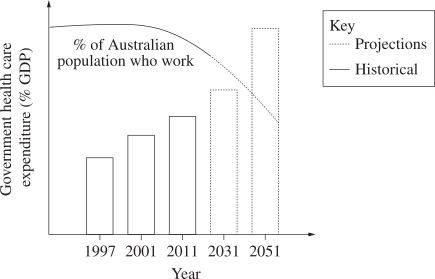
The graph summarises historical and projected data for Australian health care expenditure and the Australian working population.
 

Which major health care issue does the graph predict?

  1. Funding for new and emerging medical technologies required by working Australians
  2. Funding for health care in an increasing ageing population
  3. Increasing demand for health care by the long-term unemployed
  4. Increasing prevalence of non-communicable disease in the Australian working population
Show Answers Only

\(B\)

Show Worked Solution
  • B is correct: Rising health costs with fewer workers indicates ageing population challenges.

Other Options:

  • A is incorrect: Graph shows broader expenditure trends not technology-specific costs.
  • C is incorrect: Focus is on ageing demographics not unemployment issues.
  • D is incorrect: Graph indicates demographic shifts not disease prevalence changes.

Filed Under: Impact of an Ageing Population Tagged With: Band 4, smc-5478-10-Data interpretation

Copyright © 2014–2025 SmarterEd.com.au · Log in