SmarterEd

Aussie Maths & Science Teachers: Save your time with SmarterEd

  • Login
  • Get Help
  • About

HMS, HIC 2012 HSC 1 MC

Which condition is currently the leading cause of mortality in Australia?

  1. Asthma
  2. Lung cancer
  3. Breast cancer
  4. Cardiovascular disease
Show Answers Only

\(D\)

Show Worked Solution
  • D is correct: Cardiovascular disease remains Australia’s leading cause of death.

Other Options:

  • A is incorrect: Asthma causes relatively few deaths annually.
  • B is incorrect: Major cause but not the leading one.
  • C is incorrect: Significant but affects only females primarily.

Filed Under: Health status of Australians Tagged With: Band 3, smc-5504-10-Mortality

HMS, HIC 2021 HSC 6 MC

For which of the following has there been an increasing mortality rate for both men and women over the past 10 years in Australia?

  1. Lung cancer
  2. Coronary heart disease
  3. Cerebrovascular disease
  4. Dementia and Alzheimer's disease
Show Answers Only

\(D\)

Show Worked Solution
  • D is correct: Dementia/Alzheimer’s mortality rates increasing due to ageing population.

Other Options:

  • A is incorrect: Lung cancer mortality rates generally declining.
  • B is incorrect: Coronary heart disease mortality decreasing over time.
  • C is incorrect: Cerebrovascular disease mortality rates stable or declining.

♦ Mean mark 46%.

Filed Under: Health status of Australians Tagged With: Band 5, smc-5504-10-Mortality

HMS, HIC EQ-Bank 023

Explain how epidemiological data on mortality rates can be used to identify priority health issues in Australia.   (5 marks)

--- 10 WORK AREA LINES (style=lined) ---
Show Answers Only

*PEEL – Solution is structured using an adjusted PEEL method to show cause and effect: [P] State the cause/factor [E] Show how it causes the effect [Ev] Evidence demonstrating why/how [L] Reinforce the causal relationship.

  • [P] Mortality data identifies leading causes of death.
  • [E] This causes health authorities to allocate resources to high-fatality conditions.
  • [Ev] For example, because data shows cardiovascular disease and cancers kill the most Australians, it follows that funding should be increased for cardiac units and cancer research.
  • [L] This direct link between death statistics and resource allocation ensures targeted health interventions.
     
  • [P] Age-standardised rates enable population comparisons.
  • [E] This leads to identification of at-risk groups needing specific programs.
  • [Ev] As a result, when data reveals Indigenous Australians have higher diabetes mortality, culturally-specific prevention programs are developed.
  • [L] This relationship results in evidence-based health policies addressing population disparities.
     
  • [P] Premature mortality measures highlight youth deaths.
  • [E] This causes prioritisation of conditions affecting younger populations.
  • [Ev] Premature mortality measures like potential years of life lost (PYLL) data shows suicide and road accidents are major causes of early death, leading to youth mental health initiatives and road safety campaigns.
  • [L] This demonstrates why mortality analysis drives prevention strategies beyond just total death counts.

Show Worked Solution

*PEEL – Solution is structured using an adjusted PEEL method to show cause and effect: [P] State the cause/factor [E] Show how it causes the effect [Ev] Evidence demonstrating why/how [L] Reinforce the causal relationship.

  • [P] Mortality data identifies leading causes of death.
  • [E] This causes health authorities to allocate resources to high-fatality conditions.
  • [Ev] For example, because data shows cardiovascular disease and cancers kill the most Australians, it follows that funding should be increased for cardiac units and cancer research.
  • [L] This direct link between death statistics and resource allocation ensures targeted health interventions.
     
  • [P] Age-standardised rates enable population comparisons.
  • [E] This leads to identification of at-risk groups needing specific programs.
  • [Ev] As a result, when data reveals Indigenous Australians have higher diabetes mortality, culturally-specific prevention programs are developed.
  • [L] This relationship results in evidence-based health policies addressing population disparities.
     
  • [P] Premature mortality measures highlight youth deaths.
  • [E] This causes prioritisation of conditions affecting younger populations.
  • [Ev] Premature mortality measures like potential years of life lost (PYLL) data shows suicide and road accidents are major causes of early death, leading to youth mental health initiatives and road safety campaigns.
  • [L] This demonstrates why mortality analysis drives prevention strategies beyond just total death counts.

Filed Under: Health status of Australians Tagged With: Band 4, Band 5, smc-5504-05-Epidemiology, smc-5504-10-Mortality

HMS, HIC EQ-Bank 010

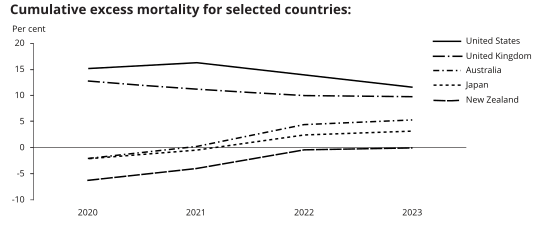
Describe what excess mortality data reveals about the impact of COVID-19 on Australia compared to other countries.   (3 marks)

--- 8 WORK AREA LINES (style=lined) ---

Show Answers Only
  • Australia experienced fewer deaths than expected in 2020, followed by increasing excess deaths in 2021-2023.
  • This increase occurs as the COVID-19 pandemic took hold and spread throughout the world.
  • When compared internationally, Australia had one of the lowest excess mortality rates among countries with available data, significantly lower than the United States and United Kingdom, although higher than Japan and New Zealand.
  • This international comparison suggests Australia’s pandemic response was relatively effective at minimising deaths compared to many other developed nations, though not as successful as some other Asian countries.
Show Worked Solution
  • Australia experienced fewer deaths than expected in 2020, followed by increasing excess deaths in 2021-2023.
  • This increase occurs as the COVID-19 pandemic took hold and spread throughout the world.
  • When compared internationally, Australia’s excess mortality rate was significantly lower than the United States and United Kingdom, although higher than Japan and New Zealand.
  • This international comparison suggests Australia’s pandemic response was relatively effective at minimising deaths compared to many other developed nations, though not as successful as some other Asian countries.

Filed Under: Health status of Australians Tagged With: Band 4, smc-5504-10-Mortality

HMS, HIC EQ-Bank 009

Australia's Health 2024 report published findings that

  • 5-year relative survival rates for cancer have improved from 53% in 1990-1994 to 71% in 2015-2019.
  • This improvement is particularly notable in specific cancers such as prostate cancer, which saw survival rates rise from 66% to 96%, and breast cancer in females which increased from 78% to 92%.

Outline TWO reasons for these improved statistics and explain how these they affect survival rates?   (5 marks)

--- 15 WORK AREA LINES (style=lined) ---

Show Answers Only

*Cause-and-effect language that directly addresses the “Explain” keyword is bolded in the answer below.

Early Detection:

  • Earlier detection through screening programs creates better survival outcomes.
  • First, programs like BreastScreen Australia identify cancers at Stage 1 or 2, which enables immediate treatment.
  • This leads to surgical removal while tumours are small and localised. As a result, 5-year survival rates increase because cancer hasn’t spread to other organs.
  • For example, breast cancer detected through screening has 99% survival at Stage 1, demonstrating how early detection directly improves outcomes.

Improved cancer treatments:

  • Advanced treatment technologies improve survival through connected steps.
  • Initially, genetic testing identifies cancer mutations, which causes doctors to prescribe targeted therapies. This then leads to cancer cells being destroyed precisely while protecting healthy tissue.
  • Consequently, patients experience fewer side effects and stronger responses. This results in extended survival because treatments attack cancer’s specific weaknesses.

Detection and Improved Treatment combining:

  • These factors work together – when screening detects cancer early and targeted treatments are applied, this combination causes dramatic improvements like prostate cancer’s rise to 96% survival.
Show Worked Solution

*Cause-and-effect language that directly addresses the “Explain” keyword is bolded in the answer below.

Early Detection:

  • Earlier detection through screening programs creates better survival outcomes.
  • First, programs like BreastScreen Australia identify cancers at Stage 1 or 2, which enables immediate treatment.
  • This leads to surgical removal while tumours are small and localised. As a result, 5-year survival rates increase because cancer hasn’t spread to other organs.
  • For example, breast cancer detected through screening has 99% survival at Stage 1, demonstrating how early detection directly improves outcomes.

Improved cancer treatments:

  • Advanced treatment technologies improve survival through connected steps.
  • Initially, genetic testing identifies cancer mutations, which causes doctors to prescribe targeted therapies. This then leads to cancer cells being destroyed precisely while protecting healthy tissue.
  • Consequently, patients experience fewer side effects and stronger responses. This results in extended survival because treatments attack cancer’s specific weaknesses.

Detection and Improved Treatment combining:

  • These factors work together – when screening detects cancer early and targeted treatments are applied, this combination causes dramatic improvements like prostate cancer’s rise to 96% survival.

Filed Under: Health status of Australians Tagged With: Band 4, smc-5504-10-Mortality, smc-5504-70-Health Reports

Copyright © 2014–2025 SmarterEd.com.au · Log in