SmarterEd

Aussie Maths & Science Teachers: Save your time with SmarterEd

  • Login
  • Get Help
  • About

HMS, HIC 2013 HSC 21

Outline TWO indicators of morbidity. Include examples in your answer.   (3 marks)

--- 7 WORK AREA LINES (style=lined) ---

Show Answers Only
  • Prevalence measures the proportion of a population with a specific condition at a particular time. For example, the prevalence of chronic conditions like diabetes shows how many people currently live with the disease.
  • Incidence measures the number of new cases developing within a specific time period. For example, cancer incidence tracks how many people are newly diagnosed each year.
  • Both indicators enable healthcare planners to understand disease patterns and allocate appropriate resources.
Show Worked Solution
  • Prevalence measures the proportion of a population with a specific condition at a particular time. For example, the prevalence of chronic conditions like diabetes shows how many people currently live with the disease.
  • Incidence measures the number of new cases developing within a specific time period. For example, cancer incidence tracks how many people are newly diagnosed each year.
  • Both indicators enable healthcare planners to understand disease patterns and allocate appropriate resources.

Filed Under: Health status of Australians Tagged With: Band 4, smc-5504-20-Morbidity, smc-5504-50-Incidence/prevalence

HMS, HIC 2023 HSC 1 MC

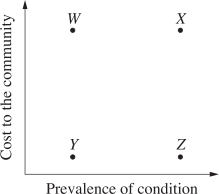
Four health conditions \(W, X, Y\) and \(Z\) currently affecting Australians, are plotted on the following graph.
 

Which of these conditions is most likely to be identified as the greatest health priority issue in Australia?

  1. \(W\)
  2. \(X\)
  3. \(Y\)
  4. \(Z\)
Show Answers Only

\(B\)

Show Worked Solution
  • B is correct: \(X\) represents the ideal health priority as it has a high prevalence and high cost to the community.

Other Options:

  • A is incorrect: \(W\rightarrow\) Lower prevalence despite high cost means fewer people affected.
  • C is incorrect: \(Y\rightarrow\) Both low prevalence and low cost make it the lowest priority of the options.
  • D is incorrect: \(Z\rightarrow\) High prevalence but lower cost to community, making it less of a priority.

Filed Under: Health status of Australians Tagged With: Band 3, smc-5504-50-Incidence/prevalence

HMS, HIC EQ-Bank 029

Explain the prevalence of diabetes in Aboriginal and Torres Strait Islander communities and outline TWO possible determinants contributing to this health issue.   (4 marks)

--- 10 WORK AREA LINES (style=lined) ---

Show Answers Only

*Cause-and-effect language that directly addresses the “Explain” keyword is bolded in the answer below.

  • Aboriginal and Torres Strait Islander adults have approximately twice the diabetes rate of non-Indigenous Australians (7.9% vs 4.1%).

Determinant 1

  • Limited access to affordable fresh food in remote communities results in ATSI Peoples buying processed foods high in sugar and fat.
  • This dietary pattern directly causes insulin resistance and weight gain, which leads to Type 2 diabetes development.
  • As a result, diabetes incidence rises significantly in these communities.

Determinant 2

  • Historical dispossession from traditional lands resulted in loss of traditional hunting/gathering practices and native food sources.
  • This disruption caused a shift from nutrient-rich bush foods to Western processed diets.
  • Additionally, cultural barriers in healthcare prevent early diabetes screening and management, allowing the disease to develop undetected and untreated.

Show Worked Solution

*Cause-and-effect language that directly addresses the “Explain” keyword is bolded in the answer below.

  • Aboriginal and Torres Strait Islander adults have approximately twice the diabetes rate of non-Indigenous Australians (7.9% vs 4.1%).

Determinant 1

  • Limited access to affordable fresh food in remote communities results in ATSI Peoples buying processed foods high in sugar and fat.
  • This dietary pattern directly causes insulin resistance and weight gain, which leads to Type 2 diabetes development.
  • As a result, diabetes incidence rises significantly in these communities.

Determinant 2

  • Historical dispossession from traditional lands resulted in loss of traditional hunting/gathering practices and native food sources.
  • This disruption caused a shift from nutrient-rich bush foods to Western processed diets.
  • Additionally, cultural barriers in healthcare prevent early diabetes screening and management, allowing the disease to develop undetected and untreated.

Filed Under: Health status of Australians Tagged With: Band 4, smc-5504-50-Incidence/prevalence, smc-5504-60-Indigenous/TSI health, smc-5504-70-Health Reports

HMS, HIC EQ-Bank 028

Discuss how THREE epidemiological measures are used to explain the health status of Aboriginal and Torres Strait Islander peoples in Australia.

In your response, include specific examples from health reports to illustrate the role of these measures.   (5 marks)

--- 15 WORK AREA LINES (style=lined) ---

Show Answers Only

*PEEL – Solution is structured using the PEEL method; [P] Identify the point, [E] expand on the point with a link to question asked, [Ev] apply evidence/examples, [L] linking sentence back to question.

Mortality rates

  • [P] Mortality rates are used to identify inequities in Aboriginal and Torres Strait Islander health status.
  • [E] This measure shows progress and ongoing inequities.
  • [Ev] Australia’s Health 2024 reports cardiovascular deaths fell 22% for Indigenous Peoples, yet remain higher than non-Indigenous rates.
  • [L] This creates evidence of success and challenges requiring continued focus.

Infant mortality rates

  • [P] Infant mortality rates provide insight into maternal health services, living conditions and healthcare access.
  • [E] Infant mortality rates have improved from 6.9 to 5.4 per 1,000 births but are still nearly double non-Indigenous rates of 3.1 per 1,000 births.
  • [Ev] While indicating healthcare access, remote data collection is extremely challenging and can be incomplete.
  • [L] Despite limitations, this measure is an important determinant of maternal and child health programs.

Prevalence of disease

  • [P] Prevalence measures the proportion of a population affected by specific conditions.
  • [E] This reveals chronic conditions requiring programs, although undiagnosed cases affect the accuracy of statistics.
  • [Ev] For example, the prevalence of diabetes among Indigenous adults (7.9%) is almost double the rate of non-Indigenous Australians (4.1%).
  • [L] This highlights areas requiring intervention programs and reveals the impact of social determinants of health, including food security and healthcare access in remote communities.

Show Worked Solution

*PEEL – Solution is structured using the PEEL method; [P] Identify the point, [E] expand on the point with a link to question asked, [Ev] apply evidence/examples, [L] linking sentence back to question.

Mortality rates

  • [P] Mortality rates are used to identify inequities in Aboriginal and Torres Strait Islander health status.
  • [E] This measure shows progress and ongoing inequities.
  • [Ev] Australia’s Health 2024 reports cardiovascular deaths fell 22% for Indigenous Peoples, yet remain higher than non-Indigenous rates.
  • [L] This creates evidence of success and challenges requiring continued focus.

Infant mortality rates

  • [P] Infant mortality rates provide insight into maternal health services, living conditions and healthcare access.
  • [E] Infant mortality rates have improved from 6.9 to 5.4 per 1,000 births but are still nearly double non-Indigenous rates of 3.1 per 1,000 births.
  • [Ev] While indicating healthcare access, remote data collection is extremely challenging and can be incomplete.
  • [L] Despite limitations, this measure is an important determinant of maternal and child health programs.

Prevalence of disease

  • [P] Prevalence measures the proportion of a population affected by specific conditions.
  • [E] This reveals chronic conditions requiring programs, although undiagnosed cases affect the accuracy of statistics.
  • [Ev] For example, the prevalence of diabetes among Indigenous adults (7.9%) is almost double the rate of non-Indigenous Australians (4.1%).
  • [L] This highlights areas requiring intervention programs and reveals the impact of social determinants of health, including food security and healthcare access in remote communities.

Filed Under: Health status of Australians Tagged With: Band 4, Band 5, smc-5504-05-Epidemiology, smc-5504-20-Morbidity, smc-5504-50-Incidence/prevalence, smc-5504-60-Indigenous/TSI health, smc-5504-70-Health Reports

HMS, HIC EQ-Bank 026

Explain the difference between the prevalence and incidence of a disease and how each contributes to our understanding of the health status of Australians.   (4 marks)

--- 10 WORK AREA LINES (style=lined) ---

Show Answers Only

  • Prevalence measures the total number of existing cases of a disease or condition in a population at a specific point in time, helping us understand the burden of chronic conditions like diabetes.
  • Incidence measures new cases that develop during a specific time period, allowing health authorities to track emerging health issues or the effectiveness of prevention strategies.
  • Together, these measures provide complementary insights into the magnitude and progression of health conditions across Australian populations.

Show Worked Solution
  • Prevalence measures the total number of existing cases of a disease or condition in a population at a specific point in time, helping us understand the burden of chronic conditions like diabetes.
  • Incidence measures new cases that develop during a specific time period, allowing health authorities to track emerging health issues or the effectiveness of prevention strategies.
  • Together, these measures provide complementary insights into the magnitude and progression of health conditions across Australian populations.

Filed Under: Health status of Australians Tagged With: Band 4, smc-5504-50-Incidence/prevalence

HMS, HIC EQ-Bank 019 MC

The table below shows data for a particular health condition in Australia:

\begin{align*}
\begin{array}{|l|l|l|l|}
\hline
\rule{0pt}{2.5ex}\textbf{Year}\rule[-1ex]{0pt}{0pt}& \textbf{Existing Cases} & \textbf{Population}& \textbf{New Cases}\\
\hline
\rule{0pt}{2.5ex}\text{2020}\rule[-1ex]{0pt}{0pt}&\text{50,000}&\text{10,000,000}&\text{5,000}\\
\hline
\rule{0pt}{2.5ex}\text{2021}\rule[-1ex]{0pt}{0pt}& \text{54,000}& \text{10,200,000}& \text{5,200}\\
\hline
\end{array}
\end{align*}

What was the prevalence rate (per 100,000 people) of this condition in 2021?

  1. 51.0
  2. 529.4
  3. 5,200
  4. 54,000
Show Answers Only

\( B\)

Show Worked Solution
  • Prevalence rate = (Number of existing cases ÷ Population) × 100,000 = (54,000 ÷ 10,200,000) × 100,000 = 529.4 per 100,000

\(\Rightarrow B\)

Filed Under: Health status of Australians Tagged With: Band 4, smc-5504-50-Incidence/prevalence

HMS, HIC EQ-Bank 008

Explain how epidemiologists use both incidence and prevalence data when monitoring a chronic disease such as diabetes in Australia.   (4 marks)

--- 10 WORK AREA LINES (style=lined) ---

Show Answers Only

*PEEL – Solution is structured using an adjusted PEEL method to show cause and effect: [P] State the cause/factor [E] Show how it causes the effect [Ev] Evidence demonstrating why/how [L] Reinforce the causal relationship.

  • [P] Epidemiologists collect incidence data to track new diabetes cases.
  • [E] This leads to identifying emerging patterns and at-risk groups.
  • [Ev] This occurs because incidence shows how many people develop diabetes each year, revealing if rates are increasing in specific populations like young adults.
  • [L] This relationship results in targeted prevention programs for high-risk groups.
     
  • [P] Prevalence data provides total diabetes numbers.
  • [E] This causes accurate healthcare planning and resource allocation.
  • [Ev] The reason for this is prevalence shows everyone currently living with diabetes, enabling calculation of insulin supplies and specialist services needed .
  • [L] This demonstrates why prevalence directly influences healthcare budget decisions.
     
  • [P] Combining both data types creates comprehensive monitoring.
  • [E] This enables evaluation of intervention effectiveness.
  • [Ev] This works by comparing whether prevention programs reduce new cases (incidence) while managing existing cases (prevalence).
  • [L] These elements work together to show if Australia’s diabetes strategies succeed.
Show Worked Solution

*PEEL – Solution is structured using an adjusted PEEL method to show cause and effect: [P] State the cause/factor [E] Show how it causes the effect [Ev] Evidence demonstrating why/how [L] Reinforce the causal relationship.

  • [P] Epidemiologists collect incidence data to track new diabetes cases.
  • [E] This leads to identifying emerging patterns and at-risk groups.
  • [Ev] This occurs because incidence shows how many people develop diabetes each year, revealing if rates are increasing in specific populations like young adults.
  • [L] This relationship results in targeted prevention programs for high-risk groups.
     
  • [P] Prevalence data provides total diabetes numbers.
  • [E] This causes accurate healthcare planning and resource allocation.
  • [Ev] The reason for this is prevalence shows everyone currently living with diabetes, enabling calculation of insulin supplies and specialist services needed .
  • [L] This demonstrates why prevalence directly influences healthcare budget decisions.
     
  • [P] Combining both data types creates comprehensive monitoring.
  • [E] This enables evaluation of intervention effectiveness.
  • [Ev] This works by comparing whether prevention programs reduce new cases (incidence) while managing existing cases (prevalence).
  • [L] These elements work together to show if Australia’s diabetes strategies succeed.

Filed Under: Health status of Australians Tagged With: Band 4, smc-5504-05-Epidemiology, smc-5504-50-Incidence/prevalence

Copyright © 2014–2025 SmarterEd.com.au · Log in