SmarterEd

Aussie Maths & Science Teachers: Save your time with SmarterEd

  • Login
  • Get Help
  • About

HMS, HIC EQ-Bank 029

Explain the prevalence of diabetes in Aboriginal and Torres Strait Islander communities and outline TWO possible determinants contributing to this health issue.   (4 marks)

--- 10 WORK AREA LINES (style=lined) ---

Show Answers Only

*Cause-and-effect language that directly addresses the “Explain” keyword is bolded in the answer below.

  • Aboriginal and Torres Strait Islander adults have approximately twice the diabetes rate of non-Indigenous Australians (7.9% vs 4.1%).

Determinant 1

  • Limited access to affordable fresh food in remote communities results in ATSI Peoples buying processed foods high in sugar and fat.
  • This dietary pattern directly causes insulin resistance and weight gain, which leads to Type 2 diabetes development.
  • As a result, diabetes incidence rises significantly in these communities.

Determinant 2

  • Historical dispossession from traditional lands resulted in loss of traditional hunting/gathering practices and native food sources.
  • This disruption caused a shift from nutrient-rich bush foods to Western processed diets.
  • Additionally, cultural barriers in healthcare prevent early diabetes screening and management, allowing the disease to develop undetected and untreated.

Show Worked Solution

*Cause-and-effect language that directly addresses the “Explain” keyword is bolded in the answer below.

  • Aboriginal and Torres Strait Islander adults have approximately twice the diabetes rate of non-Indigenous Australians (7.9% vs 4.1%).

Determinant 1

  • Limited access to affordable fresh food in remote communities results in ATSI Peoples buying processed foods high in sugar and fat.
  • This dietary pattern directly causes insulin resistance and weight gain, which leads to Type 2 diabetes development.
  • As a result, diabetes incidence rises significantly in these communities.

Determinant 2

  • Historical dispossession from traditional lands resulted in loss of traditional hunting/gathering practices and native food sources.
  • This disruption caused a shift from nutrient-rich bush foods to Western processed diets.
  • Additionally, cultural barriers in healthcare prevent early diabetes screening and management, allowing the disease to develop undetected and untreated.

Filed Under: Health status of Australians Tagged With: Band 4, smc-5504-50-Incidence/prevalence, smc-5504-60-Indigenous/TSI health, smc-5504-70-Health Reports

HMS, HIC EQ-Bank 028

Discuss how THREE epidemiological measures are used to explain the health status of Aboriginal and Torres Strait Islander peoples in Australia.

In your response, include specific examples from health reports to illustrate the role of these measures.   (5 marks)

--- 15 WORK AREA LINES (style=lined) ---

Show Answers Only

*PEEL – Solution is structured using the PEEL method; [P] Identify the point, [E] expand on the point with a link to question asked, [Ev] apply evidence/examples, [L] linking sentence back to question.

Mortality rates

  • [P] Mortality rates are used to identify inequities in Aboriginal and Torres Strait Islander health status.
  • [E] This measure shows progress and ongoing inequities.
  • [Ev] Australia’s Health 2024 reports cardiovascular deaths fell 22% for Indigenous Peoples, yet remain higher than non-Indigenous rates.
  • [L] This creates evidence of success and challenges requiring continued focus.

Infant mortality rates

  • [P] Infant mortality rates provide insight into maternal health services, living conditions and healthcare access.
  • [E] Infant mortality rates have improved from 6.9 to 5.4 per 1,000 births but are still nearly double non-Indigenous rates of 3.1 per 1,000 births.
  • [Ev] While indicating healthcare access, remote data collection is extremely challenging and can be incomplete.
  • [L] Despite limitations, this measure is an important determinant of maternal and child health programs.

Prevalence of disease

  • [P] Prevalence measures the proportion of a population affected by specific conditions.
  • [E] This reveals chronic conditions requiring programs, although undiagnosed cases affect the accuracy of statistics.
  • [Ev] For example, the prevalence of diabetes among Indigenous adults (7.9%) is almost double the rate of non-Indigenous Australians (4.1%).
  • [L] This highlights areas requiring intervention programs and reveals the impact of social determinants of health, including food security and healthcare access in remote communities.

Show Worked Solution

*PEEL – Solution is structured using the PEEL method; [P] Identify the point, [E] expand on the point with a link to question asked, [Ev] apply evidence/examples, [L] linking sentence back to question.

Mortality rates

  • [P] Mortality rates are used to identify inequities in Aboriginal and Torres Strait Islander health status.
  • [E] This measure shows progress and ongoing inequities.
  • [Ev] Australia’s Health 2024 reports cardiovascular deaths fell 22% for Indigenous Peoples, yet remain higher than non-Indigenous rates.
  • [L] This creates evidence of success and challenges requiring continued focus.

Infant mortality rates

  • [P] Infant mortality rates provide insight into maternal health services, living conditions and healthcare access.
  • [E] Infant mortality rates have improved from 6.9 to 5.4 per 1,000 births but are still nearly double non-Indigenous rates of 3.1 per 1,000 births.
  • [Ev] While indicating healthcare access, remote data collection is extremely challenging and can be incomplete.
  • [L] Despite limitations, this measure is an important determinant of maternal and child health programs.

Prevalence of disease

  • [P] Prevalence measures the proportion of a population affected by specific conditions.
  • [E] This reveals chronic conditions requiring programs, although undiagnosed cases affect the accuracy of statistics.
  • [Ev] For example, the prevalence of diabetes among Indigenous adults (7.9%) is almost double the rate of non-Indigenous Australians (4.1%).
  • [L] This highlights areas requiring intervention programs and reveals the impact of social determinants of health, including food security and healthcare access in remote communities.

Filed Under: Health status of Australians Tagged With: Band 4, Band 5, smc-5504-05-Epidemiology, smc-5504-20-Morbidity, smc-5504-50-Incidence/prevalence, smc-5504-60-Indigenous/TSI health, smc-5504-70-Health Reports

HMS, HIC EQ-Bank 025

The graph below shows the prevalence of 12-month mental disorders (i.e. had a mental disorder in the past 12 months) by age group and gender in Australia for 2020-2022.
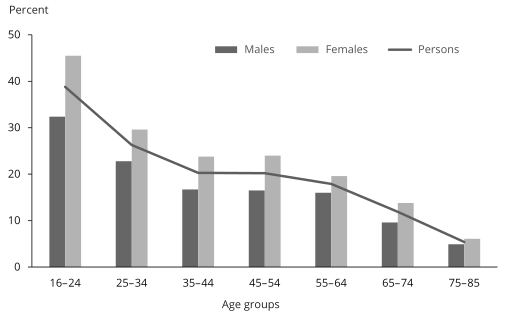
 

Identify two key trends in the prevalence of mental disorders shown in the graph and explain possible reasons for these patterns.   (4 marks)

--- 10 WORK AREA LINES (style=lined) ---

Show Answers Only

Trend 1

  • Females consistently show higher prevalence of mental disorders across all age groups compared to males, with the largest gender gap in the 16-24 age group (46% vs 32%).

Trend 2

  • Mental disorder prevalence decreases significantly with age for both genders, declining from approximately 39% in 16-24 year-olds to 6% in 75-85 year-olds.

Reasons for higher female prevalence

  • Hormonal influences during reproductive years, greater likelihood of reporting mental health symptoms, and increased exposure to social pressures including social media impacts.

Reasons for age-related decline

  • Older adults develop better coping mechanisms over time, generational differences in mental health recognition and reporting, and potential survivor bias where those with severe mental health issues may not reach older ages.

Show Worked Solution

Trend 1

  • Females consistently show higher prevalence of mental disorders across all age groups compared to males, with the largest gender gap in the 16-24 age group (46% vs 32%).

Trend 2

  • Mental disorder prevalence decreases significantly with age for both genders, declining from approximately 39% in 16-24 year-olds to 6% in 75-85 year-olds.

Reasons for higher female prevalence

  • Hormonal influences during reproductive years, greater likelihood of reporting mental health symptoms, and increased exposure to social pressures including social media impacts.

Reasons for age-related decline

  • Older adults develop better coping mechanisms over time, generational differences in mental health recognition and reporting, and potential survivor bias where those with severe mental health issues may not reach older ages.

Filed Under: Health status of Australians Tagged With: Band 4, smc-5504-05-Epidemiology, smc-5504-70-Health Reports

HMS, HIC EQ-Bank 024

The graph below shows the prevalence of diabetes (type 1, type 2 and other diabetes excluding gestational diabetes) in Australia from 2000-2021.
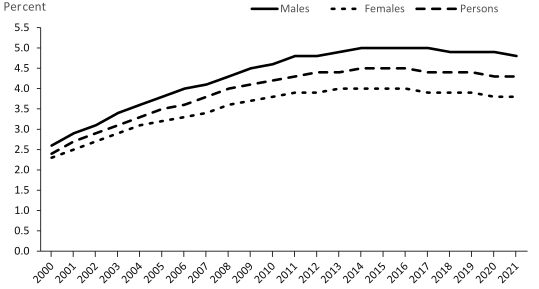
 

Analyse the trends and discuss what these patterns suggest about the health status of Australians.   (8 marks)

--- 22 WORK AREA LINES (style=lined) ---

Show Answers Only

*PEEL – Solution is structured using an adjusted PEEL method; [P] Identify components and their relationship, [E] explain the interaction/influence between them, [Ev] provide evidence showing the relationship in action, [L] linking sentence back to question.

  • [P] Rising diabetes prevalence (2000-2013) connects directly to lifestyle changes and demographics.
  • [E] This trend directly influences the population’s health through increased obesity rates interacting with sedentary behaviours.
  • [Ev] The graph shows prevalence climbing steadily as these risk factors combine.
  • [L] This establishes a cause-effect pattern revealing deteriorating health behaviours among Australians.
     
  • [P] The plateau after 2013 relates to intervention effectiveness.
  • [E] The relationship between prevention programs and prevalence rates shows stabilisation occurring when awareness campaigns interact with early screening.
  • [Ev] These elements combine to produce the flattening trend visible from 2013-2021.
  • [L] This interaction demonstrates that targeted health strategies can influence disease patterns.
      
  • [P] Gender disparity reveals different risk profiles between males and females.
  • [E] Males’ consistently higher rates result from the combination of poorer health behaviours and reduced healthcare engagement.
  • [Ev] The 1% gap demonstrates how lifestyle factors function through the interaction of diet, exercise and medical check-ups.
  • [L] This dynamic shows that gender-specific approaches are important to address health issues.
     
  • [P] Sustained high prevalence indicates a continuing systemic issue despite stabilisation.
  • [E] This trend reveals that ongoing healthcare demands are operating on multiple levels – managing existing cases while preventing new ones.
  • [Ev] High rates persisting means that, in practice, resources remain stretched.
  • [L] This fact reveals how chronic disease remains a defining feature of Australia’s health status.

Show Worked Solution

*PEEL – Solution is structured using an adjusted PEEL method; [P] Identify components and their relationship, [E] explain the interaction/influence between them, [Ev] provide evidence showing the relationship in action, [L] linking sentence back to question.

  • [P] Rising diabetes prevalence (2000-2013) connects directly to lifestyle changes and demographics.
  • [E] This trend directly influences the population’s health through increased obesity rates interacting with sedentary behaviours.
  • [Ev] The graph shows prevalence climbing steadily as these risk factors combine.
  • [L] This establishes a cause-effect pattern revealing deteriorating health behaviours among Australians.
     
  • [P] The plateau after 2013 relates to intervention effectiveness.
  • [E] The relationship between prevention programs and prevalence rates shows stabilisation occurring when awareness campaigns interact with early screening.
  • [Ev] These elements combine to produce the flattening trend visible from 2013-2021.
  • [L] This interaction demonstrates that targeted health strategies can influence disease patterns.
      
  • [P] Gender disparity reveals different risk profiles between males and females.
  • [E] Males’ consistently higher rates result from the combination of poorer health behaviours and reduced healthcare engagement.
  • [Ev] The 1% gap demonstrates how lifestyle factors function through the interaction of diet, exercise and medical check-ups.
  • [L] This dynamic shows that gender-specific approaches are important to address health issues.
     
  • [P] Sustained high prevalence indicates a continuing systemic issue despite stabilisation.
  • [E] This trend reveals that ongoing healthcare demands are operating on multiple levels – managing existing cases while preventing new ones.
  • [Ev] High rates persisting means that, in practice, resources remain stretched.
  • [L] This fact reveals how chronic disease remains a defining feature of Australia’s health status.

Filed Under: Health status of Australians Tagged With: Band 4, Band 5, smc-5504-05-Epidemiology, smc-5504-70-Health Reports

HMS, HIC EQ-Bank 009

Australia's Health 2024 report published findings that

  • 5-year relative survival rates for cancer have improved from 53% in 1990-1994 to 71% in 2015-2019.
  • This improvement is particularly notable in specific cancers such as prostate cancer, which saw survival rates rise from 66% to 96%, and breast cancer in females which increased from 78% to 92%.

Outline TWO reasons for these improved statistics and explain how these they affect survival rates?   (5 marks)

--- 15 WORK AREA LINES (style=lined) ---

Show Answers Only

*Cause-and-effect language that directly addresses the “Explain” keyword is bolded in the answer below.

Early Detection:

  • Earlier detection through screening programs creates better survival outcomes.
  • First, programs like BreastScreen Australia identify cancers at Stage 1 or 2, which enables immediate treatment.
  • This leads to surgical removal while tumours are small and localised. As a result, 5-year survival rates increase because cancer hasn’t spread to other organs.
  • For example, breast cancer detected through screening has 99% survival at Stage 1, demonstrating how early detection directly improves outcomes.

Improved cancer treatments:

  • Advanced treatment technologies improve survival through connected steps.
  • Initially, genetic testing identifies cancer mutations, which causes doctors to prescribe targeted therapies. This then leads to cancer cells being destroyed precisely while protecting healthy tissue.
  • Consequently, patients experience fewer side effects and stronger responses. This results in extended survival because treatments attack cancer’s specific weaknesses.

Detection and Improved Treatment combining:

  • These factors work together – when screening detects cancer early and targeted treatments are applied, this combination causes dramatic improvements like prostate cancer’s rise to 96% survival.
Show Worked Solution

*Cause-and-effect language that directly addresses the “Explain” keyword is bolded in the answer below.

Early Detection:

  • Earlier detection through screening programs creates better survival outcomes.
  • First, programs like BreastScreen Australia identify cancers at Stage 1 or 2, which enables immediate treatment.
  • This leads to surgical removal while tumours are small and localised. As a result, 5-year survival rates increase because cancer hasn’t spread to other organs.
  • For example, breast cancer detected through screening has 99% survival at Stage 1, demonstrating how early detection directly improves outcomes.

Improved cancer treatments:

  • Advanced treatment technologies improve survival through connected steps.
  • Initially, genetic testing identifies cancer mutations, which causes doctors to prescribe targeted therapies. This then leads to cancer cells being destroyed precisely while protecting healthy tissue.
  • Consequently, patients experience fewer side effects and stronger responses. This results in extended survival because treatments attack cancer’s specific weaknesses.

Detection and Improved Treatment combining:

  • These factors work together – when screening detects cancer early and targeted treatments are applied, this combination causes dramatic improvements like prostate cancer’s rise to 96% survival.

Filed Under: Health status of Australians Tagged With: Band 4, smc-5504-10-Mortality, smc-5504-70-Health Reports

HMS, HIC EQ-Bank 007

Australia's Health 2024 report states that 

"Over the last century there have been substantial decreases in child and infant mortality rates, contributing to increases in overall life expectancy. For example, death rates for children under 5 declined by 97% between 1907 and 2022."

Outline how the decrease in infant mortality rates in Australia over the past century has contributed to increased life expectancy.   (2 marks)

--- 5 WORK AREA LINES (style=lined) ---

Show Answers Only
  • The significant decrease in infant mortality rates in Australia has contributed to increased life expectancy by reducing deaths in the early years of life.
  • As more children survive past their first year, the average life expectancy of the population increases because fewer lives are being cut short in infancy.
Show Worked Solution
  • The significant decrease in infant mortality rates in Australia has contributed to increased life expectancy by reducing deaths in the early years of life.
  • As more children survive past their first year, the average life expectancy of the population increases because fewer lives are being cut short in infancy.

Filed Under: Health status of Australians Tagged With: Band 3, smc-5504-30-Infant mortality, smc-5504-70-Health Reports

Copyright © 2014–2025 SmarterEd.com.au · Log in