SmarterEd

Aussie Maths & Science Teachers: Save your time with SmarterEd

  • Login
  • Get Help
  • About

HMS, BM 2013 HSC 14 MC

During which stage of skill acquisition is anticipation initially learned?

  1. Associative
  2. Autonomous
  3. Cognitive
  4. Developmental
Show Answers Only

\(A\)

Show Worked Solution
  • A is correct: Associative stage develops anticipation skills through practice refinement.

Other Options:

  • B is incorrect: Autonomous stage has automatic anticipation, not initial learning.
  • C is incorrect: Cognitive stage focuses on basic movement understanding.
  • D is incorrect: Developmental is not recognised skill acquisition stage.

♦♦ Mean mark 43%.

Filed Under: Stages of learning Tagged With: Band 5, smc-5921-20-Associative, smc-5921-45-Identify stage

HMS, BM 2022 HSC 14 MC

The diagram shows the scoring system that a coach is using to assess the kicking accuracy of players in a team.
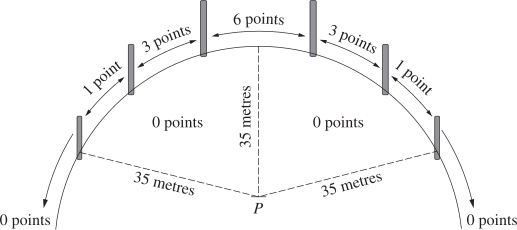
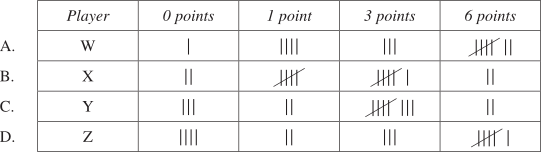
Each player is given 15 kicking attempts to score as many points as possible from the spot marked P, which is located 35 metres away from each post. The coach tallies the number of times each player scores 0,1,3 and 6 points.

Which row in the table represents the player who is most likely to be in the cognitive stage of skill acquisition?
Show Answers Only

\( B \)

Show Worked Solution
  • B is correct: High variability and inconsistent performance indicates cognitive stage learning.

Other Options:

  • A is incorrect: Consistent high scores suggest autonomous stage performance.
  • C is incorrect: Too many misses for cognitive stage learner.
  • D is incorrect: Moderate consistency suggests associative stage performance.

♦♦ Mean mark 48%.

Filed Under: Stages of learning Tagged With: Band 5, smc-5921-45-Identify stage

HMS, BM EQ-Bank 542 MC

A basketball player demonstrates the following behaviours during practice:

  1. Can shoot free throws without consciously thinking about technique
  2. Consistently maintains proper shooting form even when fatigued
  3. Simultaneously reads defensive positioning while dribbling
  4. Automatically adjusts technique when shots are missing

Which skill acquisition stage is the player demonstrating?

  1. Early cognitive stage
  2. Late cognitive stage
  3. Associative stage
  4. Autonomous stage
Show Answers Only

\(D\)

Show Worked Solution
  • D is correct: Performing without conscious thought, maintaining technique under fatigue, attending to other cues (defensive positioning), and automatically making adjustments are all characteristics of the autonomous stage.

Other Options:

  • A and B incorrect: Any cognitive stage would involve conscious focus on technique and inability to attend to other aspects simultaneously.
  • C is incorrect: The associative stage would still require conscious attention to technique execution rather than automatic adjustments.

Filed Under: Stages of learning Tagged With: Band 5, smc-5921-45-Identify stage

HMS, BM EQ-Bank 541 MC

The table below shows characteristics of different skill acquisition stages.

Focus Error Recognition   Movement Efficiency  
How to do the skill     Can identify errors  Moderately Efficient

Which stage of skill acquisition is being described?

  1. Cognitive stage
  2. Associative stage
  3. Autonomous stage
  4. Preparatory stage
Show Answers Only

\(B\)

Show Worked Solution
  • B is correct: Focusing on “how to do the skill,” being able to identify errors, and moderately efficient movements are key characteristics of the associative stage.

Other Options:

  • A is incorrect: The cognitive stage focuses on “what to do” with limited error recognition and inefficient movement.
  • C is incorrect: The autonomous stage would show automatic movement execution with high efficiency.
  • D is incorrect: “Preparatory stage” is not a recognised stage in the three-stage process of skill acquisition.

Filed Under: Stages of learning Tagged With: Band 2, smc-5921-45-Identify stage

HMS, BM EQ-Bank 540 MC

A tennis coach observes that a beginner player frequently makes large errors when attempting a forehand stroke, struggles to coordinate the footwork with the arm movement, and requires regular demonstrations to understand the technique.

In which stage of skill acquisition is this tennis player most likely to be?

  1. Cognitive stage
  2. Associative stage
  3. Autonomous stage
  4. Refinement stage
Show Answers Only

\(A\)

Show Worked Solution
  • A is correct: Frequent large errors, coordination difficulties, and reliance on demonstrations are key characteristics of the cognitive stage where learners are understanding what to do.

Other Options:

  • B is incorrect: The associative stage would show fewer and smaller errors with improved coordination.
  • C is incorrect: The autonomous stage would display automatic execution with minimal errors.
  • D is incorrect: “Refinement stage” is not a recognised stage in the three-stage process of skill acquisition.

Filed Under: Stages of learning Tagged With: Band 3, smc-5921-45-Identify stage

Copyright © 2014–2025 SmarterEd.com.au · Log in