Matrix \(D\) is a \(2 \times 2\) matrix where each element is given by \(d_{ij}\)
Which rule will result in a binary matrix?
- \(d_{i j}=i+j\)
- \(d_{i j}=i-j\)
- \(d_{i j}=i \times j\)
- \(d_{i j}=i \ ÷ \ j\)
- \(d_{i j}=(i-j)^2\)
Aussie Maths & Science Teachers: Save your time with SmarterEd
Matrix \(D\) is a \(2 \times 2\) matrix where each element is given by \(d_{ij}\)
Which rule will result in a binary matrix?
To access the southern end of the construction site, Vince must enter a security code consisting of five numbers. The security code is represented by the row matrix \(W\). The element in row \(i\) and column \(j\) of \(W\) is \(w_{i j}\). The elements of \(W\) are determined by the rule \((i-j)^2+2 j\). --- 0 WORK AREA LINES (style=lined) --- To access the northern end of the construction site, Vince enters a different security code, consisting of eight numbers. This security code is represented by the row matrix \(X\). The element in row \(i\) and column \(j\) of \(X\) is \(x_{i j}\). The elements of \(X\) are also determined by the rule \((i-j)^2+2 j\). --- 2 WORK AREA LINES (style=lined) ---

Matrix \(K\) is a \(3 \times 2\) matrix.
The elements of \(K\) are determined by the rule \(k_{i j}=(i-j)^2\).
Matrix \(K\) is
|
|
\begin{bmatrix} 0 & 1 & -2 \\ 1 & 0 & -1 \end{bmatrix} |
|
\begin{bmatrix} 0 & 1 & 4 \\ 1 & 0 & 1 \end{bmatrix} |
|
|
\begin{bmatrix} |
|
\begin{bmatrix} 0 & 1\\ 1 & 0\\ 2 & 1 \end{bmatrix} |
|
|
\begin{bmatrix} 0 & 1\\ 1 & 0\\ 4 & 1 \end{bmatrix} |
The daily maximum temperature at a regional town for two weeks is displayed in the table below.
\begin{array} {|c|c|c|}
\hline \rule{0pt}{2.5ex} \text{} \rule[-1ex]{0pt}{0pt} & \text{Monday} & \text{Tuesday} & \text{Wednesday} & \text{Thursday} & \text{Friday} & \text{Saturday} & \text{Sunday} \\
\hline \rule{0pt}{2.5ex} \text{Week 1} \rule[-1ex]{0pt}{0pt} & \text{20 °C} & \text{17 °C} & \text{23 °C} & \text{20 °C} & \text{18 °C} & \text{19 °C} & \text{30 °C} \\
\hline \rule{0pt}{2.5ex} \text{Week 2} \rule[-1ex]{0pt}{0pt} & \text{29 °C} & \text{27 °C} & \text{28 °C} & \text{21 °C} & \text{20 °C} & \text{20 °C} & \text{22 °C} \\
\hline
\end{array}
This information can also be represented by matrix \(M\), shown below.
Element \(m_{21}\) indicates that
The element in row `i` and column `j` of matrix `M` is `m_(ij)`.
`M` is a 3 × 3 matrix. It is constructed using the rule `m_(ij) = 3i + 2j`.
`M` is
| A. |
`[(5,7,9),(7,9,11),(11,13,15)]`
|
B. |
`[(5,7,9),(8,10,12),(11,13,15)]`
|
| C. |
`[(5,7,10),(8,10,13),(11,13,16)]`
|
D. |
`[(5,8,11),(7,10,13),(9,12,15)]`
|
| E. |
`[(5,8,11),(8,11,14),(11,14,17)]`
|
The number of individual points scored by Rhianna (`R`), Suzy (`S`), Tina (`T`), Ursula (`U`) and Vicki (`V`) in five basketball matches `(F, G, H, I, J)` is shown in matrix `P` below.
`{:(),(),(P=):}{:(qquadqquadqquad\ text(match)),((quadF,G,H,I,J)),([(2,\ 0,\ 3,\ 1,\ 8),(4,7,2,5,3),(6,4,0,0,5),(1,6,1,4,5),(0,5,3,2,0)]):}{:(),(),({:(R),(S),(T),(U),(V):}):}{:(),(),(text(player)):}`
Who scored the highest number of points and in which match?
Consider the matrix `P`, where `P = [(3, 2, 1), (5, 4, 3)]`.
The element in row `i` and column `j` of matrix `P` is `p_(ij)`.
The elements in matrix `P` are determined by the rule
The table below shows information about two matrices, `A` and `B`.
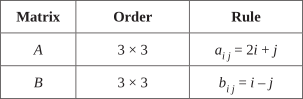
The element in row `i` and column `j` of matrix `A` is `a_(ij)`.
The element in row `i` and column `j` of matrix `B` is `b_(ij)`.
The sum `A + B` is
| A. |
`[(5,7,9),(8,10,12),(11,13,15)]`
|
B. |
`[(5,8,11),(7,10,13),(9,12,15)]`
|
| C. |
`[(3,6,9),(3,6,9),(3,6,9)]`
|
D. |
`[(3,3,3),(6,6,6),(9,9,9)]`
|
| E. |
`[(3,6,3),(6,3,9),(3,9,3)]`
|
Kai has a part-time job.
Each week, he earns money and saves some of this money.
The matrix below shows the amounts earned (`E`) and saved (`S`), in dollars, in each of three weeks.
`{:(qquadqquadqquadqquadquadEquadqquadS),({:(text(week 1)),(text(week 2)),(text(week 3)):}[(300,100),(270,90),(240,80)]):}`
How much did Kai save in week 2?
Let `M = [(1,2,3,4),(3,4,5,6)]`.
The element in row `i` and column `j` of `M` is `m_(ij)`.
The elements of `M` are determined by the rule
The order of matrix `X` is `3 xx 2.`
The element in row `i ` and column `j` of matrix `X` is `x_(ij)` and it is determined by the rule
`x_(ij) = i + j`
The matrix `X` is


The order of matrix `X` is `2 xx 3`.
The element in row `i` and column `j` of matrix `X` is `x_(ij)` and it is determined by the rule
`x_(ij) = i - j`
Which one of the following calculations would result in matrix `X`?
A. `[(1,1,1),(2,2,2)] - [(1,2,3),(1,2,3)]`
B. `[(1,2,3),(1,2,3)] - [(1,1,1),(2,2,2)]`
C. `[(2,2,2),(2,2,2)] - [(3,3,3),(3,3,3)]`
D. `[(1,2),(1,2),(1,2)] - [(1,1),(2,2),(3,3)]`
E. `[(1,1),(2,2),(3,3)] - [(1,2),(1,2),(1,2)]`