SmarterEd

Aussie Maths & Science Teachers: Save your time with SmarterEd

  • Login
  • Get Help
  • About

Matrices, GEN1 2024 NHT 25-26 MC

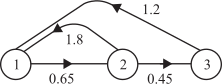
The following life cycle transition diagram shows changes in a female population of mammals with three age groups (1,2 and 3).
 

Question 25

On average, what percentage of the female population from group 2 will survive to group 3 ?

  1. 12%
  2. 18%
  3. 45%
  4. 50%
  5. 65%

 
Question 26

The associated Leslie matrix, \(L\), for the above transition diagram is

  1. \(L=\begin{bmatrix} 0 & 0 & 0 \\ 0 & 1.8 & 1.2 \\ 0 & 0.65 & 0.45\end{bmatrix}\)
     
  2. \(L=\begin{bmatrix}1 & 1.8 & 1.2 \\ 0 & 0.65 & 0 \\ 0 & 0 & 0.45\end{bmatrix}\)
     
  3. \(L=\begin{bmatrix}0 & 1.8 & 1.2 \\ 0.65 & 0 & 0 \\ 0.45 & 0 & 0\end{bmatrix}\)
     
  4. \(L=\begin{bmatrix}1.8 & 1.2 & 0 \\ 0 & 0.65 & 0.45 \\ 0 & 0 & 0\end{bmatrix}\)
     
  5. \(L=\begin{bmatrix}0 & 1.8 & 1.2 \\ 0.65 & 0 & 0 \\ 0 & 0.45 & 0\end{bmatrix}\)
Show Answers Only

\(\text{Question 25:}\ C\)

\(\text{Question 26:}\ E\)

Show Worked Solution

\(\text{Question 25}\)

\(0.45 = 45\%\ \text{of group 2 transition (survive) to group 3.}\)

\(\Rightarrow C\)
 

\(\text{Question 26}\)

\(\text{By elimination:}\)

\(\text{Row 1: Reproduction rate of each group}\ \ \Rightarrow\ \ \text{Eliminate A, B and D}\)

\(e_{3,2}\ \text{shows group 2 to group 3 survival rate} \)

\(\Rightarrow E\)

Filed Under: Transition Matrices - Regular Tagged With: Band 3, Band 4, smc-618-25-Interpret Diagram, smc-618-55-Leslie matrix, smc-618-61-3x3 Matrix

Matrices, GEN2 2024 VCAA 11

A population of a native animal species lives near the construction site.

To ensure that the species is protected, information about the initial female population was collected at the beginning of 2023. The birth rates and the survival rates of the females in this population were also recorded.

This species has a life span of 4 years and the information collected has been categorised into four age groups: 0-1 year, 1-2 years, 2-3 years, and 3-4 years.

This information is displayed in the initial population matrix, \(R_0\), and the Leslie matrix, \(L\), below.

\(R_0=\left[\begin{array}{c}70 \\ 80 \\ 90 \\ 40\end{array}\right] \quad \quad L=\left[\begin{array}{cccc}0.4 & 0.75 & 0.4 & 0 \\ 0.4 & 0 & 0 & 0 \\ 0 & 0.7 & 0 & 0 \\ 0 & 0 & 0.5 & 0\end{array}\right]\)

  1. Using the information above
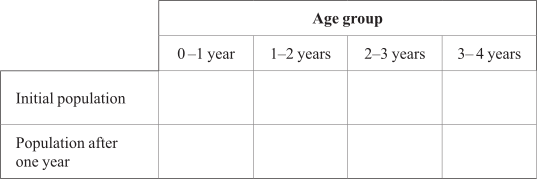
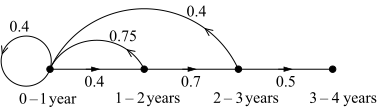
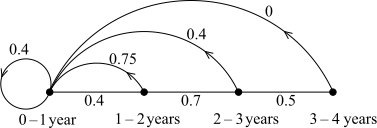
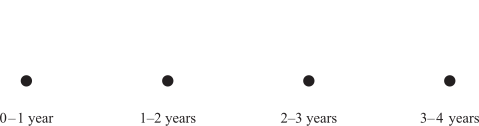
  2.  i. complete the following transition diagram.   (1 mark) 

    --- 0 WORK AREA LINES (style=lined) ---

  1. ii. complete the following table, showing the initial female population, and the predicted female population after one year, for each of the age groups.  (1 mark)  

--- 0 WORK AREA LINES (style=lined) ---


  1. It is predicted that if this species is not protected, the female population of each of the four age groups will rapidly decrease within the next 10 years.
  2. After how many years is it predicted that the total female population of this species will first be half the initial female population?   (1 mark)

    --- 1 WORK AREA LINES (style=lined) ---

Show Answers Only

a.i. 

a.ii.

  \(\textbf{Age Group}\)
  \(\ 0-1\ \text{year}\ \) \(\ 1-2\ \text{years}\ \) \(\ 2-3\ \text{years}\ \) \(\ 3-4\ \text{years}\ \)
\(\ \text{Initial population}\ \) \(70\) \(80\) \(90\) \(40\)
\(\ \text{Population after}\ \)
\(\ \text{one year}\)
\(124\) \(28\) \(56\) \(45\)


b.    \(\text{5 years}\)

Show Worked Solution

a.i. 

♦♦♦ Mean mark (a) 24%.

a.ii.  \(\text{Population after 1 yr calculations}\)

\(0-1\ \text{year}\ =0.4\times 70+0.75\times 80+0.4\times 90=124\)

\(1-2\ \text{years}\ =0.4\times 70=28\)

\(2-3\ \text{years}\ =0.7\times 80=56\)

\(3-4\ \text{years}\ =0.5\times 90=45\)


  \(\textbf{Age Group}\)
  \(\ 0-1\ \text{year}\ \) \(\ 1-2\ \text{years}\ \) \(\ 2-3\ \text{years}\ \) \(\ 3-4\ \text{years}\ \)
\(\ \text{Initial population}\ \) \(70\) \(80\) \(90\) \(40\)
\(\ \text{Population after}\ \)
\(\ \text{one year}\)
\(124\) \(28\) \(56\) \(45\)


b.    \(\text{Using CAS:}\)

\(R_1=L\times R_0=\begin{bmatrix}
124  \\
28 \\
56  \\
45  \end{bmatrix}\ \ \text{Total = 253}\ ,\ \ R_2=L\times R_1=\begin{bmatrix}
93  \\
49.6 \\
19.6  \\
28  \end{bmatrix}\ \ \text{Total = 190.2}\)


\(R_3=L\times R_2=\begin{bmatrix}
82.24  \\
37.2 \\
34.72  \\
9.8  \end{bmatrix}\ \ \text{Total = 163.96}\ ,\ \ R_4=L\times R_3=\begin{bmatrix}
74.684  \\
32.896 \\
26.04  \\
17.36  \end{bmatrix}\ \ \text{Total =150.98}\)


\(R_5=L\times R_4=\begin{bmatrix}
64.9616 \\
29.8736 \\
23.0272 \\
13.02 \end{bmatrix}\ \ \text{Total = 130.8824}\)

 
\(\therefore\ \text{Total female population less than 140 after 5 years}\)

♦ Mean mark (b) 39%.

Filed Under: Transition Matrices - Regular Tagged With: Band 4, Band 5, Band 6, smc-618-20-Matrix to Diagram, smc-618-24-Interpret Matrix, smc-618-55-Leslie matrix

Matrices, GEN1 2024 VCAA 30 MC

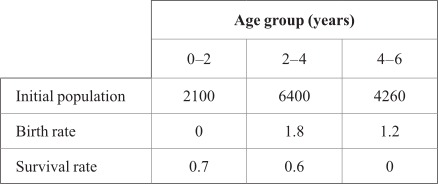
Data has been collected on the female population of a species of mammal located on a remote island.

The female population has been divided into three age groups, with the initial population (at the time of data collection), the birth rate, and the survival rate of each age group shown in the table below.
 

The Leslie matrix \((L)\) that may be used to model this particular population is

  1. \(L=\begin{bmatrix}0 & 1.8 & 0 \\ 0.7 & 0 & 1.2 \\ 0 & 0.6 & 0\end{bmatrix}\)
  2. \(L=\begin{bmatrix}0 & 1.8 & 1.2 \\ 0.7 & 0 & 0 \\ 0 & 0.6 & 0\end{bmatrix}\)
  3. \(L=\begin{bmatrix}0 & 1.8 & 1.2 \\ 0.7 & 0.6 & 0 \\ 0 & 0 & 0\end{bmatrix}\)
  4. \(L=\begin{bmatrix}2100 & 6400 & 4260 \\ 0 & 1.8 & 1.2 \\ 0.7 & 0.6 & 0\end{bmatrix}\)
Show Answers Only

\(B\)

Show Worked Solution

\(\text{Row 1 represents the birth rates for the time periods: Eliminate A}\)

\(\text{The sub-diagonal represents survival rates: Eliminate C and D}\)

\(\Rightarrow B\)

Filed Under: Transition Matrices - Regular Tagged With: Band 4, smc-618-55-Leslie matrix

Matrices, GEN1 2023 VCAA 31 MC

A species of bird has a life span of three years.

The females in this species do not reproduce in their first year but produce an average of four female offspring in their second year, and three in their third year.

The Leslie matrix, \(L\), below is used to model the female population distribution of this species of bird.
 

\(L=\begin{bmatrix}
0 & 4 & 3\\
0.2 & 0 & 0\\
0 & 0.4 & 0 
\end{bmatrix}\)
 

The element in the second row, first column states that on average 20% of this population will

  1. be female.
  2. never reproduce.
  3. survive into their second year.
  4. produce offspring in their first year.
  5. live for the entire lifespan of three years.
Show Answers Only

\(C\)

Show Worked Solution

\(\text{Second and third rows represent survival rates from one year to the next.} \)

\(e_{21}\ \text{indicates an average of 20% survive into their second year.}\) 

\(\Rightarrow C\)

Filed Under: Transition Matrices - Regular Tagged With: Band 5, smc-618-24-Interpret Matrix, smc-618-55-Leslie matrix

Copyright © 2014–2025 SmarterEd.com.au · Log in