SmarterEd

Aussie Maths & Science Teachers: Save your time with SmarterEd

  • Login
  • Get Help
  • About

Matrices, GEN1 2022 VCAA 4 MC

The communication matrix below shows the communication links between five people: Steph \((S)\), Tran \((T)\),Ursula \((U)\), Vinh \((V)\) and Wanda \((W)\).

\(\begin{aligned}
&\quad \quad \quad \quad \quad \quad \ \ \ receiver \\
& \begin{array}{lllll}
\quad \quad \quad \quad \quad \ S \ \ \ T \ \ \ U \ \ \  V \ \ \  W\end{array} \\ &
sender \ \ \ \begin{array}{cc} S  \\ T\\ U\\  V\\ W \end{array}
\begin{bmatrix}
0 & 1 & 1 & 0 & 1 \\
0 & 0 & 0 & 1 & 1 \\
0 & 1 & 0 & 1 & 0 \\
0 & 0 & 1 & 0 & 0 \\
1 & 0 & 0 & 1 & 0
\end{bmatrix} \\
& \end{aligned}\)

In this matrix:

  • the '1' in row \(S\), column \(T\) indicates that Steph can communicate directly with Tran
  • the '0' in row \(V\), column \(W\) indicates that Vinh cannot communicate directly with Wanda.

Ursula needs to communicate with Steph.

The sequence of communication links that will successfully allow Ursula to communicate with Steph is

  1. \(U-T-S\)
  2. \(U-W-S\)
  3. \(U-T-W-S\)
  4. \(U-V-T-S\)
  5. \(U-W-T-S\)
Show Answers Only

\(C\)

Show Worked Solution

By elimination:

Option A:  \(U \rightarrow T \nrightarrow S\) (eliminate A)

Option B:  \(U \nrightarrow W\) (eliminate B)

Option C:  \(U \rightarrow T \rightarrow W \rightarrow S\) (correct)

Option D:  \(U \rightarrow V \nrightarrow T\) (eliminate D)

Option E:  \(U \nrightarrow W\) (eliminate E)

\(\Rightarrow C\)

Filed Under: Matrix Applications Tagged With: Band 3, smc-619-80-Communication

MATRICES, FUR2 2021 VCAA 2

The main computer system in Elena's office has broken down.

The five staff members, Alex (`A`), Brie (`B`), Chai (`C`), Dex (`D`) and Elena (`E`), are having problems sending information to each other.

Matrix `M` below shows the available communication links between the staff members.

`qquadqquadqquadqquadqquadqquadqquadqquadqquad text(receiver)`

`qquadqquadqquadqquadqquadqquadqquad \ \ \ A \ \ B \ \ C \ \ D \ \ E`

`M= \ text{sender} \ \ {:(A),(B),(C),(D),(E):} [(0,1,0,0,1),(0,0,1,1,0),(1,0,0,1,0),(0,1,0,0,0),(0,0,0,1,0)] `

In this matrix:

  • the '1' in row `A`, column `B` indicates that Alex can send information to Brie
  • the '0' in row `D`, column `C` indicates that Dex cannot send information to Chai.
  1. Which two staff members can send information directly to each other?   (1 mark)

    --- 1 WORK AREA LINES (style=lined) ---

  2. Elena needs to send documents to Chai.
  3. What is the sequence of communication links that will successfully get the information from Elena to Chai?   (1 mark)

    --- 2 WORK AREA LINES (style=lined) ---

  4. Matrix  `M^2` below is the square of `M` and shows the number of two-step communication links between each pair of staff members.
     

    `qquadqquadqquadqquadqquadqquadqquadqquadqquad text(receiver)`

    `qquadqquadqquadqquadqquadqquadqquad \ \ \ A \ \ B \ \ C \ \ D \ \ E`

    `M= \ text{sender} \ \ {:(A),(B),(C),(D),(E):} [(0,0,1,2,0),(0,1,0,1,0),(0,1,0,0,0),(0,0,1,1,0),(0,1,0,0,0)] `

    Only one pair of individuals has two different two-step communication links.

  5. List each two-step communication link for this pair.   (1 mark)

    --- 2 WORK AREA LINES (style=lined) ---

Show Answers Only
  1. `text{B and D}`
  2. `text{Elena} to text{Dex} to text{Brie} to text{Chai}`
  3. `text{Alex} to text{Brie} to text{Dex}`
    `text{Alex} to text{Elena} to text{Dex}`
Show Worked Solution

a.   `text{B (sender) to D (receiver)} => 1`

`text{D (sender) to B (receiver)} => 1`

`:. \ text{B and D can send information to each other}`
 

b.   `text{Elena} to text{Dex} to text{Brie} to text{Chai}`
 

c.   `text{The two 2-step links are from Alex to Dex.}`

`text{These are:}`

`text{Alex} to text{Brie} to text{Dex}`

`text{Alex} to text{Elena} to text{Dex}`

Filed Under: Matrix Applications Tagged With: Band 2, Band 3, Band 4, smc-619-70-One/Two Step Dominances, smc-619-80-Communication

MATRICES, FUR1 2020 VCAA 5 MC

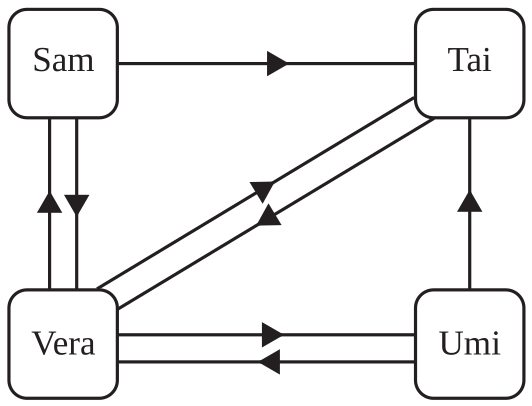
The diagram below shows the direct communication links that exist between Sam (S), Tai (T), Umi (U) and Vera (V). For example, the arrow from Umi to Vera indicates that Umi can communicate directly with Vera.


A communication matrix can be used to convey the same information.

In this matrix:

  • a ‘1’ indicates that a direct communication link exists between a sender and a receiver
  • a ‘0’ indicates that a direct communication link does not exist between a sender and a receiver.

The communication matrix could be

A.  

`{:(qquadqquadqquadqquadqquadqquadquad receiver),(\ quad qquadqquadqquadqquad qquadS\ \ \ Tquad U\ \ V),(sender qquad{:(S),(T),(U),(V):}[(0,1,0,1),(0,0,0,1),(0,1,0,1),(1,0,1,0)]):}`


B.  

`{:(qquadqquadqquadqquadqquadqquadquad receiver),(\ quad qquadqquadqquadqquad qquadS\ \ \ Tquad U\ \ V),(sender qquad{:(S),(T),(U),(V):}[(0,1,0,1),(1,0,0,1),(0,1,0,1),(1,1,1,0)]):}`


C.  

`{:(qquadqquadqquadqquadqquadqquadquad receiver),(\ quad qquadqquadqquadqquad qquadS\ \ \ Tquad U\ \ V),(sender qquad{:(S),(T),(U),(V):}[(0,1,0,1),(0,0,0,1),(0,1,0,0),(1,1,1,0)]):}`


D.  

`{:(qquadqquadqquadqquadqquadqquadquad receiver),(\ quad qquadqquadqquadqquad qquadS\ \ \ Tquad U\ \ V),(sender qquad{:(S),(T),(U),(V):}[(0,1,0,1),(0,0,0,1),(0,1,0,1),(1,1,1,0)]):}`


E.  

`{:(qquadqquadqquadqquadqquadqquadquad receiver),(\ quad qquadqquadqquadqquad qquadS\ \ \ Tquad U\ \ V),(sender qquad{:(S),(T),(U),(V):}[(0,1,0,2),(0,0,0,2),(0,1,0,2),(2,2,2,0)]):}`


Show Answers Only

`D`

Show Worked Solution

`text(By Elimination):`

`text(Vera can talk to Tai) \ => \ e_42 = 1`

`:.\ text(Eliminate)\ A and E`
 

`text(Umi can talk to Vera) \ => \ e_34 = 1`

`:.\ text(Eliminate)\ C`
 

`text(Tai cannot talk to Sam) \ => \ e_21 = 0`

`:.\ text(Eliminate)\ B`

`=>  D`

Filed Under: Matrix Applications Tagged With: Band 3, smc-619-80-Communication

MATRICES, FUR1 2019 VCAA 7 MC

The communication matrix below shows the direct paths by which messages can be sent between two people in a group of six people, `U` to `Z`.
 

`{:(qquad qquad qquad qquad qquad qquad qquad qquad text(receiver)),(qquad qquad qquad qquad qquad quad U quad V quad W \ \ \ X \ \ \ Y quad \ Z), (text(sender) qquad {:(U),(V),(W),(X),(Y), (Z):}[(0, 1, 1, 0, 1, 1), (1, 0, 1, 0, 1, 0), (1, 1, 0, 1, 0, 1), (0, 1, 0, 0, 1, 1), (0, 0, 1, 1, 0, 1), (1, 1, 0, 1, 1, 0)]):}`
 

A 1 in the matrix shows that the person named in that row can send a message directly to the person named in that column.

For example, the 1 in row 4, column 2 shows that `X` can send a message directly to `V`.

In how many ways can `Y` get a message to `W` by sending it directly to one other person?

  1. 0
  2. 1
  3. 2
  4. 3
  5. 4
Show Answers Only

`A`

Show Worked Solution

`Y\ text(can send directly to)\ W, X and Z.`

`text(Consider the next message after)\ Y\ text(sends to)`

`W:\ text(can’t send directly to)\ W`

`X:\ text(can’t send directly to)\ W`

`Z:\ text(can’t send directly to W)`

`=>  A`

Filed Under: Matrix Applications Tagged With: Band 4, smc-619-80-Communication

MATRICES, FUR1 2017 VCAA 2 MC

The matrix below shows how five people, Alan (`A`), Bevan (`B`), Charlie (`C`), Drew (`D`) and Esther (`E`), can communicate with each other.
 

`{:(),(),(text(sender)\ ):}{:(qquadqquadqquad\ text(receiver)),(qquadqquadAquadBquadCquadDquadE),({:(A),(B),(C),(D),(E):}[(0,1,0,1,0),(1,0,0,0,0),(0,0,0,1,1),(1,0,1,0,0),(0,0,1,0,0)]):}`
 

A 1 in the matrix shows that the person named in that row can send a message directly to the person named in that column.

For example, the 1 in row 3 and column 4 shows that Charlie can send a message directly to Drew.

Esther wants to send a message to Bevan.

Which one of the following shows the order of people through which the message is sent?

  1. Esther – Bevan
  2. Esther – Charlie – Bevan
  3. Esther – Charlie – Alan – Bevan
  4. Esther – Charlie – Drew – Bevan
  5. Esther – Charlie – Drew – Alan – Bevan
Show Answers Only

`E`

Show Worked Solution

`text(Esther can only send to Charlie.)`

`text(Charlie can send to Drew.)`

`text(Drew can send to Alan.)`

`text(Alan can send to Bevan.)`

`:.\ text(Esther – Charlie – Drew – Alan – Bevan)`

`=> E`

Filed Under: Matrix Applications Tagged With: Band 4, smc-619-80-Communication

MATRICES, FUR2 2016 VCAA 2

A travel company has five employees, Amara (`A`), Ben (`B`), Cheng (`C`), Dana (`D`) and Elka (`E`).

The company allows each employee to send a direct message to another employee only as shown in the communication matrix `G` below.

The matrix `G^2` is also shown below.
 

`{:(),(),(G = text(sender )):}{:(qquadqquadqquad\ text(receiver)),(qquadqquadAquadBquadCquadDquadE),({:(A),(B),(C),(D),(E):}[(0,1,1,1,1),(1,0,1,0,0),(1,1,0,1,0),(0,1,0,0,1),(0,0,0,1,0)]):}qquad{:(),(),(G^2 = text(sender )):}{:(qquadqquadqquad\ text(receiver)),(qquadqquadAquadBquadCquadDquadE),({:(A),(B),(C),(D),(E):}[(2,2,1,2,1),(1,2,1,2,1),(1,2,2,1,2),(1,0,1,1,0),(0,1,0,0,1)]):}`
 

The 1 in row `E`, column `D` of matrix `G` indicates that Elka (sender) can send a direct message to Dana (receiver).

The 0 in row `E`, column `C` of matrix `G` indicates that Elka cannot send a direct message to Cheng.

  1. To whom can Dana send a direct message?   (1 mark)

    --- 1 WORK AREA LINES (style=lined) ---

  2. Cheng needs to send a message to Elka, but cannot do this directly.
  3. Write down the names of the employees who can send the message from Cheng directly to Elka.   (1 mark) 

    --- 2 WORK AREA LINES (style=lined) ---

Show Answers Only
  1. `text(Ben and Elka)`
  2. `text(Amara and Dana)`
Show Worked Solution

a.   `text(Ben and Elka)`
 

b.   `text(Amara and Dana)`

Filed Under: Matrix Applications Tagged With: Band 2, Band 3, smc-619-80-Communication

MATRICES, FUR2 2013 VCAA 1

Five trout-breeding ponds, `P`, `Q`, `R`, `X` and `V`, are connected by pipes, as shown in the diagram below.
 

Matrices, FUR2 2013 VCAA 1 

The matrix `W` is used to represent the information in this diagram.

`{:({:\ qquadqquadqquadPquadQquad\ Rquad\ Xquad\ V:}),(W = [(0,1,1,1,0), (1,0,0,1,0),(1,0,0,1,0),(1,1,1,0,1),(0,0,0,1,0)]):}{:(),(P),(Q),(R),(X),(V):}`

In matrix `W`

•  the 1 in column 1, row 2, for example, indicates that a pipe directly connects pond `P` and pond `Q`

•  the 0 in column 1, row 5, for example, indicates that pond `P` and pond `V` are not directly connected by a pipe.

  1. Find the sum of the elements in row 3 of matrix `W`.   (1 mark)

    --- 1 WORK AREA LINES (style=lined) ---

  2. In terms of the breeding ponds described, what does the sum of the elements in row 3 of matrix `W` represent?   (1 mark)

    --- 2 WORK AREA LINES (style=lined) ---

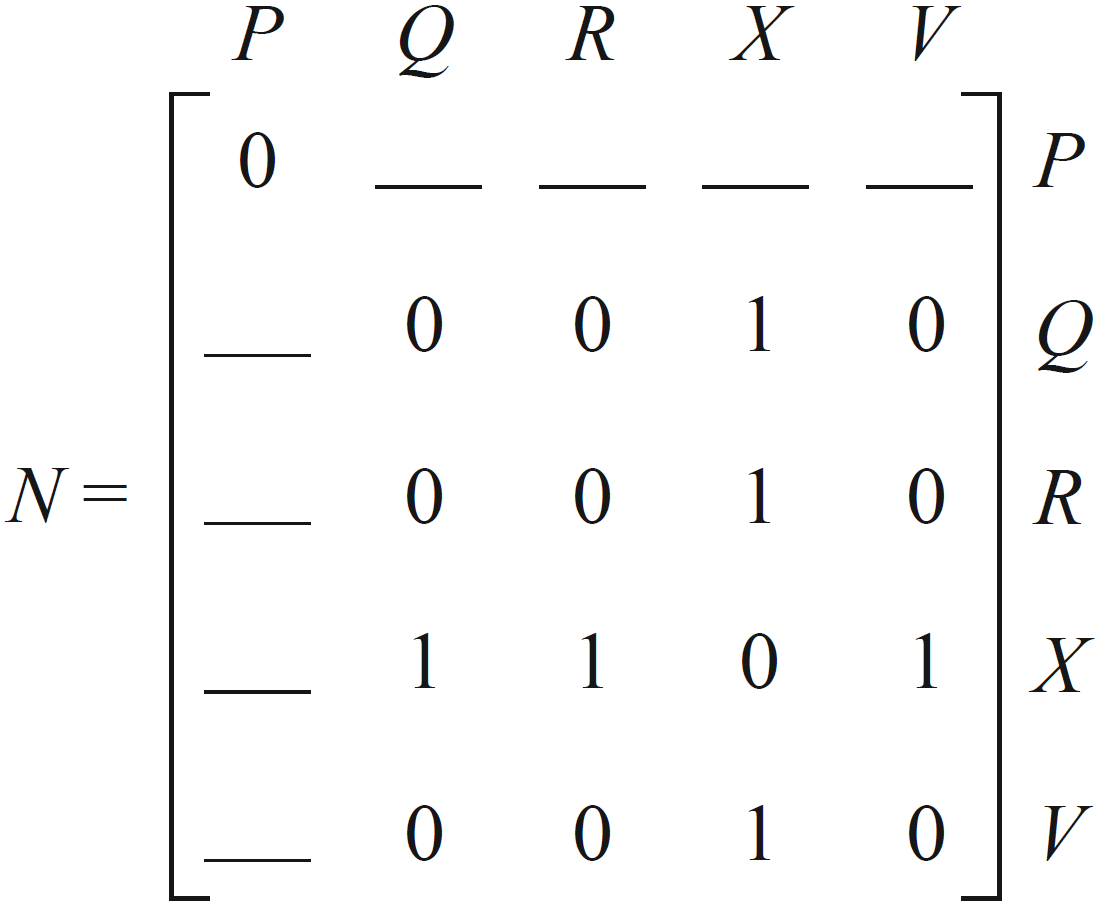
The pipes connecting pond `P` to pond `R` and pond `P` to pond `X` are removed.

Matrix `N` will be used to show this situation. However, it has missing elements.

  1. Complete matrix `N` below by filling in the missing elements in row 1 and column 1.   (1 mark)

    --- 0 WORK AREA LINES (style=lined) ---

        
             Matrices, FUR2 2013 VCAA 1_c

Show Answers Only
  1. `2`
  2. `text(The sum means that 2 other)`
    `text(ponds connect directly to pond)\ R.`
  3.  
    `{:({:qquadqquadqquadPquadQquadRquadXquadV:}),(N = [(0,1,0,0,0),(1,0,0,1,0),(0,0,0,1,0),(0,1,1,0,1),(0,0,0,1,0)]):}{:(),(P),(Q),(R),(X),(V):}`
Show Worked Solution

a.   `1+ 0 + 0 +1+ 0 = 2`
 

b.   `text(The sum means that 2 other ponds)`

`text(connect directly to pond)\ R.`
 

c.    `{:({:qquadqquadqquadPquadQquad\ Rquad\ Xquad\ V:}),(N = [(0,1,0,0,0),(1,0,0,1,0),(0,0,0,1,0),(0,1,1,0,1),(0,0,0,1,0)]):}{:(),(P),(Q),(R),(X),(V):}`

Filed Under: Matrix Applications Tagged With: Band 2, Band 3, Band 4, smc-619-10-Matrix from info/table, smc-619-40-Interpret Elements, smc-619-80-Communication

MATRICES, FUR1 2009 VCAA 5 MC

`A`, `B`, `C`, `D` and `E` are five intersections joined by roads as shown in the diagram below.

Some of these roads are one-way only.
 

MATRICES, FUR1 2009 VCAA 5 MC

The matrix below indicates the direction that cars can travel along each of these roads.

In this matrix

    • 1 in column `A` and row `B` indicates that cars can travel directly from `A` to `B`
    • 0 in column `B` and row `A` indicates that cars cannot travel directly from `B` to `A` (either it is a one-way road or no road exists).
       

`{:(text(from intersection)),({:quad\ Aquad\ Bquad\ Cquad\ Dquad\ E:}),([(0,0,0,0,0),(1,0,0,0,0),(0,1,0,1,1),(1,0,0,0,0),(0,0,1,1,0)]):}{:(),(),(A),(B),(Cqquadtext(to intersection)),(D),(E):}`
 

Cars can travel in both directions between intersections

A.   `A` and `D`

B.   `B` and `C`

C.   `C` and `D`

D.   `D` and `E`

E.   `C` and `E`

Show Answers Only

`E`

Show Worked Solution

`e_(CE) = e_(EC) = 1`

`:.\ text(Cars can travel both ways)`

`text(between)\ E\ text(and)\ C.` 

`=>  E`

Filed Under: Matrix Applications Tagged With: Band 4, smc-619-40-Interpret Elements, smc-619-80-Communication

MATRICES, FUR1 2013 VCAA 5 MC

Five students, Richard (R), Brendon (B), Lee (L), Arif (A) and Karl (K), were asked whether they played each of the following sports, football (F), golf (G), soccer (S) or tennis (T). Their responses are displayed in the table below.
 

MATRICES, FUR1 2013 VCAA 5 MC
 

If 1 is used to indicate that the student plays a particular sport and 0 is used to indicate that the student does not play a particular sport, which one of the following matrices could be used to represent the information in the table?
 

MATRICES, FUR1 2013 VCAA 5 MC ab1

MATRICES, FUR1 2013 VCAA 5 MC cd1

MATRICES, FUR1 2013 VCAA 5 MC e

Show Answers Only

`C`

Show Worked Solution

`rArr C`

Filed Under: Matrix Applications Tagged With: Band 3, smc-619-10-Matrix from info/table, smc-619-80-Communication

Copyright © 2014–2025 SmarterEd.com.au · Log in