The time taken to clean a warehouse varies inversely with the number of cleaners employed.
It takes 8 cleaners 60 hours to clean a warehouse.
Working at the same rate, how many hours would it take 10 cleaners to clean the same warehouse.
- 45
- 48
- 62
- 75
Aussie Maths & Science Teachers: Save your time with SmarterEd
The time taken to clean a warehouse varies inversely with the number of cleaners employed.
It takes 8 cleaners 60 hours to clean a warehouse.
Working at the same rate, how many hours would it take 10 cleaners to clean the same warehouse.
The number of trees that can be planted along the fence line of a paddock varies inversely with the distance between each tree.
There will be 108 trees if the distance between them is 5 metres.
--- 4 WORK AREA LINES (style=lined) ---
--- 1 WORK AREA LINES (style=lined) ---
The intensity of light \((I)\), measured in lux, from a lamp varies inversely with the square of the distance from the lamp \((d)\), measured in metres.
At a distance of 2.2 metres from the lamp, the light intensity is 400 lux.
What is the light intensity at a distance of 5.0 metres from the lamp? (2 marks)
--- 6 WORK AREA LINES (style=lined) ---
The quantity \(y\) varies inversely with the square of \(x\).
When \(x = 4, \ y = 10\).
Find the value of \(y\) when \(x = 8\). (2 marks)
--- 6 WORK AREA LINES (style=lined) ---
A student believes that the time it takes for an ice cube to melt (`M` minutes) varies inversely with the room temperature `(T^@ text{C})`. The student observes that at a room temperature of `15^@text{C}` it takes 12 minutes for an ice cube to melt.
--- 2 WORK AREA LINES (style=lined) ---
\begin{array} {|c|c|c|c|}
\hline \ \ T\ \ & \ \ 5\ \ & \ 15\ & \ 30\ \\
\hline M & & & \\
\hline \end{array}
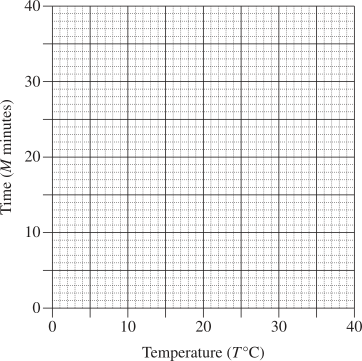
--- 0 WORK AREA LINES (style=lined) ---
a. `M=180/T`
b.
\begin{array} {|c|c|c|c|}
\hline \ \ T\ \ & \ \ 5\ \ & \ 15\ & \ 30\ \\
\hline M & 36 & 12 & 6 \\
\hline \end{array}
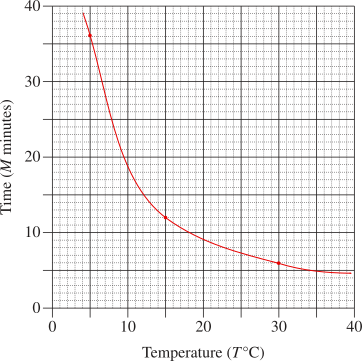
| a. | `M` | `prop 1/T` |
| `M` | `=k/T` | |
| `12` | `=k/15` | |
| `k` | `=15 xx 12` | |
| `=180` |
`:.M=180/T`
b.
\begin{array} {|c|c|c|c|}
\hline \ \ T\ \ & \ \ 5\ \ & \ 15\ & \ 30\ \\
\hline M & 36 & 12 & 6 \\
\hline \end{array}
The current of an electrical circuit, measured in amps `(A)`, varies inversely with its resistance, measured in ohms `(R)`.
When the resistance of a circuit is 28 ohms, the current is 3 amps.
What is the current when the resistance is 8 ohms? (2 marks)
--- 6 WORK AREA LINES (style=lined) ---