SmarterEd

Aussie Maths & Science Teachers: Save your time with SmarterEd

  • Login
  • Get Help
  • About

Functions, 2ADV F2 2025 HSC 30

The parabola with equation  \(y=(x-1)(x-5)\)  is translated both horizontally to the right and vertically up by \(k\) units, where \(k\) is positive.

The translated parabola passes through the point \((6,11)\).

Find the value of \(k\).   (3 marks)

--- 12 WORK AREA LINES (style=lined) ---
Show Answers Only

\(k=6\)

Show Worked Solution

\(y=(x-1)(x-5)\)

\(\text{Translate \(k\) units to the right:}\)

\(y \rightarrow y^{\prime}=(x-k-1)(x-k-5)\)

\(\text{Translate \(k\) units vertically up:}\)

\(y^{\prime} \rightarrow y^{\prime \prime}=(x-k-1)(x-k-5)+k\)

\(y^{\prime \prime} \ \text{passes through}\ (6,11):\)

\(11=(6-k-1)(6-k-5)+k\)

\(11=(5-k)(1-k)+k\)

\(11=5-6 k+k^2+k\)

\(0=k^2-5 k-6\)

\(0=(k-6)(k+1)\)

\(\therefore k=6 \quad(k>0)\)

Filed Under: Graph Transformations (Adv-2027), Transformations (Y12) Tagged With: Band 4, smc-1008-10-Polynomials, smc-1008-70-Combinations, smc-6408-10-Polynomials, smc-6408-60-Combinations

Functions, 2ADV F2 EQ-Bank 2

The curve  \(f(x)=x^2\)  is transformed to  \(g(x)=3 f[2(x+2)]\)

  1. Write the equation of \(g(x)\)   (1 mark)

    --- 3 WORK AREA LINES (style=lined) ---
  2. \(P(-3,9)\) lies on \(f(x)=x^2\)
  3. Determine the corresponding co-ordinates of \(P\) on the curve \(g(x)\).   (2 marks)

    --- 5 WORK AREA LINES (style=lined) ---
Show Answers Only

a.   \(g(x)=12(x+2)^2\)

b.   \(\left( -\dfrac{7}{2}, 27 \right) \)

Show Worked Solution
a.     \(g(x)\) \(=3[2(x+2)]^2\)
    \(=3 \times 4(x+2)^2\)
    \(=12(x+2)^2\)

 
b.
   \(P(-3,9)\ \text{lies on}\ \ f(x)=x^2 \)

\(\text{Find corresponding point on}\ f(x)\)

\(\text{Mapping}\ x_f\ \text{to}\ x_g: \)

\(2(x_g +2)=x_f\ \ \Rightarrow\ \ x_g=\dfrac{1}{2} x_f-2 \)

\(x_g=\dfrac {1}{2} \times -3 -2=-\dfrac{7}{2} \)
 

\(\text{Mapping}\ y_f\ \text{to}\ y_g: \)

\(y_g=3 \times y_f = 3 \times 9=27\)

\(\therefore\ \text{Corresponding point}\ = \left( -\dfrac{7}{2}, 27 \right) \)

Filed Under: Graph Transformations (Adv-2027), Transformations (Y12) Tagged With: Band 4, Band 5, smc-1008-10-Polynomials, smc-1008-70-Combinations, smc-1008-80-Corresponding points, smc-6408-10-Polynomials, smc-6408-60-Combinations, smc-6408-70-Corresponding Points

Functions, 2ADV F2 SM-Bank 2

\(f(x)=(x+2)^2\)  is transformed and the equation of the new function is in the form

\(y=k f(x+a)+c\), where \(k, a\) and \(c\) are constants.

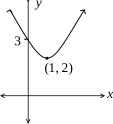
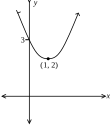
The graph of the transformed function is shown below.
 

Determine the values of \(k, a\) and \(c\).   (3 marks)

--- 7 WORK AREA LINES (style=lined) ---

Show Answers Only

\(a=-3, c=2, k=1\)

Show Worked Solution

\(f(x)=(x+2)^2\ \ \Rightarrow\ \ f(x+a)=(x+a+2)^2\)

\(\text{Horizontal translation: 3 units to right}\)

\(y=k f(x-3)+c\)
 

\(\text{Vertical translation: 2 units up}\)

\(y=k f(x-3)+2\)
 

\(\text{Since}\ (0,3) \  \text{lies on the transformed function:}\)

\(3\) \(=k f(-3)+2\)
\(3\) \(=k+2\)
\(k\) \(=1\)
\(\therefore a=-3, c=2, k=1\)

Filed Under: Graph Transformations (Adv-2027), Transformations (Y12) Tagged With: Band 5, smc-1008-10-Polynomials, smc-1008-70-Combinations, smc-6408-10-Polynomials, smc-6408-60-Combinations

Functions, 2ADV F2 2024 MET2 12 MC

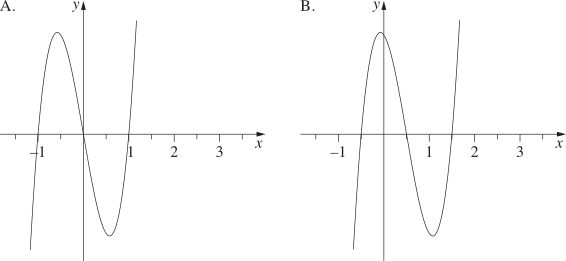
The graph of \(y=f(x)\) is shown below.

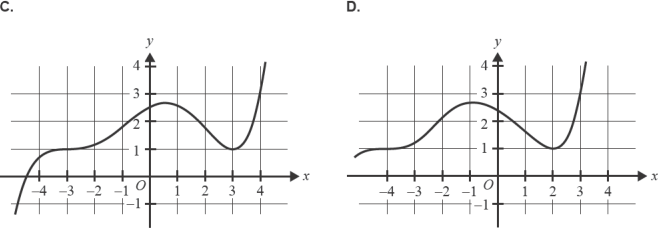
Which of the following options best represents the graph of \(y=f(2 x+1)\) ?
 

Show Answers Only

\(A\)

Show Worked Solution

\(\text{By elimination:}\)

\(\text{Graph has been dilated by a factor of}\ \dfrac{1}{2}\ \text{from}\ y\text{axis.}\)

→ \(\text{Eliminate C and D.}\)

\(\text{Graph is then translated}\ \dfrac{1}{2}\ \text{unit to the left.}\)

\(\text{Consider the turning point}\ (2, 1)\ \text{after translation:}\)

\(\left(2, 1\right)\ \rightarrow \ \left(2\times \dfrac{1}{2}-\dfrac{1}{2}, 1\right)=\left(\dfrac{1}{2}, 1\right)\)

\(\therefore\ \text{Option A is the only possible solution.}\)

\(\Rightarrow A\)

♦ Mean mark 47%.

Filed Under: Graph Transformations (Adv-2027), Transformations (Y12) Tagged With: Band 5, smc-1008-10-Polynomials, smc-1008-70-Combinations, smc-6408-10-Polynomials, smc-6408-60-Combinations

Functions, 2ADV F2 2024 HSC 7 MC

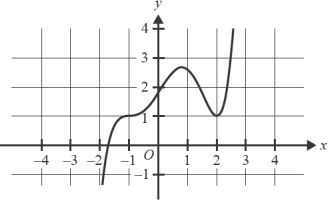
The diagram shows the graph  \(y = f(x)\).
 

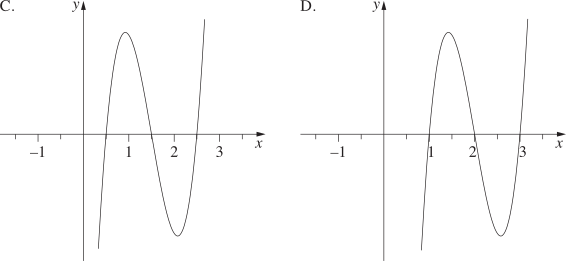
Which of the following best represents the graph  \(y = f(2x-1)\)?
 

Show Answers Only

\(C\)

Show Worked Solution

\(\text{At}\ \ x=0:\)

\(f(2x-1)=f(-1)\ \ \Rightarrow\ \ \text{Eliminate}\ A\ \text{and}\ B.\)
 

\(\text{Consider the transformations of}\ f(x) \rightarrow\ f(2x-1) \)

\(\rightarrow\ \text{Shift}\ f(x)\ \text{1 unit to the right.}\)

\(\rightarrow\ \text{Dilate}\ f(x-1)\ \text{by a factor of}\ \dfrac{1}{2}\ \text{from the}\ y\text{-axis.}\)

\(\Rightarrow C\)

♦ Mean mark 47%.

Filed Under: Graph Transformations (Adv-2027), Transformations (Y12) Tagged With: Band 5, smc-1008-10-Polynomials, smc-1008-70-Combinations, smc-6408-10-Polynomials, smc-6408-60-Combinations

Functions, 2ADV F2 2024 HSC 4 MC

The parabola  \(y=(x-3)^2-2\)  is reflected about the \(y\)-axis. This is then reflected about the \(x\)-axis.

What is the equation of the resulting parabola?

  1. \(y=(x+3)^2+2\)
  2. \(y=(x-3)^2+2\)
  3. \(y=-(x+3)^2+2\)
  4. \(y=-(x-3)^2+2\)
Show Answers Only

\( C \)

Show Worked Solution

\(y=(x-3)^2-2\)

\(\text{Reflect in the}\ y\text{-axis}\ (f(-x)):\)

\(y=(-x-3)^2-2\)

\(\text{Reflect in the}\ x\text{-axis}\ (-f(-x)):\)

\(y\) \(=-\left[(-x-3)^2-2\right]\)  
  \(=-(x+3)^2+2\)  

 
\( \Rightarrow C \)

♦ Mean mark 54%.

Filed Under: Graph Transformations (Adv-2027), Transformations (Y12) Tagged With: Band 5, smc-1008-10-Polynomials, smc-1008-70-Combinations, smc-6408-10-Polynomials, smc-6408-60-Combinations

Functions, 2ADV F2 2022 HSC 19

The graph of the function  `f(x)=x^2`  is translated `m` units to the right, dilated vertically by a scale factor of `k` and then translated 5 units down. The equation of the transformed function is  `g(x)=3 x^2-12 x+7`.

Find the values of `m` and `k`.  (3 marks)

--- 6 WORK AREA LINES (style=lined) ---
Show Answers Only

`m=2, \ \ k=3`

Show Worked Solution

`text{Horizontal translation}\ m\ text{units to the right:}`

`x^2\ → \ (x-m)^2`

`text{Dilated vertically by scale factor}\ k:`

`(x-m)^2\ →\ k(x-m)^2`

`text{Vertical translation 5 units down:}`

`k(x-m)^2\ →\ k(x-m)^2-5`

`y` `=k(x-m)^2-5`  
  `=k(x^2-2mx+m^2)-5`  
  `=kx^2-2kmx+(km^2-5)`  

 
`:.k=3`

`-2km` `=-12`  
`:.m` `=2`  

♦ Mean mark 51%.

Filed Under: Graph Transformations (Adv-2027), Transformations (Y12) Tagged With: Band 5, smc-1008-10-Polynomials, smc-1008-70-Combinations, smc-6408-10-Polynomials, smc-6408-60-Combinations

Functions, 2ADV F2 SM-Bank 16

Let  `f(x) = x^2 - 4`

Let the graph of `g(x)` be a transformation of the graph of `f(x)` where the transformations have been applied in the following order:
• dilation by a factor of  `1/2`  from the vertical axis (parallel to the horizontal axis)
• translation by two units to the right (in the direction of the positive horizontal axis

Find `g(x)` and the coordinates of the horizontal axis intercepts of the graph of `g(x)`.  (3 marks)

--- 6 WORK AREA LINES (style=lined) ---
Show Answers Only

`(1,0) and (3,0)`

Show Worked Solution

`text(1st transformation)`

`text(Dilation by a factor of)\ 1/2\ text(from the)\ ytext(-axis:)`

`x^2 – 4 \ => \ (x/(1/2))^2 -4 = 4x^2-4`
 

`text(2nd transformation)`

`text(Translation by 2 units to the right:)`

`4x^2-4 \ => \ g(x) = 4(x-2)^2 – 4`
 

`xtext(-axis intercept of)\ g(x):`

`4(x-2)^2-4` `=0`  
`(x-2)^2` `=1`  
`x-2` `=+-1`  

 
`x-2=1 \ => \ x=3`

`x-2=-1 \ => \ x=1`

 
`:.\ text(Horizontal axis intercepts occur at)\ (1,0) and (3,0).`

Filed Under: Graph Transformations (Adv-2027), Transformations (Y12) Tagged With: Band 4, smc-1008-10-Polynomials, smc-1008-70-Combinations, smc-6408-10-Polynomials, smc-6408-60-Combinations

Functions, 2ADV F2 2021 HSC 21

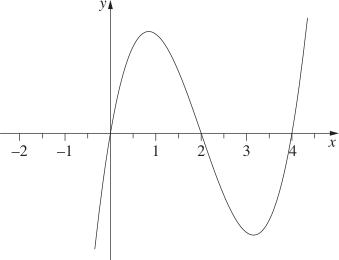
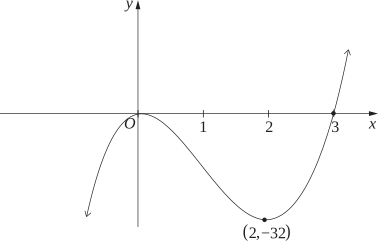
Consider the graph of  `y = f(x)`  as shown.


Sketch the graph of  `y = 4f(2x)`  showing the `x`-intercepts and the coordinates of the turning points.  (2 marks)

Show Answers Only

Show Worked Solution

♦ Mean mark 48%.

Filed Under: Graph Transformations (Adv-2027), Transformations (Y12) Tagged With: Band 5, smc-1008-10-Polynomials, smc-1008-65-Dilation (Only), smc-6408-10-Polynomials, smc-6408-50-Dilation (only)

Functions, 2ADV F2 2020 HSC 2 MC

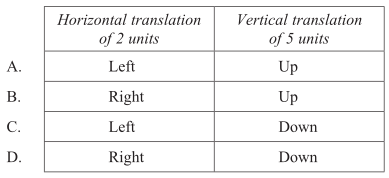
The function  `f(x) = x^3`  is transformed to  `g(x) = (x - 2)^3 + 5`  by a horizontal translation of 2 units followed by a vertical translation of 5 units.

Which row of the table shows the directions of the translations?
 

Show Answers Only

`B`

Show Worked Solution

`text(Horizontal translation: 2 units to the right)`

`x^3 -> (x – 2)^3`

`text(Vertical translation: 5 units up`

`(x – 2)^3 -> (x – 2)^3 + 5`

`=>\ B`

Filed Under: Graph Transformations (Adv-2027), Transformations (Y12) Tagged With: Band 3, smc-1008-10-Polynomials, smc-1008-60-Translation (Only), smc-6408-10-Polynomials, smc-6408-40-Translation (only)

Functions, 2ADV F2 EQ-Bank 13

The curve  `y = kx^2 + c`  is subject to the following transformations

    • Translated 2 units in the positive `x`-direction
    • Dilated in the positive `y`-direction by a factor of 4
    • Reflected in the `y`-axis

The final equation of the curve is  `y = 8x^2 + 32x - 8`.

  1.  Find the equation of the graph after the dilation.  (1 mark)

    --- 4 WORK AREA LINES (style=lined) ---
  2.  Find the values of  `k`  and  `c`.  (2 marks)

    --- 6 WORK AREA LINES (style=lined) ---
Show Answers Only
  1. `y = 4k(x – 2)^2 + 4c`
  2. `k = 2, c = −10`
Show Worked Solution

i.    `y = kx^2 + c`

`text(Translate 2 units in positive)\ xtext(-direction.)`

`y = kx^2 + c \ => \ y = k(x – 2)^2 + c`

`text(Dilate in the positive)\ ytext(-direction by a factor of 4.)`

`y = k(x – 2)^2 + c \ => \ y = 4k(x – 2)^2 + 4c`


ii.    `y` `= 4k(x^2 – 4x + 4) + 4c`
    `= 4kx^2 – 16kx + 16k + 4c`


`text(Reflect in the)\ ytext(-axis.)`

COMMENT: Using “swap” terminology for reflections in the y-axis is simpler and more intelligible for students in our view.

`=>\ text(Swap:)\ \ x →\ – x`

`y` `= 4k(−x)^2 – 16k(−x) + 16k + 4c`
  `= 4kx^2 + 16kx + 16k + 4c`


`text(Equating co-efficients:)`

`4k` `=8`  
`:. k` `=2`  


`16k + 4c` `= −8`
`4c` `= −40`
`:. c` `=-10`

Filed Under: Graph Transformations (Adv-2027), Transformations (Y12) Tagged With: Band 4, Band 5, smc-1008-10-Polynomials, smc-1008-70-Combinations, smc-6408-10-Polynomials, smc-6408-60-Combinations

Functions, 2ADV F2 EQ-Bank 14

List a set of transformations that, when applied in order, would transform  `y = x^2`  to the graph with equation  `y = 1 - 6x - x^2`.  (3 marks)

--- 6 WORK AREA LINES (style=lined) ---
Show Answers Only

`text(T1: Translate 3 units in negative)\ xtext(-direction)`

`text(T2: Translate 10 units in negative)\ ytext(-direction)`

`text(T3: Reflect in the)\ xtext(-axis)`

Show Worked Solution

`y = x^2`

`text(Transformation 1:)`

`text(Translate 3 units in negative)\ xtext(-direction)`

`y = (x + 3)^2`

`y = x^2 + 6x + 9`
 

`text(Transformation 2:)`

`text(Translate 10 units in negative)\ ytext(-direction)`

`y = x^2 + 6x – 1`
 

`text(Transformation 3:)`

`text(Reflect in the)\ xtext(-axis)`

`y` `= −(x^2 + 6x – 1)`
  `= 1 – 6x – x^2`

Filed Under: Graph Transformations (Adv-2027), Transformations (Y12) Tagged With: Band 4, smc-1008-10-Polynomials, smc-1008-70-Combinations, smc-6408-10-Polynomials, smc-6408-60-Combinations

Functions, 2ADV F2 EQ-Bank 2 MC

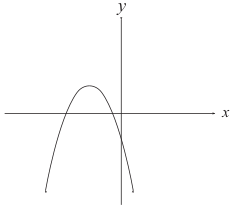
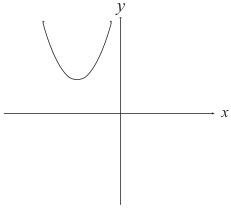
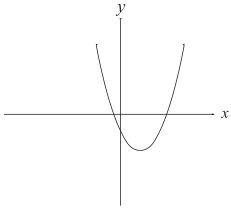
Which diagram best shows the graph

`y = 1 - 2(x + 1)^2`

A. B.
C. D.
Show Answers Only

`A`

Show Worked Solution

`text(Transforming)\ \ y = x^2 :`

`text(Translate 1 unit left)\ \ => \ y = (x + 1)^2`

`text(Dilate from)\ xtext(-axis by a factor of 2)\ => \ y = 2(x + 1)^2`

`text(Reflect in)\ xtext(-axis)\ \ => \ y= −2(x + 1)^2`

`text(Translate 1 unit up)\ \ => \ y = 1 – 2(x + 1)^2`

`:.\ text(Transformations describe graph)\ A.`

`=>\ A`

Filed Under: Graph Transformations (Adv-2027), Transformations (Y12) Tagged With: Band 3, smc-1008-10-Polynomials, smc-1008-70-Combinations, smc-6408-10-Polynomials, smc-6408-60-Combinations

Functions, 2ADV F2 EQ-Bank 16

`y = -(x + 2)^4/3`  has been produced by three successive transformations: a translation, a dilation and then a reflection.

  1. Describe each transformation and state the equation of the graph after each transformation.  (2 marks)

    --- 4 WORK AREA LINES (style=lined) ---

  2. Sketch the graph.  (1 mark)

    --- 6 WORK AREA LINES (style=lined) ---

Show Answers Only
  1. `text(See Worked Solutions)`
  2.  
Show Worked Solution

i.   `text(Transformation 1:)`

`text(Translate)\ \ y = x^4\ \ 2\ text(units to the left.)`

`y = x^4 \ => \ y = (x + 2)^4`
  

`text(Transformation 2:)`

`text(Dilate)\ \ y = (x + 2)^4\ \ text(by a factor of)\ 1/3\ text(from the)\ xtext(-axis)`

`y = (x + 2)^4 \ => \ y = ((x + 2)^4)/3`
 

`text(Transformation 3:)`

`text(Reflect)\ \ y = ((x + 2)^4)/3\ \ text(in the)\ xtext(-axis).`

`y = ((x + 2)^4)/3 \ => \ y = −(x + 2)^4/3`


ii.   

Filed Under: Graph Transformations (Adv-2027), Transformations (Y12) Tagged With: Band 3, Band 4, smc-1008-10-Polynomials, smc-1008-70-Combinations, smc-6408-10-Polynomials, smc-6408-60-Combinations

Functions, 2ADV F2 SM-Bank 35

  1. Sketch the function  `y = f(x)`  where  `f(x) = (x - 1)^3`  on a number plane, labelling all intercepts.  (1 mark)

    --- 8 WORK AREA LINES (style=lined) ---
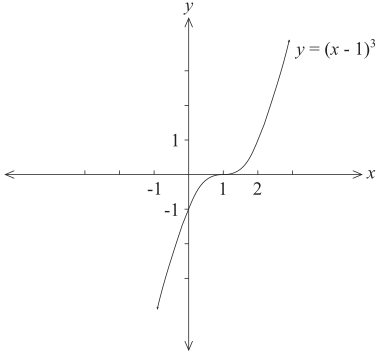
  2. On the same graph, sketch  `y = −f(−x)`. Label all intercepts.  (2 marks)

    --- 0 WORK AREA LINES (style=lined) ---

Show Answers Only
  1.   
  2.   
Show Worked Solution

i.   `y = (x – 1)^3 => y = x^3\ text(shifted 1 unit to the right.)`


ii.   `y = −f(x) \ => \ text(reflect)\ \ y = (x – 1)^3\ \ text(in)\ xtext(-axis).`

`y = −f(−x) \ => \ text(reflect)\ \ y = −f(x)\ \ text(in)\ ytext(-axis).`


Filed Under: Graph Transformations (Adv-2027), Non-Calculus Graphing (Y12), Transformations (Y12) Tagged With: Band 3, Band 4, smc-1008-10-Polynomials, smc-1008-60-Translation (Only), smc-1009-50-Odd Functions, smc-6408-10-Polynomials, smc-6408-40-Translation (only)

Functions, 2ADV F2 2016 HSC 3 MC

Which diagram best shows the graph of the parabola  `y = 3 - (x - 2)^2?`
 

hsc-2016-3mci

hsc-2016-3mcii

Show Answers Only

`B`

Show Worked Solution

`y = 3 – (x – 2)^2`

`text(Curve is concave down and passes through)\ (2, 3)`

`=>  B`

Filed Under: 4. Real Functions, Graph Transformations (Adv-2027), The Parabola, Transformations (Y12) Tagged With: Band 3, smc-1008-10-Polynomials, smc-1008-60-Translation (Only), smc-6408-10-Polynomials, smc-6408-40-Translation (only)

Functions, 2ADV F2 2014 HSC 2 MC

Which graph best represents  `y = (x - 1)^2`?

2014 2 mc

Show Answers Only

`B`

Show Worked Solution

`y = (x- 1)^2\  →\ text(vertex)\ (1, 0)`

`=>  B`

Filed Under: 4. Real Functions, Graph Transformations (Adv-2027), The Parabola, Transformations (Y12) Tagged With: Band 3, smc-1008-10-Polynomials, smc-1008-60-Translation (Only), smc-6408-10-Polynomials, smc-6408-40-Translation (only)

Copyright © 2014–2025 SmarterEd.com.au · Log in