SmarterEd

Aussie Maths & Science Teachers: Save your time with SmarterEd

  • Login
  • Get Help
  • About

Calculus, MET2 2020 VCAA 2

An area of parkland has a river running through it, as shown below. The river is shown shaded.

The north bank of the river is modelled by the function  `f_(1):[0,200]rarr R, \ f_(1)(x)=20 cos((pi x)/(100))+40`.

The south bank of the river is modelled by the function  `f_(2):[0,200]rarr R, \ f_(2)(x)=20 cos((pi x)/(100))+30`.

The horizontal axis points east and the vertical axis points north.

All distances are measured in metres.
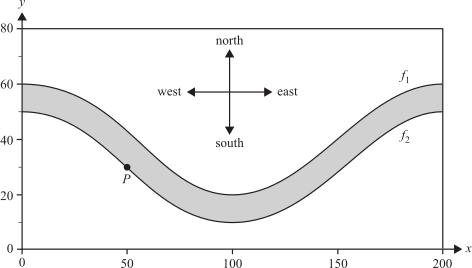
 

A swimmer always starts at point `P`, which has coordinates  (50, 30).

Assume that no movement of water in the river affects the motion or path of the swimmer, which is always a straight line.

  1. The swimmer swims north from point `P`.
  2. Find the distance, in metres, that the swimmer needs to swim to get to get to the north bank of the river.   (1 mark)

    --- 2 WORK AREA LINES (style=lined) ---

  3. The swimmer swims east from point `P`.
  4. Find the distance, in metres, that the swimmer needs to swim to get to the north bank of the river.   (2 marks)

    --- 4 WORK AREA LINES (style=lined) ---

  5. On another occasion, the swimmer swims the minimum distance from point `P` to the north bank of the river.
  6. Find this minimum distance. Give your answer in metres, correct to one decimal place.   (2 marks)

    --- 5 WORK AREA LINES (style=lined) ---

  7. Calculate the surface area of the section of the river shown on the graph in square metres.   (1 mark)

    --- 3 WORK AREA LINES (style=lined) ---

  8. A horizontal line is drawn through point `P`. The section of the river that is south of the line is declared a no "no swimming" zone.
  9. Find the area of the "no swimming" zone, correct to the nearest square metre.   (3 marks)

    --- 6 WORK AREA LINES (style=lined) ---

  10. Scientists observe that the north bank of the river is changing over time. It is moving further north from its current position. They model its predicted new location using the function with rule  `y=kf_(1)(x)`, where `k >= 1`.
  11. Find the values of  `k` for which the distance north across the river, for all parts of the river, is strictly less than 20 m.   (2 marks)

    --- 6 WORK AREA LINES (style=lined) ---

Show Answers Only
  1. `10\ text{m}`
  2. `16 2/3\ text{m}`
  3. `8.5\ text{m}`
  4. `2000\ text{m}^2`
  5. `837\ text{m²}`
  6. `k in [1, 7/6)`
Show Worked Solution

a.   `text{Since swimmer swims due north,}`

`text{Distance}\ = 40-30=10\ text{m}`


b.  `text{Solve} \ f_(1)(x)=30 \ text{or} \ x in[50,100]`

`=> x=200/3`

`:.\ text{Distance to swim (east) to reach north bank}`

`=200/3-50`

`=16 2/3\ text{m}`
 

c.   `text{Let swimmer arrive at north bank at the point}\ \ (x,f_(1)(x))`

`text{By Pythagoras,}`

♦ Mean mark part (c) 39%.

`d(x)=sqrt((x-50)^(2)+(f_(1)(x)-30)^(2))`

`text{Solve} \ d/dx(d(x))=0 \ text{for} \ x:`

`x=54.47…`

`:. d_min=8.5\ text{m (to 1 d.p.)}`


d.   `text{Shaded Area}`

`=int_(0)^(200)(f_(1)(x)-f_(2)(x))\ dx`

`=2000\ text{m}^2`


e.   `text{Find}\ \ f_(1)(x) = 30 \ text{for} x in [50,150]:`

♦♦ Mean mark part (e) 35%.

`=>x=200/3, 400/3`

`text{Find}\ \ f_(2)(x) = 30 \ text{for} \ x in [50,150]:`

`=>x=50, 150`

`:.\ text{Area}` `=int_(50)^(150)(30-f_(2)(x))\ dx-int_((200)/(3))^((400)/(3))(30-f_(1)(x))\ dx`  
  `=837\ text{m² (to nearest m²)}`  

♦♦♦Mean mark part (f) 15%.


f.   `text{Let}\ \ D(x)=\ text{vertical distance between banks}`

`D(x)` `=kf_(1)(x)-f_(2)(x)`  
  `=20k cos((pi x)/(100))+40k-(20 cos((pi x)/(100))+30)`   
  `=(20k-20)cos((pi x)/(100)) +40k-30`  

  
`text{Given}\ \ D(x)<20 \ text{for}\ x in[0,200]`

`text{Maximum} \ cos((pi x)/(100)) = 1\  text{when}\ \ x=0, 200`

`text{Solve} \ 20k-20+40k-30<20\ \ text{for}\ k:`

`=> k<7/6`

`:. k in [1,7/6)`

Filed Under: Area Under Curves, Maxima and Minima Tagged With: Band 4, Band 5, Band 6, smc-641-50-Distance, smc-723-60-Trig, smc-723-80-Area between graphs, smc-723-95-Transformations

Calculus, MET1 2018 VCAA 7

Let `P` be a point on the straight line  `y = 2x-4`  such that the length of `OP`, the line segment from the origin `O` to `P`, is a minimum.

  1.  Find the coordinates of `P`.   (3 marks)

    --- 9 WORK AREA LINES (style=lined) ---

  2.  Find the distance `OP`. Express your answer in the form `(asqrtb)/b` , where `a` and `b` are positive integers.   (2 marks)

    --- 5 WORK AREA LINES (style=lined) ---

Show Answers Only
  1. `P(8/5, −4/5)`
  2. `(4sqrt5)/5`
Show Worked Solution

a.   `text(Solution 1)`

♦ Mean mark 42%.

`text(Let)\ \ P = (x, 2x-4)`

`L_(OP)` `= sqrt(x^2 + (2x-4)^2)`
  `= sqrt(x^2 + 4x^2-16x + 16)`
  `= sqrt(5x^2-16x + 16)`
   
`(d(L_(OP)))/(dx)` `= 1/2 · (10x-16) · (5x^2-16x + 16)^(−1/2)`


`text(Find)\ \ x\ \ text(when)\ \ (d(L_(OP)))/(dx) = 0,`

`10x-16` `= 0`
`x` `= 8/5`

 
`:. P(8/5, −4/5)`
 

`text(Solution 2)`

`text(Find equation of line ⊥ to)\ \ y = 2x-4`

`text(passing through the origin:)`

`m = −1/2\ \ (text(so that)\ \ m_1 m_2 = −1)`

`y` `= −1/2x\ \ …\ (1)`
`y` `= 2x-4\ \ …\ (2)`

 
`P\ text{is the intersection of (1) and (2)}`

`−1/2x` `= 2x-4`
`5/2x` `= 4`
`x` `= 8/5, y = −4/5`


b.  `text(Using)\ \ L_(OP)\ \ text(from part a:)`

♦ Mean mark 42%.

`L_(OP)` `= sqrt(5 · (8/4)^2-16 · 8/5 + 16)`
  `= sqrt(64/5-128/5 + 16)`
  `= sqrt(16/5)`
  `= 4/sqrt5 xx sqrt5/sqrt5`
  `= (4sqrt5)/5`

Filed Under: Maxima and Minima Tagged With: Band 5, smc-641-50-Distance

Calculus, MET2 2011 VCAA 4

Deep in the South American jungle, Tasmania Jones has been working to help the Quetzacotl tribe to get drinking water from the very salty water of the Parabolic River. The river follows the curve with equation  `y = x^2-1`,  `x >= 0` as shown below. All lengths are measured in kilometres.

Tasmania has his camp site at `(0, 0)` and the Quetzacotl tribe’s village is at `(0, 1)`. Tasmania builds a desalination plant, which is connected to the village by a straight pipeline.
 

met2-2011-vcaa-q4

  1. If the desalination plant is at the point `(m, n)` show that the length, `L` kilometres, of the straight pipeline that carries the water from the desalination plant to the village is given by
  2.    `L = sqrt(m^4-3m^2 + 4)`.   (3 marks)

    --- 6 WORK AREA LINES (style=lined) ---
  3. If the desalination plant is built at the point on the river that is closest to the village
    1. find `(dL)/(dm)` and hence find the coordinates of the desalination plant.   (3 marks)

      --- 5 WORK AREA LINES (style=lined) ---

    2. find the length, in kilometres, of the pipeline from the desalination plant to the village.   (2 marks)

      --- 3 WORK AREA LINES (style=lined) ---

The desalination plant is actually built at `(sqrt7/2, 3/4)`.

If the desalination plant stops working, Tasmania needs to get to the plant in the minimum time.

Tasmania runs in a straight line from his camp to a point `(x,y)` on the river bank where  `x <= sqrt7/2`. He then swims up the river to the desalination plant.

Tasmania runs from his camp to the river at 2 km per hour. The time that he takes to swim to the desalination plant is proportional to the difference between the `y`-coordinates of the desalination plant and the point where he enters the river.

  1. Show that the total time taken to get to the desalination plant is given by


    `qquadT = 1/2 sqrt(x^4-x^2 + 1) + 1/4k(7-4x^2)` hours where `k` is a positive constant of proportionality.   (3 marks)

    --- 6 WORK AREA LINES (style=lined) ---
The value of `k` varies from day to day depending on the weather conditions.

  1. If  `k = 1/(2sqrt13)`
    1. find `(dT)/(dx)`   (1 mark)

      --- 1 WORK AREA LINES (style=lined) ---

    2. hence find the coordinates of the point where Tasmania should reach the river if he is to get to the desalination plant in the minimum time.   (2 marks)

      --- 4 WORK AREA LINES (style=lined) ---

  2. On one particular day, the value of `k` is such that Tasmania should run directly from his camp to the point `(1,0)` on the river to get to the desalination plant in the minimum time. Find the value of `k` on that particular day.   (2 marks)

    --- 4 WORK AREA LINES (style=lined) ---

  3. Find the values of `k` for which Tasmania should run directly from his camp towards the desalination plant to reach it in the minimum time.   (2 marks)

    --- 5 WORK AREA LINES (style=lined) ---

Show Answers Only
  1. `text(See Worked Solutions)`
  2.  i. `(sqrt6/2, 1/2)`
  3. ii. `sqrt7/2\ text(km)`
  4. `text(See Worked Solutions)`
  5.  i. `(dT)/(dx) = (x(2x^2-1))/(2sqrt(x^4-x^2 + 1))-(sqrt13 x)/13`
  6. ii. `(sqrt3/2, −1/4)`
  7. `1/4`
  8. `(5sqrt37)/74`
Show Worked Solution

a.   `text(S)text(ince)\ \ (m,n)\ \ text(lies on)\ \ y=x^2-1,`

♦ Mean mark (a) 47%.

`=> n=m^2-1`

`V(0,1), D(m,m^2-1)`

`L` `= sqrt((m-0)^2 + ((m^2-1)-1)^2)`
  `= sqrt(m^2 + m^4-4m^2 + 4)`
  `= sqrt(m^4-3m^2 + 4)\ \ text(… as required)`


b.i.   `(dL)/(dm) = (2m^2-3m)/(sqrt(m^4-3m^2 + 4))`

`text(Solve:)\ \ (dL)/(dm) = 0quadtext(for)quadm >= 0`

`\Rightarrow m = sqrt6/2`

`text(Substitute into:)\ \ D(m, m^2-1),`

`:. text(Desalination plant at)\ \ (sqrt6/2, 1/2)`
 

♦ Mean mark part (b)(ii) 41%.
b.ii.   `L(sqrt6/2)` `= sqrt(m^4-3m^2 + 4)`
    `=sqrt(36/16-3xx6/4+4`
    `=sqrt7/2`


c.   `text(Let)\ \ P(x,x^2-1)\ text(be run point on bank)`

♦♦♦ Mean mark (c) 16%.

`text(Let)\ \ D(sqrt7/2, 3/4)\ text(be desalination location)`

`T` `=\ text(run time + swim time)`
  `= (sqrt((x-0)^2 + ((x^2-1)-0)^2))/2 + k(3/4-(x^2-1))`
  `= (sqrt(x^2 + x^4-2x^2 + 1))/2 + k/4(3-4(x^2-1))`
`:. T` `= (sqrt(x^4-x^2 + 1))/2 + 1/4k(7-4x^2)`


d.i.   `(dT)/(dx) = (x(2x^2-1))/(2sqrt(x^4-x^2 + 1))-(sqrt13 x)/13`


d.ii.   `text(Solve:)\ \ (dT)/(dx) = 0`

♦♦ Mean mark (d.ii.) 33%.

`x = sqrt3/2`

`y=x^2-1=-1/4`

`:. T_(text(min)) \ text(when point is)\ \ (sqrt3/2, −1/4)`


e.  `(dT)/(dx) = (x(2x^2-1))/(2sqrt(x^4-x^2 + 1))-2kx`

♦♦ Mean mark (e) 39%.

`text(When)\ \ x=1:`

`text(Solve:)\ \ (dT)/(dx)` `=0\ \ text(for)\ k,`
`1/2 -2k` `=0`
`:.k` `=1/4`


f.   `text(Require)\ T_text(min)\ text(to occur at right-hand endpoint)\ \ x = sqrt7/2.`

`text(This can occur in 2 situations:)`

♦♦♦ Mean mark (f) 13%.

`text(Firstly,)\ \ T\ text(has a local min at)\ \ x = sqrt7/2,`

`text(Solve:)\ \ (x(2x^2-1))/(2sqrt(x^4-x^2 + 1))-2kx=0| x = sqrt7/2,\ \ text(for)\ k,`

`:.k = (5sqrt37)/74`
 

`text(S)text(econdly,)\ \ T\ text(is decreasing function over)\ x ∈ (0, sqrt7/2),`

`text(Solve:)\ \ (dT)/(dx) <= 0 | x = sqrt7/2,\ text(for)\ k,`

`:. k > (5sqrt37)/74`

`:. k >= (5sqrt37)/74`

Filed Under: Maxima and Minima Tagged With: Band 4, Band 5, Band 6, smc-641-50-Distance, smc-641-60-Other themes

Calculus, MET2 2016 VCAA 4

  1. Express  `(2x + 1)/(x + 2)`  in the form  `a + b/(x + 2)`,  where `a` and `b` are non-zero integers.   (2 marks)

    --- 2 WORK AREA LINES (style=lined) ---

  2. Let  `f: R text(\){−2} -> R,\ f(x) = (2x + 1)/(x + 2)`.
    1. Find the rule and domain of `f^(-1)`, the inverse function of `f`.   (2 marks)

      --- 3 WORK AREA LINES (style=lined) ---

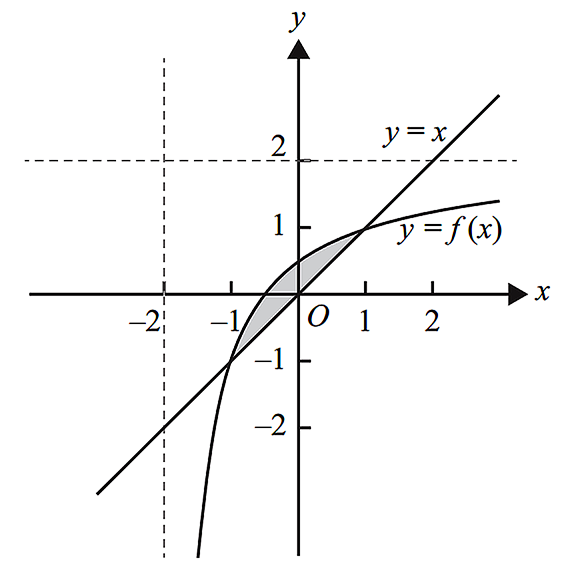
    2. Part of the graphs of `f` and  `y = x`  are shown in the diagram below.
       

    3. Find the area of the shaded region.   (1 mark)

      --- 5 WORK AREA LINES (style=lined) ---

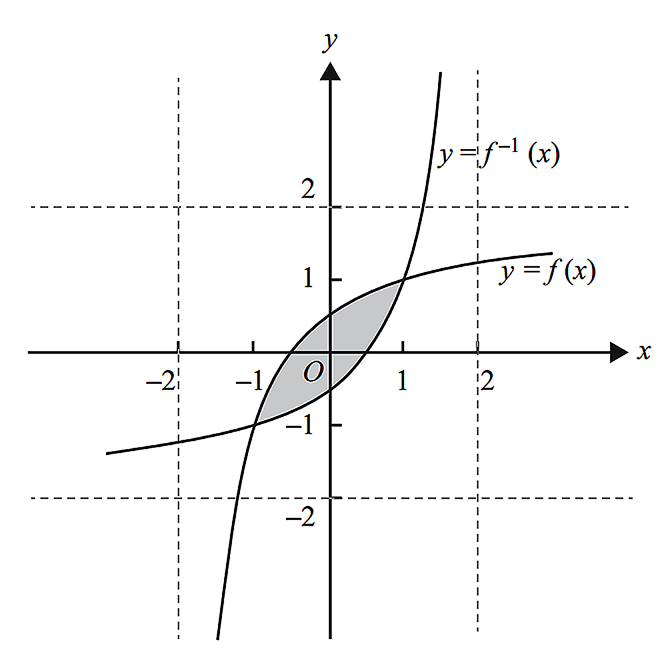
    4. Part of the graphs of `f` and `f^(-1)` are shown in the diagram below.
       

    5. Find the area of the shaded region.   (1 mark) 

      --- 5 WORK AREA LINES (style=lined) ---

  1. Part of the graph of `f` is shown in the diagram below.


    The point `P(c, d)` is on the graph of `f`.


    Find the exact values of `c` and `d` such that the distance of this point to the origin is a minimum, and find this minimum distance.   (3 marks)

    --- 6 WORK AREA LINES (style=lined) ---
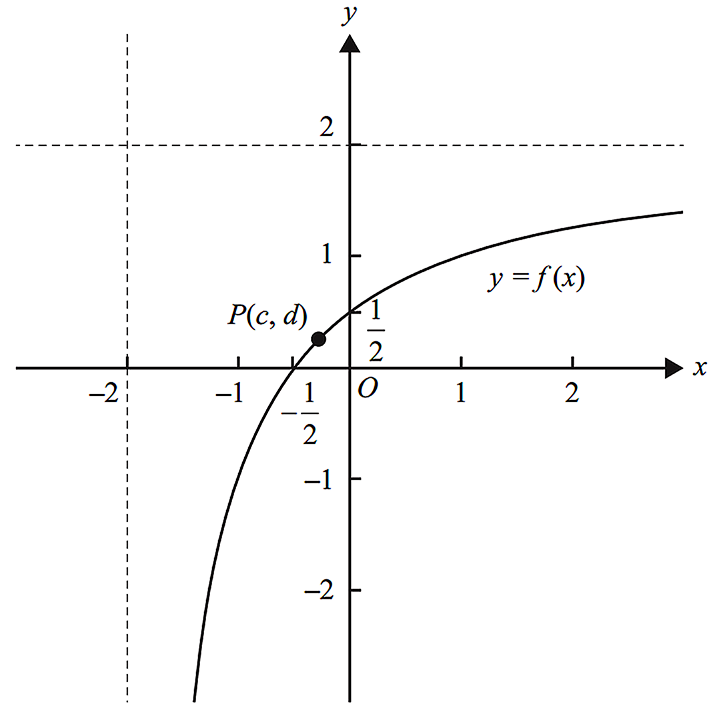
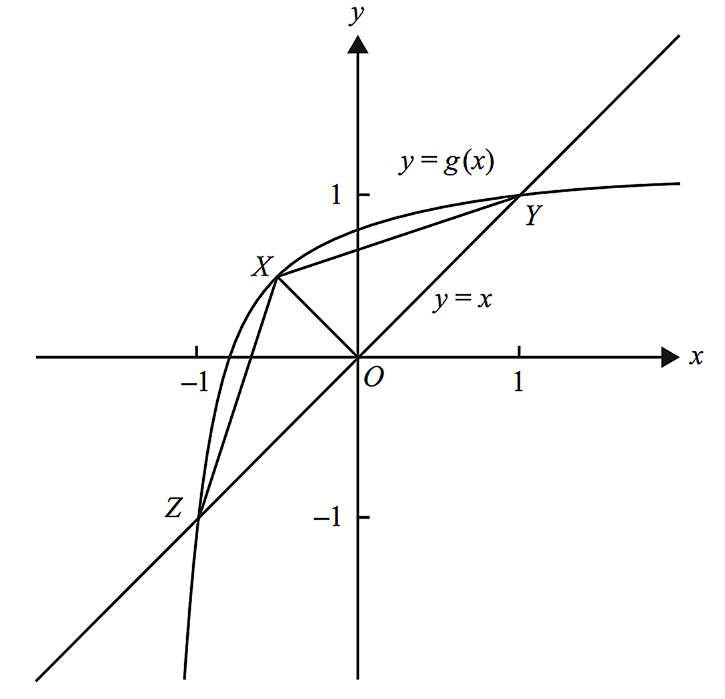
Let  `g: (−k, oo) -> R, g(x) = (kx + 1)/(x + k)`, where `k > 1`.

  1. Show that  `x_1 < x_2`  implies that  `g(x_1) < g(x_2),` where  `x_1 in (−k, oo) and x_2 in (−k, oo)`.   (2 marks)

    --- 7 WORK AREA LINES (style=lined) ---

  2. Let `X` be the point of intersection of the graphs of  `y = g (x) and y = −x`.
    1. Find the coordinates of `X` in terms of `k`.   (2 marks)

      --- 7 WORK AREA LINES (style=lined) ---

    2. Find the value of `k` for which the coordinates of `X` are  `(-1/2, 1/2)`.   (2 marks)

      --- 5 WORK AREA LINES (style=lined) ---

    3. Let  `Ztext{(− 1, − 1)}, Y(1, 1)`  and `X` be the vertices of the triangle `XYZ`. Let  `s(k)`  be the square of the area of triangle `XYZ`.


      Find the values of `k` such that  `s(k) >= 1`.   (2 marks)

      --- 5 WORK AREA LINES (style=lined) ---

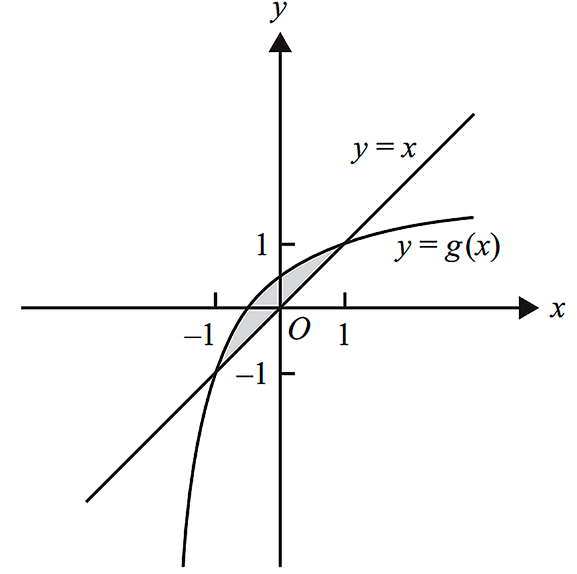
  3. The graph of `g` and the line  `y = x`  enclose a region of the plane. The region is shown shaded in the diagram below.


    Let  `A(k)`  be the rule of the function `A` that gives the area of this enclosed region. The domain of `A` is  `(1, oo)`.

    1. Give the rule for `A(k)`.   (2 marks)

      --- 4 WORK AREA LINES (style=lined) ---

    2. Show that  `0 < A(k) < 2`  for all  `k > 1`.   (2 marks)

      --- 6 WORK AREA LINES (style=lined) ---
Show Answers Only
  1. `2 + {(−3)}/(x + 2)`
  2.   i. `f^(-1) (x) = (-3)/(x-2)-2,\ \ x in R text(\){2}`
  3.  ii. `4-3 ln(3)\ text(units²)`
  4. iii. `8-6 log_e (3)\ text(units²)`
  5. `c = sqrt 3-2, \ d = 2-sqrt 3`
  6. `text(min distance) = (2 sqrt 2-sqrt 6)`
  7. `text(Proof)\ \ text{(See Worked Solutions)}`
  8.   i. `X (−k + sqrt (k^2-1), k-sqrt (k^2-1))`
  9.  ii. `k = 5/4`
  10. iii. `k in (1, 5/4]`
  11.  i. `A(k) = (k^2-1) log_e ((k-1)/(k + 1)) + 2k`
  12. ii. `text(Proof)\ \ text{(See Worked Solutions)}`
Show Worked Solution

a.   `text(Solution 1)`

`(2x + 1)/(x + 2)` `= 2-3/(x + 2)`
  `= 2 + {(-3)}/(x + 2) qquad [text(CAS: prop Frac) ((2x + 1)/(x + 2))]`


`text(Solution 2)`

`(2x + 1)/(x + 2)` `=(2(x+2)-3)/(x+2)`
  `=2+ (-3)/(x+2)`


b.i.  `text(Let)\ \ y = f(x)`

`text(For Inverse: swap)\ \ x ↔ y`

`x` `=2-3/(y + 2)`
`(x-2)(y+2)` `=-3`
`y` `=(-3)/(x-2)-2`


`text(Range of)\ f(x):\ \ y in R text(\){2}`

`:. f^(-1) (x) = (-3)/(x-2)-2, \ x in R text(\){2}`


b.ii.   `text(Find intersection points:)`

`f(x)` `= x`
`(2x+1)/(x+2)` `=x`
`2x+1` `=x^2+2x`
`:. x` `= +- 1`
`:.\ text(Area)` `= int_(-1)^1 (f(x)-x)\ dx`
  `=int_(-1)^1 (2-3/(x + 2)-x)\ dx`
  `= 4-3 ln(3)\ text(u²)`


b.iii.    `text(Area)` `= int_(-1)^1 (f(x)-f^(-1) (x)) dx`
    `=2 xx (4-3 ln(3))\ \ \ text{(twice the area in (b)(ii))}`
    `= 8-6 log_e (3)\ text(u²)`
♦♦♦ Mean mark part (c) 25%.


c.   
  `text(Let)\ \ z` `= OP, qquad P(c, -3/(c + 2) + 2)`
  `z` `= sqrt (c^2 + (2-3/(c + 2))^2), \ c > -2`

`text(Stationary point when:)`

`(dz)/(dc) = 0, c > -2`

`:.\ c = sqrt 3-2 overset and (->) d = 2-sqrt 3`

`:. text(Minimum distance) = (2 sqrt 2-sqrt 6)`


d.   `text(Given:)\ \ -k < x_1 < x_2`

♦♦♦ Mean mark part (d) 8%.

`text(Must prove:)\ \ g(x_2)-g(x_1) > 0`

`text(LHS:)`

`g(x_2)-g(x_1)`

`= (kx_2 +1)/(x_2+k)-(kx_1 +1)/(x_1+k)`

`=((kx_2 +1)(x_1+k)-(kx_1 +1)(x_2+k))/((x_2+k)(x_1+k))`

`=(k^2(x_2-x_1)-(x_2-x_1))/((x_2+k)(x_1+k))`

`=((k^2-1)(x_2-x_1))/((x_2+k)(x_1+k))`


`x_2-x_1 >0,\ and \ k^2-1>0`

`text(S)text(ince)\ \ x_2>x_1> -k,`

`=> -x_2<-x_1<k`

`=>k+x_1 >0, \ and \ k+x_2>0`


`:.g(x_2)-g(x_1) >0`

`:. g(x_2) > g(x_1)`


♦♦ Mean mark part (e)(i) 32%.
e.i.    `g(x)` `= -x`
  `(kx +1)/(x+k)` `=-x`
  `kx+1` `=-x^2-xk`
  `x^2+2k+1` `=0`
  `:. x` `=(-2k +- sqrt(4k^2-4))/2`
    `= sqrt (k^2-1)-k\ \ text(for)\ \ x > -k`


`:. X (-k + sqrt(k^2-1),\ \ k-sqrt(k^2-1))`


e.ii.   `text(Equate)\ \ x text(-coordinates:)`

♦ Mean mark part (e)(ii) 44%.
`-k + sqrt(k^2-1)` `= -1/2`
`sqrt(k^2-1)` `=k-1/2`
`k^2-1` `=k^2-k+1/4`
`:. k` `= 5/4`


e.iii.   `s(k)` `= (1/2 xx YZ xx XO)^2`
    `= 1/4 xx (YZ)^2 xx (XO)^2`


`ZO = sqrt(1^2+1^2) = sqrt2`

♦♦♦ Mean mark (e)(iii) 6%.

`YZ=2 xx ZO = 2sqrt2`

`(YZ)^2 = 8`

`(XO)^2` `=(-k + sqrt(k^2-1))^2-(k-sqrt (k^2-1))^2`
  `=2(-k + sqrt(k^2-1))^2`
   

 `text(Solve)\ \ s(k) >= 1\ \ text(for)\ \ k >= 1,`

`1/4 xx 8 xx 2(-k + sqrt(k^2-1))^2` `>=1`
`(-k + sqrt(k^2-1))^2` `>=1/4`
`k-sqrt(k^2-1)` `>=1/2`
`k-1/2` `>= sqrt(k^2-1)`
`k^2-k+1/4` `>=k^2-1`
`:.k` `<= 5/4`

`:.  1<k<= 5/4`


♦♦ Mean mark (f)(i) 28%.
f.i.    `A(k)` `= int_(-1)^1 (g(x)-x)\ dx,\ \ k > 1`
    `= int_(-1)^1 ((kx+1)/(x+k) -x)\ dx`
    `= int_(-1)^1 (k+ (1-k^2)/(x+k) -x)`
    `=[kx + (1-k^2) log_e(x+k)-x^2/2]_(-1)^1`
    `=(k+(1-k^2)log_e(1+k)-1/2)-(-k+(1-k^2)log_e(k-1)-1/2)`
    `=2k+(1-k^2)log_e ((1+k)/(k-1))`
    `= (k^2-1) log_e ((k-1)/(k + 1)) + 2k`


♦♦♦ Mean mark part (f)(ii) 4%.
f.ii.  
  `0` `< A(k) < text(Area of)\ Delta ABC`
  `0` `< A(k) < 1/2 xx AC xx BO`
  `0` `< A(k) < 1/2 sqrt(2^2 + 2^2) xx (sqrt(1^2 + 1^2))`
  `0` `< A(k) < 1/2 xx 2 sqrt 2 xx sqrt 2`
  `:. 0` `< A(k) < 2`

Filed Under: Area Under Curves, Maxima and Minima Tagged With: Band 4, Band 5, Band 6, page-break-before-question, smc-641-50-Distance, smc-723-40-Hyperbola/Quotient, smc-723-80-Area between graphs

Calculus, MET1 2007 VCAA 12

`P` is the point on the line  `2x + y-10 = 0`  such that the length of `OP`, the line segment from the origin `O` to `P`, is a minimum. Find the coordinates of `P` and this minimum length.  (4 marks)

Show Answers Only

`P(4,2)\ text(for minimum length)\ 2sqrt5\ text(units)`

Show Worked Solution

`P(x, − 2x + 10)`

♦ Mean mark 26%.
`text(Let)\ z` `=\ text(length of)\ OP`
`z` `= sqrt((x-0)^2 + (−2x + 10)^2)`
`z^2` `= x^2 + 4x^2-40x + 100`
`z^2` `= 5x^2-40x + 100`


`text(Minimum)\ z\ text(occurs when minimum)\ z^2\ text(occurs.)`

`text(Stationary point when:)`

`d/(dx) (z^2)` `= 0`
`10x-40` `= 0`
`x` `= 4`

 
`text(Find)\ ytext(-coordinate:)`

`2(4) + y-10` `= 0`
`y` `= 2`

 
`text(Find length)\ OP:`

`z` `= sqrt(4^2 + (−2 xx 4 + 10)^2)`
  `= sqrt20`
  `=2 sqrt5\ \ text(units)`

 
`:. P(4,2)\ text(for minimum length)\ 2sqrt5\ text(units)`

Filed Under: Maxima and Minima Tagged With: Band 5, smc-641-50-Distance

Copyright © 2014–2025 SmarterEd.com.au · Log in