SmarterEd

Aussie Maths & Science Teachers: Save your time with SmarterEd

  • Login
  • Get Help
  • About

Measurement, STD2 M1 2021 HSC 16

The volume, `V`, of a sphere is given by the formula

`V = frac{4}{3} pi r^3,`

where `r` is the radius of the sphere.

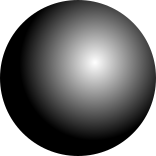
A tank consists of the bottom half of a sphere of radius 2 metres, as shown.
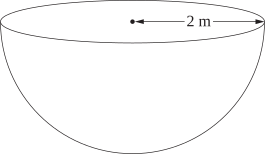
 

Find the volume of the tank in cubic metres, correct to one decimal place.   (2 marks)
Show Answers Only

`16.8\ text{m}^3`

Show Worked Solution
 `V` `= frac{1}{2} times frac{4}{3} pi r^3`
  `= frac{1}{2} times frac{4}{3} times pi times 2^3`
  `= 16.755…`
  `= 16.8\ text{m}^3\ \ text{(1 d.p.)}`

Filed Under: Perimeter, Area and Volume (Std 2), Volume, Mass and Capacity, Volume, Mass and Capacity Tagged With: Band 4, num-title-ct-pathb, num-title-qs-hsc, smc-4235-60-Spheres, smc-6304-50-Volume (Circular Measure), smc-6521-50-Volume (Circular Measure), smc-798-50-Volume (Circular Measure)

Measurement, STD2 M1 2019 HSC 16

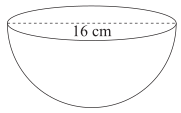
A bowl is in the shape of a hemisphere with a diameter of 16 cm.
 

What is the volume of the bowl, correct to the nearest cubic centimetre?  (2 marks)

Show Answers Only

`1072\ text(cm)^3`

Show Worked Solution
`V` `= 1/2 xx 4/3pir^3`
  `= 1/2 xx 4/3 xx pi xx 8^3`
  `= 1072.3…`
  `= 1072\ text{cm}^3\ text{(nearest cm}^3 text{)}`

Filed Under: Perimeter, Area and Volume (Std 2), Volume, Mass and Capacity, Volume, Mass and Capacity Tagged With: Band 4, num-title-ct-pathb, num-title-qs-hsc, smc-4235-60-Spheres, smc-6304-50-Volume (Circular Measure), smc-6521-50-Volume (Circular Measure), smc-798-50-Volume (Circular Measure)

Measurement, STD2 M1 EQ-Bank 17

A cannon ball is made out of steel and has a diameter of 23 cm.

  1. Find the volume of the sphere in cubic centimetres (correct to 1 decimal place).   (2 marks)

    --- 4 WORK AREA LINES (style=lined) ---

  2. It is known that the mass of the steel used is 8.2 tonnes/m³. Use this information to find the mass of the cannon ball to the nearest gram.   (2 marks)

    --- 5 WORK AREA LINES (style=lined) ---

Show Answers Only
  1. `6370.6\ text{cm}^3\ \text{(to 1 d.p.)}`
  2. `52\ 239\ text(grams)`
Show Worked Solution

a.   `text(Radius)= 23/2 = 11.5\ text(cm)`

`text(Volume)` `= 4/3pir^3`
  `= 4/3 xx pi xx 11.5^3`
  `= 6370.626…`
  `= 6370.6\ text{cm}^3\ \text{(to 1 d.p.)}`


b.   `text(Convert m)^3\ \text{to cm}^3:`

`text(1 m)^3= 100\ text(cm × 100 cm × 100 cm)= 1\ 000\ 000\ text(cm)^3`
 

`text(Convert 8.2 tonnes to grams:)`

`text(8.2 tonnes)= 8200\ text(kg)= 8\ 200\ 000\ text(g)`
 

`:.\ text(Weight of cannon ball)`

`= 6370.6 xx (8\ 200\ 000)/(1\ 000\ 000)`

`= 52\ 238.92`

`= 52\ 239\ text(grams)`

Filed Under: Energy and Mass (Std 2), Perimeter, Area and Volume (Std 2), Volume, Mass and Capacity, Volume, Mass and Capacity Tagged With: Band 3, Band 4, smc-6304-50-Volume (Circular Measure), smc-6521-50-Volume (Circular Measure), smc-798-50-Volume (Circular Measure), smc-799-30-Mass

Measurement, STD2 M1 2017 HSC 22 MC

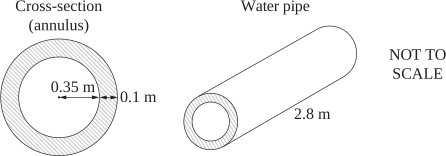
A concrete water pipe is manufactured in the shape of an annular cylinder. The dimensions are shown in the diagrams.


What is the approximate volume of concrete needed to make the water pipe?

  1. `text(0.06 m)³`
  2. `text(0.09 m)³`
  3. `text(0.70 m)³`
  4. `text(0.99 m)³`
Show Answers Only

`C`

Show Worked Solution
`text(Volume)` `= text(Area of annulus) xx h`
  `= (piR^2 – pir^2) xx 2.8`
  `= (pi xx 0.45^2 – pi xx 0.35^2) xx 2.8`
  `= 0.7037…`
  `= 0.70\ text(m)³`

  
`=>C`

Filed Under: Areas and Volumes (Harder), Perimeter, Area and Volume (Std 2), Volume, Mass and Capacity, Volume, Mass and Capacity Tagged With: Band 4, smc-6304-50-Volume (Circular Measure), smc-6521-50-Volume (Circular Measure), smc-798-50-Volume (Circular Measure)

Measurement, STD2 M1 2005 HSC 23b

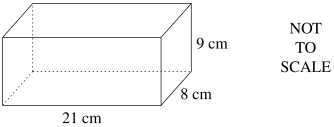
A clay brick is made in the shape of a rectangular prism with dimensions as shown.
 

  1. Calculate the volume of the clay brick.  (1 mark)

    --- 2 WORK AREA LINES (style=lined) ---

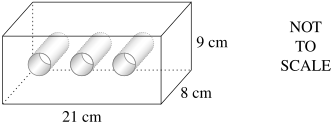
Three identical cylindrical holes are made through the brick as shown. Each hole has a radius of 1.4 cm.  
 

  1. What is the volume of clay remaining in the brick after the holes have been made? (Give your answer to the nearest cubic centimetre.)  (3 marks)

    --- 6 WORK AREA LINES (style=lined) ---

  2. What percentage of clay is removed by making the holes through the brick? (Give your answer correct to one decimal place.)  (1 mark)

    --- 2 WORK AREA LINES (style=lined) ---

Show Answers Only
  1. `text(1512 cm)^3`
  2. `text{1364 cm}^3`
  3. `text{9.8%}`
Show Worked Solution
a.    `V` `= l × b × h`
    `= 21 × 8 × 9`
    `= 1512\ text(cm)^3`


b.  `text(Volume of each hole)`

`= pir^2h`

`= pi × 1.4^2 × 8`

`= 49.260…\ text(cm)^3`


`:.\ text(Volume of clay still in brick)`

`= 1512 − (3 × 49.260…)`

`= 1364.219…`

`= 1364\ text{cm}^3\ text{(nearest whole)}`


c.  `text(Percentage of clay removed)`

`= ((3 × 49.260…))/1512 × 100`

`= 9.773…`

`= 9.8 text{%   (1 d.p.)}`

Filed Under: Areas and Volumes (Harder), Perimeter, Area and Volume (Std 2), Volume, Volume, Mass and Capacity, Volume, Mass and Capacity Tagged With: Band 3, Band 4, Band 5, num-title-ct-corea, num-title-qs-hsc, smc-4235-10-Prisms, smc-4235-20-Cylinders, smc-6304-50-Volume (Circular Measure), smc-6521-50-Volume (Circular Measure), smc-798-50-Volume (Circular Measure)

Measurement, STD2 M1 2007 HSC 23b

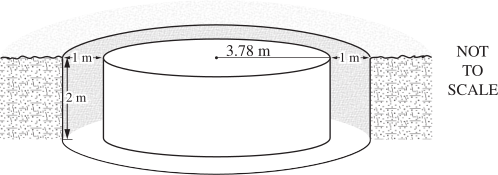
A cylindrical water tank, of height 2 m, is placed in the ground at a school.

The radius of the tank is 3.78 metres. The hole is 2 metres deep. When the tank is placed in the hole there is a gap of 1 metre all the way around the side of the tank.


  1. When digging the hole for the water tank, what volume of soil was removed? Give your answer to the nearest cubic metre.  (3 marks)

    --- 6 WORK AREA LINES (style=lined) ---

  2. Sprinklers are used to water the school oval at a rate of 7500 litres per hour.   


    The water tank holds 90 000 litres when full. 


    For how many hours can the sprinklers be used before a full tank is emptied?   (1 mark)

    --- 2 WORK AREA LINES (style=lined) ---

  3. Water is to be collected in the tank from the roof of the school hall, which has an area of 400 m².


    During a storm, 20 mm of rain falls on the roof and is collected in the tank. 


    How many litres of water were collected?   (2 marks)

    --- 4 WORK AREA LINES (style=lined) ---

Show Answers Only
  1. `144\ text(m³)\ \ text{(nearest m³)}`
  2. `text(12 hours)`
  3. `8000\ text(litres)`
Show Worked Solution

a.  `V = pi r^2 h\ \ \ \ text(where)`

`h = 2\ text(and)\ r = 4.78\ text(m)`

`:.\ V` `= pi xx 4.78^2 xx 2`
  `= 143.56…`
  `= 144\ text(m³)\ \ text{(nearest m³)}`


b.  `text(Total water) = 90\ 000\ text(litres)`

`text(Usage) = 7500\ \ text(litres/hr)`

`:.\ text(Hours before it is empty)`

`= (90\ 000)/7500`

`= 12\ text(hours)`


c.  `text(Water collected)`

`= 400 xx 0.020`

`= 8\ text(m²)`

`= 8000\ text(litres)`

Filed Under: Areas and Volumes (Harder), FS Resources, Perimeter, Area and Volume (Std 2), Volume, Mass and Capacity, Volume, Mass and Capacity Tagged With: Band 3, Band 4, smc-6304-50-Volume (Circular Measure), smc-6521-50-Volume (Circular Measure), smc-798-50-Volume (Circular Measure)

Measurement, STD2 M1 2009 HSC 19 MC

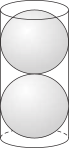
Two identical spheres fit exactly inside a cylindrical container, as shown.
 

The diameter of each sphere is 12 cm.

What is the volume of the cylindrical container, to the nearest cubic centimetre?

  1. `1357\ text(cm)^3`
  2. `2714\ text(cm)^3`
  3. `5429\ text(cm)^3`
  4. `10\ 857\ text(cm)^3`
Show Answers Only

`B`

Show Worked Solution

`text(S)text(ince diameter sphere = 12 cm) `

`=>\ text(Radius of cylinder = 6 cm)`

`text(Height of cylinder)` `= 2 xx text(diameter of sphere)`
  `= 2 xx 12`
  `= 24\ text(cm)`
   
`:.\ text(Volume cylinder)` `= pi r^2 h`
  `= pi xx 6^2 xx 24`
  `= 2714.336…\ text(cm³)`

 
`=>  B`

Filed Under: MM2 - Perimeter, Area and Volume (Prelim), Perimeter, Area and Volume (Std 2), Volume, Mass and Capacity, Volume, Mass and Capacity Tagged With: Band 4, smc-6304-50-Volume (Circular Measure), smc-6521-50-Volume (Circular Measure), smc-798-50-Volume (Circular Measure)

Copyright © 2014–2026 SmarterEd.com.au · Log in