The polynomial \(R(x)=x^3+p x^2+q x+6\) has a double zero at \(x=-1\) and a zero at \(x=s\).
Find the values of \(p, q\) and \(s\). (3 marks)
--- 10 WORK AREA LINES (style=lined) ---
Aussie Maths & Science Teachers: Save your time with SmarterEd
The polynomial \(R(x)=x^3+p x^2+q x+6\) has a double zero at \(x=-1\) and a zero at \(x=s\).
Find the values of \(p, q\) and \(s\). (3 marks)
--- 10 WORK AREA LINES (style=lined) ---
The polynomial \(R(x)=2 x^4+a x^3+b x^2+c x+d\) has a double zero at \(x=1\), a zero at \(x=-3\), and passes through the point \((0,-12)\).
Find the integer values of \(a, b, c, d\) and the fourth zero of the polynomial. (4 marks)
--- 12 WORK AREA LINES (style=lined) ---
A polynomial has the equation
\(Q(x)=(x+1)^2(x-2)\left(x^2+2 x-8\right)\)
--- 6 WORK AREA LINES (style=lined) ---
--- 12 WORK AREA LINES (style=lined) ---
a. \(Q(x) = (x+1)^2(x-2)\left(x^2+2 x-8\right) \)
\(\text{Roots:}\)
\(x=-1 \ \ \text{(multiplicity 2)}\)
\(x=2 \ \ \text{(multiplicity 2)}\)
\(x=4 \ \ \text{(multiplicity 1)}\)
b.

| a. | \(Q(x)\) | \(=(x+1)^2(x-2)\left(x^2+2 x-8\right)\) |
| \(=(x+1)^2(x-2)(x-2)(x+4)\) | ||
| \(=(x+1)^2(x-2)^2(x-4)\) |
\(\text{Roots:}\)
\(x=-1 \ \ \text{(multiplicity 2)}\)
\(x=2 \ \ \text{(multiplicity 2)}\)
\(x=4 \ \ \text{(multiplicity 1)}\)
b. \(Q(x) \ \text{degree}=5, \ \text{Leading coefficient}=1\)
\(\text{As} \ \ x \rightarrow-\infty, y \rightarrow-\infty\)
\(\text{As} \ \ x \rightarrow \infty, y \rightarrow \infty\)
\(\text{At}\ \ x=0, \ y=1^2 \times (-2)^2 \times -4 = -16\)
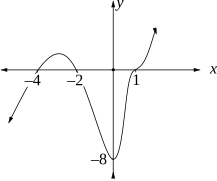
Consider the function \(P(x)=(x-1)^2(x+2)\left(x^2+3 x-4\right)\)
--- 6 WORK AREA LINES (style=lined) ---
--- 8 WORK AREA LINES (style=lined) ---
a. \(P(x)=(x-1)^3(x+2)(x+4)\)
\(\text{Roots:}\)
\(x=-2 \ \ \text{(multiplicity 1)}\)
\(x=-4 \ \ \text{(multiplicity 1)}\)
\(x=1 \ \ \text{(multiplicity 3)}\)
b.

| a. | \(P(x)\) | \(=(x-1)^2(x+2)\left(x^2+3 x-4\right)\) |
| \(=(x-1)^2(x+2)(x-1)(x+4)\) | ||
| \(=(x-1)^3(x+2)(x+4)\) |
\(\text{Roots:}\)
\(x=-2 \ \ \text{(multiplicity 1)}\)
\(x=-4 \ \ \text{(multiplicity 1)}\)
\(x=1 \ \ \text{(multiplicity 3)}\)
b. \(\text{Degree} \ P(x)=5, \ \ \text {Leading coefficient }=1\)
\(\text{As} \ \ x \rightarrow \infty, \ y \rightarrow \infty\)
\(\text{As} \ \ x \rightarrow -\infty, \ y \rightarrow -\infty\)
\(\text{At} \ \ x=0, y=-8\)
A polynomial has the equation
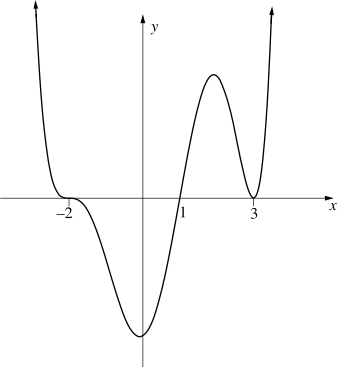
\(P(x)=(x-1)(x-3)(x+2)^2\left(x^2-x-6\right)\).
--- 5 WORK AREA LINES (style=lined) ---
--- 12 WORK AREA LINES (style=blank) ---
| a. | \(P(x)\) | \(=(x-1)(x-3)(x+2)^2\left(x^2-x-6\right)\) |
| \(=(x-1)(x-3)(x+2)^2(x-3)(x+2)\) | ||
| \(=(x-1)(x-3)^2(x+2)^3\) |
\(\text{Roots:}\)
\(x=1\ \text{(multiplicity 1)}\)
\(x=-2\ \text{(multiplicity 3)}\)
\(x=3\ \text{(multiplicity 2)}\)
b.
| a. | \(P(x)\) | \(=(x-1)(x-3)(x+2)^2\left(x^2-x-6\right)\) |
| \(=(x-1)(x-3)(x+2)^2(x-3)(x+2)\) | ||
| \(=(x-1)(x-3)^2(x+2)^3\) |
\(\text{Roots:}\)
\(x=1\ \text{(multiplicity 1)}\)
\(x=-2\ \text{(multiplicity 3)}\)
\(x=3\ \text{(multiplicity 2)}\)
b.