SmarterEd

Aussie Maths & Science Teachers: Save your time with SmarterEd

  • Login
  • Get Help
  • About

Polynomials, EXT1 EQ-Bank 9

A polynomial has the equation

\(Q(x)=(x+1)^2(x-2)\left(x^2+2 x-8\right)\)

  1. Express  \(Q(x)\)  as a product of linear factors and determine the multiplicity of each of its roots.   (2 marks)

    --- 6 WORK AREA LINES (style=lined) ---

  2. Hence, without using calculus, draw a sketch of \(y=Q(x)\), showing all  \(x\)-intercepts.   (2 marks)

    --- 12 WORK AREA LINES (style=lined) ---

Show Answers Only

a.    \(Q(x) = (x+1)^2(x-2)\left(x^2+2 x-8\right) \)

\(\text{Roots:}\)

\(x=-1 \ \ \text{(multiplicity 2)}\)

\(x=2 \ \ \text{(multiplicity 2)}\)

\(x=4 \ \ \text{(multiplicity 1)}\)
 

b.

Show Worked Solution
a.     \(Q(x)\) \(=(x+1)^2(x-2)\left(x^2+2 x-8\right)\)
    \(=(x+1)^2(x-2)(x-2)(x+4)\)
    \(=(x+1)^2(x-2)^2(x-4)\)


\(\text{Roots:}\)

\(x=-1 \ \ \text{(multiplicity 2)}\)

\(x=2 \ \ \text{(multiplicity 2)}\)

\(x=4 \ \ \text{(multiplicity 1)}\)
 

b.    \(Q(x) \ \text{degree}=5, \ \text{Leading coefficient}=1\)

\(\text{As} \ \ x \rightarrow-\infty, y \rightarrow-\infty\)

\(\text{As} \ \ x \rightarrow \infty, y \rightarrow \infty\)

\(\text{At}\ \ x=0, \ y=1^2 \times (-2)^2 \times -4 = -16\)

Filed Under: Graphs of Polynomials Tagged With: Band 3, Band 4, smc-6742-25-Multiplicity of Zeroes, smc-6742-40-Sketch Graphs, syllabus-2027

Polynomials, EXT1 EQ-Bank 5

Consider the function  \(P(x)=(x-1)^2(x+2)\left(x^2+3 x-4\right)\)

  1. By expressing \(P(x)\) as a product of its linear factors, identify its zeroes and the multiplicity of each zero.   (2 marks)

    --- 6 WORK AREA LINES (style=lined) ---

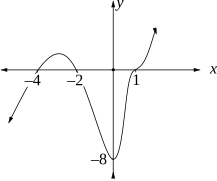
  2. Without using calculus, draw a sketch of  \(y=P(x)\)  showing any \(x\)-intercepts.   (2 marks)

    --- 8 WORK AREA LINES (style=lined) ---

Show Answers Only

a.    \(P(x)=(x-1)^3(x+2)(x+4)\)

\(\text{Roots:}\)

\(x=-2 \ \ \text{(multiplicity 1)}\)

\(x=-4 \ \ \text{(multiplicity 1)}\)

\(x=1 \ \ \text{(multiplicity 3)}\)
 

b.  

Show Worked Solution
a.     \(P(x)\) \(=(x-1)^2(x+2)\left(x^2+3 x-4\right)\)
    \(=(x-1)^2(x+2)(x-1)(x+4)\)
    \(=(x-1)^3(x+2)(x+4)\)

 
\(\text{Roots:}\)

\(x=-2 \ \ \text{(multiplicity 1)}\)

\(x=-4 \ \ \text{(multiplicity 1)}\)

\(x=1 \ \ \text{(multiplicity 3)}\)
 

b.    \(\text{Degree} \ P(x)=5, \ \ \text {Leading coefficient }=1\)

\(\text{As} \ \ x \rightarrow \infty, \ y \rightarrow \infty\)

\(\text{As} \ \ x \rightarrow -\infty, \ y \rightarrow -\infty\)

\(\text{At} \ \ x=0, y=-8\)
 

Filed Under: Graphs of Polynomials Tagged With: Band 3, Band 4, smc-6742-25-Multiplicity of Zeroes, smc-6742-40-Sketch Graphs, syllabus-2027

Polynomials, EXT1 EQ-Bank 3

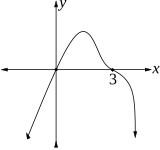
Consider the polynomial \(P(x)=x(3-x)^3\).

  1. State the degree of the polynomial and identify the leading coefficient.   (1 mark)

    --- 2 WORK AREA LINES (style=lined) ---

  2. Explain what happens to \(y\) as  \(x \rightarrow \pm \infty\).   (1 mark)

    --- 2 WORK AREA LINES (style=lined) ---

  3. Without using calculus, sketch \(P(x)\) showing its general form and any \(x\)-intercepts.   (2 marks)

    --- 6 WORK AREA LINES (style=lined) ---

Show Answers Only

a.    \(\text{Degree}\ P(x)=4\)

\(\text{Leading co-efficient}=-1\)
 

b.    \(\text{As} \ \ x \rightarrow-\infty,-x^4 \rightarrow-\infty, \ y \rightarrow-\infty\).

\(\text{As} \ \ x \rightarrow \infty,-x^4 \rightarrow-\infty, \ y \rightarrow-\infty\).
 

c.    \(P(x)\ \text{has zeroes at}\ \ x=0, 3:\)


Show Worked Solution

a.    \(\text{Degree}\ P(x)=4\)

\(\text{Leading co-efficient}=-1\)
 

b.    \(\text{As} \ \ x \rightarrow-\infty,-x^4 \rightarrow-\infty, \ y \rightarrow-\infty\).

\(\text{As} \ \ x \rightarrow \infty,-x^4 \rightarrow-\infty, \ y \rightarrow-\infty\).
 

c.    \(P(x)\ \text{has zeroes at}\ \ x=0, 3:\)


Filed Under: Graphs of Polynomials Tagged With: Band 3, smc-6742-20-Degree/Coefficients, smc-6742-30-\(x \rightarrow \pm \infty\), smc-6742-40-Sketch Graphs, syllabus-2027

Polynomials, EXT1 EQ-Bank 1

A polynomial has the equation

\(P(x)=(x-1)(x-3)(x+2)^2\left(x^2-x-6\right)\).

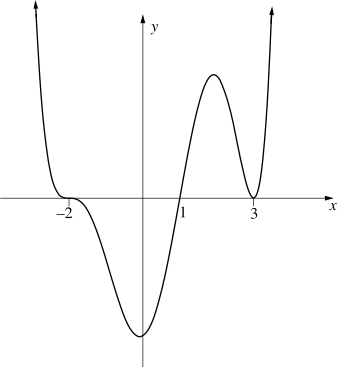
  1. By expressing \(P(x)\) as a product of its linear factors, determine the multiplicity of each of the roots of  \(P(x)=0\).   (2 marks)

    --- 5 WORK AREA LINES (style=lined) ---

  2. Hence, without using calculus, draw a sketch of  \(y=P(x)\)  showing all \(x\)-intercepts.   (2 marks)

    --- 12 WORK AREA LINES (style=blank) ---

Show Answers Only
a.     \(P(x)\) \(=(x-1)(x-3)(x+2)^2\left(x^2-x-6\right)\)
    \(=(x-1)(x-3)(x+2)^2(x-3)(x+2)\)
    \(=(x-1)(x-3)^2(x+2)^3\)


\(\text{Roots:}\)

\(x=1\ \text{(multiplicity 1)}\)

\(x=-2\ \text{(multiplicity 3)}\)

\(x=3\ \text{(multiplicity 2)}\)
 

b.
     

Show Worked Solution
a.     \(P(x)\) \(=(x-1)(x-3)(x+2)^2\left(x^2-x-6\right)\)
    \(=(x-1)(x-3)(x+2)^2(x-3)(x+2)\)
    \(=(x-1)(x-3)^2(x+2)^3\)


\(\text{Roots:}\)

\(x=1\ \text{(multiplicity 1)}\)

\(x=-2\ \text{(multiplicity 3)}\)

\(x=3\ \text{(multiplicity 2)}\)
 

b.
     

Filed Under: Graphs of Polynomials Tagged With: Band 3, Band 4, smc-6742-25-Multiplicity of Zeroes, smc-6742-40-Sketch Graphs, syllabus-2027

Copyright © 2014–2026 SmarterEd.com.au · Log in