A probability density function is shown in the diagram.
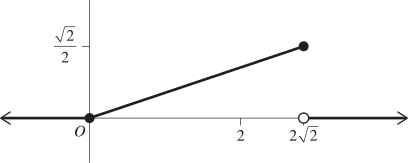
What is the mode of the given probability density function?
- \(0\)
- \(\dfrac{\sqrt{2}}{2}\)
- \(2\)
- \(2\sqrt{2}\)
Aussie Maths & Science Teachers: Save your time with SmarterEd
A probability density function is shown in the diagram.
What is the mode of the given probability density function?
A function, \(h(x)\), is defined as
\(h(x)=\left\{
\begin{array} {c}
\rule{0pt}{2.5ex} \ \ \ \ \ \dfrac{x}{6}+k \rule[-1ex]{0pt}{0pt} & -3 \leq x<0 \\
\rule{0pt}{2.5ex} \ \ -\dfrac{x}{2}+k \rule[-1ex]{0pt}{0pt} & 0 \leq x \leq 1 \\
\rule{0pt}{2.5ex} 0 \rule[-1ex]{0pt}{0pt} & \text { elsewhere } \\
\end{array}\right.\)
and \(k\) is a constant.
Find the value of \(k\) such that \(h(x)\) is a probability density function. (3 marks)
--- 8 WORK AREA LINES (style=lined) ---