SmarterEd

Aussie Maths & Science Teachers: Save your time with SmarterEd

  • Login
  • Get Help
  • About

Statistics, 2ADV S3 EQ-Bank 24

A continuous random variable \(X\) has probability density function \(f(x)\) given by

\begin{align*}
f(x)=\left\{\begin{array}{cl}
k x(1-x)^5, & \text { for } 0 \leq x \leq 1 \\
0, & \text { for all other values of } x
\end{array}\ \ \ , \text { where } k\right. \text { is a constant. }
\end{align*}

It is given that

\(\displaystyle \int_0^a x(1-x)^5\, d x=\frac{1}{42}+\frac{(1-a)^7}{7}-\frac{(1-a)^6}{6}\)

and \(\displaystyle\int_0^1 x^m(1-x)^5\, d x=\dfrac{120}{(m+1)(m+2)(m+3)(m+4)(m+5)(m+6)}\)

where  \(a>0\)  and  \(m>0\).

  1. Show that  \(k=42\).   (1 mark)

    --- 4 WORK AREA LINES (style=lined) ---

  2. Show that  \(E (X)=0.25\).   (2 marks)

    --- 6 WORK AREA LINES (style=lined) ---

  3. Show that the median of \(X\) is less than the expected value of \(X\).   (3 marks)

    --- 9 WORK AREA LINES (style=lined) ---
Show Answers Only

a.    \(k \displaystyle \int_0^1 x(1-x)^5 d x=1\)

\(k\left[\dfrac{1}{42}+\dfrac{(1-1)^7}{7}-\dfrac{(1-1)^6}{6}\right]=1\)

\(\dfrac{k}{42}\) \(=1\)  
\(k\) \(=42\)  


b.     \(E (X)\) \(=\displaystyle \int_0^1 x \times f(x)\, d x\)
    \(=\displaystyle \int_0^1 42 x^2(1-x)^5\, d x\)
    \(=42 \times \dfrac{120}{3 \times 4 \times 5 \times 6 \times 7 \times 8}\)
    \(=0.25\)


c.   \(\text{Let}\ m =\text{ median}\)

\(P(X\leqslant m) = 0.5\ \ \Rightarrow\ \ \displaystyle \int_0^m 42 x(1-x)^5\, d x=0.5 \)

\(E(X)=0.25\)

\(\text{Calculate }\ P(X\leqslant 0.25):\)

\(\displaystyle \int_0^{0.25} 42 x(1-x)^5\, d x\) \(=42\left[\frac{1}{42}+\dfrac{(1-0.25)^7}{7}-\dfrac{(1-0.25)^6}{6}\right]\)  
  \(=0.555 \ldots\ \text{(3 dp)}\)  

 
\(\therefore \displaystyle \int_0^m 42 x(1-x)^5 d x=0.5 \ \ \text{requires the median to be less than 0.25.}\)

Show Worked Solution

a.    \(k \displaystyle \int_0^1 x(1-x)^5 d x=1\)

\(k\left[\dfrac{1}{42}+\dfrac{(1-1)^7}{7}-\dfrac{(1-1)^6}{6}\right]=1\)

\(\dfrac{k}{42}\) \(=1\)  
\(k\) \(=42\)  


b.     \(E (X)\) \(=\displaystyle \int_0^1 x \times f(x)\, d x\)
    \(=\displaystyle \int_0^1 42 x^2(1-x)^5\, d x\)
    \(=42 \times \dfrac{120}{3 \times 4 \times 5 \times 6 \times 7 \times 8}\)
    \(=0.25\)


c.   \(\text{Let}\ m =\text{ median}\)

\(P(X\leqslant m) = 0.5\ \ \Rightarrow\ \ \displaystyle \int_0^m 42 x(1-x)^5\, d x=0.5 \)

\(E(X)=0.25\)

\(\text{Calculate }\ P(X\leqslant 0.25):\)

\(\displaystyle \int_0^{0.25} 42 x(1-x)^5\, d x\) \(=42\left[\frac{1}{42}+\dfrac{(1-0.25)^7}{7}-\dfrac{(1-0.25)^6}{6}\right]\)  
  \(=0.555 \ldots\ \text{(3 dp)}\)  

 
\(\therefore \displaystyle \int_0^m 42 x(1-x)^5 d x=0.5 \ \ \text{requires the median to be less than 0.25.}\)

Filed Under: Continuous Random Variables Tagged With: Band 3, Band 4, Band 5, smc-7137-10-Median, smc-7137-60-Polynomial PDF, syllabus-2027

Statistics, 2ADV 2025 MET2 14*

Let \(f\) be the probability density function for a continuous random variable \(X\), where

\begin{align*}
f(x)=\left\{\begin{array}{cl}
k\, \sin (x) & 0 \leq x<\dfrac{\pi}{4} \\
k\, \cos (x) & \dfrac{\pi}{4} \leq x \leq \dfrac{\pi}{2} \\
0 & \text {otherwise }
\end{array}\right.
\end{align*}

and \(k\) is a positive real number.

Determine the exact value of \(k\), expressing your answer in the form  \(a+b\sqrt{2}\), where \(a, b \in R.\)   (3 marks)

--- 8 WORK AREA LINES (style=lined) ---
Show Answers Only

\(k=1+\dfrac{1}{2} \sqrt{2}\)

Show Worked Solution
\(\displaystyle k \int_0^{\tfrac{\pi}{4}} \sin x+k \int_{\tfrac{\pi}{4}}^{\tfrac{\pi}{2}} \cos x\) \(=1\)
\(k[-\cos x]_0^{\tfrac{\pi}{4}}+k[\sin x]_{\tfrac{\pi}{4}}^{\tfrac{\pi}{2}}\) \(=1\)
\(k\left(-\dfrac{1}{\sqrt{2}}+1\right)+k\left(1-\dfrac{1}{\sqrt{2}}\right)\) \(=1\)

\(k\left(2-\dfrac{2}{\sqrt{2}}\right)=1\)

\(k\left(\dfrac{2 \sqrt{2}-2}{\sqrt{2}}\right)=1\)

\(k\) \(=\dfrac{\sqrt{2}}{2 \sqrt{2}-2} \times \dfrac{2 \sqrt{2}+2}{2 \sqrt{2}+2}\)
  \(=\dfrac{4+2 \sqrt{2}}{8-4}\)
  \(=1+\dfrac{1}{2} \sqrt{2}\)

Filed Under: Continuous Random Variables, Probability Density Functions Tagged With: Band 5, smc-7137-40-CDF, smc-7137-80-Trig PDF, smc-994-40-Cumulative Distribution Fn, smc-994-80-Trig PDF

Statistics, 2ADV S3 2025 MET1 8

Consider

\begin{align*}
f(x)=\left\{\begin{array}{cc}
\dfrac{3}{8}(4-3 x) & 0 \leq x \leq \dfrac{4}{3} \\
0 & \text {otherwise }
\end{array}\right.
\end{align*}

  1. The continuous random variable \(X\) has probability density function \(f(x)\).
  2. Find \(k\) such that  \(\operatorname{Pr}(X>k)=\dfrac{9}{16}\).   (3 marks)

    --- 12 WORK AREA LINES (style=lined) ---
  3. The function \(h(x)\) is a transformation of \(f(x)\) such that
  4. \begin{align*}
    \ \ \ \ h(x)=m f(x)+n
    \end{align*}
  5. where \(m\) and \(n\) are real numbers.
  6. Find  \(\displaystyle \int_0^{\tfrac{4}{3}} h(x) d x\)  in terms of \(m\) and \(n\).    (2 marks)

    --- 7 WORK AREA LINES (style=lined) ---
Show Answers Only

a.    \(k=\dfrac{1}{3}\)

b.    \(\displaystyle\int_0^{\frac{4}{3}} h(x)=m+\dfrac{4}{3} n\)

Show Worked Solution

a.    \(\text{Solve}\ \ \operatorname{Pr}(X>k)=\dfrac{9}{16}\ \ \text{for}\ k\) :

\(\operatorname{Pr}(X>k)\) \(=\displaystyle\int_k^{\frac{4}{3}} \frac{3}{8}(4-3 x) d x\)
  \(=\displaystyle-\frac{3}{8} \int_k^{\frac{4}{3}}(3 x-4) d x\)
  \(=-\dfrac{3}{8} \cdot \dfrac{1}{2} \cdot \dfrac{1}{3}\left[(3 x-4)^2\right]_k^{\frac{4}{3}}\)
  \(=-\dfrac{1}{16}\left[(4-4)^2-(3 k-4)^2\right]\)
  \(=\dfrac{(3 k-4)^2}{16}\)
♦ Mean mark (a) 47%.


\(\dfrac{(3 k-4)^2}{16}\) \(=\dfrac{9}{16}\)
\((3 k-4)^2\) \(=9\)
\(3 k-4\) \(= \pm 3\)


\(3 k=1 \ \ \ \ \text{or}\ \ \ \ 3 k=7\)

\(k=\dfrac{1}{3} \quad \quad \ \ \ k=\dfrac{7}{3}\ \ \left(\text{No solution as}\ k \in\left[0, \dfrac{4}{3}\right]\right)\)

 \(\therefore\ k=\dfrac{1}{3}\)
  

b.    \(h(x)=m f(x)+n\)

  \(\displaystyle\int_0^{\frac{4}{3}} h(x)\) \(=\displaystyle \int_0^{\frac{4}{3}}(m f(x)+n) d x\)
    \(=m \underbrace{\displaystyle \int_0^{\frac{4}{3}} f(x) d x}_{=1\  \ \text{since p.d.f. }}+n \displaystyle\int_0^{\frac{4}{3}} 1\ d x\)
    \(=m+n[x]_0^{\frac{4}{3}}\)
    \(=m+\dfrac{4}{3} n\)
♦♦ Mean mark (b) 38%.

Filed Under: Continuous Random Variables, Probability Density Functions Tagged With: Band 5, smc-7137-30-Other Probability, smc-7137-95-X-topic, smc-994-30-Other Probability, smc-994-97-X-Topic Transformations

Statistics, 2ADV S3 2025 HSC 21

A continuous random variable \(X\) has a probability density function given by

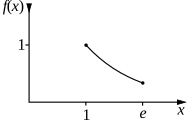
\(f(x)= \begin{cases}\ 0 & \quad x<1 \\ \dfrac{1}{x} & \quad 1 \leq x \leq e \\ \ 0 & \quad x>e\end{cases}\)

  1. Find the mode of the given probability density function. Justify your answer.   (2 marks)

    --- 6 WORK AREA LINES (style=lined) ---
  2. Calculate the value of the 25th percentile \(\left(Q_1\right)\) of this distribution. Give your answer correct to 3 decimal places.   (3 marks)

    --- 6 WORK AREA LINES (style=lined) ---
Show Answers Only

a.    
     

\(\text{Graph is monotonically decreasing.}\)

\(\text{Mode:} \ \ x=1\)

b.   \(Q_1=1.284 \)

Show Worked Solution

a.    
         

\(\text{Graph is monotonically decreasing.}\)

\(f(x)_{\text{max}}\ \text{occurs on interval when}\ \ x=1.\)

\(\text{Mode:} \ \ x=1\)

♦ Mean mark (a) 48%.

b.    \(\text{Find \(k\) such that} \ P(X<k)=0.25:\)

\(\displaystyle \int_1^{Q_1} \frac{1}{x}\) \(=0.25\)
\(\ln Q_1-\ln 1\) \(=0.25\)
\(Q_1\) \(=e^{0.25}\)
  \(=1.284 \ \text{(3 d.p.)}\)

Filed Under: Continuous Random Variables, Probability Density Functions Tagged With: Band 4, Band 5, smc-7137-20-Mode, smc-7137-90-Other PDF functions, smc-994-20-Mode, smc-994-90-Other PDF functions

Statistics, 2ADV S3 EQ-Bank 15

A probability density function for a random variable, \(X\), is defined by the following function
 

\(f(x)=\left\{\begin{array}{rl}
k x(2-x), & 0 \leqslant x \leqslant 2 \\
0, & \text{for all other } x
\end{array}\right.\)
 

Determine the value of \(k\) and hence write the equation of the Cumulative Density Function.   (3 marks)

--- 10 WORK AREA LINES (style=lined) ---

Show Answers Only

\(F(x)=\dfrac{3}{4} x^2-\dfrac{1}{4} x^3\)

Show Worked Solution
  \(\displaystyle \int_0^2 k x(2-x)\) \(=1\)
  \(\displaystyle \int_0^2 2 k x-k x^2\) \(=1\)
  \(\left[k x^2-\dfrac{k}{3} x^3\right]_0^2\) \(=1\)
  \(\left(4 k-\dfrac{8 k}{3}\right)-0\) \(=1\)
  \(4 k\) \(=3\)
  \(k\) \(=\dfrac{3}{4}\)


\(F(x)\) \(=\displaystyle \int 2 \times \frac{3}{4} x-\frac{3}{4} x^2\, d x\)
  \(=\displaystyle \int \frac{3}{2} x-\frac{3}{4} x^2\, d x\)
  \(=\dfrac{3}{4} x^2-\dfrac{1}{4} x^3+c\)

 
\(\text{When} \ \ x=0, F(x)=0 \ \Rightarrow \ c=0\)

\(\therefore\ F(x)=\dfrac{3}{4} x^2-\dfrac{1}{4} x^3\)

Filed Under: Continuous Random Variables, Probability Density Functions Tagged With: Band 4, smc-7137-40-CDF, smc-994-40-Cumulative Distribution Fn

Statistics, 2ADV S3 2024 MET2 14*

A function, \(h(x)\), is defined as

\(h(x)=\left\{
\begin{array} {c}
\rule{0pt}{2.5ex} \ \ \ \ \ \dfrac{x}{6}+k \rule[-1ex]{0pt}{0pt} & -3 \leq x<0 \\
\rule{0pt}{2.5ex} \ \ -\dfrac{x}{2}+k \rule[-1ex]{0pt}{0pt} & 0 \leq x \leq 1 \\
\rule{0pt}{2.5ex} 0 \rule[-1ex]{0pt}{0pt} & \text { elsewhere } \\
\end{array}\right.\)

and \(k\) is a constant.

Find the value of \(k\) such that \(h(x)\) is a probability density function.   (3 marks)

--- 8 WORK AREA LINES (style=lined) ---

Show Answers Only

\(k=\dfrac{1}{2}\)

Show Worked Solution

\(h(x)\ \text{is a PDF if}\ \ \displaystyle \int_{-3}^1 h(x)=1\)

\(\displaystyle \int_{-3}^1 h(x)\) \(=\displaystyle \int_{-3}^0 \dfrac{x}{6}+k\,dx +\int_0^1 -\dfrac{x}{2}+k\,dx\)
\(1\) \(=\left[\dfrac{x^2}{12}+kx\right] _{-3}^0 +\left[-\dfrac{x^2}{4}+kx\right] _0^1\) 
\(1\) \(=0-\left(\dfrac{9}{12}-3k\right)+\left(-\dfrac{1}{4}+k\right)-0\)
\(1\) \(=4k-1\)
\(k\) \(=\dfrac{1}{2}\)

Filed Under: Continuous Random Variables, Probability Density Functions Tagged With: Band 4, smc-7137-50-Linear PDF, smc-994-50-Linear PDF

Statistics, 2ADV S3 2024 HSC 25

A function \(f(x)\) is defined as

\(f(x)=\left\{\begin{array}{ll} 0, & \text { for}\ \ x \lt 0 \\
1-\dfrac{x}{h}, & \text { for}\ \ 0 \leq x \leq h, \\
0, & \text { for}\ \  x \gt h \end{array}\right.\)

where \(h\) is a constant.

  1. Find the value of \(h\) such that \(f(x)\) is a probability density function.   (2 marks)

    --- 6 WORK AREA LINES (style=lined) ---

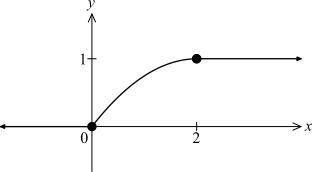
  2. By first finding a formula for the cumulative distribution function, sketch its graph.   (2 marks)

    --- 7 WORK AREA LINES (style=lined) ---

  3. Find the value of the median of the probability density function \(f(x)\) . Give your answer correct to 3 decimal places.   (2 marks)

    --- 10 WORK AREA LINES (style=lined) ---

Show Answers Only

a.   \(h=2\)

b.   

c.   \(\text{Median}\ =0.586\)

Show Worked Solution

a.   \(f(x)\ \text{is a PDF if:}\)

\(\displaystyle \int_{0}^{h} 1-\dfrac{x}{h}\,dx\) \(=1\)  
\(\Big[x-\dfrac{x^2}{2h} \Big]_0^{h}\) \(=1\)  
\(h-\dfrac{h}{2}\) \(=1\)  
\(h\) \(=2\)  

  
b.
   \( \displaystyle \int 1-\dfrac{x}{2}\,dx = x-\dfrac{x^2}{4} + c\)

\(\text{At}\ \ x=0, \ \ F(0)=0,\ \ c=0 \)

\(f(x)=\left\{\begin{array}{ll} 0, & \text { for}\ \ x \lt 0 \\
x-\dfrac{x^2}{4}, & \text { for}\ \ 0 \leq x \leq 2, \\
1, & \text { for}\ \  x \gt 2 \end{array}\right.\)
 

♦♦ Mean mark (b) 27%.

c.   \(\text{Let}\ \ m=\ \text{median of}\ f(x) \)

\(\displaystyle \int_0^{m} 1-\dfrac{x}{2}\,dx\)  \(=0.5\)  
\(\Big[ x-\dfrac{x^2}{4} \Big]_0^m\) \(=0.5\)  
\(m-\dfrac{m^2}{4}\) \(=0.5\)  
\(4m-m^2\) \(=2\)  
\(m^2-4m+2\) \(=0\)  
\((m-2)^2\) \(=2\)  
\(m\) \(=2 \pm \sqrt{2}\)  


\(\therefore \ \text{Median}\) \(=2-\sqrt{2}\ \ (x \in [0,2]) \)   
  \(=0.586\ \text{(3 d.p.)}\)  
♦♦ Mean mark (c) 38%.

Filed Under: Continuous Random Variables, Probability Density Functions Tagged With: Band 4, Band 5, smc-7137-10-Median, smc-7137-40-CDF, smc-994-10-Median, smc-994-40-Cumulative Distribution Fn, smc-994-50-Linear PDF

Statistics, 2ADV S3 2023 HSC 29

A continuous random variable \(X\) has probability density function \(f(x)\) given by
 

\(f(x)=\left\{\begin{array}{cl} 12 x^2(1-x), & \text { for } 0 \leq x \leq 1 \\ 0, & \text { for all other values of } x \end{array}\right.\)


  1. Find the mode of \(X\).  (2 marks)

    --- 6 WORK AREA LINES (style=lined) ---

  2. Find the cumulative distribution function for the given probability density function.  (2 marks)

    --- 6 WORK AREA LINES (style=lined) ---

  3. Without calculating the median, show that the mode is greater than the median.  (2 marks)

    --- 5 WORK AREA LINES (style=lined) ---

Show Answers Only

a.   \(x=\dfrac{2}{3} \)

b.   \(F(x)=\left\{\begin{array}{cl} 0, & \text { for } x \lt 0 & \\ 4x^3-3x^4, & \text { for } 0 \leq x \leq 1 \\ 1, & \text { for } x > 1 \end{array}\right.\)

c.    \(\text{See Worked Solutions}\)

Show Worked Solution

a.    \(\text{Mode}\ \rightarrow \ f(x)_\text{max} \)

\(f(x)=12 x^2(1-x)=12x^2-12x^3 \)

\(f^{′}(x)=24x-36x^2=12x(2-3x) \)

\(f^{″}(x)=24-72x \)

♦ Mean mark (a) 45%.

\(\text{Max/min when}\ f^{′}(x)=0 \)

\(2-3x=0\ \ ⇒\ \ x=\dfrac{2}{3} \ \ (x \neq 0) \)

\(\text{At}\ x=\dfrac{2}{3}, \ f^{″}(x)=24-72(\dfrac{2}{3})=-24<0 \)

\(\therefore \ \text{Mode (max) at}\ x=\dfrac{2}{3} \)
  

b.     \(F(x)\) \(= \int 12x^2-12x^3\ dx\)
    \(=4x^3-3x^4+c \)

 
\(\text{At}\ x=0, F(x)=0\ \ ⇒\ \ c=0 \)

\(F(x)=4x^3-3x^4 \)
 

\(F(x)=\left\{\begin{array}{cl} 0, & \text { for } x \lt 0 & \\ 4x^3-3x^4, & \text { for } 0 \leq x \leq 1 \\ 1, & \text { for } x > 1 \end{array}\right.\)

 
c.
    \(\text{Find}\ F\Big{(}\dfrac{2}{3}\Big{)}: \)

\(F\Big{(}\dfrac{2}{3}\Big{)} \) \(=4 \times \Big{(}\dfrac{2}{3}\Big{)}^3-3 \times \Big{(}\dfrac{2}{3}\Big{)}^4 \)  
  \(=\dfrac{16}{27}>0.5 \)  

 
\(\therefore\ \text{Mode > median}\)

♦♦♦ Mean mark (c) 17%.

Filed Under: Continuous Random Variables, Probability Density Functions Tagged With: Band 4, Band 5, Band 6, smc-7137-10-Median, smc-7137-20-Mode, smc-7137-40-CDF, smc-7137-60-Polynomial PDF, smc-994-10-Median, smc-994-20-Mode, smc-994-40-Cumulative Distribution Fn, smc-994-60-Polynomial PDF

Statistics, 2ADV S3 2022 HSC 30

A continuous random variable \(X\) has cumulative distribution function given by

\(F(x)= \begin{cases}
1 & x>e^3 \\
\ \\
\dfrac{1}{k}\, \ln x & 1 \leq x \leq e^3 . \\
\ \\
0 & x<1\end{cases}\)

  1. Show that  \(k = 3\).  (1 mark)

    --- 2 WORK AREA LINES (style=lined) ---

  2. Given that  \(P(X < c)=2P(X > c)\), find the exact value of \(c\).  (2 marks)

    --- 4 WORK AREA LINES (style=lined) ---

Show Answers Only
  1. \(\text{Proof (See Worked Solutions)}\)
  2. \(e^2\)
Show Worked Solution

a.  \(\text{Show} \ \ k=3\)

\begin{aligned}
{\left[\dfrac{1}{k} \, \ln x\right]_1^{e^3} } & =1 \\
\dfrac{1}{k}\, \ln \left(e^3\right)-\dfrac{1}{k}\, \ln 1 & =1 \\
\dfrac{1}{k}(3)-\frac{1}{k}(0) & =1 \\
k & =3 \ldots \text{as required}
\end{aligned}


♦♦ Mean mark (a) 38%.
b.    \(P(X<c)\) \(=\left[\dfrac{1}{3}\, \ln x\right]_0^c\)
    \(=\dfrac{1}{3}\, \ln c\)

\begin{aligned}
2 P(X>c) & =2 P(1-P(X<c)) \\
& =2\left(1-\frac{1}{3} \ln c\right)
\end{aligned}

\(\text { Given } P(X<c)=2 P(X>c)\)

\begin{aligned}
\dfrac{1}{3}\, \ln c & =2-\dfrac{2}{3}\, \ln c \\
\ln c & =2 \\
\therefore c & =e^2
\end{aligned}


♦♦♦ Mean mark (b) 19%.

Filed Under: Continuous Random Variables, Probability Density Functions Tagged With: Band 5, Band 6, smc-7137-40-CDF, smc-994-40-Cumulative Distribution Fn

Statistics, 2ADV S3 2022 HSC 7 MC

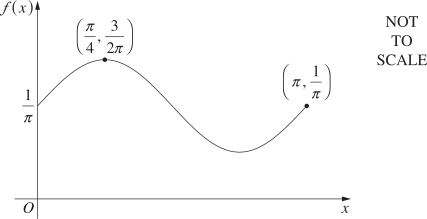
Consider the following graph of a probability density function  `f(x)`.
 

What is the value of the mode?

  1. `1/pi`
  2. `3/{2pi}`
  3. `pi/4`
  4. `pi`
Show Answers Only

`C`

Show Worked Solution

`text{Mode →}\ f(x)\ text{is a MAX}`

`text{MAX occurs when}\ \ x=pi/4`

`=>C`

Filed Under: Continuous Random Variables, Probability Density Functions Tagged With: Band 4, smc-7137-20-Mode, smc-7137-80-Trig PDF, smc-994-20-Mode, smc-994-80-Trig PDF

Statistics, 2ADV S3 EQ-Bank 29

A random variable \(X\) has the probability density function \(f(x)\) given by

\(f(x)= \begin{cases}
\dfrac{k}{x^2} & 1 \leq x \leq 2 \\
\ \\
0 & \text {elsewhere }
\end{cases}\)

where \(k\) is a positive real number.

Show that  \(k = 2\).  (2 marks)

Show Answers Only

\(\text{See Worked Solution}\)

Show Worked Solution

♦ Mean mark 48%.

\(\begin{aligned} \int_1^2 \dfrac{k}{x^2} d x & =1 \\
k\left[-\dfrac{1}{x}\right]_1^2 & =1 \\
k\left(-\dfrac{1}{2}+1\right) & =1 \\
\dfrac{k}{2} & =1 \\
\therefore k & =2 \quad \ldots \text{ as required }
\end{aligned}\)


Filed Under: Continuous Random Variables, Probability Density Functions Tagged With: Band 5, smc-7137-90-Other PDF functions, smc-994-90-Other PDF functions

Statistics, 2ADV S3 2021 HSC 33

People are given a maximum of six hours to complete a puzzle. The time spent on the puzzle, in hours, can be modelled using the continuous random variable \(X\) which has probability density function

\(f(x)= \begin{cases}
\dfrac{A x}{x^2+4} & \text{for } 0 \leq x \leq 6,(\text { where } A>0) \\
\ \\
0 & \text {for all other values of } x
\end{cases}\)

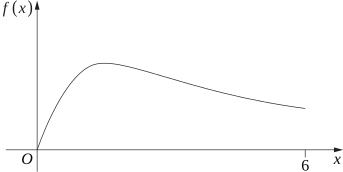
The graph of the probability density function is shown below. The graph has a local maximum.
 

  1. Show that  \(A=\dfrac{2}{\ln 10}\).   (2 marks)

    --- 4 WORK AREA LINES (style=lined) ---

  2. Show that the mode of \(X\) is two hours.   (2 marks)

    --- 4 WORK AREA LINES (style=lined) ---

  3. Show that  \(P(X<2)=\log _{10} 2\).   (2 marks)

    --- 5 WORK AREA LINES (style=lined) ---

  4. The Intelligence Quotient (IQ) scores of people are normally distributed with a mean of 100 and standard deviation of 15.
  5. It has been observed that the puzzle is generally completed more quickly by people with a high IQ.
  6. It is known that 80% of people with an IQ greater than 130 can complete the puzzle in less than two hours.
  7. A person chosen at random can complete the puzzle in less than two hours.
  8. What is the probability that this person has an IQ greater than 130? Give your answer correct to three decimal places.   (2 marks)

    --- 4 WORK AREA LINES (style=lined) ---

Show Answers Only
  1. \(\text{See Worked Solution}\)
  2. \(\text{See Worked Solution}\)
  3. \(\text{See Worked Solution}\)
  4. \(0.066\)
Show Worked Solution

a.  \(\displaystyle\int_0^6 \dfrac{A x}{x^2+4} \, d x=1\)

\(\begin{aligned} \dfrac{A}{2} \int_0^6 \dfrac{2 x}{x^2+4} d x & =1 \\
\dfrac{A}{2}\left[\ln \left(x^2+4\right)\right]_0^6 & =1 \\
\dfrac{A}{2}(\ln 40-\ln 4) & =1 \\
\dfrac{A}{2} \ln \left(\dfrac{40}{4}\right) & =1 \\
\dfrac{A}{2} \ln 10 & =1 \\
A & =\dfrac{2}{\ln 10}\end{aligned}\)
 

b.  \(\text{Mode \(\rightarrow f(x)\) is a MAX}\)

♦♦♦ Mean mark part (b) 24%.

\(\begin{aligned}
f(x) & =\dfrac{A x}{x^2+4} \\
f^{\prime}(x) & =\dfrac{A\left(x^2+4\right)-A x(2 x)}{\left(x^2+4\right)^2} \\
& =\dfrac{A x^2+4 A-2 A x^2}{\left(x^2+4\right)^2} \\
& =\dfrac{A\left(4-x^2\right)}{\left(x^2+4\right)^2}
\end{aligned}\)

\(\text{\(f(x)\) max occurs when \(f^{\prime}(x)=0\) :}\)

\(\begin{aligned}
4-x^2 & =0 \\
x & =2 \quad(x>0)
\end{aligned}\)


♦♦ Mean mark part (c) 30%.
c.    \(P(X<2)\) \(=\displaystyle \int_0^2 \dfrac{A x}{x^2+4} d x\)
    \(=\dfrac{A}{2}\left[\ln \left(x^2+4\right)\right]_0^2\)
    \(=\dfrac{1}{\ln 10}(\ln 8-\ln 4)\)
    \(=\dfrac{1}{\ln 10}\left(\ln \dfrac{8}{4}\right)\)
    \(=\dfrac{1}{\ln 10} \cdot \ln 2\)
    \(=\log _{10} 2\)


d.   \(z \text{-score}(130)=\dfrac{x-\mu}{\sigma}=\dfrac{130-100}{15}=2\)

♦♦ Mean mark part (d) 25%.

\(P(z>2)=2.5 \%\)

\begin{aligned}
P(\text { IQ }>130 \mid x<2) & =\dfrac{P(\text { IQ }>130 \cap X<2)}{P(X<2)} \\
& =\dfrac{0.8 \times 0.025}{\log _{10} 2} \\
& =0.0664 \ldots \\
& =0.066\ \text{(3 d.p.)}
\end{aligned}

Filed Under: Continuous Random Variables, Probability Density Functions Tagged With: Band 4, Band 5, Band 6, smc-7137-20-Mode, smc-7137-40-CDF, smc-7137-90-Other PDF functions, smc-7137-95-X-topic, smc-994-20-Mode, smc-994-40-Cumulative Distribution Fn, smc-994-90-Other PDF functions, smc-994-95-Conditional Probability

Statistics, 2ADV S3 2021 HSC 30

The number of hours for which light bulbs will work before failing can be modelled by the random variable `X` with cumulative distribution function

`F(x) = { {:(1 - e^(-0.01x)),(0):} {: (\ \ x >= 0), (\ \ x < 0):} :}`

Jane sells light bulbs and promises that they will work for longer than exactly 99% of all light bulbs.

Find how long, according to Jane’s promise, a light bulb bought from her should work. Give your answer in hours, rounded to two decimal places.  (2 marks)

--- 5 WORK AREA LINES (style=lined) ---

Show Answers Only

`text(460.52 hours.)`

Show Worked Solution

`text(Find)\ x\ text(when)\ \ F(x) > 0.99:`

♦♦ Mean mark 22%.
`1 – e^(-0.01x)` `= 0.99`
`e^(-0.01x)` `= 0.01`
`-0.01x` `= ln(0.01)`
`x` `= (ln(0.01))/(-0.01)`
  `= 460.517 …`
  `= 460.52\ text(hours)`

 
`:.\ text(Light bulbs should work at least 460.52 hours.)`

Filed Under: Continuous Random Variables, Probability Density Functions Tagged With: Band 5, smc-7137-40-CDF, smc-994-40-Cumulative Distribution Fn

Statistics, 2ADV S3 2020 HSC 23

A continuous random variable, `X`, has the following probability density function.
 

`f(x) = {(sin x, text(for)\ \ 0 <= x <= k),(0, text(for all other values of)\ x):}`
 

  1. Find the value of `k`.  (2 marks)

    --- 4 WORK AREA LINES (style=lined) ---

  2. Find  `P(X <= 1)`. Give your answer correct to four decimal places.  (2 marks)

    --- 4 WORK AREA LINES (style=lined) ---

Show Answers Only
  1. `pi/2`
  2. `0.4597\ \ (text(to 2 d.p.))`
Show Worked Solution
a.    `int_0^k sin x` `= 1`
  `[−cos x]_0^k` `= 1`
  `−cos k + cos 0` `= 1`
  `−cos k` `= 0`
  `cos k` `= 0`
  `k` `= pi/2`


♦ Mean mark part (b) 44%.
b.    `P(X <= 1)` `= int_0^1 sin x\ dx`
    `= [−cos x]_0^1`
    `= −cos1 + cos0`
    `= 1 – cos1`
    `= 0.45969…`
    `= 0.4597\ \ (text(to 4 d.p.))`

Filed Under: Continuous Random Variables, Probability Density Functions Tagged With: Band 4, Band 5, smc-7137-30-Other Probability, smc-7137-80-Trig PDF, smc-994-30-Other Probability, smc-994-80-Trig PDF

Statistics, 2ADV S3 EQ-Bank 27

A probability density function can be used to model the lifespan of a termite, `X`, in weeks, is given by
 

`f(x) = {(k(36 - x^2)),(0):}\ \ \ {:(3 <= x <= 6),(text(otherwise)):}`
 

  1. Show that the value of  `k`  is  `1/45`.  (2 marks)

    --- 4 WORK AREA LINES (style=lined) ---

  2. Find the cumulative distribution function.  (2 marks)

    --- 4 WORK AREA LINES (style=lined) ---

  3. Find the probability that a termite's lifespan is greater than 5 weeks.  (1 mark)

    --- 2 WORK AREA LINES (style=lined) ---

Show Answers Only

a.    `text(See Worked Solutions)`

b.    `F(x) = {(0),(1/135 (108t – t^3  – 297)),(1):}\ \ \ {:(x < 3),(3 <= x <= 6),(x > 6):}`

c.    `17/135`

Show Worked Solution
a.     `k int_3^6 36 – x^2\ dx` `= 1`
  `k[36x – (x^3)/3]_3^6` `= 1`
  `k[(216 – 72)-(108 – 9)]` `= 1`
  `45k` `= 1`
  `k` `= 1/45`


b.     `F(t)` `= int_(-∞)^t f(x)\ dx`
    `= int_3^t f(x)\ dx`
    `= 1/45 int_3^t 36 – x^2\ dx`
    `= 1/45 [36x – (x^3)/3]_3^t`
    `= 1/135[108x – x^3]_3^t`
    `= 1/35[(108t – t^3) – (324 – 27)]`
    `= 1/135(108t – t^3 – 297)`

 
`:. F(x) = {(0),(1/135 (108t – t^3  – 297)),(1):}\ \ \ {:(x < 3),(3 <= x <= 6),(x > 6):}`


c.      `P(X > 5)` `= 1 – F(5)`
    `= 1 – 1/135(108 xx 5 – 5^3 – 297)`
    `= 1 – 118/135`
    `= 17/135`

Filed Under: Continuous Random Variables, Probability Density Functions Tagged With: Band 4, Band 5, smc-7137-30-Other Probability, smc-7137-40-CDF, smc-7137-60-Polynomial PDF, smc-994-30-Other Probability, smc-994-40-Cumulative Distribution Fn, smc-994-60-Polynomial PDF

Statistics, 2ADV S3 EQ-Bank 4 MC

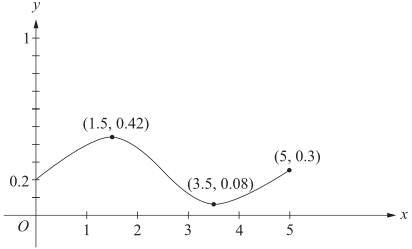
A continuous probability density function graph is drawn below.


Which of the following is the mode?

  1. 0.42
  2. 0.08
  3. 1.5
  4. 5
Show Answers Only

`C`

Show Worked Solution

`text(Mode is the most common)\ xtext(-value.)`

`ytext(-axis measures the probability.)`

`text(Highest probability = 0.42)`

`:.\ text(Mode = 1.5)`

`=>\ C`

Filed Under: Continuous Random Variables, Probability Density Functions Tagged With: Band 4, smc-7137-20-Mode, smc-7137-80-Trig PDF, smc-994-20-Mode, smc-994-80-Trig PDF

Statistics, 2ADV S3 EQ-Bank 28

The Lorenz birdwing is the largest butterfly in a habitat.

The probability density function that describes its life span, \(X\), in weeks, is given by
 

\(f(x)= \begin{cases}
\dfrac{4}{625}\left(5 x^3-x^4\right) & 0 \leq x \leq 5 \\
\\
0 & \text {elsewhere }\end{cases}\)
 

In a sample of 80 Lorenz birdwing butterflies, how many butterflies are expected to live longer than two weeks, correct to the nearest integer?  (2 marks)

--- 6 WORK AREA LINES (style=lined) ---

Show Answers Only

\(73\)

Show Worked Solution

\(\begin{aligned} \operatorname{Pr}(X>2) & =\dfrac{4}{625} \int_2^5 5 x^3-x^4 \, dx \\
& =\dfrac{4}{625}\left[\dfrac{5}{4} x^4-\dfrac{x^5}{5}\right]_2^5 \\
& =\dfrac{4}{625}\left[\left(\dfrac{5^5}{4}-\dfrac{5^5}{5}\right)-\left(\dfrac{5}{4} \times 2^4-\dfrac{2^5}{5}\right)\right] \\
& =\dfrac{4}{625}\left[\dfrac{625}{4}-\dfrac{68}{5}\right] \\
& =0.9129 \ldots\end{aligned}\)


\(\begin{aligned} \therefore \text { Expected number } & =80 \times 0.9129 \ldots \\ & \approx 73.03 \\ & \approx 73\end{aligned}\)

Filed Under: Continuous Random Variables, Probability Density Functions Tagged With: Band 5, smc-7137-30-Other Probability, smc-7137-60-Polynomial PDF, smc-994-30-Other Probability, smc-994-60-Polynomial PDF

Statistics, 2ADV S3 EQ-Bank 26

A probability density function is defined by
 

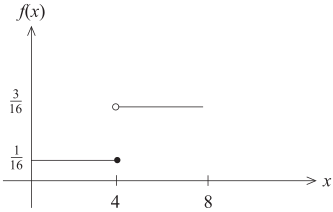
`f(x) = {(a, \ text(for)\ \ 0 <= x <= 4),(3a, \ text(for)\  4 < x <= 8):}`
 

  1. Find the value of  `a`.  (2 marks)

    --- 4 WORK AREA LINES (style=lined) ---

  2. Sketch the probability density function.  (1 mark)

    --- 6 WORK AREA LINES (style=lined) ---

  3. Find an expression for the cumulative distribution function.  (2 marks)

    --- 5 WORK AREA LINES (style=lined) ---

Show Answers Only

a.    `1/16`

b.
   

  1. `F(x) = {(x/16, text(for)\ 0 <= x <= 4),((3x)/16 – 1/2, text(for)\ 4 < x <= 8):}`
Show Worked Solution

a.    `int_0^4 a\ dx = [ax]_0^4 = 4a`

`int_4^8 3a\ dx = [3ax]_4^8 = 24a – 12a = 12a`

`4a + 12a` `= 1`
`a` `= 1/16`


b.     


c.    `text(When)\ \ 0 <= x <= 4:`

`F(x) = int 1/16\ dx = x/16 + C`

`F(0) = 0 \ => \ C = 0`

`F(x) = x/16\ \ …\ (1)`
 

`text(When)\ \ 4 < x <= 8:`

`F(x) = int 3/16\ dx = (3x)/16 + C`

`F(4) = 1/4\ \ (text{see (1) above})`

COMMENT: Understand why you can check your equation here by confirming  `F(8)=1`

`(3 xx 4)/16 + C` `= 1/4`
`C` `= −1/2`

 
`F(x) = (3x)/16 – 1/2`
 

`:. F(x) = {(x/16, \ text(for)\ \ 0 <= x <= 4),((3x)/16 – 1/2, \ text(for)\ \ 4 < x <= 8):}`

Filed Under: Continuous Random Variables, Probability Density Functions Tagged With: Band 4, Band 5, smc-7137-40-CDF, smc-7137-90-Other PDF functions, smc-994-40-Cumulative Distribution Fn, smc-994-90-Other PDF functions

Statistics, 2ADV S2 EQ-Bank 12

A probability density function  `f(x)`  is given by
 

`f(x) = {(px(3 - x), \ text(if)\ \ 0 <= x <= 3),(0, \ text(if)\ \ x < 0\ \ text(or if)\ \ x > 3):}`
 

where  `p`  is a positive constant.

  1. Find the value of  `p`.  (2 marks)

    --- 4 WORK AREA LINES (style=lined) ---

  2. Find the mode of  `f(x)`.  (2 marks)

    --- 4 WORK AREA LINES (style=lined) ---

Show Answers Only

a.    `2/9`

b.    `3/2`

Show Worked Solution

a.    `text(Total Area under curve = 1)`

`p int_0^3 3x-x^2\ dx` `= 1`
`p[3/2 x^2-(x^3)/3]_0^3` `= 1`
`p[27/2-27/3-0]` `= 1`
`(9p)/2` `= 1`
`p` `= 2/9`


b.    `f(x) = 2/9(3x-x^2)`

`f^{′}(x) = 2/9(3-2x)`

`text(S.P. when)\ \ f^{′}(x) = 0:`

`3-2x` `= 0`
`x` `= 3/2`

 
`f^{″}(x) = -4/9 < 0 \ =>\ text(MAX)`

`:.\ text(Mode) = 3/2`

Filed Under: Continuous Random Variables, Probability Density Functions Tagged With: Band 3, Band 4, smc-7137-20-Mode, smc-7137-60-Polynomial PDF, smc-994-20-Mode, smc-994-60-Polynomial PDF

Statistics, 2ADV S2 EQ-Bank 13

A function  \(f(x)\)  is given by

 \(f(x)= \begin{cases}
\dfrac{3}{4}(x-2)(4-x) & \text {if } 2 \leq x \leq 4 \\
\ \\
0 & \text{if } x<2 \text { or if } x>4
\end{cases}\)

  1. Show this curve is a probability density function.  (2 marks)

    --- 4 WORK AREA LINES (style=lined) ---

  2. Find the mode.  (2 marks)

    --- 4 WORK AREA LINES (style=lined) ---

Show Answers Only

a.    \(\text{See Worked Solutions}\)

b.    \(3\)

Show Worked Solution
b.       \(f(x)\) \( =\dfrac{3}{4}(x-2)(4-x)\)
  \(\displaystyle \int_2^4 f(x) \) \( =\dfrac{3}{4} \displaystyle\int_2^4-x^2+6 x-8 d x\)
    \( =\dfrac{3}{4}\left[\dfrac{-x^3}{3}+3 x^2-8 x\right]_2^4\)
    \( =\dfrac{3}{4}\left[\left(-\dfrac{64}{3}+48-32\right)-\left(-\dfrac{8}{3}+12-16\right)\right] \)
    \( =\dfrac{3}{4}\left(-\dfrac{16}{3}+\dfrac{20}{3}\right) \)
    \(= 1\)


\(f(2)=0, f(4)=0\)

\(f(x)>0 \text { for } 2<x<4\)

\(f(2) \geq 0 \text { for } 2 \leq x \leq 4\)

 
\(\therefore f(x) \ \text{is a probability density function.}\)
 

b.     \(f(x\) \(=\dfrac{3}{4}\left(-x^2+6 x-8\right)\)
  \(f^{\prime}(x)\) \(=\dfrac{3}{4}(-2 x+6)\)
  \(f^{\prime\prime}(x)\)  \(=-\dfrac{3}{2}\)

 
\(\text{SP when}\ f'(x) = 0\)

\(\begin{array}{r}-2 x+6=0 \\
x=3\end{array}\)

\(f^{\prime \prime}(x)<0 \Rightarrow \text {MAX}\)

\(\therefore \text {Mode}=3\)

Filed Under: Continuous Random Variables, Probability Density Functions Tagged With: Band 4, smc-7137-20-Mode, smc-7137-60-Polynomial PDF, smc-994-20-Mode, smc-994-60-Polynomial PDF

Statistics, 2ADV S3 EQ-Bank 16

A continuous random variable `X` has a probability density function given by
 

`f(x) = {{:(Cx + D),(0):}\ \ \ \ {:(2 <= x <= 5),(text(elsewhere)):}:}`
 

where `C` and `D` are constants.

Find the exact values of `C` and `D`, given the median of  `X`  is 4.  (4 marks)

--- 8 WORK AREA LINES (style=lined) ---

Show Answers Only

`C = 1/6`

`D = −1/4`

Show Worked Solution

`int_2^5 Cx + D\ dx = 1`

`[C/2 x^2 + Dx]_2^5 = 1`

`[(25/2 C + 5D) – (2C + 2D)]` `= 1`
`21/2C + 3D` `= 1`
`21C + 6D` `= 2\ \ …\ (1)`

 
`text(Using median)\ \ X = 4:`

`[C/2 x^2 + Dx]_2^4 = 0.5`

`[(8C + 4D) – (2C + 2D)]` `= 0.5`
`6C + 2D` `= 0.5\ \ …\ (2)`

  
`text(Multiply:)\ (2) xx 3`

`18C + 6D = 1.5\ \ …\ (3)`
 

`text(Subtract:)\ \ (1) – (3)`

`3C` `= 1/2`
`:. C` `= 1/6`

 
`text{Substitute into (1):}`

`21/6 + 6D` `= 2`
`6D` `= −9/6`
`:. D` `= −1/4`

Filed Under: Continuous Random Variables, Probability Density Functions Tagged With: Band 4, smc-7137-10-Median, smc-994-10-Median, smc-994-50-Linear PDF

Statistics, 2ADV S3 EQ-Bank 31

The time Jennifer spends on her homework each day varies, but she does some homework every day.

The continuous random variable \(T\), which models the time, \(t\), in minutes, that Jennifer spends each day on her homework, has a probability density function \(f\), where

\(f(t)= \begin{cases}
\dfrac{1}{625}(t-20) & 20 \leq t<45 \\
\ \\
\dfrac{1}{625}(70-t) & 45 \leq t \leq 70 \\
\ \\
0 & \text {elsewhere }
\end{cases}\)

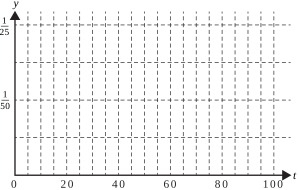
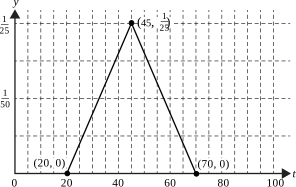
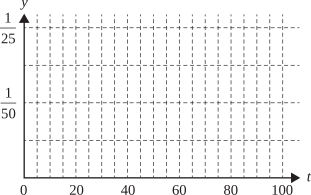
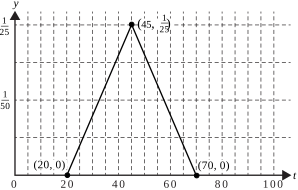
  1. Sketch the graph of  \(f(t)\) on the axes provided below.  (3 marks)


  2. Find the mode.  (1 mark)

    --- 1 WORK AREA LINES (style=lined) ---

  3. Find  \(P(25 \leq T \leq 55)\).  (2 marks)

    --- 4 WORK AREA LINES (style=lined) ---

Show Answers Only

a.
   

b.    \(45\)

c.    \(\dfrac{4}{5}\)

Show Worked Solution
a.    

MARKER’S COMMENT: Many did not draw graph along \(t\)-axis between 0 and 20 and for  \(t>70\).

 
b.   
\(\text{Mode \(=45\) (value of \(t\) at highest value of \(f(t))\)}\)
 

c.    \(P(25 \leq T \leq 55)\)

\(\begin{aligned}
& =\int_{25}^{45} \dfrac{1}{625}(t-20) d t+\int_{45}^{55} \dfrac{1}{625}(70-t) d t \\
& =\dfrac{1}{625}\left[\dfrac{t^2}{2}-20 t\right]_{25}^{45}+\dfrac{1}{625}\left[70 t-\dfrac{t^2}{2}\right]_{45}^{55} \\
& =\dfrac{1}{625}[112.5-(-187.5)]+\dfrac{1}{625}(2337.5-2137.5) \\ & =\dfrac{300}{625}+\dfrac{200}{625} \\
& =\dfrac{4}{5}
\end{aligned}\)

Filed Under: Continuous Random Variables, Probability Density Functions Tagged With: Band 5, smc-7137-20-Mode, smc-7137-30-Other Probability, smc-994-20-Mode, smc-994-30-Other Probability, smc-994-50-Linear PDF

Statistics, 2ADV S3 EQ-Bank 19

The function
 

`f(x) = {{:(k),(0):}{:(sin(pix)qquad\ \ 0<=x<=1),(qquadqquadqquadqquadquadtext(otherwise)):}`
 

is a probability density function for the continuous random variable `X`.

Show that  `k = pi/2`.  (2 marks)

--- 4 WORK AREA LINES (style=lined) ---

Show Answers Only

`text(See Worked Solutions)`

Show Worked Solution

`text(Total Area under curve) = 1\ text(u²)`

`int_0^1 k sin(pix)\ dx` `= 1`
`- k/pi [cos(pix)]_0^1` `= 1`
`- k/pi[cos(pi) – cos(0)]` `= 1`
`- k/pi[-1 – 1]` `= 1`
`2k` `= pi`
`:.k` `= pi/2`

Filed Under: Continuous Random Variables, Probability Density Functions Tagged With: Band 4, smc-7137-80-Trig PDF, smc-994-80-Trig PDF

Statistics, 2ADV S3 EQ-Bank 18

The probability density function of a continuous random variable \(X\) is given by

\(f(x)=\begin{cases}
\dfrac{x}{12} & 1 \leq x \leq 5 \\
\ \\
0 & \text {otherwise }
\end{cases}\)

Find  \(P(X < 3)\)  (2 marks)

Show Answers Only

\(\dfrac{1}{3}\)

Show Worked Solution

\(\begin{aligned}
P(X & <3)\\
& =\int_1^3 \dfrac{1}{12} x d x \\
& =\dfrac{1}{12}\left[\frac{1}{2} x^2\right]_1^3 \\
& =\dfrac{1}{24}\left[3^2-1^2\right] \\
& =\dfrac{1}{3}
\end{aligned}\)

Filed Under: Continuous Random Variables, Probability Density Functions Tagged With: Band 4, smc-7137-30-Other Probability, smc-994-30-Other Probability, smc-994-50-Linear PDF

Statistics, 2ADV S3 EQ-Bank 17

A continuous random variable, \(X\), has a probability density function given by

\(f(x)= \begin{cases}\dfrac{1}{5}\,e^{-\frac{x}{5}} & x \geq 0 \\
\ \\
0 & x<0
\end{cases}\) 

The median of \(X\) is  \(m\).

Determine the value of  \(m\).  (3 marks)

Show Answers Only

\(-5 \log _e\left(\dfrac{1}{2}\right)\) or \(5 \log _e(2)\) or \(\log _e 32\)

Show Worked Solution

\(\begin{aligned} \dfrac{1}{5} \int_0^m e^{-\frac{x}{5}} d x & =\dfrac{1}{2} \\
\dfrac{1}{5} \times(-5)\left[e^{-\frac{x}{5}}\right]_0^m & =\dfrac{1}{2} \\
{\left[-e^{-\frac{x}{5}}\right]_0^m } & =\dfrac{1}{2} \\
-e^{-\frac{m}{5}}+1 & =\frac{1}{2} \\ e^{-\frac{m}{5}} & =\dfrac{1}{2} \\
-\frac{m}{5} & =\log _e\left(\dfrac{1}{2}\right)
\end{aligned}\)

\(\therefore m=-5 \log _e\left(\dfrac{1}{2}\right)\) (or \(5 \log _e(2)\), or \(\log _e 32\) )

Filed Under: Continuous Random Variables, Probability Density Functions Tagged With: Band 4, smc-7137-10-Median, smc-7137-90-Other PDF functions, smc-994-10-Median, smc-994-90-Other PDF functions

Statistics, 2ADV S3 EQ-Bank 22

The probability density function  \(f(x)\)  of a random variable \(X\) is given by

\(f(x)=\begin{cases}
\dfrac{x+1}{12} & 0 \leq x \leq 4 \\
\ \\
0 & \text{otherwise }
\end{cases}\)

Find the value of \(b\) such that \(P(X \leq b)=\dfrac{5}{8}\).  (3 marks)

Show Answers Only

\(3\)

Show Worked Solution

\(\begin{aligned}
\dfrac{1}{12} \int_0^b(x+1) d x & =\dfrac{5}{8} \\
{\left[\dfrac{1}{2} x^2+x\right]_0^b } & =\dfrac{15}{2} \\
\dfrac{1}{2} b^2+b & =\dfrac{15}{2} \\
b^2+2 b-15 & =0 \\ (b+5)(b-3) & =0
\end{aligned}\)

\(\therefore b=3 \quad(0 \leq b \leq 4)\)

Filed Under: Continuous Random Variables, Probability Density Functions Tagged With: Band 4, smc-7137-30-Other Probability, smc-994-30-Other Probability, smc-994-50-Linear PDF

Statistics, 2ADV S3 EQ-Bank 21

The continuous random variable `X` has a distribution with probability density function given by
 

`f(x) = {(ax(5 - x), \ text(if)\ \ 0 <= x <= 5), (0,\ text (if)\ \ x < 0\ \ text(or if)\ \ x > 5):}`
 

where `a` is a positive constant.

  1. Find the value of  `a`.  (3 marks)

    --- 6 WORK AREA LINES (style=lined) ---

  2. Express  `P(X < 3)`  as a  definite integral. (Do not evaluate the definite integral.)  (1 mark)

    --- 2 WORK AREA LINES (style=lined) ---

Show Answers Only
  1. `6/125`
  2. `int_0^3 ax(5 – x)\ dx`
Show Worked Solution
a.   `text(Total Area under curve)` `= 1`
  `a int_0^5 (5x – x^2)\ dx` `= 1`
  `a [5/2 x^2 – 1/3 x^3]_0^5` `= 1`
  `a [(125/2 – 125/3) – (0)]` `= 1`
  `125/6 a` `= 1`
  `:. a` `= 6/125`


b.   `P(X < 3) = int_0^3 ax(5 – x)\ dx`

Filed Under: Continuous Random Variables, Probability Density Functions Tagged With: Band 4, smc-7137-30-Other Probability, smc-7137-60-Polynomial PDF, smc-994-30-Other Probability, smc-994-60-Polynomial PDF

Statistics, 2ADV S3 EQ-Bank 7 MC

A probability density function  \(f(x)\)  is given by

\(f(x)= \begin{cases}
\dfrac{1}{12}\left(8 x-x^3\right) & 0 \leq x \leq 2 \\
\ \\
0 & \text{elsewhere }
\end{cases}\)

The median  \(m\)  of this function satisfies the equation

  1. \(-m^4+16 m^2-6=0\)
  2. \(m^4-16 m^2=0\)
  3. \(m^4-16 m^2+24=0.5\)
  4. \(m^4-16 m^2+24=0\)
Show Answers Only

\(D\)

Show Worked Solution

\(\begin{aligned} \int_0^m \dfrac{1}{12}\left(8 x-x^3\right) d x & =0.5 \\
{\left[\dfrac{1}{12}\left(4 x^2-\dfrac{x^4}{4}\right)\right]_0^m } & =0.5 \\
4 m^2-\dfrac{m^4}{4} & =6 \\
16 m^2-m^4 & =24 \\ m^4-16 m^2+24 & =0
\end{aligned}\)

\(\Rightarrow D\)

Filed Under: Continuous Random Variables, Probability Density Functions Tagged With: Band 5, smc-7137-10-Median, smc-7137-60-Polynomial PDF, smc-994-10-Median, smc-994-60-Polynomial PDF

Statistics, 2ADV S3 EQ-Bank 6 MC

The continuous random variable, \(X\), has a probability density function given by

\(f(x)= \begin{cases}
\dfrac{1}{4} \cos \left(\dfrac{x}{2}\right) & 3 \pi \leq x \leq 5 \pi \\
\ & \ \\
0 & \text {elsewhere}
\end{cases}\)

The value of \(a\) such that  \(P(X<a)=\dfrac{\sqrt{3}+2}{4}\)  is

  1. \(\dfrac{19 \pi}{6}\)
  2. \(\dfrac{14 \pi}{3}\)
  3. \(\dfrac{10 \pi}{3}\)
  4. \(\dfrac{29 \pi}{6}\)
Show Answers Only

\(B\)

Show Worked Solution

\(\begin{aligned}
\int_{3 \pi}^a \dfrac{1}{4}\, \cos \left(\dfrac{x}{2}\right) d x & =\dfrac{\sqrt{3}+2}{4} \\
{\left[\dfrac{1}{2}\, \sin \left(\dfrac{x}{2}\right)\right]_{3 \pi}^a } & =\dfrac{\sqrt{3}+2}{4} \\
\dfrac{1}{2}\left[\sin \left(\dfrac{a}{2}\right)-\sin \left(\dfrac{3 \pi}{2}\right)\right] & =\dfrac{\sqrt{3}+2}{4} \\
\dfrac{1}{2}\, \sin \left(\dfrac{a}{2}\right)+\dfrac{1}{2} & =\dfrac{\sqrt{3}+2}{4} \\
\sin \left(\dfrac{a}{2}\right) & =\dfrac{\sqrt{3}}{2} \\
\dfrac{a}{2} & =\dfrac{\pi}{3}, \dfrac{2 \pi}{3}, \dfrac{7 \pi}{3}, \ldots \\
\therefore a & =\dfrac{14 \pi}{3} \quad(3 \pi \leq a \leq 5 \pi)
\end{aligned}\)

\(\Rightarrow B\)

Filed Under: Continuous Random Variables, Probability Density Functions Tagged With: Band 5, smc-7137-30-Other Probability, smc-7137-80-Trig PDF, smc-994-30-Other Probability, smc-994-80-Trig PDF

Statistics, 2ADV S3 EQ-Bank 5 MC

The function  `f(x)`  is a probability density function of a continuous random variable with the rule
 

`f(x) = {(ae^x, 0 <= x <= 1), (ae, 1 < x <= 2), (\ 0, text(otherwise)):}`
 

The value of `a` is

A.   `1`

B.   `1/e`

C.   `1/(2e)`

D.   `1/(2e - 1)`

Show Answers Only

`D`

Show Worked Solution

`text(Total area) = 1`

`int_0^1 ae^x\ dx + int_1^2 ae\ dx` `= 1`
`[ae^x]_0^1 + [ae*x]_1^2` `=1`
`[ae-a] + [2ae-ae]` `=1`
`2ae-a` `=1`
`a(2e-1)` `=1`
`:. a` `= 1/(2e – 1)`

 
`=>   D`

Filed Under: Continuous Random Variables, Probability Density Functions Tagged With: Band 4, smc-7137-90-Other PDF functions, smc-994-90-Other PDF functions

Statistics, 2ADV S3 EQ-Bank 36

The continuous random variable \(X\) has a probability density function given  by
 

\(f(x)= \begin{cases}
\cos(2x)& \text {if}\quad \dfrac{3 \pi}{4}<x<\dfrac{5 \pi}{4} \\
\ \\
0 & \text{elsewhere}
\end{cases}\)
 

Find the value of  \(a\) such that  \(P(X < a) = 0.25\). Give your answer correct to 2 decimal places.   (3 marks)

--- 6 WORK AREA LINES (style=lined) ---

Show Answers Only

\(2.8\)

Show Worked Solution

\(\displaystyle \int_{\frac{3 x}{4}}^a \cos (2 x) d x=0.25\)

\begin{aligned}
\frac{1}{2}[\sin (2 x)]_{\frac{3 \pi}{4}}^a & =0.25 \\
{\left[\sin (2 a)-\sin \left(\frac{3 \pi}{2}\right)\right] } & =0.5 \\
\sin (2 a)+1 & =0.5 \\
2 a & =\sin ^{-1}(-0.5) \\
& =-0.5235
\end{aligned}

\(\text {Since sin is negative in 3rd/4th quadrants: }\)

\begin{aligned}
2 a & =\pi+0.5234 \\
a &=1.832 \ldots \quad \text { (not in range) } \\
&\text { or } \\
2a & =2 \pi-0.5234 \\
 a &=2.87989 \ldots \\
&=2.88 \quad\left(\text{in range: } \frac{3 \pi}{4}<x<\frac{5 \pi}{4}\right)
\end{aligned}

Filed Under: Continuous Random Variables, Probability Density Functions Tagged With: Band 6, smc-7137-30-Other Probability, smc-7137-80-Trig PDF, smc-994-30-Other Probability, smc-994-80-Trig PDF

Statistics, 2ADV S3 EQ-Bank 33

The continuous random variable `X` has a probability density function given by
 

`f(x) = {(pi sin (2 pi x), text(if)\ \ 0 <= x <= 1/2), (0, text(elsewhere)):}`
 

Find the value of  `a`  such that  `P(X > a) = 0.2`. Give your answer to 2 decimal places.   (3 marks)

--- 6 WORK AREA LINES (style=lined) ---

Show Answers Only

`0.35`

Show Worked Solution

`int_a^(1/2) pi sin (2 pi x)\ dx = 0.2`

`-1/2 [cos(2 pi x)]_a^(1/2)` `=0.2`  
`-1/2[cos(pi) -cos(2 pia)]`  `=0.2`  
`-1/2(-1-cos(2pia))` `=0.2`  
`-1-cos(2pia)` `=-0.4`  
`cos(2pia)` `=-0.6`  
`2pia` `=cos^(-1)(-0.6)`  
`:.a` `=cos^(-1)(-0.6)/(2pi)`  
  `=0.3524…`  
  `=0.35\ \ \ text{(to 2 d.p.)}`  

Filed Under: Continuous Random Variables, Probability Density Functions Tagged With: Band 5, smc-7137-30-Other Probability, smc-7137-80-Trig PDF, smc-994-30-Other Probability, smc-994-80-Trig PDF

Statistics, 2ADV S3 EQ-Bank 20

If a continuous random variable  \(X\)  has probability density function

\(f(x)=
\begin{cases}
\dfrac{x}{2} & \text{if } \quad 0 \leq x \leq 2 \\
\ \\
0 & \text {otherwise }
\end{cases}\)

Find the exact value of  \(p\)  such that  \(P(X>p) = 0.4\).   (3 marks)

Show Answers Only

\(\dfrac{2 \sqrt{15}}{5}\)

Show Worked Solution

\(\displaystyle \int_p^2 \dfrac{x}{2} d x=0.4\)

\(\begin{aligned} {\left[\dfrac{x^2}{4}\right]_p^2 } & =\dfrac{2}{5} \\
1-\dfrac{p^2}{4} & =\dfrac{2}{5} \\
\dfrac{p^2}{4} & =\dfrac{3}{5} \\ p^2 & =\dfrac{12}{5} \\
\therefore p & =\dfrac{2 \sqrt{3}}{\sqrt{5}} \\
& =\dfrac{2 \sqrt{15}}{5} \quad(0 \leq p \leq 2)
\end{aligned}\)

Filed Under: Continuous Random Variables, Probability Density Functions Tagged With: Band 4, smc-7137-30-Other Probability, smc-994-30-Other Probability, smc-994-50-Linear PDF

Copyright © 2014–2026 SmarterEd.com.au · Log in