Consider the functions `f: R -> R,\ \ f(x) = 3 + 2x-x^2` and `g: R -> R,\ \ g(x) = e^x`
- State the rule of `g(f(x))` . (1 mark)
--- 2 WORK AREA LINES (style=lined) ---
- Find the values of `x` for which the derivative of `g(f(x))` is a negative. (2 marks)
--- 4 WORK AREA LINES (style=lined) ---
- State the rule of `f(g(x))`. (1 mark)
--- 2 WORK AREA LINES (style=lined) ---
- Solve `f(g(x)) = 0`. (2 marks)
--- 5 WORK AREA LINES (style=lined) ---
- Find the coordinates of the stationary point of the graph of `f(g(x))`. (2 marks)
--- 5 WORK AREA LINES (style=lined) ---
- State the number of solutions to `g(f(x)) + f(g(x)) = 0`. (1 mark)
--- 5 WORK AREA LINES (style=lined) ---
a. `g(f(x)) = e^(3 + 2x-x^2)`
b. `d/(dx) g(f(x)) = (2-2x)e^(3 + 2x-x^2)`
`e^(3 + 2x-x^2) > 0\ \ text(for all)\ \ x`
`=> d/(dx) g(f(x)) < 0\ \text(when):`
| `2-2x` | `< 0` |
| `x` | `> 1` |
c. `f(g(x)) = 3 + 2e^x-e^(2x)`
d. `e^(2x)-2e^x-3 = 0`
`text(Let)\ \ X = e^x`
| `X^2-2X-3` | `= 0` |
| `(X-3)(X + 1)` | `= 0` |
`X = 3 or -1`
`text(When)\ \ X = 3,\ \ e^x = 3 => x = ln 3`
`text(When)\ \ X = -1,\ \ e^x = -1 \ => \ text(no solution)`
`:. x = ln 3`
| e. | `d/(dx)\ f(g(x))` | `= 2e^x-2e^(2x)` |
| `= 2e^x (1-e^x)` |
`text(S.P. occurs when:)`
| `2e^x(1-e^x)` | `= 0` |
| `e^x` | `= 1` |
| `x` | `= 0` |
`text(When)\ \ x = 0,`
| `f(g(x))` | `= 3 + 2-1=4` |
`:.\ text(S.P. at)\ \ (0, 4)`
f. `text(Solutions occur when)\ \ g(f(x)) = -f(g(x))`
`text{Sketch both graphs (using parts a-e):}`
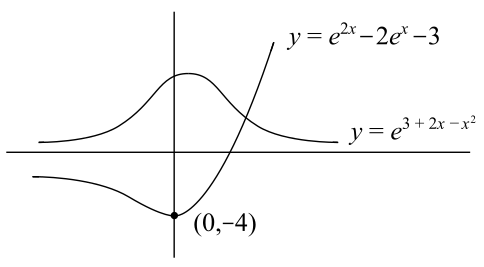
`:. 1\ text(solution only)`