Graph the polynomial \(P(x)=(x+1)^2(2-x)^3\) on the grid below, clearly identifying all axis intercepts. (3 marks)
--- 5 WORK AREA LINES (style=lined) ---
Aussie Maths & Science Teachers: Save your time with SmarterEd
Graph the polynomial \(P(x)=(x+1)^2(2-x)^3\) on the grid below, clearly identifying all axis intercepts. (3 marks)
--- 5 WORK AREA LINES (style=lined) ---
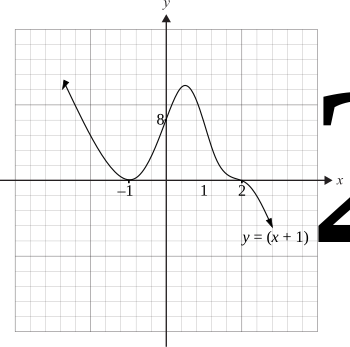
\(P(x)=(x+1)^2(2-x)^3 \ \ \Rightarrow\ \ \text{zeros at} \ \ x=-1,2\)
\(\text{At} \ \ x=-1, m (\text{multiplicity})=2 \ \ \Rightarrow\ \ \text{curve is a tangent to} \ x \text{-axis}\)
\(\text{At} \ \ x=2, m=3 \ \ \Rightarrow\ \ \text{curve has horizontal POI.}\)
\(\text{At} \ \ x=0, P(x)=(1)^2(2)^3=8\)
Graph the polynomial \(p(x)=(x-1)\left(x^2+3 x+1\right)\), clearly identifying all axis intercepts. (3 marks)
--- 5 WORK AREA LINES (style=lined) ---
\(p(x)=(x-1)\left(x^2+3 x+1\right)\)
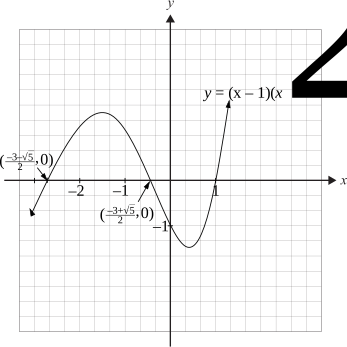
\(\text{Zeros:} \ \ x=1, x=\dfrac{-3 \pm \sqrt{9-4 \cdot 1 \cdot 1}}{2}=\dfrac{-3 \pm \sqrt{5}}{2}\ \ (\approx-2.62,-0.38)\)
\(\text{At}\ \ x=1, m(\text{multiplicity})=1 \ \Rightarrow \ \text{curve crosses}\ x\text {-axis}\)
\(\text{At} \ \ x=\dfrac{-3 \pm \sqrt{5}}{2}, m=1 \ \Rightarrow \ \text{curve crosses} \ x\text {-axis}\)
\(p(0)=(-1)(1)=-1\)
`D`
`y = x(1-x)^3 (3-x)^2`
`text(By elimination)`
`text(Consider when)\ \ x < 0:`
`y = text{(–ve)} xx text{(+ve)} xx text{(+ve)} < 0`
`:.\ text(Cannot be)\ A\ text(or)\ C`
`text(Consider the cubic factor)\ (1-x)^3:`
`text(The graph must have a stationary point at)\ x = 1`
`:.\ text(Cannot be)\ B`
`=> D`