Solve \(2 \log _3(x-4)+\log _3(x)=2\) for \(x\). (4 marks) --- 8 WORK AREA LINES (style=lined) ---
\(1^3-8(1)^2+16(1)-9=0\) \(\therefore\ x-1\ \text{is a factor} \) \((x-1)(x^2-7x+9)=0\) \(\text{Using quadratic formula to solve}\ \ x^2-7x+9=0:\) \( x=1, \dfrac{7- \sqrt{13}}{2}, \dfrac{7 + \sqrt{13}}{2}\) \(\therefore\ \dfrac{7 + \sqrt{13}}{2}\ \text{ is the only possible solution.}\)
\(2\log_3(x-4)+\log_3(x)\)
\(=2\)
\(\log_3x(x-4)^2\)
\(=2\)
\(x(x-4)^2\)
\(=3^2\)
\(x(x^2-8x+16)-9\)
\(=0\)
\(x^3-8x^2+16x-9\)
\(=0\)
\(\text{Find a factor}\ \ \Rightarrow\ \ \text{Test}\ \ x=1:\)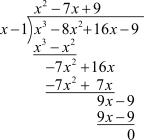
\(x\)
\(=\dfrac{-(-7)\pm\sqrt{(-7)^2-4(1)(9)}}{2(1)}\)
\(=\dfrac{7\pm \sqrt{49-36}}{2}\)
\(=\dfrac{7\pm \sqrt{13}}{2}\)
\(\text{For }\log_3(x-4)\ \text{to exist}\ x>4\)
Functions, MET2 2024 VCAA 1
Consider the function \( f: R \rightarrow R, f(x)=(x+1)(x+a)(x-2)(x-2 a) \text { where } a \in R \text {. } \) --- 2 WORK AREA LINES (style=lined) --- --- 4 WORK AREA LINES (style=lined) --- ii. exactly four \(x\)-intercepts. (1 mark) --- 3 WORK AREA LINES (style=lined) --- --- 2 WORK AREA LINES (style=lined) --- ii. Find the coordinates of the local maximum of \(g\). (1 mark) --- 3 WORK AREA LINES (style=lined) --- iii. Find the values of \(x\) for which \(g^{\prime}(x)>0\). (1 mark) --- 3 WORK AREA LINES (style=lined) --- iv. Consider the two tangent lines to the graph of \(y=g(x)\) at the points where --- 5 WORK AREA LINES (style=lined) --- Let \(h\) be the function \(h: R \rightarrow R, h(x)=(x+1)(x-1)(x+2)(x-2)\), which is the function \(f\) where \(a=-1\). --- 4 WORK AREA LINES (style=lined) --- ii. Using a dilation and translations, describe a different sequence of transformations of \(h\), for which its image would have both local minimums at the same coordinates as that of \(g\). (2 marks) --- 6 WORK AREA LINES (style=lined) ---
a. \(x=-1, x=a, x=2, x=2a\) bi. \(a=0, -2, -\dfrac{1}{2}\) bii. \(\text{The solution must be all }R\ \text{except those that give 3 or less solutions.}\) \(\therefore\ R\ \backslash\left\{ -2, -\dfrac{1}{2}, 0, 1\right\}\) \(\text{From graph local maximum occurs when }x=\dfrac{1}{2}\) ciii. \(\text{From graph}\ g^{\prime}(x)>0\ \text{when }x\in\left(-1, \dfrac{1}{2}\right)\cup (2, \infty)\) civ. \(\text{Use CAS to find tangent lines and solve to find intersection.}\) \(\text{Point of intersection of tangent lines}\ \left(\dfrac{1}{2}, \dfrac{27}{4}\right)\) di. \(\text{Local maximum of }g(x)\ \rightarrow\left(\dfrac{1}{2}, \dfrac{81}{16}\right)\) \(\text{From CAS local maximum of }h(x)\ \rightarrow \left(0, 4\right)\) \(\therefore\ \text{Translate }\dfrac{1}{2}\ \text{unit to the right and }\dfrac{81}{16}-4=\dfrac{17}{16}\ \text{units upwards.}\) dii. \(\text{Using CAS to solve }g^{\prime}(x)=0\ \text{and }h^{\prime}(x)=0\) \(\text{Local Minimums for }g(x)\ \text{at }(-1, 0)\ \text{and }(2, 0)\ \text{which are 3 apart.}\) \(\text{Local minimums for at }h(x)\ \text{at }\left(-\sqrt{\dfrac{5}{2}}, -\dfrac{9}{4}\right)\ \text{and }\left(\sqrt{\dfrac{5}{2}}, -\dfrac{9}{4}\right)\) \(\therefore\ \text{Combination is a dilation of }h(x)\ \text{by a factor of}\ \dfrac{3}{\sqrt{10}}\ \text{followed by a }\) \(\text{translation of }\dfrac{1}{2} \ \text{a unit to the right and an upwards translation of}\ \dfrac{9}{4} \ \text{units.}\)
i. exactly three \(x\)-intercepts. (2 marks)
i. Find \(g^{\prime}(x)\) (1 mark)
\(x=\dfrac{-\sqrt{3}+1}{2}\) and \(x=\dfrac{\sqrt{3}+1}{2}\). Determine the coordinates of the point of intersection of these two tangent lines. (2 marks)
i. Using translations only, describe a sequence of transformations of \(h\), for which its image would have a local maximum at the same coordinates as that of \(g\). (1 mark)
Show Worked Solution
ci.
\(g^{\prime}(x)\)
\(=2(2-x)(x+1)^2+(x-2)^22(x+1)\)
\(=2(x-2)(x+1)(x+1+x+2)\)
\(=2(x-2)(x+1)(2x-1)\)
cii. \(\text{When }g^{\prime}(x)=0, x=2, -1, \dfrac{1}{2}\)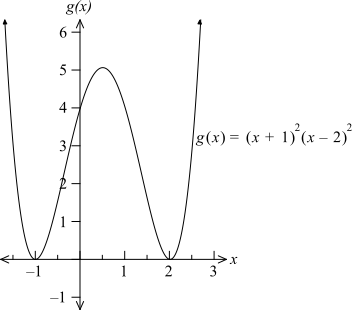
\(g\left(\dfrac{1}{2}\right)\)
\(=\left(\dfrac{1}{2}+1\right)^2\left(\dfrac{1}{2}-2\right)^2\)
\(=\dfrac{9}{4}\times \dfrac{9}{4}=\dfrac{81}{16}\)
\(\therefore\ \text{Local maximum at}\ \left(\dfrac{1}{2} , \dfrac{81}{16}\right)\)
Algebra, MET2-NHT 2019 VCAA 3 MC
If `x + a` is a factor of `8x^3 - 14x^2 - a^2 x`, where `a ∈ R text(\{0})`, then the value of `a` is
- 7
- 4
- 1
- –2
- –1
Algebra, MET1 SM-Bank 24
The polynomial `p(x) = x^3-ax + b` has a remainder of 2 when divided by `(x-1)` and a remainder of 5 when divided by `(x + 2)`.
Find the values of `a` and `b`. (3 marks)
--- 6 WORK AREA LINES (style=lined) ---
Algebra, MET1 SM-Bank 23
The graph of `P(x) = x^2 + ax + b` cuts the `x`-axis when `x=2.` When `P(x)` is divided by `x + 1`, the remainder is 18.
Find the values of `a` and `b`. (3 marks)
--- 8 WORK AREA LINES (style=lined) ---
Algebra, MET2 SM-Bank 7 MC
If `x-2` is a factor of `2x^3 - 10x^2 + 6x + a` where `a in R text{\}{0},` then the value of `a` is
A. `-68`
B. `-20`
C. `-2`
D. `2`
E. `12`
Algebra, MET2 2011 VCAA 3 MC
If `x + a` is a factor of `4x^3 - 13x^2 - ax` where `a ∈ R text(\{0})`, then the value of `a` is
A. `−4`
B. `−3`
C. `−1`
D. `1`
E. `2`
Algebra, MET2 2013 VCAA 3 MC
If `x + a` is a factor of `7x^3 + 9x^2 - 5ax`, where `a in R text(\){0}`, then the value of `a` is
A. `-4`
B. `-2`
C. `-1`
D. `1`
E. `2`