SmarterEd

Aussie Maths & Science Teachers: Save your time with SmarterEd

  • Login
  • Get Help
  • About

Algebra, STD2 A4 2025 HSC 11 MC

The thickness of the skin of a spherical balloon varies inversely with the surface area of the balloon.

What would be the effect on the thickness of the skin if the radius of the balloon is doubled?

  1. Divided by 2
  2. Multiplied by 2
  3. Divided by 4
  4. Multiplied by 4
Show Answers Only

\(C\)

Show Worked Solution

\(\text{Thickness}\ (T) \propto \dfrac{1}{\text{S.A. balloon}}\)

\(\text{Since}\ \ \text{S.A.}\ = 4\pi\,r^2:\)

\(T \propto\ \dfrac{1}{r^2}\)

\(\text{If \(r\) is doubled, \(T\) will be reduced to}\ \dfrac{1}{4}T.\)

\(\Rightarrow C\)

Filed Under: Non-Linear: Inverse and Other Problems (Std 2) Tagged With: Band 5, smc-795-40-Proportional

v1 Algebra, STD2 A4 EO-Bank 2

The number of chairs that can be placed around a circular stage varies inversely with the space left between each chair.

There will be 72 chairs if the distance between them is 0.5 metres.

  1. How many chairs can be placed if the distance between them is 0.9 metres?   (2 marks)

    --- 4 WORK AREA LINES (style=lined) ---

  2. What is the spacing between chairs if 90 chairs are placed around the stage?   (1 mark)

    --- 1 WORK AREA LINES (style=lined) ---

Show Answers Only

a.   40 chairs

b.   0.4 metres

Show Worked Solution

a.   `c \prop 1/d\ \ =>\ \ c=k/d`

`72` `= k/0.5`
`k` `= 0.5 xx 72 = 36`

 
`text(Find)\ c\ text(when)\ \ d = 0.9:`

`c=36/0.9=40\ \text{chairs}`
 

b.   `text(Find)\ d\ text(when)\ \ c = 90:`

`90` `= 36/d`
`d` `= 36/90`
  `= 0.4\ text(metres)`

Filed Under: Non-Linear: Inverse and Other Problems (Std 2-X) Tagged With: Band 5, smc-795-10-Inverse, smc-795-40-Proportional

v1 Algebra, STD2 A4 2018 HSC 29c

Snowhound makes snow shoes of various sizes. In its design phase, Snowhound collect data on the different footprint depths of snow shoes of different sizes, all worn by the same person.

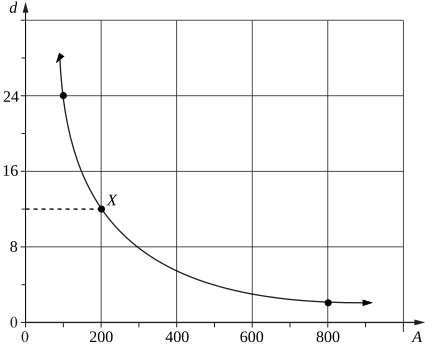
 The footprint depth (`d` cm) is then graphed against the area of the sole of the snow shoe (`A` cm).


  1. The graph shape shows that `d` is inversely proportional to `A`. The point `X` lies on the graph.


    Find the equation relating `d` and `A`.  (2 marks)

    --- 4 WORK AREA LINES (style=lined) ---

  2. A man from this group walks in snow and the depth of his footprint is 5 cm.


    Use your equation from part (a) to calculate the area of his shoe sole.  (1 mark)

    --- 1 WORK AREA LINES (style=lined) ---

Show Answers Only

a.   `D = 4500/A`

b.   `480\ text(cm)^2`

Show Worked Solution

a.   `d prop 1/A \ =>\ d = k/A`

`text(When)\ D = 12, A = 200:`

`12` `= k/200`
`k` `= 12 xx 200 = 2400`
`:. d` `=2400/A`


b.    `5` `= 2400/A`
  `:. A` `= 2400/5= 480\ text(cm)^2`

Filed Under: Non-Linear: Inverse and Other Problems (Std 2-X) Tagged With: Band 5, smc-795-10-Inverse, smc-795-40-Proportional

v1 Algebra, STD2 A4 2011 HSC 28a

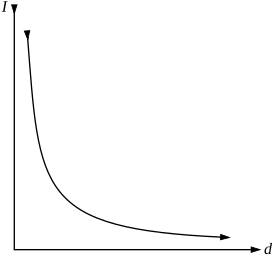
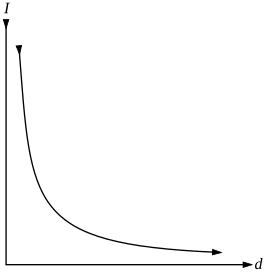
The intensity of light, `I`, from a lamp varies inversely with the square of the distance, `d`, from the lamp.

  1. Write an equation relating `I`, `d` and `k`, where `k` is a constant.    (1 mark)

    --- 2 WORK AREA LINES (style=lined) ---

  2. It is known that `I = 20` when `d = 2`.


    By finding the value of the constant, `k`, find the value of `I` when `d = 5`.    (2 marks)

    --- 4 WORK AREA LINES (style=lined) ---

  3. Sketch a graph to show how `I` varies for different values of `d`.


    Use the horizontal axis to represent distance and the vertical axis to represent light intensity.   (2 marks)

    --- 8 WORK AREA LINES (style=lined) ---


Show Answers Only

a.   `I = k/d^2`

b.   `P = 1 1/2`

c.   
         

Show Worked Solution

a.   `I prop 1/d\ \ =>\ \ I=k/d^2`
 

b.  `text(When)\ I=20, d=2:`

`20` `= k/2^2`
`k` `=4 xx 20=80`

 
`text(Find)\ I\ text(when)\ d = 5:`

`I=80/5^2=16/5`
 

c.

Filed Under: Non-Linear: Inverse and Other Problems (Std 2-X) Tagged With: Band 5, num-title-ct-patha, num-title-qs-hsc, smc-4239-30-a prop 1/b, smc-795-10-Inverse, smc-795-40-Proportional

v1 Algebra, STD2 A4 2021 HSC 13 MC

The time taken to harvest a field varies inversely with the number of workers employed.

It takes 12 workers 36 hours to harvest the field.

Working at the same rate, how many hours would it take 27 workers to harvest the same field?

  1. 12
  2. 16
  3. 24
  4. 54
Show Answers Only

`B`

Show Worked Solution

`text{Time to harvest}\ (T) prop 1/text{Number of workers (W)}`

`T=k/W`

`text(When)\ \ T=36, W=12:`

`36=k/12\ \ =>\ \ k=36 xx 12 = 432`  
 

`text{Find}\ T\ text(when)\ \ W=27:`

`T=432/27=16\ \text{hours}`

 `=>  B`

Filed Under: Non-Linear: Inverse and Other Problems (Std 2-X) Tagged With: Band 5, smc-795-10-Inverse, smc-795-40-Proportional

v1 Algebra, STD2 A4 2007 HSC 15 MC

If the speed `(s)` of a journey varies inversely with the time `(t)` taken, which formula correctly expresses `s` in terms of `t` and `k`, where `k` is a constant?

  1. `s = k/t`
  2. `s = kt`
  3. `s = k + t`
  4. `s = t/k`
Show Answers Only

`A`

Show Worked Solution

`s prop 1/t \ \ => \ s = k/t`

`=>  A`

Filed Under: Non-Linear: Inverse and Other Problems (Std 2-X) Tagged With: Band 4, num-title-ct-patha, num-title-qs-hsc, smc-4239-30-a prop 1/b, smc-795-10-Inverse, smc-795-40-Proportional

v1 Algebra, STD2 A4 2010 HSC 13 MC

The time taken to charge a battery varies inversely with the charging voltage. At 24 volts \((V)\) it takes 15 hours to fully charge a battery.

How long will it take the same battery to fully charge at 40 volts?

  1. 8 hours
  2. 9 hours
  3. 10.5 hours
  4. 12 hours
Show Answers Only

`B`

Show Worked Solution
 
♦ Mean mark 50% 

`text{Time to charge}\ (T) prop 1/text(Voltage) \ => \ T=k/V`

`text(When) \ T=15, V = 24:`

`15=k/24\ \ => \ k=15 xx 24=360` 
   

`text{Find}\ T\ text{when}\ \ V= 40:}`

`T=360/40=9\ \text{hours}`

 `=>  B`

Filed Under: Non-Linear: Inverse and Other Problems (Std 2-X) Tagged With: Band 5, num-title-ct-patha, num-title-qs-hsc, smc-4239-30-a prop 1/b, smc-795-10-Inverse, smc-795-40-Proportional

v1 Algebra, STD2 A4 2024 HSC 9 MC

The time taken to fill a swimming pool varies inversely with the number of hoses being used.

Using 4 hoses, it takes 18 hours to fill the pool.

How many hours would it take 9 hoses to fill the same pool?

  1. 6
  2. 7.5
  3. 8
  4. 12
Show Answers Only

\(C\)

Show Worked Solution

\(T \propto \dfrac{1}{H} \ \Rightarrow \ \ T=\dfrac{k}{H}\)

\(\text {Find}\ k\ \text{given}\ \  T=18\ \ \text {when}\ \ H=4 \text {:}\)

\(18=\dfrac{k}{4} \ \Rightarrow\ \ k=72\)
 

\(\text {Find}\ T \ \text {if}\ \ H=9:\)

\(T=\dfrac{72}{9}=8 \text { hours}\)

\(\Rightarrow C\)

Filed Under: Non-Linear: Inverse and Other Problems (Std 2-X) Tagged With: Band 4, smc-795-10-Inverse, smc-795-40-Proportional

Algebra, STD2 A4 2024 HSC 9 MC

The time taken to paint a school varies inversely with the number of painters completing the task.

It takes 6 painters a total of 20 days to paint a school.

How many days would it take 15 painters to paint the same school?

  1. 4.5
  2. 8
  3. 15.5
  4. 50
Show Answers Only

\(B\)

Show Worked Solution

\(T \propto \dfrac{1}{N} \ \Rightarrow \ \ T=\dfrac{k}{N}\)

\(\text {Find}\ k\ \text{given}\ \  T=20\ \ \text {when}\ \ N=6 \text {:}\)

\(20=\dfrac{k}{6} \ \Rightarrow\ \ k=120\)

\(\therefore\ T=\dfrac{120}{N}\)

\(\text {Find}\ T \ \text {if}\ \ N=15:\)

\(T=\dfrac{120}{15}=8 \text { days }\)

\(\Rightarrow B\)

Filed Under: Non-Linear: Inverse and Other Problems (Std 2) Tagged With: Band 4, smc-795-10-Inverse, smc-795-40-Proportional

Algebra, STD2 A4 2021 HSC 13 MC

The time taken to clean a warehouse varies inversely with the number of cleaners employed.

It takes 8 cleaners 60 hours to clean a warehouse.

Working at the same rate, how many hours would it take 10 cleaners to clean the same warehouse.

  1. 45
  2. 48
  3. 62
  4. 75
Show Answers Only

`B`

Show Worked Solution

`text{Time to clean}\ (T) prop 1/text{Number of cleaners (C)}`

♦ Mean mark 41%.

`T=k/C`

`text(When)\ \ T=60, C=8`

`60` `=k/8`
`k` `=480`


`text{Find}\ \ T\ \ text(when)\ \ C=10:`

`T` `=480/10`
  `=48\ text(hours)`

 
`=>  B`

Filed Under: Non-Linear: Inverse and Other Problems (Std 2) Tagged With: Band 5, smc-795-10-Inverse, smc-795-40-Proportional

Algebra, STD2 A4 SM-Bank 10

The number of trees that can be planted along the fence line of a paddock varies inversely with the distance between each tree.

There will be 108 trees if the distance between them is 5 metres.

  1. How many trees can be planted if the distance between them is 6 metres?  (2 marks)

    --- 4 WORK AREA LINES (style=lined) ---

  2. What is the distance between the trees if 120 trees are planted.  (1 mark)

    --- 1 WORK AREA LINES (style=lined) ---

Show Answers Only

a.   `90`

b.   `4.5\ text(metres)`

Show Worked Solution

a.   `t \prop 1/d \ \ =>\ \ t=k/d`

`108` `= k/5`
`k` `= 540`

 
`text(Find)\ \ t\ \ text(when)\ \ d = 6:`

`t= 540/6= 90`
 

ii.   `text(Find)\ \ d\ \ text(when)\ \ t = 120:`

`120` `= 540/d`
`d` `= 540/120`
  `= 4.5\ text(metres)`

Filed Under: Non-Linear: Inverse and Other Problems (Std 2) Tagged With: Band 5, smc-795-10-Inverse, smc-795-40-Proportional

Algebra, STD2 A4 2018 HSC 29c

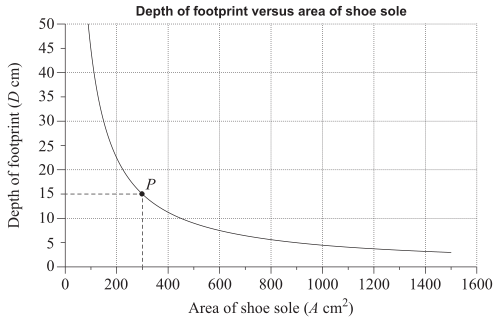
When people walk in snow, the depth (`D` cm) of each footprint depends on both the area (`A` cm²) of the shoe sole and the weight of the person. The graph shows the relationship between the area of the shoe sole and the depth of the footprint in snow, for a group of people of the same weight.


  1. The graph is a hyperbola because `D` is inversely proportional to `A`. The point `P` lies on the hyperbola.


    Find the equation relating `D` and `A`.  (2 marks)

    --- 4 WORK AREA LINES (style=lined) ---

  2. A man from this group walks in snow and the depth of his footprint is 4 cm.


    Use your equation from part (i) to calculate the area of his shoe sole.  (1 mark)

    --- 1 WORK AREA LINES (style=lined) ---

Show Answers Only
  1. `D = 4500/A`
  2. `1125\ text(cm²)`
Show Worked Solution

i.     `D prop 1/A \ =>\ D = k/A`

♦♦ Mean mark part (i) 22%.


`text(When)\ D = 15, A = 300`

`15` `= k/300`
`k` `= 4500`
`:. D` `=4500/A`


♦♦ Mean mark part (ii) 33%.

ii.    `4` `= 4500/A`
  `:. A` `= 4500/4`
    `= 1125\ text(cm²)`

Filed Under: Non-Linear: Inverse and Other Problems (Std 2) Tagged With: Band 5, smc-795-10-Inverse, smc-795-40-Proportional

Algebra, STD2 A4 2007 HSC 15 MC

If pressure (`p`) varies inversely with volume (`V`), which formula correctly expresses  `p`  in terms of  `V`  and  `k`, where  `k`  is a constant?

  1. `p = k/V`
  2. `p = V/k`
  3. `p = kV`
  4. `p = k + V`
Show Answers Only

`A`

Show Worked Solution

`p prop 1/V`

`p = k/V`

`=>  A`

Filed Under: Inverse, Non-Linear: Inverse and Other Problems (Std 2), Variation and Rates of Change Tagged With: Band 5, num-title-ct-patha, num-title-qs-hsc, smc-4239-30-a prop 1/b, smc-795-10-Inverse, smc-795-40-Proportional

Algebra, STD2 A4 2011 HSC 28a

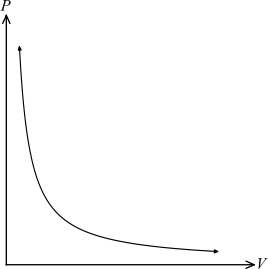
The air pressure, `P`, in a bubble varies inversely with the volume, `V`, of the bubble. 

  1. Write an equation relating `P`, `V` and `a`, where `a` is a constant.    (1 mark)

    --- 1 WORK AREA LINES (style=lined) ---

  2. It is known that `P = 3` when `V = 2`.


    By finding the value of the constant, `a`, find the value of `P` when `V = 4`.    (2 marks)

    --- 4 WORK AREA LINES (style=lined) ---

  3. Sketch a graph to show how `P` varies for different values of `V`.


    Use the horizontal axis to represent volume and the vertical axis to represent air pressure.   (2 marks)

    --- 8 WORK AREA LINES (style=lined) ---


Show Answers Only
  1. `P = a/V`
  2. `P = 1 1/2`
  3.  
     
Show Worked Solution
♦ Mean mark (i) 39%
COMMENT: Expressing the proportional relationship `P prop 1/V` as the equation `P=k/V` is a core skill here.
i. `P` `prop 1/V`
    `= a/V`


ii. `text(When)\ P=3,\ V = 2`
`3` `= a/2`
`a` `=6`


`text(Need to find)\ P\ text(when)\ V = 4`  

♦ Mean mark (ii) 47%
`P` `=6/4`
  `= 1 1/2`


♦♦ Mean mark (iii) 26%
COMMENT: An inverse relationship is reflected by a hyperbola on the graph.
iii.

Filed Under: Inverse, Non-Linear: Inverse and Other Problems (Std 2), Variation and Rates of Change Tagged With: Band 5, num-title-ct-patha, num-title-qs-hsc, smc-4239-30-a prop 1/b, smc-795-10-Inverse, smc-795-40-Proportional

Algebra, STD2 A4 2010 HSC 13 MC

The number of hours that it takes for a block of ice to melt varies inversely with the temperature. At 30°C it takes 8 hours for a block of ice to melt.

How long will it take the same size block of ice to melt at 12°C?  

  1. 3.2 hours
  2. 20 hours
  3. 26  hours
  4. 45 hours
Show Answers Only

`B`

Show Worked Solution
 
♦ Mean mark 50% 

`text{Time to melt}\ (T) prop1/text(Temp) \ => \ T=k/text(Temp)`

`text(When) \ T=8, text(Temp = 30)`

`8` `=k/30`
`k` `=240`


`text{Find}\ T\ text{when  Temp = 12:}`

`T` `=240/12`
  `=20\ text(hours)`

 
`=>  B`

Filed Under: Inverse, Non-Linear: Inverse and Other Problems (Std 2), Variation and Rates of Change Tagged With: Band 5, num-title-ct-patha, num-title-qs-hsc, smc-4239-30-a prop 1/b, smc-795-10-Inverse, smc-795-40-Proportional

Copyright © 2014–2025 SmarterEd.com.au · Log in