An owl is 7 metres above ground level, in a tree. The owl sees a mouse on the ground at an angle of depression of 32°.
How far must the owl fly in a straight line to catch the mouse, assuming the mouse does not move?
- 3.7 m
- 5.9 m
- 8.3 m
- 13.2 m
Aussie Maths & Science Teachers: Save your time with SmarterEd
An owl is 7 metres above ground level, in a tree. The owl sees a mouse on the ground at an angle of depression of 32°.
How far must the owl fly in a straight line to catch the mouse, assuming the mouse does not move?
`D`
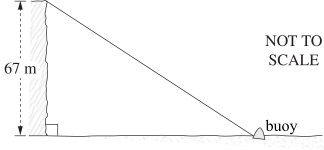
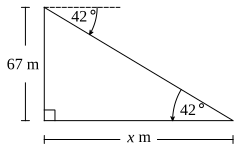
From the top of a cliff 67 metres above sea level, the angle of depression of a buoy is 42°.
How far is the buoy from the base of the cliff, to the nearest metre?
`B`
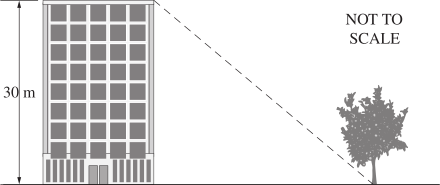
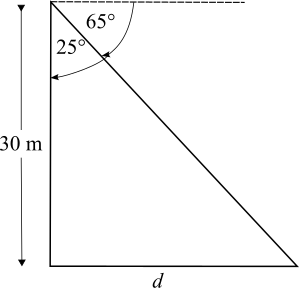
The angle of depression of the base of the tree from the top of the building is 65°. The height of the building is 30 m.
How far away is the base of the tree from the building, correct to one decimal place?
`B`
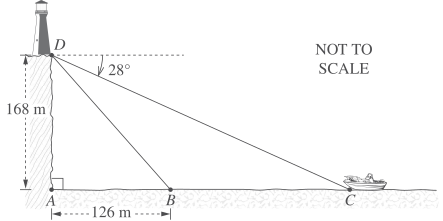
The base of a lighthouse, `D`, is at the top of a cliff 168 metres above sea level. The angle of depression from `D` to a boat at `C` is 28°. The boat heads towards the base of the cliff, `A`, and stops at `B`. The distance `AB` is 126 metres.
--- 6 WORK AREA LINES (style=lined) ---
--- 4 WORK AREA LINES (style=lined) ---
| i. | `tan/_ADB` | `=126/168` |
| ` /_ADB` | `=36.8698…` | |
| `=36.9^circ\ \ \ \ text{(to 1 d.p)}` |
| `/_text(Depression)\ D\ text(to)\ B` | `=90-36.9` |
| `=53.1` | |
| `=53^circ\ text{(nearest degree)}` |
ii. `text(Find)\ CB:`
| `/_ADC+28` | `=90` |
| `/_ADC` | `=62^circ` |
| `tan 62^circ` | `=(AC)/168` |
| `AC` | `=168xxtan 62^circ` |
| `=315.962…` |
| `CB` | `=AC-AB` |
| `=315.962…-126` | |
| `=189.962…` | |
| `=190\ text(m (nearest m))` |
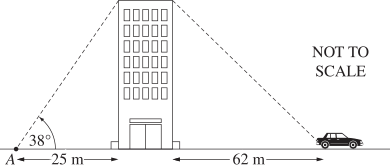
The point `A` is 25 m from the base of a building. The angle of elevation from `A` to the top of the building is 38°.
--- 2 WORK AREA LINES (style=lined) ---
What is the angle of depression from the top of the building to the car?
Give your answer to the nearest minute. (2 marks)
--- 5 WORK AREA LINES (style=lined) ---
i. `text{Proof (See Worked Solutions)}`
ii. `17°28^{′}`
i. `text(Need to prove height (h) ) ~~ 19.5\ text(m)`
| `tan 38^@` | `= h/25` |
| `h` | `= 25 xx tan38^@` |
| `= 19.5321…` | |
| `~~ 19.5\ text(m)\ \ text(… as required.)` |
| ii. |
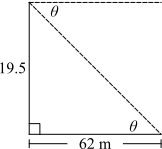
`text(Let)\ \ /_ \ text(Elevation (from car) ) = theta`
| `tan theta` | `= h/62` |
| `= 19.5/62` | |
| `= 0.3145…` | |
| `:. theta` | `= 17.459…` |
| `= 17°27^{′}33^{″}..` | |
| `=17°28^{′}\ \ text{(nearest minute)}` |
`:./_ \ text(Depression to car) =17°28^{′}\ \ text{(alternate to}\ theta text{)}`
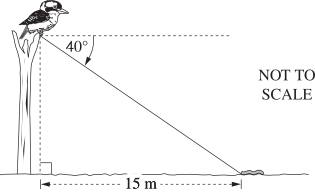
The angle of depression from a kookaburra’s feet to a worm on the ground is 40°. The worm is 15 metres from a point on the ground directly below the kookaburra’s feet.
How high above the ground are the kookaburra's feet, correct to the nearest metre?
`C`
| ` /_ \ text{Elevation (worm)}` | `= 40^@` `text{(alternate angles)}` |
| `tan 40^@` | `=h/15` |
| `:. h` | `=15xxtan 40^@` |
| `=12.58…\ text(m)` |
`=>C`