SmarterEd

Aussie Maths & Science Teachers: Save your time with SmarterEd

  • Login
  • Get Help
  • About

Calculus, 2ADV C3 2019 HSC 14b

The derivative of a function  `y = f(x)`  is given by  `f^{′}(x) = 3x^2 + 2x-1`.

  1. Find the `x`-values of the two stationary points of  `y = f(x)`, and determine the nature of the stationary points.  (2 marks)

    --- 6 WORK AREA LINES (style=lined) ---

  2. The curve passes through the point  `(0, 4)`.


    Find an expression for  `f(x)`.  (2 marks)

    --- 4 WORK AREA LINES (style=lined) ---

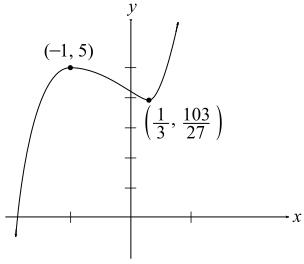
  3. Hence sketch the curve, clearly indicating the stationary points.  (2 marks)

    --- 8 WORK AREA LINES (style=lined) ---

  4. For what values of `x` is the curve concave down?  (1 mark)

    --- 2 WORK AREA LINES (style=lined) ---

Show Answers Only
  1. `x = 1/3\ \ text{(min)}`
    `x = -1\ \ text{(max)}`
  2. `f(x) = x^3 + x^2-x + 4`
  3. `text(See Worked Solution)`
  4. `x < -1/3`
Show Worked Solution

a.    `f^{′}(x) = 3x^2 + 2x-1`

`f^{″}(x) = 6x + 2`

`text(S.P.’s when)\ \ f^{′}(x) = 0`

`3x^2 + 2x-1` `= 0`
`(3x-1)(x + 1)` `= 0`

 
`x = 1/3 or -1`

`text(When)\ x = 1/3,`

`f^{″}(x) = 4 > 0 =>\ text(MIN)`
 

`text(When)\ x = -1,`

`f^{″}(x)= -4 < 0 =>\ text(MAX)`


b.    `f(x)` `= int f^{′}(x)\ dx`
    `= int 3x^2 + 2x-1\ dx`
    `= x^3 + x^2-x + c`

 
`(0, 4)\ \ text(lies on)\ \ f(x)\ \ =>\ \ c = 4`

`:. f(x) = x^3 + x^2-x + 4`


c.    `text(When)\ \ x = -1,\ \ y = 5`
  `text(When)\ \ x = 1/3,\ \ y = 103/27`


d.   `text(Concave down when)\ f^{″}(x) < 0`

♦ Mean mark 36%.

`6x + 2` `< 0`
`6x` `< -2`
`x` `< -1/3`

Filed Under: Curve Sketching (Y12) Tagged With: Band 3, Band 5, smc-969-10-Cubic, smc-969-40-Concavity Intervals

Calculus, 2ADV C3 2004 HSC 4b

Consider the function  `f(x) = x^3 − 3x^2`.

  1. Find the coordinates of the stationary points of the curve  `y = f(x)`  and determine their nature.   (3 marks)

    --- 6 WORK AREA LINES (style=lined) ---

  2. Sketch the curve showing where it meets the axes.   (2 marks)

    --- 8 WORK AREA LINES (style=lined) ---

  3. Find the values of  `x`  for which the curve  `y = f(x)`  is concave up.   (2 marks)

    --- 5 WORK AREA LINES (style=lined) ---

Show Answers Only
  1. `text(MAX at)\ (0,0),\ \ text(MIN at)\ (2,-4)`
  2.  
    1. Geometry and Calculus, 2UA 2004 HSC 4b Answer
  3. `f(x)\ text(is concave up when)\ x>1`
Show Worked Solution
(i)    `f(x)` `= x^3 – 3x^2`
  `f'(x)` `= 3x^2 – 6x`
  `f″(x)` `= 6x – 6`


`text(S.P.’s  when)\ \ f'(x) = 0`

`3x^2 – 6x` `= 0`
`3x (x – 2)` `= 0`
`x` `= 0\ \ text(or)\ \ 2`


`text(When)\ x = 0`

`f(0)` `= 0`
`f″(0)` `= 0 – 6 = -6 < 0`
`:.\ text(MAX at)\ (0,0)`


`text(When)\ x = 2`

`f(2)` `= 2^3 – (3 xx 4) = -4`
`f″(2)` `= (6 xx 2) – 6 = 6 > 0`
`:.\ text(MIN at)\ (2, -4)`


(ii)   `f(x) = x^3 – 3x^2\ text(meets the)\ x text(-axis when)\ f(x) = 0`
`x^3 – 3x^2` `= 0`
`x^2 (x-3)` `= 0`
`x` `= 0\ \ text(or)\ \ 3`

 Geometry and Calculus, 2UA 2004 HSC 4b Answer

(iii)   `f(x)\ text(is concave up when)`
`f″(x)` `>0`
`6x – 6` `>0`
`6x` `>6`
`x` `>1`


`:. f(x)\ text(is concave up when)\ \ x>1`

Filed Under: Curve Sketching (Y12), Curve Sketching and The Primitive Function Tagged With: Band 3, Band 4, Band 5, page-break-before-solution, smc-969-10-Cubic, smc-969-40-Concavity Intervals

Calculus, 2ADV C3 2005 HSC 4b

A function  `f(x)`  is defined by  `f(x) = (x + 3)(x^2- 9)`.

  1. Find all solutions of  `f(x) = 0`  (2 marks)

    --- 4 WORK AREA LINES (style=lined) ---

  2. Find the coordinates of the turning points of the graph of  `y = f(x)`, and determine their nature.  (3 marks)

    --- 8 WORK AREA LINES (style=lined) ---

  3. Hence sketch the graph of  `y = f(x)`, showing the turning points and the points where the curve meets the `x`-axis.  (2 marks)

    --- 8 WORK AREA LINES (style=lined) ---

  4. For what values of `x` is the graph of  `y = f(x)`  concave down?  (1 mark)

    --- 2 WORK AREA LINES (style=lined) ---

Show Answers Only
  1. `−3 or 3`
  2. `text{53.2 cm  (to 1 d.p.)}`
  3. `text(See worked solutions)`
  4. `x < −1`
Show Worked Solutions
i.    `f(x)` `= (x + 3)(x^2 − 9)`
    `= (x + 3)(x +3)(x − 3)`
  `:. f(x)` `= 0\ text(when)\ \ x=–3\ text(or)\ 3`


ii.   `f (x)` `= (x +3)(x^2 − 9)`
    `= x^3 − 9x + 3x^2 − 27`
    `= x^3 + 3x^2 − 9x − 27`
  `f′(x)` `= 3x^2 + 6x − 9`
  `f″(x)` `= 6x + 6`


`text(S.P.’s  when)\ \ f′(x) = 0`

`3x^2 + 6x − 9` `= 0`
`3(x^2 + 2x − 3)` `= 0`
`3(x − 1)(x + 3)` `= 0`


`text(At)\ x =1`

`f(1)` `= (4)(−8)=−32`
 `f″(1)` `= 6 + 6=12>0`
`:.\ text(MIN at)\ (1, −32)` 


`text(At)\ x = −3`

`f(-3)` `= 0`
`f″(−3)` `= (6 xx −3) + 6 = −12 <0`
`:.\ text(MAX at)\ (−3, 0)`


iii.   Geometry and Calculus, 2UA 2005 HSC 4b Answer


iv.  `f(x)\ \ text(is concave down when)`

`f″(x)` `< 0`
`6x + 6` `< 0`
`6x` `< −6`
`x` `< −1`

Filed Under: Curve Sketching (Y12), Curve Sketching and The Primitive Function Tagged With: Band 3, Band 4, smc-969-10-Cubic, smc-969-40-Concavity Intervals

Calculus, 2ADV C3 2010 HSC 6a

Let  `f(x) = (x + 2)(x^2 + 4)`.

  1. Show that the graph  `y=f(x)`  has no stationary points.   (2 marks)

    --- 5 WORK AREA LINES (style=lined) ---

  2. Find the values of  `x`  for which the graph  `y=f(x)`  is concave down, and the values for which it is concave up.    (2 marks)

    --- 5 WORK AREA LINES (style=lined) ---

  3. Sketch the graph  `y=f(x)`,  indicating the values of the  `x`  and  `y` intercepts.   (2 marks)

    --- 8 WORK AREA LINES (style=lined) ---

Show Answers Only
  1. `text(Proof)  text{(See Worked Solutions)}`
  2.  `f(x)\ text(is concave down when)\ x < -2/3`


    `f(x)\ text(is concave up when)\ x > -2/3`

  3.  
Show Worked Solution

i.  `text(Need to show no  S.P.’s)`

`f(x)` `= (x+2)(x^2 + 4)`
  `=x^3 + 2x^2 + 4x + 8`
`f prime (x)` `= 3x^2 + 4x + 4`


`text(S.P.s  occur when)\ \ f prime (x) =0,`

`3x^2 + 4x + 4 =0`

`Delta` `= b^2\ – 4ac`
  `=4^2\ – (4 xx 3 xx 4)`
  `=16\ – 48`
  `= -32 < 0`


`text(S)text(ince)\ \ Delta < 0,\ \ text(No Solution)`

`:.\ text(No  S.P.’s  for)\ \ f(x)`


ii.  `f(x)\ text(is concave down when)\ f″(x) < 0`

MARKER’S COMMENT: The significance of the sign of the second derivative was not well understood by most students.

`f″(x) = 6x + 4`

`=> 6x + 4` `< 0`
`6x` `< -4`
`x` `< -2/3`

`:.\ f(x)\ text(is concave down when)\ x < -2/3`

`f(x)\ text(is concave up when)\ f″(x) > 0`

`f″(x) = 6x + 4`

`=> 6x + 4` `> 0`
`6x` `> -4`
`x` `> -2/3`

`:. f(x)\ text(is concave up when)\ x > -2/3`


♦♦ Mean mark 33%.
MARKER’S COMMENT: Students are reminded to bring a ruler to the exam and use it to draw the axes for graphing and to help with an appropriate scale.

iii.  `y text(-intercept) =2 xx4=8`

`x text(-intercept)=–2` 


Filed Under: Curve Sketching (Y12), Curve Sketching and The Primitive Function Tagged With: Band 4, Band 5, smc-969-10-Cubic, smc-969-40-Concavity Intervals

Copyright © 2014–2025 SmarterEd.com.au · Log in