The quantity \(y\) varies inversely with the square of \(x\).
When \(x = 4, \ y = 10\).
Find the value of \(y\) when \(x = 8\). (2 marks)
--- 6 WORK AREA LINES (style=lined) ---
Aussie Maths & Science Teachers: Save your time with SmarterEd
The quantity \(y\) varies inversely with the square of \(x\).
When \(x = 4, \ y = 10\).
Find the value of \(y\) when \(x = 8\). (2 marks)
--- 6 WORK AREA LINES (style=lined) ---
A student believes that the time it takes for an ice cube to melt (`M` minutes) varies inversely with the room temperature `(T^@ text{C})`. The student observes that at a room temperature of `15^@text{C}` it takes 12 minutes for an ice cube to melt.
--- 2 WORK AREA LINES (style=lined) ---
\begin{array} {|c|c|c|c|}
\hline \ \ T\ \ & \ \ 5\ \ & \ 15\ & \ 30\ \\
\hline M & & & \\
\hline \end{array}
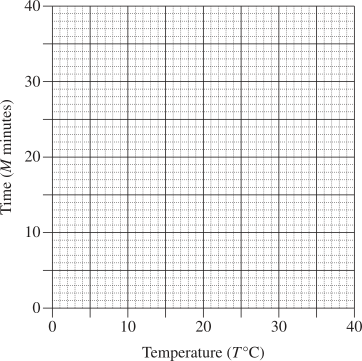
--- 0 WORK AREA LINES (style=lined) ---
a. `M=180/T`
b.
\begin{array} {|c|c|c|c|}
\hline \ \ T\ \ & \ \ 5\ \ & \ 15\ & \ 30\ \\
\hline M & 36 & 12 & 6 \\
\hline \end{array}
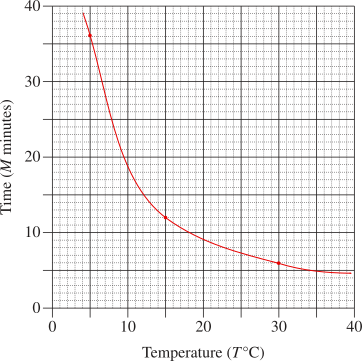
| a. | `M` | `prop 1/T` |
| `M` | `=k/T` | |
| `12` | `=k/15` | |
| `k` | `=15 xx 12` | |
| `=180` |
`:.M=180/T`
b.
\begin{array} {|c|c|c|c|}
\hline \ \ T\ \ & \ \ 5\ \ & \ 15\ & \ 30\ \\
\hline M & 36 & 12 & 6 \\
\hline \end{array}
Jacques is a marine biologist and finds that the mass of a crab is directly proportional to the cube of the diameter of its shell.
If a crab with a shell diameter of 15 cm weighs 680 grams, what will be the diameter of a crab that weighs 1.1 kilograms? Give your answer to 1 decimal place. (2 marks)
--- 5 WORK AREA LINES (style=lined) ---
The current of an electrical circuit, measured in amps `(A)`, varies inversely with its resistance, measured in ohms `(R)`.
When the resistance of a circuit is 28 ohms, the current is 3 amps.
What is the current when the resistance is 8 ohms? (2 marks)
--- 6 WORK AREA LINES (style=lined) ---
The stopping distance of a car on a certain road, once the brakes are applied, is directly proportional to the square of the speed of the car when the brakes are first applied.
A car travelling at 70 km/h takes 58.8 metres to stop.
How far does it take to stop if it is travelling at 105 km/h? (3 marks)
--- 6 WORK AREA LINES (style=lined) ---
Fuifui finds that for Giant moray eels, the mass of an eel is directly proportional to the cube of its length.
An eel of this species has a length of 25 cm and a mass of 4350 grams.
What is the expected length of a Giant moray eel with a mass of 6.2 kg? Give your answer to one decimal place. (3 marks)
--- 7 WORK AREA LINES (style=lined) ---