SmarterEd

Aussie Maths & Science Teachers: Save your time with SmarterEd

  • Login
  • Get Help
  • About

Statistics, 2ADV S3 2020 HSC 23

A continuous random variable, `X`, has the following probability density function.
 

`f(x) = {(sin x, text(for)\ \ 0 <= x <= k),(0, text(for all other values of)\ x):}`
 

  1. Find the value of `k`.  (2 marks)

    --- 4 WORK AREA LINES (style=lined) ---

  2. Find  `P(X <= 1)`. Give your answer correct to four decimal places.  (2 marks)

    --- 4 WORK AREA LINES (style=lined) ---
Show Answers Only
  1. `pi/2`
  2. `0.4597\ \ (text(to 2 d.p.))`
Show Worked Solution
a.    `int_0^k sin x` `= 1`
  `[−cos x]_0^k` `= 1`
  `−cos k + cos 0` `= 1`
  `−cos k` `= 0`
  `cos k` `= 0`
  `k` `= pi/2`


♦ Mean mark part (b) 44%.
b.    `P(X <= 1)` `= int_0^1 sin x\ dx`
    `= [−cos x]_0^1`
    `= −cos1 + cos0`
    `= 1 – cos1`
    `= 0.45969…`
    `= 0.4597\ \ (text(to 4 d.p.))`

Filed Under: Probability Density Functions (Y12) Tagged With: Band 4, Band 5, smc-994-30-Other Probability, smc-994-80-Trig PDF

Statistics, 2ADV S3 EQ-Bank 1

A probability density function can be used to model the lifespan of a termite, `X`, in weeks, is given by
 

`f(x) = {(k(36 - x^2)),(0):}\ \ \ {:(3 <= x <= 6),(text(otherwise)):}`
 

  1. Show that the value of  `k`  is  `1/45`.  (2 marks)

    --- 4 WORK AREA LINES (style=lined) ---
  2. Find the cumulative distribution function.  (2 marks)

    --- 4 WORK AREA LINES (style=lined) ---

  3. Find the probability that a termite's lifespan is greater than 5 weeks.  (1 mark)

    --- 2 WORK AREA LINES (style=lined) ---

Show Answers Only
  1. `text(See Worked Solutions)`
  2. `F(x) = {(0),(1/135 (108t – t^3  – 297)),(1):}\ \ \ {:(x < 3),(3 <= x <= 6),(x > 6):}`
  3. `17/135`
Show Worked Solution
i.    `k int_3^6 36 – x^2\ dx` `= 1`
  `k[36x – (x^3)/3]_3^6` `= 1`
  `k[(216 – 72)-(108 – 9)]` `= 1`
  `45k` `= 1`
  `k` `= 1/45`


ii.    `F(t)` `= int_(-∞)^t f(x)\ dx`
    `= int_3^t f(x)\ dx`
    `= 1/45 int_3^t 36 – x^2\ dx`
    `= 1/45 [36x – (x^3)/3]_3^t`
    `= 1/135[108x – x^3]_3^t`
    `= 1/35[(108t – t^3) – (324 – 27)]`
    `= 1/135(108t – t^3 – 297)`

 
`:. F(x) = {(0),(1/135 (108t – t^3  – 297)),(1):}\ \ \ {:(x < 3),(3 <= x <= 6),(x > 6):}`


iii.    `P(X > 5)` `= 1 – F(5)`
    `= 1 – 1/135(108 xx 5 – 5^3 – 297)`
    `= 1 – 118/135`
    `= 17/135`

Filed Under: Probability Density Functions (Y12) Tagged With: Band 4, Band 5, smc-994-30-Other Probability, smc-994-40-Cumulative Distribution Fn, smc-994-60-Polynomial PDF

Statistics, 2ADV S3 SM-Bank 18

The Lorenz birdwing is the largest butterfly in a habitat.

The probability density function that describes its life span, \(X\), in weeks, is given by
 

\(f(x)= \begin{cases}
\dfrac{4}{625}\left(5 x^3-x^4\right) & 0 \leq x \leq 5 \\
\\
0 & \text {elsewhere }\end{cases}\)
 

In a sample of 80 Lorenz birdwing butterflies, how many butterflies are expected to live longer than two weeks, correct to the nearest integer?  (2 marks)

--- 6 WORK AREA LINES (style=lined) ---

Show Answers Only

\(73\)

Show Worked Solution

\(\begin{aligned} \operatorname{Pr}(X>2) & =\dfrac{4}{625} \int_2^5 5 x^3-x^4 \, dx \\
& =\dfrac{4}{625}\left[\dfrac{5}{4} x^4-\dfrac{x^5}{5}\right]_2^5 \\
& =\dfrac{4}{625}\left[\left(\dfrac{5^5}{4}-\dfrac{5^5}{5}\right)-\left(\dfrac{5}{4} \times 2^4-\dfrac{2^5}{5}\right)\right] \\
& =\dfrac{4}{625}\left[\dfrac{625}{4}-\dfrac{68}{5}\right] \\
& =0.9129 \ldots\end{aligned}\)


\(\begin{aligned} \therefore \text { Expected number } & =80 \times 0.9129 \ldots \\ & \approx 73.03 \\ & \approx 73\end{aligned}\)

Filed Under: Probability Density Functions (Y12) Tagged With: Band 5, smc-994-30-Other Probability, smc-994-60-Polynomial PDF

Statistics, 2ADV S3 SM-Bank 13

The time Jennifer spends on her homework each day varies, but she does some homework every day.

The continuous random variable \(T\), which models the time, \(t\), in minutes, that Jennifer spends each day on her homework, has a probability density function \(f\), where

\(f(t)= \begin{cases}
\dfrac{1}{625}(t-20) & 20 \leq t<45 \\
\ \\
\dfrac{1}{625}(70-t) & 45 \leq t \leq 70 \\
\ \\
0 & \text {elsewhere }
\end{cases}\)

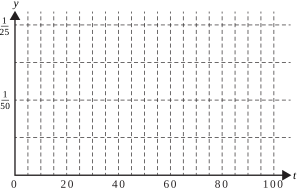
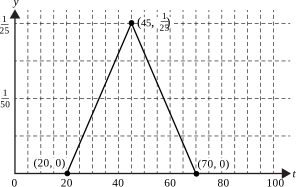
  1. Sketch the graph of  \(f(t)\) on the axes provided below.  (3 marks)


  2. Find the mode.  (1 mark)

    --- 1 WORK AREA LINES (style=lined) ---

  3. Find  \(P(25 \leq T \leq 55)\).  (2 marks)

    --- 4 WORK AREA LINES (style=lined) ---
Show Answers Only
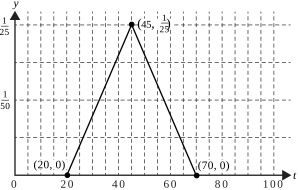
  1.  

  2. \(45\)
  3. \(\dfrac{4}{5}\)
Show Worked Solution
i.   

MARKER’S COMMENT: Many did not draw graph along \(t\)-axis between 0 and 20 and for  \(t>70\).

 
ii.
     \(\text{Mode \(=45\) (value of \(t\) at highest value of \(f(t))\)}\)
 

iii.    \(P(25 \leq T \leq 55)\)

\(\begin{aligned}
& =\int_{25}^{45} \dfrac{1}{625}(t-20) d t+\int_{45}^{55} \dfrac{1}{625}(70-t) d t \\
& =\dfrac{1}{625}\left[\dfrac{t^2}{2}-20 t\right]_{25}^{45}+\dfrac{1}{625}\left[70 t-\dfrac{t^2}{2}\right]_{45}^{55} \\
& =\dfrac{1}{625}[112.5-(-187.5)]+\dfrac{1}{625}(2337.5-2137.5) \\ & =\dfrac{300}{625}+\dfrac{200}{625} \\
& =\dfrac{4}{5}
\end{aligned}\)

Filed Under: Probability Density Functions (Y12) Tagged With: Band 5, smc-994-20-Mode, smc-994-30-Other Probability, smc-994-50-Linear PDF

Statistics, 2ADV S3 SM-Bank 11

The probability density function of a continuous random variable \(X\) is given by

\(f(x)=\begin{cases}
\dfrac{x}{12} & 1 \leq x \leq 5 \\
\ \\
0 & \text {otherwise }
\end{cases}\)

Find  \(P(X < 3)\)  (2 marks)

Show Answers Only

\(\dfrac{1}{3}\)

Show Worked Solution

\(\begin{aligned}
P(X & <3)\\
& =\int_1^3 \dfrac{1}{12} x d x \\
& =\dfrac{1}{12}\left[\frac{1}{2} x^2\right]_1^3 \\
& =\dfrac{1}{24}\left[3^2-1^2\right] \\
& =\dfrac{1}{3}
\end{aligned}\)

Filed Under: Probability Density Functions (Y12) Tagged With: Band 4, smc-994-30-Other Probability, smc-994-50-Linear PDF

Statistics, 2ADV S3 SM-Bank 9

The probability density function  \(f(x)\)  of a random variable \(X\) is given by

\(f(x)=\begin{cases}
\dfrac{x+1}{12} & 0 \leq x \leq 4 \\
\ \\
0 & \text{otherwise }
\end{cases}\)

Find the value of \(b\) such that \(P(X \leq b)=\dfrac{5}{8}\).  (3 marks)

Show Answers Only

\(3\)

Show Worked Solution

\(\begin{aligned}
\dfrac{1}{12} \int_0^b(x+1) d x & =\dfrac{5}{8} \\
{\left[\dfrac{1}{2} x^2+x\right]_0^b } & =\dfrac{15}{2} \\
\dfrac{1}{2} b^2+b & =\dfrac{15}{2} \\
b^2+2 b-15 & =0 \\ (b+5)(b-3) & =0
\end{aligned}\)

\(\therefore b=3 \quad(0 \leq b \leq 4)\)

Filed Under: Probability Density Functions (Y12) Tagged With: Band 4, smc-994-30-Other Probability, smc-994-50-Linear PDF

Statistics, 2ADV S3 SM-Bank 8

The continuous random variable `X` has a distribution with probability density function given by
 

`f(x) = {(ax(5 - x), \ text(if)\ \ 0 <= x <= 5), (0,\ text (if)\ \ x < 0\ \ text(or if)\ \ x > 5):}`
 

where `a` is a positive constant.

  1. Find the value of  `a`.  (3 marks)

    --- 6 WORK AREA LINES (style=lined) ---

  2. Express  `P(X < 3)`  as a  definite integral. (Do not evaluate the definite integral.)  (1 mark)

    --- 2 WORK AREA LINES (style=lined) ---

Show Answers Only
  1. `6/125`
  2. `int_0^3 ax(5 – x)\ dx`
Show Worked Solution
a.   `text(Total Area under curve)` `= 1`
  `a int_0^5 (5x – x^2)\ dx` `= 1`
  `a [5/2 x^2 – 1/3 x^3]_0^5` `= 1`
  `a [(125/2 – 125/3) – (0)]` `= 1`
  `125/6 a` `= 1`
  `:. a` `= 6/125`


b.   `P(X < 3) = int_0^3 ax(5 – x)\ dx`

Filed Under: Probability Density Functions (Y12) Tagged With: Band 4, smc-994-30-Other Probability, smc-994-60-Polynomial PDF

Statistics, 2ADV S3 SM-Bank 6 MC

The continuous random variable, \(X\), has a probability density function given by

\(f(x)= \begin{cases}
\dfrac{1}{4} \cos \left(\dfrac{x}{2}\right) & 3 \pi \leq x \leq 5 \pi \\
\ & \ \\
0 & \text {elsewhere}
\end{cases}\)

The value of \(a\) such that  \(P(X<a)=\dfrac{\sqrt{3}+2}{4}\)  is

  1. \(\dfrac{19 \pi}{6}\)
  2. \(\dfrac{14 \pi}{3}\)
  3. \(\dfrac{10 \pi}{3}\)
  4. \(\dfrac{29 \pi}{6}\)
Show Answers Only

\(B\)

Show Worked Solution

\(\begin{aligned}
\int_{3 \pi}^a \dfrac{1}{4}\, \cos \left(\dfrac{x}{2}\right) d x & =\dfrac{\sqrt{3}+2}{4} \\
{\left[\dfrac{1}{2}\, \sin \left(\dfrac{x}{2}\right)\right]_{3 \pi}^a } & =\dfrac{\sqrt{3}+2}{4} \\
\dfrac{1}{2}\left[\sin \left(\dfrac{a}{2}\right)-\sin \left(\dfrac{3 \pi}{2}\right)\right] & =\dfrac{\sqrt{3}+2}{4} \\
\dfrac{1}{2}\, \sin \left(\dfrac{a}{2}\right)+\dfrac{1}{2} & =\dfrac{\sqrt{3}+2}{4} \\
\sin \left(\dfrac{a}{2}\right) & =\dfrac{\sqrt{3}}{2} \\
\dfrac{a}{2} & =\dfrac{\pi}{3}, \dfrac{2 \pi}{3}, \dfrac{7 \pi}{3}, \ldots \\
\therefore a & =\dfrac{14 \pi}{3} \quad(3 \pi \leq a \leq 5 \pi)
\end{aligned}\)

\(\Rightarrow B\)

Filed Under: Probability Density Functions (Y12) Tagged With: Band 5, smc-994-30-Other Probability, smc-994-80-Trig PDF

Statistics, 2ADV S3 SM-Bank 4

The continuous random variable \(X\) has a probability density function given  by
 

\(f(x)= \begin{cases}
\cos(2x)& \text {if}\quad \dfrac{3 \pi}{4}<x<\dfrac{5 \pi}{4} \\
\ \\
0 & \text{elsewhere}
\end{cases}\)
 

Find the value of  \(a\) such that  \(P(X < a) = 0.25\). Give your answer correct to 2 decimal places.   (3 marks)

--- 6 WORK AREA LINES (style=lined) ---

Show Answers Only

\(2.8\)

Show Worked Solution

\(\displaystyle \int_{\frac{3 x}{4}}^a \cos (2 x) d x=0.25\)

\begin{aligned}
\frac{1}{2}[\sin (2 x)]_{\frac{3 \pi}{4}}^a & =0.25 \\
{\left[\sin (2 a)-\sin \left(\frac{3 \pi}{2}\right)\right] } & =0.5 \\
\sin (2 a)+1 & =0.5 \\
2 a & =\sin ^{-1}(-0.5) \\
& =-0.5235
\end{aligned}

\(\text {Since sin is negative in 3rd/4th quadrants: }\)

\begin{aligned}
2 a & =\pi+0.5234 \\
a &=1.832 \ldots \quad \text { (not in range) } \\
&\text { or } \\
2a & =2 \pi-0.5234 \\
 a &=2.87989 \ldots \\
&=2.88 \quad\left(\text{in range: } \frac{3 \pi}{4}<x<\frac{5 \pi}{4}\right)
\end{aligned}

Filed Under: Probability Density Functions (Y12) Tagged With: Band 6, smc-994-30-Other Probability, smc-994-80-Trig PDF

Statistics, 2ADV S3 SM-Bank 3

The continuous random variable `X` has a probability density function given by
 

`f(x) = {(pi sin (2 pi x), text(if)\ \ 0 <= x <= 1/2), (0, text(elsewhere)):}`
 

Find the value of  `a`  such that  `P(X > a) = 0.2`. Give your answer to 2 decimal places.   (3 marks)

--- 6 WORK AREA LINES (style=lined) ---

Show Answers Only

`0.35`

Show Worked Solution

`int_a^(1/2) pi sin (2 pi x)\ dx = 0.2`

`-1/2 [cos(2 pi x)]_a^(1/2)` `=0.2`  
`-1/2[cos(pi) -cos(2 pia)]`  `=0.2`  
`-1/2(-1-cos(2pia))` `=0.2`  
`-1-cos(2pia)` `=-0.4`  
`cos(2pia)` `=-0.6`  
`2pia` `=cos^(-1)(-0.6)`  
`:.a` `=cos^(-1)(-0.6)/(2pi)`  
  `=0.3524…`  
  `=0.35\ \ \ text{(to 2 d.p.)}`  

Filed Under: Probability Density Functions (Y12) Tagged With: Band 5, smc-994-30-Other Probability, smc-994-80-Trig PDF

Statistics, 2ADV S3 SM-Bank 2

If a continuous random variable  \(X\)  has probability density function

\(f(x)=
\begin{cases}
\dfrac{x}{2} & \text{if } \quad 0 \leq x \leq 2 \\
\ \\
0 & \text {otherwise }
\end{cases}\)

Find the exact value of  \(p\)  such that  \(P(X>p) = 0.4\).   (3 marks)

Show Answers Only

\(\dfrac{2 \sqrt{15}}{5}\)

Show Worked Solution

\(\displaystyle \int_p^2 \dfrac{x}{2} d x=0.4\)

\(\begin{aligned} {\left[\dfrac{x^2}{4}\right]_p^2 } & =\dfrac{2}{5} \\
1-\dfrac{p^2}{4} & =\dfrac{2}{5} \\
\dfrac{p^2}{4} & =\dfrac{3}{5} \\ p^2 & =\dfrac{12}{5} \\
\therefore p & =\dfrac{2 \sqrt{3}}{\sqrt{5}} \\
& =\dfrac{2 \sqrt{15}}{5} \quad(0 \leq p \leq 2)
\end{aligned}\)

Filed Under: Probability Density Functions (Y12) Tagged With: Band 4, smc-994-30-Other Probability, smc-994-50-Linear PDF

Copyright © 2014–2025 SmarterEd.com.au · Log in