The velocity, \(v\) m/s, of a particle moving in a straight line is given by the function
\(v(t)=1-e^{\cos(\pi t)}\)
where \(0 \le t \le 1.25\) is the time in seconds. The graph of \(v(t)\) is shown.
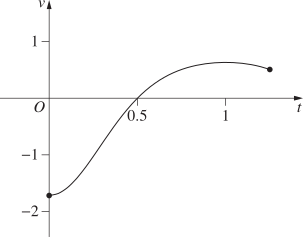
- At what value(s) of \(t\) does the particle change direction in this interval? (1 mark)
--- 2 WORK AREA LINES (style=lined) ---
- Find the acceleration of the particle when \(t=0.5\). (2 marks)
--- 6 WORK AREA LINES (style=lined) ---
- The table provides five function values for \(v\), correct to 2 decimal places.
\(t\) \(0\) \(0.25\) \(0.5\) \(0.75\) \(1\) \(v\) \(-1.72\) \(-1.03\) \(0\) \(0.51\) \(0.63\) Using the trapezoidal rule with four subintervals, find the approximate distance travelled by the particle in the interval \(0 \le t \le 1\). (2 marks)
--- 6 WORK AREA LINES (style=lined) ---