SmarterEd

Aussie Maths & Science Teachers: Save your time with SmarterEd

  • Login
  • Get Help
  • About

Calculus, 2ADV C4 2024 MET2 2 MC

A function \(g(x)\) has the derivative  \( { \displaystyle g^{\prime}(x)=x^3-x } \).

Given that  \(g(0)=5\), the value of \(g(2)\) is

  1. \(2\)
  2. \(3\)
  3. \(5\)
  4. \(7\)
Show Answers Only

\(D\)

Show Worked Solution
\({ \displaystyle g^{\prime}(x)}\) \(=x^3-x\)
\(g(x)\) \(=\dfrac{x^4}{4}-\dfrac{x^2}{2}+c\)

 
\(\text{Given }g(0)=5,\ c=5\) 

\(g(x)=\dfrac{x^4}{4}-\dfrac{x^2}{2}+5\)

\(\therefore\ g(2)=\dfrac{2^4}{4}-\dfrac{2^2}{2}+5=7\)

\(\Rightarrow D\)

Filed Under: Other Integration Applications, Rates of Change Tagged With: Band 4, smc-1213-25-Tangents/Primitive function, smc-7135-35-Tangents/Primitive function

Calculus, 2ADV C4 2024 HSC 10 MC

The diagram shows the graph  \(y = f(x)\).
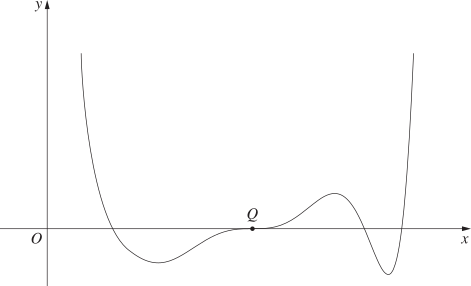
 

The point \(Q\) is a horizontal point of inflection.

Let  \(A(x)= \displaystyle \int_0^x f(t)\,dt\).

How many points of inflection does the graph  \(y=A(x)\)  have?

  1. \(2\)
  2. \(3\)
  3. \(4\)
  4. \(5\)
Show Answers Only

\(B\)

Show Worked Solution

\(A(x) = \displaystyle \int_0^x f(t)\,dt \ \text{(note this definite integral produces a}\ F(x)\text{)}\)

\(A^{′}(x) = f(x) \)

\(A^{″}(x) = f^{′}(x) \)

♦♦ Mean mark 41%.

\(\text{POI requirements:}\ A^{″}(x) = 0\ \text{and sign (concavity) changes either side.}\)

\(\text{Inspect graph of}\ f(x)\ \text{to find where}\ \ f^{′}(x)=0\ \ \text{and gradient changes}\)

\(\text{either side of possible points.}\)

\(\text{→ the three turning points all qualify}\)

\(\text{→ point}\ Q\ \text{does not qualify (gradient is positive both sides)}\)

\(\Rightarrow B\)

Filed Under: Other Integration Applications, Rates of Change Tagged With: Band 5, smc-1213-30-Other applications, smc-7135-40-Other Themes

Calculus, 2ADV C3 2024 HSC 17

In a particular electrical circuit, the voltage \(V\) (volts) across a capacitor is given by

\(V(t)=6.5\left(1-e^{-k t}\right)\),

where \(k\) is a positive constant and \(t\) is the number of seconds after the circuit is switched on.

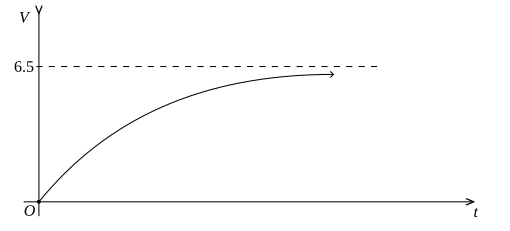
  1. Draw a sketch of the graph of \(V(t)\), showing its behaviour as \(t\) increases.   (2 marks)
     

    --- 0 WORK AREA LINES (style=blank) ---

  1. When \(t=1\), the voltage across the capacitor is 2.6 volts.
  2. Find the value of \(k\), correct to 3 decimal places.   (2 marks)

    --- 6 WORK AREA LINES (style=lined) ---

  1. Find the rate at which the voltage is increasing when \(t=2\), correct to 3 decimal places.   (2 marks)

    --- 4 WORK AREA LINES (style=lined) ---

Show Answers Only

a.   
       

b.   \(k=0.511\)

c.  \(1.195\ \text{V/s}\)

Show Worked Solution

a.   
       
♦ Mean mark (a) 49%.

b.   \(V=6.5(1-e^{-kt})\)

\(\text{When}\ \ t=1, V=2.6:\)

\(2.6\) \(=6.5(1-e^{-k})\)  
\(1-e^{-k}\) \(=0.4\)  
\(e^{-k}\) \(=0.6\)  
\(-k\) \(=\ln(0.6)\)  
\(k\) \(=0.5108…\)  
  \(=0.511\ \text{(3 d.p.)}\)  

 
c.
   \(V=6.5-6.5e^{-kt}\)

\(\dfrac{dV}{dt}=6.5ke^{-kt}\)

\(\text{Find}\ \dfrac{dV}{dt}\ \text{when}\ \ t=2:\)

\(\dfrac{dV}{dt}\) \(=6.5 \times 0.511 \times e^{-2 \times 0.511}\)  
  \(=1.1953…\)  
  \(=1.195\ \text{V/s (3 d.p.)}\)  

Filed Under: Rates of Change, Rates of Change Tagged With: Band 3, Band 4, Band 5, smc-1091-25-Other Themes, smc-1091-30-Log/Exp Function, smc-7135-40-Other Themes

Calculus, 2ADV C4 2024 HSC 15

Initially there are 350 litres of water in a tank. Water starts flowing into the tank.

The rate of increase of the volume `V` of water in litres is given by  `\frac{dV}{dt}=300-7.5t`, where `t` is the time in hours.

Find the volume of water in the tank when  `\frac{dV}{dt}=0`.   (3 marks)

--- 10 WORK AREA LINES (style=lined) ---

Show Answers Only

`\text{6350 litres}`

Show Worked Solution

`\frac{dV}{dt}=300-7.5t`

`\text{Find}\ t\ \text{when}\ \frac{dV}{dt}=0:`

`300-7.5t=0\ \ =>\ \ t=40\ \text{hours}`

`V` `=\int 300-\frac{15}{2}t\ dt`  
  `=300t-\frac{15}{4}t^2+C`  

 
`V=350\ \ \text{when}\ \ t=0\ \ =>\ \ C=350`

`V=300t-\frac{15}{4}t^2+350`

`\text{Find}\ V\ \text{when}\ \ t=40:`

`V` `=300 xx 40-\frac{15}{4} xx 40^2+350`  
  `=12\ 000-6000+350`  
  `=6350\ \text{litres}`  

Filed Under: Other Integration Applications, Rates of Change Tagged With: Band 3, smc-1213-15-Flow, smc-7135-30-Flow

Calculus, 2ADV C4 2023 HSC 28

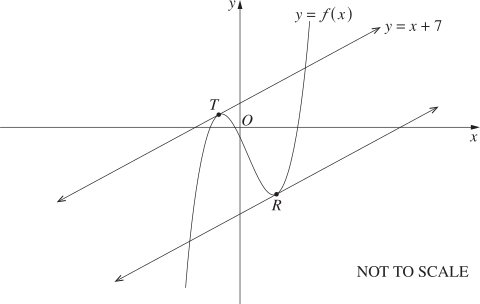
The curve  \(y=f(x)\)  is shown on the diagram. The equation of the tangent to the curve at point  \(T(-1,6)\)  is  \(y=x+7\). At a point \(R\), another tangent parallel to the tangent at \(T\) is drawn.
 

The gradient function of the curve is given by  \(\dfrac{dy}{dx}=3x^2-6x-8\).

Find the coordinates of \(R\).  (4 marks)

--- 8 WORK AREA LINES (style=lined) ---
Show Answers Only

\(R(3,-22)\)

Show Worked Solution

\(\text{Gradient at}\ R=1:\)

\(3x^2-6x-8\) \(=1\)  
\(3x^2-6x-9\) \(=0\)  
\(3(x^2-2x-3\) \(=0\)  
\(3(x+1)(x-3)\) \(=0\)  
♦ Mean mark 51%.

\(x\text{-coordinate of}\ R = 3\)

\(y\) \(=\int 3x^2-6x-8\ dx\)  
  \(=x^3-3x^2-8x+c\)  

 
\(\text{Graph passes through}\ (-1,6):\)

\(6\) \(=-1-3+8+c\)  
\(c\) \(=2\)  

 
\(y=x^3-3x^2-8x+2\)

\(\text{When}\ x=3:\)

\(y=27-27-24+2=-22\)

\(\therefore R(3,-22)\)

Filed Under: Other Integration Applications, Rates of Change Tagged With: Band 5, smc-1213-25-Tangents/Primitive function, smc-7135-35-Tangents/Primitive function

Calculus, 2ADV C4 2023 HSC 26

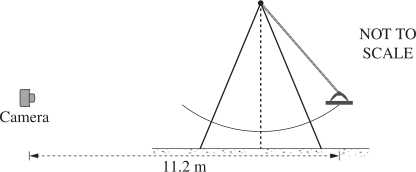
A camera films the motion of a swing in a park.

Let \(x(t)\) be the horizontal distance, in metres, from the camera to the seat of the swing at \(t\) seconds.

The seat is released from rest at a horizontal distance of 11.2 m from the camera.
 

  1. The rate of change of \(x\) can be modelled by the equation

\(\dfrac{dx}{dt}=-1.5\pi\ \sin(\dfrac{5\pi}{4}t)\).

  1. Find an expression for \(x(t)\).  (2 marks)

    --- 4 WORK AREA LINES (style=lined) ---
  2. How many times does the swing reach the closest point to the camera during the first 10 seconds?  (2 marks)

    --- 4 WORK AREA LINES (style=lined) ---

Show Answers Only

  1. \(x(t)=\dfrac{6}{5} \cos(\dfrac{5\pi}{4}t) + 10\)
  2. \(\text{6 times}\)

Show Worked Solution

a.    \(\dfrac{dx}{dt}=-1.5\pi\ \sin(\dfrac{5\pi}{4}t)\)

\(x(t)\) \(= -1.5\pi\ \int \sin(\dfrac{5\pi}{4}t)\ dt \)  
  \(= 1.5\pi \times \dfrac{4}{5\pi} \times \cos(\dfrac{5\pi}{4}t) + c\)  
  \(=\dfrac{6}{5} \cos(\dfrac{5\pi}{4}t) + c \)  
Mean mark (a) 51%.

  
\(\text{When}\ t=0, \ x(t)=11.2:\)

\(11.2\) \(=\dfrac{6}{5} \cos(0) + c\)  
\(c\) \(=11.2-\dfrac{6}{5} \)  
  \(=10\)  

 
\(x(t)=\dfrac{6}{5} \cos(\dfrac{5\pi}{4}t) + 10\)


b.    \(\text{Period}\ =\dfrac{2\pi}{n} = \dfrac{2\pi}{\frac{5\pi}{4}} = \dfrac{8}{5} = 1.6\ \text{(seconds)}\)
♦♦ Mean mark (b) 31%.

\(\text{1st time swing reaches closest point to camera = 0.8 seconds}\)

\(\text{Periods in next 9.2 seconds}\) \(=\dfrac{9.2}{1.6}\)  
  \(= 5.75\ \text{times}\)  

 
\(\therefore\ \text{Swing reaches the closest point 6 times in the 1st 10 seconds}\)

Filed Under: Other Integration Applications, Rates of Change Tagged With: Band 4, Band 5, smc-1213-10-Motion, smc-7135-10-Motion

Calculus, 2ADV C4 2023 HSC 13

Let `P(t)` be a function such that `(dP)/(dt)=3000 e^{2t}`.

When `t=0, P=4000`.

Find an expression for `P(t)`.  (2 marks)

--- 4 WORK AREA LINES (style=lined) ---

Show Answers Only

`P(t)=1500e^{2t}+2500`

Show Worked Solution
`P(t)` `=int (dP)/(dt)\ dt`  
  `=int 3000e^{2t}\ dt`  
  `=1500e^{2t}+c`  

 
`text{When}\ t=0, P=4000`

`4000` `=1500e^0+c`  
`c` `=2500`  

 
`:.P(t)=1500e^{2t}+2500`

Filed Under: Other Integration Applications, Rates of Change Tagged With: Band 4, smc-1213-20-Population, smc-7135-20-Exponential G&D

Calculus, 2ADV C3 2022 HSC 20

A scientist is studying the growth of bacteria. The scientist models the number of bacteria, `N`, by the equation

`N(t)=200e^(0.013 t)`,

where `t` is the number of hours after starting the experiment.

  1. What is the initial number of bacteria in the experiment?  (1 mark)

    --- 1 WORK AREA LINES (style=lined) ---

  2. What is the number of bacteria 24 hours after starting the experiment?  (1 mark)

    --- 2 WORK AREA LINES (style=lined) ---
  3. What is the rate of increase in the number of bacteria 24 hours after starting the experiment?  (2 marks)

    --- 5 WORK AREA LINES (style=lined) ---

Show Answers Only
  1. `200`
  2. `273`
  3. `3.55\ text{bacteria per hour}`
Show Worked Solution
a.    `N(0)` `=200e^0`
    `=200\ text{bacteria}`


b.   `text{Find}\ N\ text{when}\ \ t=24:`

`N(24)` `=200e^(0.013xx24)`  
  `=273.23…`  
  `=273\ text{bacteria (nearest whole)}`  


c.    `N` `=200e^(0.013 t)`
  `(dN)/dt` `=0.013xx200e^(0.013t)`
    `=2.6e^(0.013t)`

 
`text{Find}\ \ (dN)/dt\ \ text{when}\ \ t=24:`

`(dN)/dt` `=2.6e^(0.013xx24)`  
  `=3.550…`  
  `=3.55\ text{bacteria/hr (to 2 d.p.)}`  

Filed Under: Rates of Change, Rates of Change Tagged With: Band 2, Band 3, smc-1091-22-Exponential G&D, smc-1091-30-Log/Exp Function, smc-7135-20-Exponential G&D

Calculus, 2ADV C4 2021 HSC 27

Kenzo has a solar powered phone charger. Its power, `P`, can be modelled by the function

`P(t) = 400 sin(pi/12 t),\ \ 0 <= t <= 12`,

where  `t`  is the number of hours after sunrise.

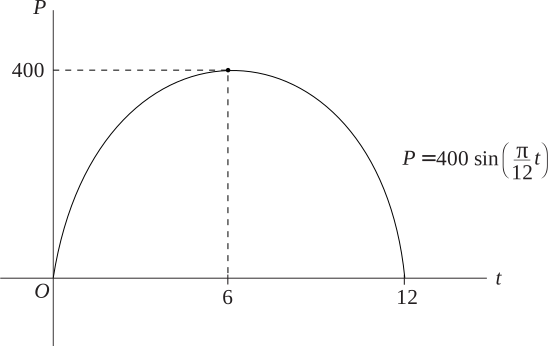
  1. Sketch the graph of  `P` for  `0 ≤ t ≤ 12`.  (2 marks)

    --- 8 WORK AREA LINES (style=lined) ---

Power is the rate of change of energy. Hence the amount of energy, `E` units, generated by the solar powered phone charger from  `t = a`  to  `t = b`,  where  `0 ≤ a ≤ b ≤ 12` is given by

`E = int_a^b P(t)\ dt`.

  1. Show that  `E = 4800/pi (cos\ (api)/12 - cos\ (bpi)/12)`.  (2 marks)

    --- 4 WORK AREA LINES (style=lined) ---

  2. To make a phone call, a phone battery needs at least 300 units of energy. Kenzo woke up 3 hours after sunrise and found that his phone battery had no units of energy. He immediately began to use his solar powered charger to charge his phone battery.
  3. Find the least amount of time he needed to wait before he could make a phone call. Give your answer correct to the nearest minute.  (3 marks)

    --- 6 WORK AREA LINES (style=lined) ---

  4. The next day, Kenzo woke up 6 hours after sunrise and again found that his phone battery had no units of energy. He immediately began to use his solar powered charger to charge his phone battery.
  5. Would it take more time or less time or the same amount of time, compared to the answer in part (c), to charge his phone battery in order to make a phone call? Explain your answer by referring to the graph drawn in part (a).  (1 mark)

    --- 2 WORK AREA LINES (style=lined) ---

Show Answers Only
  1.  
  2. `text(See Worked Solution)`
  3. `text(57 minutes)`
  4. `text(The power produced is at its peak when)\ t = 6`
  5. `:.\ text(It will charge in less time.)`
Show Worked Solution

a.

b.    `E` `= int_a^b 400 sin(pi/12 t)\ dt`
    `= [-400 · 12/pi cos(pi/12 t)]_a^b`
    `= -4800/pi cos(pi/12 b) – (-4800/pi cos(pi/12 a))`
    `= 4800/pi(cos\ (api)/12 – cos\ (bpi)/12)`


♦♦ Mean mark part (c) 29%
COMMENT: It is arguable that the nearest minute may also be 3h 58 m as the phone is not adequately charged at 3h 57 m.

c.   `text(Find)\ \ b\ \ text(given)\ \ E = 300\ \ text(and)\ \ a = 3:`

`300` `= 4800/pi (cos\ pi/4 – cos\ (bpi)/12)`
`(300pi)/4800` `= 1/sqrt2 – cos\ (bpi)/12`
`cos\ (bpi)/12` `= 1/sqrt2 – pi/16`
`(bpi)/12` `= cos^(-1) (1/sqrt2 – pi/16)`
`b` `= 12/pi cos^(-1)(1/sqrt2 – pi/16)`
  `= 3.952…`
  `= 3\ text{h 57 m  (nearest minute)}`

 
`:.\ text(Least time before phone is charged = 57 minutes)`


♦♦ Mean mark part (d) 22%

d.   `text(The power produced is at its peak when)\ \ t = 6.`

`:.\ text(It will charge in less time.)`

Filed Under: Other Integration Applications, Rates of Change Tagged With: Band 4, Band 5, smc-1213-30-Other applications, smc-7135-40-Other Themes

Calculus, 2ADV C3 2021 HSC 26

A particle is shot vertically upwards from a point 100 metres above ground level.

The position of the particle, `y` metres above the ground after `t` seconds, is given by

`y(t) = −5t^2 + 70t + 100`.

  1. Find the maximum height above ground level reached by the particle.  (2 marks)

    --- 4 WORK AREA LINES (style=lined) ---

  2. Find the velocity of the particle, in metres per second, immediately before it hits the ground, leaving your answer in the form  `asqrtb`,  where  `a`  and  `b`  are integers.  (3 marks)

    --- 6 WORK AREA LINES (style=lined) ---

Show Answers Only
  1. `345\ text(m)`
  2. `-20sqrt69\ text(m/s)`
Show Worked Solution

a.    `y(t) = -5t^2 + 70t + 100`

`y^(′)(t) = -10t + 70`

`y^(″)(t) = -10`

`text(Max height occurs when)\ \ y^(′)(t) = 0:`

`-10t + 70` `= 0`
`10t` `= 70`
`t` `= 7`


`:.\ text(Max height)\ ` `= -5(7)^2 + 70 xx 7 + 100`
  `= 345\ text(m)`


b.   `text(Particle hits ground when)\ \ y = 0:`

♦ Mean mark 38%.
`0` `= -5t^2 + 70t + 100`
`0` `= t^2 – 14t – 20`

 
`text(Using quadratic formula:)`

`t` `= (14 ± sqrt(14^2 + 4*20))/2`
  `= (14 + sqrt(276))/2\ \ \ (t > 0)`
  `= 7 + sqrt69`


`:. text(Velocity)\ (y^(′)(t))` `= -10(7 + sqrt69) + 70`
  `= -10sqrt69\ text(m/s)`

 
`:.a=-10 and b=69`

Filed Under: Rates of Change, Rates of Change Tagged With: Band 4, Band 5, smc-1091-10-Motion, smc-1091-50-Other Function, smc-7135-10-Motion

Calculus, 2ADV C3 2021 HSC 23

A population, \(P\), which is initially 5000, varies according to the formula

\(P = 5000b^\tfrac{-t}{10}\),

where \(b\) is a positive constant and \(t\) is time in years, \(t \geq 0\).

The population is 1250 after 20 years.

Find the value of \(t\), correct to one decimal place, for which the instantaneous rate of decrease is 30 people per year.   (4 marks)

--- 8 WORK AREA LINES (style=lined) ---

Show Answers Only

\(35.3 \ \text{years}\)

Show Worked Solution

\(P=1250 \text { when } t=20\)

♦ Mean mark 42%.
\(1250\) \(= 5000 \cdot b^\tfrac{-t}{10}\)
\(b^{-2}\) \(= \dfrac{1}{4}\)
\(b\) \(= 2\ \ (b>0)\)


\(P\) \(=5000 \cdot 2^{\tfrac{-t}{10}}\)
\(\dfrac{d P}{d t}\) \(=\ln 2 \cdot-\dfrac{1}{10} \cdot 5000 \cdot 2^{-\tfrac{t}{10}}\)
  \(=-500 \ln 2 \cdot 2^{\tfrac{-t}{10}}\)


\(\text{Find} \ t \ \text{when} \ \dfrac{d P}{d t}=-30\):

\(-30\) \(=-500 \ln 2 \cdot 2^{\tfrac{-t}{10}}\)
\(2^{\tfrac{-t}{10}}=\) \(=\dfrac{3}{50 \ln 2}\)
\(\ln 2^{\tfrac{-t}{10}}\) \(=\ln \left(\dfrac{3}{50 \ln 2}\right)\)
\(\dfrac{-t}{10}\) \(=\frac{\ln \left(\dfrac{3}{50 \ln 2}\right)}{\ln 2}\)
\(t\) \(=\dfrac{-10 \ln \left(\frac{3}{50 \ln 2}\right)}{\ln 2}\)
  \(=35.301 \ldots\)
  \(=35.3 \ \text{years (1 d.p.)}\)

Filed Under: Rates of Change, Rates of Change Tagged With: Band 5, smc-1091-22-Exponential G&D, smc-1091-30-Log/Exp Function, smc-7135-20-Exponential G&D

Trigonometry, 2ADV T3 2020 HSC 31

The population of mice on an isolated island can be modelled by the function.

`m(t) = a sin (pi/26 t) + b`,

where  `t`  is the time in weeks and  `0 <= t <= 52`. The population of mice reaches a maximum of 35 000 when  `t=13`  and a minimum of 5000 when  `t = 39`. The graph of  `m(t)`  is shown.
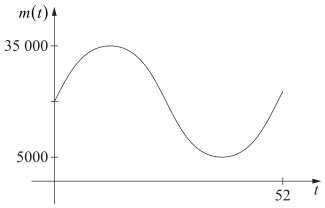
 

  1. What are the values of `a` and `b`?   (2 marks)

    --- 3 WORK AREA LINES (style=lined) ---

  2. On the same island, the population of cats can be modelled by the function
     
    `\ \ \ \ \ c(t) = −80cos(pi/26 (t-10)) + 120`
     
    Consider the graph of  `m(t)`  and the graph of  `c(t)`.


    Find the values of  `t, \ 0 <= t <= 52`, for which both populations are increasing.   (3 marks)

    --- 7 WORK AREA LINES (style=lined) ---

  3. Find the rate of change of the mice population when the cat population reaches a maximum.   (2 marks)

    --- 5 WORK AREA LINES (style=lined) ---

Show Answers Only

a.    `a = 15\ 000, b = 20\ 000`

b.    `text(Both populations are increasing when)\ 10 < t < 13`

c.    `\text(Decreasing by 643 mice per week)`

Show Worked Solution

a.    `b=(35\ 000 + 5000)/2= 20\ 000`

`a` `=\ text(amplitude of sin graph)`
  `= 35\ 000-20\ 000`
  `= 15\ 000`


b.    `text(By inspection of the)\ \ m(t)\ \ text(graph)`

♦♦ Mean mark (b) 30%.

`m^{′}(t) > 0\ \ text(when)\ \ 0 <= t < 13\ \ text(and)\ \ 39 < t <= 52`

`text(Sketch)\ \ c(t):`
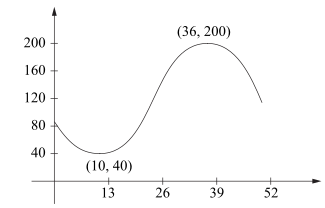
`text(Minimum)\ \ (cos0)\ \ text(when)\ \ t = 10`

`text(Maximum)\ \ (cospi)\ \ text(when)\ \ t = 36`

`:. c^{′}(t) > 0\ \ text(when)\ \ 10 < t < 36`

`:. text(Both populations are increasing when)\ \ 10 < t < 13`
  

c.   `c(t)\ text(maximum when)\ \ t = 36`

♦♦♦ Mean mark (c) 27%.
`m(t)` `= 15\ 000 sin(pi/26 t) + 20\ 000`
`m^{′}(t)` `= (15\ 000pi)/26 cos(pi/26 t)`
`m^{′}(36)` `= (15\ 000pi)/26 · cos((36pi)/26)`
  `= -642.7`

 
`:.\ text(Mice population is decreasing at 643 mice per week.)`

Filed Under: Modelling with Functions, Rates of Change, Rates of Change, Trig Applications Tagged With: Band 4, Band 5, Band 6, smc-1091-25-Other Themes, smc-1091-40-Trig Function, smc-1188-10-Population, smc-7125-10-Trig Applications, smc-7125-30-Population Models, smc-7135-40-Other Themes

Calculus, 2ADV C3 2020 HSC 21

Hot tea is poured into a cup. The temperature of tea can be modelled by  `T = 25 + 70(1.5)^(−0.4t)`, where `T` is the temperature of the tea, in degrees Celsius, `t` minutes after it is poured.

  1. What is the temperature of the tea 4 minutes after it has been poured?  (1 mark)

    --- 1 WORK AREA LINES (style=lined) ---

  2. At what rate is the tea cooling 4 minutes after it has been poured?  (2 marks)

    --- 4 WORK AREA LINES (style=lined) ---

  3. How long after the tea is poured will it take for its temperature to reach 55°C?  (3 marks)

    --- 6 WORK AREA LINES (style=lined) ---

Show Answers Only
  1. `61.6\ \ (text(to 1 d.p.))`
  2. `−5.9^@text(C/min)`
  3. `5.2\ text(minutes  (to 1 d.p.))`
Show Worked Solution
a.    `T` `= 25 + 70(1.5)^(−0.4 xx 4)`
    `= 61.58…`
    `= 61.6\ \ (text(to 1 d.p.))`


b.    `(dT)/(dt)` `= 70 log_e(1.5) xx −0.4(1.5)^(−0.4t)`
    `= −28log_e(1.5)(1.5)^(−0.4t)`


`text(When)\ \ t = 4,`

`(dT)/(dt)` `= −28log_e(1.5)(1.5)^(−1.6)`
  `= −5.934…`
  `= −5.9^@text(C/min  (to 1 d.p.))`


c.   `text(Find)\ \ t\ \ text(when)\ \ T = 55:`

♦ Mean mark part (c) 44%.
`55` `= 25 + 70(1.5)^(−0.4t)`
`30` `= 70(1.5)^(0.4t)`
`(1.5)^(−0.4t)` `= 30/70`
`−0.4t log_e(1.5)` `= log_e\ 3/7`
`−0.4t` `= (log_e\ 3/7)/(log_e (1.5))`
`:. t` `= (−2.08969)/(−0.4)`
  `= 5.224…`
  `= 5.2\ text(minutes  (to 1 d.p.))`

Filed Under: Rates of Change, Rates of Change Tagged With: Band 2, Band 3, Band 5, smc-1091-22-Exponential G&D, smc-1091-30-Log/Exp Function, smc-7135-20-Exponential G&D, smc-966-30-Other exponential modelling

Calculus, 2ADV C4 EQ-Bank 28

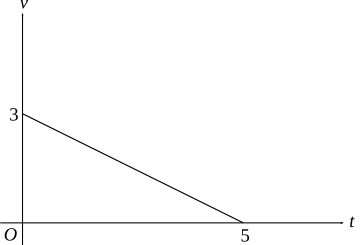
The velocity of a particle moving along the `x`-axis at `v` metres per second at `t` seconds, is shown in the graph below.
 

Initially, the displacement `x` is equal to 12 metres.

  1. Write an equation that describes the displacement, `x`, at time `t` seconds.   (2 marks)

    --- 4 WORK AREA LINES (style=lined) ---

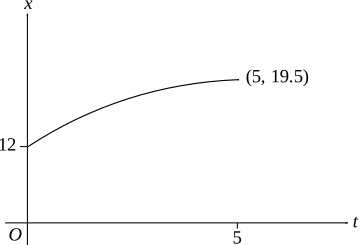
  2. Draw a graph that shows the displacement of the particle, `x`  metres from the origin, at a time `t` seconds between  `t= 0`  and  `t = 5`. Label the coordinates of the endpoints of your graph.   (2 marks)

    --- 8 WORK AREA LINES (style=lined) ---

Show Answers Only

a.    `x = 3t-(3)/(10) t ^2 + 12`

b.


Show Worked Solution
a.     `m_v` `= -(3)/(5)`
  `v` `= 3-(3)/(5) t`


`x` `= int v \ dt`
  `= int 3-(3)/(5) t \ dt`
  `= 3t-(3)/(10) t^2 + c`

 
`text(When) \ \ t = 0, x = 12  \ => \ c = 12`

`:. \ x = 3t-(3)/(10) t ^2 + 12`


b.    `text(When) \ \ t = 5:`

`x = 15-(3)/(10) xx 25 + 12 = 19.5`
 

Filed Under: Other Integration Applications, Rates of Change Tagged With: Band 4, Band 5, smc-1213-10-Motion, smc-7135-10-Motion

Calculus, 2ADV C4 EQ-Bank 22

The population, `D`, of Tasmanian Devils in a sanctuary is given by  `D(t)`, where  `t`  is the time in years after the sanctuary was established.

The devil population changes at a rate modelled by the function  `(dD)/(dt) = 28 e^(0.35t)`.

Calculate the increase in the number of Tasmanian Devils at the end of the first 8 years. Give your answer correct to three significant figures.  (3 marks)

Show Answers Only

`1240 \ text((to 3 sig. fig.))`

Show Worked Solution
`int_0^8 28e^(0.35t)` `= [28 xx (1)/(0.35) e^(0.35t)]_0^8`
  `= 80(e^(0.35 xx 8) – e°)`
  `= 80(16.44 … – 1)`
  `= 1235.57 …`
  `= 1240 \ text((to 3 sig. fig.))`

Filed Under: Other Integration Applications, Rates of Change Tagged With: Band 4, smc-1213-20-Population, smc-7135-20-Exponential G&D, smc-966-20-Population

Calculus, 2ADV C4 EQ-Bank 7 MC

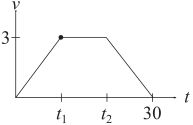
A lift accelerates from rest at a constant rate until it reaches a speed of 3 ms−1. It continues at this speed for 10 seconds and then decelerates at a constant rate before coming to rest. The total travel time for the lift is 30 seconds.

The total distance, in metres, travelled by the lift is

  1.  45
  2.  60
  3.  75
  4.  90
Show Answers Only

`B`

Show Worked Solution

`text(Consider the velocity graph:)`
 

`t_1 -> t_2 = text(10 seconds)`
 

`:.\ text(Total distance travelled)`

`=\ text(Area of trapezium)`

`= 1/2 xx 3(10 + 30)`

`= 60\ text(m)`
 

`=>\ B`

Filed Under: Other Integration Applications, Rates of Change Tagged With: Band 5, smc-1213-10-Motion, smc-7135-10-Motion

Calculus, 2ADV C4 2019 HSC 14a

A particle is moving along a straight line. The particle is initially at rest. The acceleration of the particle at time  `t`  seconds is given by  `a = e^(2t)-4`, where  `t >= 0`.

Find an expression, in terms of  `t`, for the velocity of the particle.  (2 marks)

--- 5 WORK AREA LINES (style=lined) ---

Show Answers Only

`v = 1/2e^(2t)-4t-1/2`

Show Worked Solution

`a = (dv)/(dt) = e^(2t)-4`

`v` `= int e^(2t)-4\ dt`
  `= 1/2 e^(2t)-4t + c`

 
`text(When)\ t = 0,\ v = 0`

`0 = 1/2 e^0-0 + c`

`c = -1/2`

`:. v = 1/2e^(2t)-4t-1/2`

Filed Under: Other Integration Applications, Rates of Change Tagged With: Band 4, smc-1091-10-Motion, smc-1091-30-Log/Exp Function, smc-1213-10-Motion, smc-7135-10-Motion

Calculus, 2ADV C4 2007* HSC 10a

An object is moving on the `x`-axis. The graph shows the velocity, `(dx)/(dt)`, of the object, as a function of time, `t`. The coordinates of the points shown on the graph are  `A (2, 1), B (4, 5), C (5, 0) and D (6, –5)`. The velocity is constant for  `t >= 6`.


  1. The object is initially at the origin. During which time(s) is the displacement of the object decreasing?   (1 mark)

    --- 1 WORK AREA LINES (style=lined) ---

  2. If the object travels 7 units in the first 4 seconds, estimate the time at which the object returns to the origin. Justify your answer.   (2 marks)

    --- 5 WORK AREA LINES (style=lined) ---

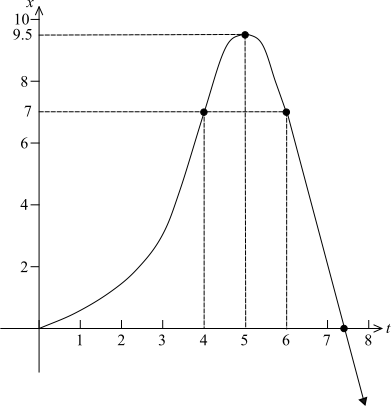
  3. Sketch the displacement, `x`, as a function of time.   (2 marks)

    --- 10 WORK AREA LINES (style=blank) ---

Show Answers Only

a.    `t > 5\ \ text(seconds)`

b.    `7.4\ \ text(seconds)`

c.    
       

Show Worked Solution

a.    `text(Displacement is reducing when the velocity is negative.)`

`:. t > 5\ \ text(seconds)`
  

b.    `text(At)\ B,\ text(the displacement) = 7\ text(units)`

`text(Consider the displacement from)\ B\ text(to)\ D:`

`text(Since the area below the graph from)\ B\ text(to)\ C\ text(equals )`

`text(the area above the graph from)\ C\ text(to)\ D,\ text(there is no )`

`text(change in displacement from)\ B\ text(to)\ D.`


`text(Consider)\ t >= 6,`

`text(Time required to return to origin:)`

`t=d/v= 7/5= 1.4\ \ text(seconds)`

`:.\ text(The particle returns to the origin after 7.4 seconds.)`
     

c.   


Filed Under: Area Under Curves, Other Integration Applications, Rates of Change Tagged With: Band 4, Band 5, Band 6, smc-1213-10-Motion, smc-7131-70-Areas Without Calculus, smc-7135-10-Motion, smc-975-70-Areas Without Calculus

Calculus, 2ADV C4 2017 HSC 13d

The rate at which water flows into a tank is given by

`(dV)/(dt) = (2t)/(1 + t^2)`,

where `V` is the volume of water in the tank in litres and `t` is the time in seconds.

Initially the tank is empty.

Find the exact amount of water in the tank after 10 seconds.  (3 marks)

--- 6 WORK AREA LINES (style=lined) ---
Show Answers Only

`text(ln)\ 101`

Show Worked Solution
`(dV)/(dt)` `= (2t)/(1 + t^2)`
`V` `= int (2t)/(1 + t^2)\ dt`
  `= text(ln)\ (1 + t^2) + c`

 
`text(When)\ \ t = 0,\ \ V = 0`

`0` `= text(ln)\ 1 + c`
`:. c` `= 0`

 
`text(Find)\ V\ text(when)\ t = 10:`

`V` `= text(ln)\ (1 + 10^2)`
  `= text(ln)\ 101`

Filed Under: Other Integration Applications, Rates of Change, Rates of Change Tagged With: Band 3, smc-1091-20-Flow, smc-1091-50-Other Function, smc-1213-15-Flow, smc-7135-30-Flow

Calculus, 2ADV C3 2017 HSC 9 MC

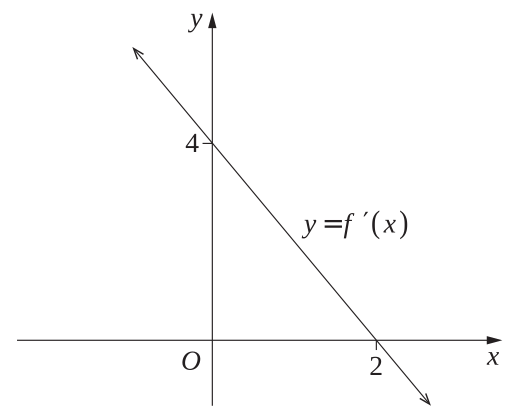
The graph of  `y = f^{′}(x)`  is shown.
 

The curve  `y = f (x)`  has a maximum value of 12.

What is the equation of the curve  `y = f (x)`?

  1. `y = x^2-4x + 12`
  2. `y = 4 + 4x-x^2`
  3. `y = 8 + 4x-x^2`
  4. `y = x^2-4x + 16`
Show Answers Only

`C`

Show Worked Solution

`text(Find the equation of)\ \ f^{′}(x):`

`m = -2,\ \ y text(-int) = 4`

`y = -2x + 4`

`f(x)` `= int -2x + 4\ dx`
  `= -x^2 + 4x + c`


`text(Maximum)\ \ f(x) = 12\ \ text(when)\ \ f^{′}(x) = 0:`

`-2x + 4` `= 0`
`x` `= 2`

 
`text(Substitute)\ \ x=2\ \ text(into)\ \ f(x):`

`:. 12` `= -2^2 + 4 ⋅ 2 + c`
`c` `= 8`


`:. f(x) = 8 + 4x-x^2`

`=>  C`

Filed Under: Other Integration Applications, Rates of Change Tagged With: Band 5, smc-1213-25-Tangents/Primitive function, smc-7135-35-Tangents/Primitive function

Calculus, 2ADV C3 2016 HSC 16b

Some yabbies are introduced into a small dam. The size of the population, `y`, of yabbies can be modelled by the function

`y = 200/(1 + 19e^(-0.5t)),`

where `t` is the time in months after the yabbies are introduced into the dam.

  1. Show that the rate of growth of the size of the population is
  2. `qquad qquad (1900 e^(-0.5t))/(1 + 19 e^(-0.5t))^2`.  (2 marks)

    --- 4 WORK AREA LINES (style=lined) ---

  3. Find the range of the function `y`, justifying your answer.  (2 marks)

    --- 4 WORK AREA LINES (style=lined) ---

  4. Show that the rate of growth of the size of the population can be written as
  5. `qquad qquad y/400 (200-y)`.  (1 mark)

    --- 4 WORK AREA LINES (style=lined) ---

  6. Hence, find the size of the population when it is growing at its fastest rate.  (2 marks)

    --- 4 WORK AREA LINES (style=lined) ---

Show Answers Only

a.    `text(Proof)\ \ text{(See Worked Solutions)}`

b.    `10 <= y < 200`

c.    `text(Proof)\ \ text{(See Worked Solutions)}`

d.    `100`

Show Worked Solution
a.     `y` `= 200/(1 + 19 e^(-0.5t))`
  `(dy)/(dt)` `= 200/(1 + 19 e^(-0.5t))^2 xx d/(dt) (1 + 19 e^(-0.5t))`
    `= (-200)/(1 + 19 e^(-0.5t))^2 xx -0.5 xx 19 e^(-0.5t)`
    `= (1900 e^(-0.5t))/(1 + 19 e^(-0.5t))^2\ \ text(… as required)`


b.    `text(When)\ \ t = 0,`

♦♦♦ Mean mark (ii) 21%.

`y = 200/(1 + 19) = 10`

`text(As)\ \ t -> oo,\ \ (1 + 19^(-0.5t)) -> 1`

`:. y -> 200`

`:.\ text(Range)\ \ \ 10 <= y < 200`


c.    `(dy)/(dt) = (1900 e^(-0.5t))/(1 + 19 e^(-0.5t))^2`

♦♦♦ Mean mark (iii) 18%.

`text(S) text(ince)\ \ y = 200/(1 + 19 e^(-0.5t))`

`=> (1 + 19 e^(-0.5t)) = 200/y`

`=> 19 e^(-0.5t) = 200/y-1 = (200-y)/y`

`text(Substituting into)\ \ (dy)/(dt):`

`(dy)/(dt)` `= (100 ((200-y)/y))/(200/y)^2`
  `= 100 ((200-y)/y) xx y^2/200^2`
  `= y/400 (200-y)\ \ text(… as required)`


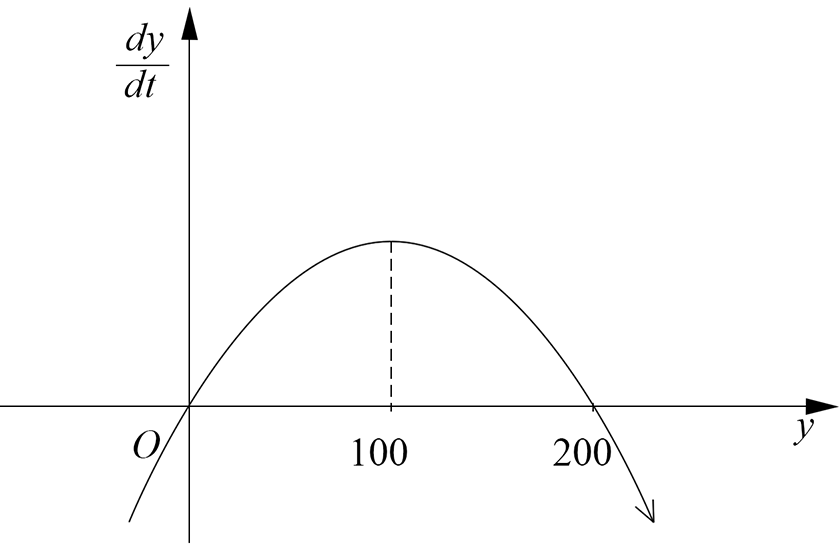
d.    `(dy)/(dt) = -y^2/400 + y/2`

♦♦♦ Mean mark (iv) 14%.

`text(Sketching the parabola:)`

`(-y^2)/400 + y/2` `= 0`
`-y^2 + 200y` `= 0`
`y (200-y)` `= 0`


hsc-2016-16bi

`:.\ text(Maximum)\ \ (dy)/(dt)\ \ text(occurs when)\ \ y = 100.`

Filed Under: Rates of Change, Rates of Change, Rates of Change Tagged With: Band 4, Band 6, smc-1091-25-Other Themes, smc-1091-30-Log/Exp Function, smc-7135-40-Other Themes

Calculus, 2ADV C4 2016 HSC 16a

A particle moves in a straight line. Its velocity `v\ text(ms)^-1` at time `t` seconds is given by

`v = 2 - 4/(t + 1).`

  1. Find the initial velocity.  (1 mark)

    --- 1 WORK AREA LINES (style=lined) ---

  2. Find the acceleration of the particle when the particle is stationary.  (2 marks)

    --- 4 WORK AREA LINES (style=lined) ---

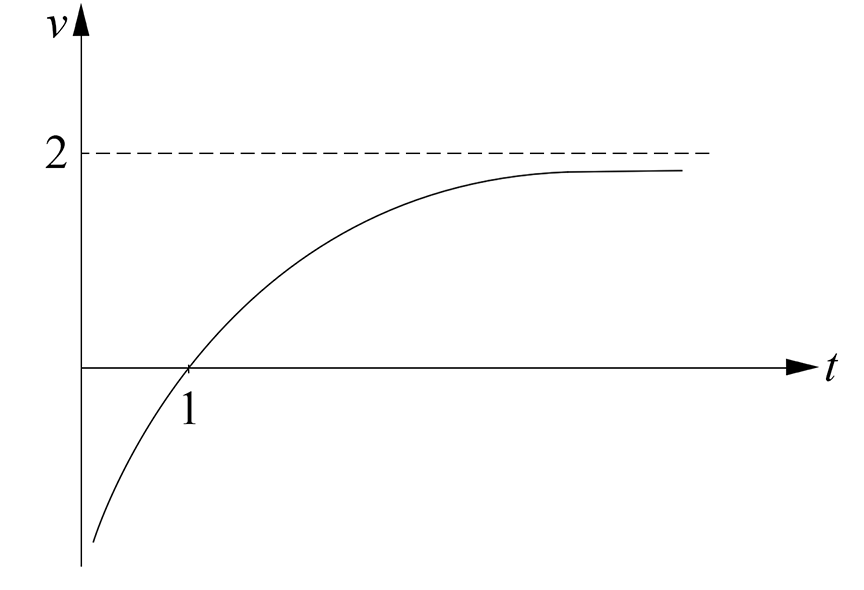
  3. By considering the behaviour of `v` for large `t`, sketch a graph of `v` against `t` for  `t >= 0`, showing any intercepts.  (2 marks)

    --- 4 WORK AREA LINES (style=lined) ---

  4. Find the exact distance travelled by the particle in the first 7 seconds.  (3 marks)

    --- 6 WORK AREA LINES (style=lined) ---

Show Answers Only
  1. `-2\ text(ms)^-1`
  2. `1\ text(ms)^-2`
  3.  
    hsc-2016-16ai
  4. `10 – 4 ln 2\ \ text(metres)`
Show Worked Solution

i.   `text(Initial velocity when)\ \ t = 0`

Mean mark 93%.
COMMENT: Great example of low hanging fruit late in the exam for students who progress efficiently.

`v = 2 – 4/1 = -2\ text(ms)^-1`


ii.   `v` `= 2 – 4/(t + 1)`
  `a` `=(dv)/(dt)= 4/(t + 1)^2`


`text(Particle is stationary when)\ \ v = 0,`

`2 – 4/(t + 1)` `= 0`
`2 (t + 1)` `= 4`
`t` `= 1`
   

`text(When)\ \ t=1,`

`:.a` `= 4/(1 + 1)^2`
  `= 1\ text(ms)^-2` 


iii.  `v = 2 – 4/(t + 1)`

♦ Mean mark 47%.

`text(As)\ \ t -> oo,\ \ \ 4/(t + 1) -> 0`

`:. v -> 2`

 hsc-2016-16ai


♦♦ Mean mark 26%.

iv.   `text(Distance travelled in 1st 7 seconds)`

`= |\ int_0^1 (2 – 4/(t + 1))\ dt\ | + int_1^7 (2 – 4/(t + 1))\ dt`

`= -[2t – 4 ln (t + 1)]_0^1 + [2t – 4 ln (t + 1)]_1^7`

`= -[(2 – 4 ln 2) – 0] + [(14 – 4 ln 8) – (2 – 4 ln 2)]`

`= 4 ln 2 – 2 + 12 – 4 ln 2^3 + 4 ln 2`

`= 10 + 8 ln 2 – 12 ln 2`

`= 10 – 4 ln 2\ \ text(metres)`

Filed Under: Motion, Other Integration Applications, Rates of Change Tagged With: Band 2, Band 4, Band 5, smc-1213-10-Motion, smc-7135-10-Motion

Calculus, 2ADV C3 2004 HSC 5b

A particle moves along a straight line so that its displacement, `x` metres, from a fixed point `O` is given by  `x = 1 + 3 cos 2t`, where  `t`  is measured in seconds.

  1. What is the initial displacement of the particle?  (1 mark)

    --- 2 WORK AREA LINES (style=lined) ---

  2. Sketch the graph of  `x`  as a function of  `t`  for  `0 ≤ t ≤ pi`.  (2 marks)

    --- 8 WORK AREA LINES (style=lined) ---

  3. Hence, or otherwise, find when AND where the particle first comes to rest after  `t = 0`.  (2 marks)

    --- 4 WORK AREA LINES (style=lined) ---

  4. Find a time when the particle reaches its greatest magnitude of velocity. What is this velocity?  (2 marks)

    --- 4 WORK AREA LINES (style=lined) ---

Show Answers Only

a.    `text(4 m to the right of)\ O.`

b.    `text(See Worked Solutions)`

c.     `t = pi/2\ text(seconds, 2 m to the left of)\ O.`

d.    `text(6 m s)^(−1)`

Show Worked Solution

a.    `x = 1 + 3 cos 2t`

`text(When)\ \ t = 0,`

`x` `= 1 + 3 cos 0`
  `= 1 + 3`
  `= 4`


`:.\ text(Initial displacement is 4 m to the right of)\ O.`


b.    `text(Period)\ = (2pi)/n = (2pi)/2 = pi`

`text(Considering the range)`

`-1` `<=cos 2t<=1`
`-3` `<=3cos 2t<=3`
`-2` `<=1 + 3 cos 2t<=4`


 Calculus in the Physical World, 2UA 2004 HSC 5b


c.      `x` `= 1 + 3 cos 2t`
  `:.v` `= −6 sin 2t`


`text(The particle comes to rest when)\ \ v=0`

`-6 sin 2t` `= 0`
`sin 2t` `= 0`
`2t` `= 0, pi, 2pi…`
`t` `= 0, pi/2, pi…`


`:.\ text(After)\ \ t=0, text(particle first comes to rest when)`

`t = pi/2\ text(seconds.)`

`text(When)\ t = pi/2,`

`x` `= 1 + 3 cos 2(pi/2)`
  `= 1 + 3 cos pi`
  `= 1 + 3(−1)`
  `= −2`


`:.\ text(Particle first comes to rest at 2 m to the left of)\ O.`


d.    `x = 1 + 3 cos 2t`

`v` `= -6 sin 2t`
`a` `= -12 cos 2t`
   

`text(MAX occurs when)\ \ a=0`

`−12 cos 2t` `= 0`
`cos 2t` `= 0`
`2t` `= pi/2, (3pi)/2, …`
`t` `= pi/4, (3pi)/4, …`

 
`:.\ text(Maximum at)\ \ t=pi/4,\ \ (3pi)/4, …\ text(seconds,)`


`text(When)\ \ t = pi/4\ text(seconds,)`

`v` `= -6 sin 2(pi/4)`
  `= -6 sin(pi/2)`
  `= −6`

 
`:.\ text(Maximum is 6 m s)^(−1).`

Filed Under: Motion, Rates of Change, Rates of Change Tagged With: Band 3, Band 4, Band 5, smc-1091-10-Motion, smc-1091-40-Trig Function, smc-7135-10-Motion

Calculus, 2ADV C4 2015 HSC 15c

Water is flowing in and out of a rock pool. The volume of water in the pool at time `t` hours is `V` litres. The rate of change of the volume is given by

`(dV)/(dt) = 80 sin(0.5t)`

At time  `t = 0`, the volume of water in the pool is 1200 litres and is increasing.

  1. After what time does the volume of water first start to decrease?  (2 marks)

    --- 6 WORK AREA LINES (style=lined) ---

  2. Find the volume of water in the pool when  `t = 3`.  (2 marks)

    --- 6 WORK AREA LINES (style=lined) ---

  3. What is the greatest volume of water in the pool?  (1 mark)

    --- 3 WORK AREA LINES (style=lined) ---

Show Answers Only

a.    `2 pi\ text(hours)`

b.    `1349\ text(litres)`

c.    `1520\ text(litres)`

Show Worked Solution

a.    `(dV)/(dt) = 80 sin (0.5t)`

♦ Mean mark (i) 37%.

`text(Volume decreases when)\ \ (dV)/(dt) < 0`

`(dV)/(dt) < 0\ \ text(when)\ \ t > 2 pi\ text(hours)`

`:.\ text(After 2)\pi\ \text(hours, volume starts to decrease.)`


b.    `V` `= int (dV)/(dt)\ dt`
  `= int 80 sin (0.5t)\ dt`
  `= -160 cos (0.5t) + c`


`text(When)\ \ t = 0,\ V = 1200`

`1200` `= -160 cos 0 + c`
`c` `= 1360`
`:.\ V` `= -160 cos (0.5t) + 1360`


`text(When)\ \ t = 3`

`V` `= -160 cos (0.5 xx 3) + 1360`
  `= 1348.68…\ \ text(litres)`
  `= 1349\ text{litres  (nearest litre)}`


c.    `V = -160 cos (0.5t) + 1360`

♦♦ Mean mark (iii) 27%.

`=>\ text(Greatest volume occurs when)`

`cos (0.5t) = -1`

`:.\ text(Maximum volume)`

`= -160 (-1) + 1360`

`= 1520\ text(litres)`

Filed Under: Other Integration Applications, Rates of Change, Rates of Change Tagged With: Band 4, Band 5, smc-1091-20-Flow, smc-1091-40-Trig Function, smc-1213-15-Flow, smc-7135-30-Flow

Calculus, 2ADV C4 2015 HSC 9 MC

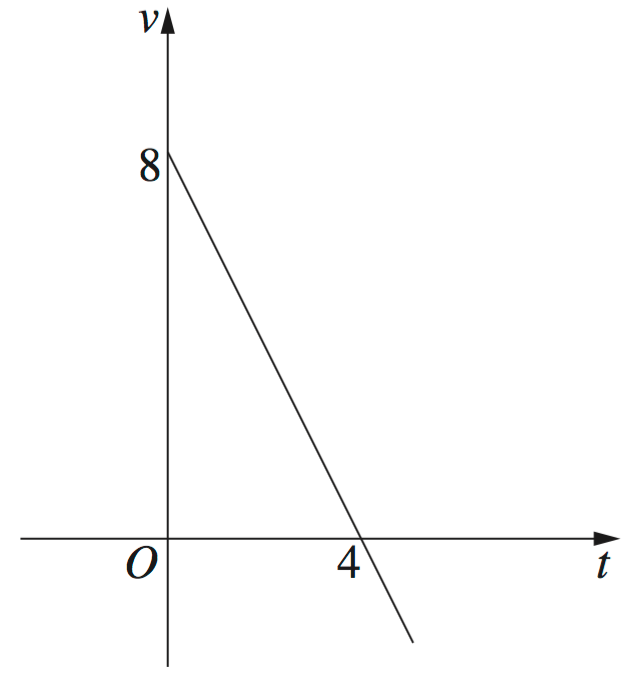
A particle is moving along the `x`‑axis. The graph shows its velocity `v` metres per second at time `t` seconds.
 

2012 2ua 9 mc
 

When `t = 0` the displacement `x` is equal to `2` metres.

What is the maximum value of the displacement `x`?

  1. `text(8 m)`
  2. `text(14 m)`
  3. `text(16 m)`
  4. `text(18 m)`
Show Answers Only

`D`

Show Worked Solution

`text(Distance travelled)`

♦♦ Mean mark 31%.

`= int_0^4 v\ dt`

`= text(Area under the velocity curve)`

`= 1/2 xx b xx h`

`= 1/2 xx 4 xx 8`

`= 16\ \ text(metres.)`


`text(S)text(ince velocity is always positive between)\ t=0`

`text(and)\  t = 4,\ text(and the original displacement = 2,)`

`text(the maximum displacement) = 16 + 2 = 18\ \ text(metres)`

`=> D`

Filed Under: Motion, Other Integration Applications, Rates of Change Tagged With: Band 6, smc-1213-10-Motion, smc-7135-10-Motion

Calculus, 2ADV C4 2006 HSC 9b

During a storm, water flows into a 7000-litre tank at a rate of `(dV)/(dt)` litres per minute, where `(dV)/(dt) = 120 + 26t-t^2` and `t` is the time in minutes since the storm began.

  1. At what times is the tank filling at twice the initial rate?  (2 marks)

    --- 6 WORK AREA LINES (style=lined) ---

  2. Find the volume of water that has flowed into the tank since the start of the storm as a function of `t`.  (1 mark)

    --- 3 WORK AREA LINES (style=lined) ---

  3. Initially, the tank contains 1500 litres of water. When the storm finishes, 30 minutes after it began, the tank is overflowing.


    How many litres of water have been lost?  (2 marks)

    --- 6 WORK AREA LINES (style=lined) ---

Show Answers Only

a.    `t = 6 or 20\ text(minutes)`

b.    `V = 120t + 13t^2 – 1/3t^3`

c.    `800\ text(litres)`

Show Worked Solution

a.    `(dV)/(dt) = 120 + 26t-t^2`

`text(When)\ t = 0, (dV)/(dt) = 120`

`text(Find)\ t\ text(when)\ (dV)/(dt) = 240`

`240 = 120 + 26t-t^2`

`t^2-26t + 120 = 0`

`(t-6)(t-20) = 0`

`t = 6 or 20`

`:.\ text(The tank is filling at twice the initial rate)`

`text(when)\ t = 6 and t = 20\ text(minutes)`


b.    `V` `= int (dV)/(dt)\ dt`
  `= int 120 + 26t-t^2\ dt`
  `= 120t + 13t^2-1/3t^3 + c`

 
`text(When)\ t = 0, V = 0`

`=>  c = 0`

`:. V= 120t + 13t^2-1/3t^3`


c.    `text(Storm water volume into the tank when)\ t = 30`

`= 120(30) + 13(30^2)-1/3 xx 30^3`

`= 3600 + 11\ 700-9000`

`= 6300\ text(litres)`
 

`text(Total volume)` `= 6300 + 1500`
  `= 7800\ text(litres)`


`:.\ text(Overflow)` `= 7800-7000`
  `= 800\ text(litres)`

Filed Under: Other Integration Applications, Rates of Change, Rates of Change Tagged With: Band 4, Band 5, Band 6, HSC, smc-1091-20-Flow, smc-1091-50-Other Function, smc-1213-15-Flow, smc-7135-30-Flow

Calculus, 2ADV C3 2005 HSC 6b

A tank initially holds 3600 litres of water. The water drains from the bottom of the tank. The tank takes 60 minutes to empty.

A mathematical model predicts that the volume, `V`  litres, of water that will remain in the tank after  `t`  minutes is given by
  

`V = 3600(1 − t/60)^2,\ \ text(where)\ \ 0 ≤ t ≤ 60`.
 

  1. What volume does the model predict will remain after ten minutes?  (1 mark)

    --- 1 WORK AREA LINES (style=lined) ---

  2. At what rate does the model predict that the water will drain from the tank after twenty minutes?  (2 marks)

    --- 4 WORK AREA LINES (style=lined) ---

  3. At what time does the model predict that the water will drain from the tank at its fastest rate?  (2 marks)

    --- 4 WORK AREA LINES (style=lined) ---

Show Answers Only

a.    `text(2500 L)`

b.    `80\ text(liters per minute)`

c.    `0`

Show Worked Solution

a.    `V = 3600(1 − t/60)^2`

`text(When)\ t = 10,`

`V` `= 3600(1 − 10/60)^2`
  `= 3600 xx (5/6)^2`
  `= 2500\ text(L)`


b.    `V = 3600(1 -t/60)^2`

`text(Using chain rule:)`

`(dV)/dt` `= 3600 xx 2 xx (1 – t/60) xx d/dt(1 – t/60)`
  `= 7200(1 – t/60) xx -1/60`
  `= −120(1 – t/60)`


`text(When)\ \ t =20`

`(dV)/dt` `= −120(1 – 20/60)`
  `= −80`


`:.\ text(After 20 minutes, the water will drain)`

`text(at 80 litres per minute.)`


c.     `(dV)/dt` `= −120(1 − t/60)`
    `= −120 + 2t`
  `(d^2V)/dt^2` `= 2`

 
`text(S)text(ince)\ (d^2V)/dt^2\ text(is a constant, no S.P.’s)`


`text(Checking limits of)\ \ 0 ≤ t ≤ 60`

`text(At)\ t = 0,`

`(dV)/dt = −120(1-0) = −120\ text(L/min)`

`text(At)\ t = 60,`

`(dV)/dt = −120(1 − 60/60) = 0\ text(L/min)`


`:.\ text(The model predicts water will drain)`

`text(out the fastest when)\ \ t = 0.`

Filed Under: Rates of Change, Rates of Change, Rates of Change Tagged With: Band 3, Band 4, Band 5, smc-1091-20-Flow, smc-1091-50-Other Function, smc-7135-30-Flow

Calculus, 2ADV C4 2008 HSC 9c

A beam is supported at  `(-b, 0)`  and  `(b, 0)`  as shown in the diagram.
 

2008 9c

 
It is known that the shape formed by the beam has equation  `y = f(x)`, where  `f(x)`  satisfies

  `f^{″}(x)` `= k (b^2-x^2),\ \ \ \ \ `(`k` is a positive constant) 
and        `f^{′}(-b)` `= -f'(b)`.


  1. Show that  `f^{′}(x) = k (b^2x-(x^3)/3)`.   (2 marks)

    --- 5 WORK AREA LINES (style=lined) ---

  2. How far is the beam below the  `x`-axis at  `x = 0`?   (2 marks)

    --- 6 WORK AREA LINES (style=lined) ---

Show Answers Only

a.    `text(Proof)\ text{(See Worked Solutions)}`

b.    `(5kb^4)/12\ text(units)`

Show Worked Solution
a.     `text(Show)\ \ f^{′}(x) = k (b^2x-x^3/3)`
`f^{″}(x)` `= k (b^2 – x^2)`
`f^{′}(x)` `= int k (b^2-x^2)\ dx`
  `= k int b^2-x^2\ dx`
  `= k (b^2x-x^3/3) + c`


`text(S)text(ince S.P. exists at)\ \ x = 0`

`=> f^{′}(x)` `= 0\ \ text(when)\ \  x = 0`
`0` `= k (b^2 * 0-0) + c`
`c` `= 0`


`:.\ f^{′}(x) = k (b^2x-x^3/3)\ \ \ text(… as required)`


b.     `f(x)` `= int f^{′}(x)\ dx`
    `= k int b^2x-x^3/3\ dx`
    `= k ((b^2x^2)/2-x^4/12) + c`


`text(We know)\ \ f(x) = 0\ \ text(when)\ \ x = b`

`=> 0` `= k ( (b^2*b^2)/2-b^4/12) + c`
`c` `= -k ( (6b^4)/12-b^4/12)`
  `= -k ( (5b^4)/12 )`
  `= -(5kb^4)/12`


`:.\ text(When)\ \ x = 0, text(the beam is)\ \ (5kb^4)/12\ \ text(units)`

`text(below the)\ x text(-axis.)`

Filed Under: Integrals, Other Integration Applications, Rates of Change Tagged With: Band 5, Band 6, page-break-before-solution, smc-1213-25-Tangents/Primitive function, smc-7135-35-Tangents/Primitive function

Calculus, 2ADV C4 2008 HSC 5a

The gradient of a curve is given by  `dy/dx = 1-6 sin 3x`. The curve passes through the point  `(0, 7)`.

What is the equation of the curve?   (3 marks)

--- 6 WORK AREA LINES (style=lined) ---

Show Answers Only

`y = x + 2 cos 3x + 5`

Show Worked Solution
`dy/dx` `= 1-6 sin 3x`
`y` `= int 1-6 sin 3x\ dx`
  `= x + 2 cos 3x + c`

  
`text(Passes through)\ (0,7):`

`=> 0 + 2 cos 0 + c` `= 7`
`2 + c` `= 7`
`c` `= 5`

  
`:.\ text(Equation is)\ \ \ y = x + 2 cos 3x + 5`

Filed Under: Differentiation and Integration, Integrals, Other Integration Applications, Rates of Change, Trig Integration, Trig Integration Tagged With: Band 4, smc-1204-10-Sin, smc-1213-25-Tangents/Primitive function, smc-7135-35-Tangents/Primitive function, smc-7188-10-Sin

Calculus, 2ADV C4 2014 HSC 11f

The gradient function of a curve  `y = f(x)`  is given by  `f^{′}(x) = 4x-5`.  The curve passes through the point  `(2, 3)`.

Find the equation of the curve.  (2 marks)

--- 6 WORK AREA LINES (style=lined) ---

Show Answers Only

`f(x) = 2x^2-5x + 5`

Show Worked Solution
`f^{′}(x)` `= 4x-5`
`f(x)` `= int 4x-5\ dx`
  `= 2x^2-5x + C`


`text(Given)\ \ f(x)\ text(passes through)\ (2,3):`

`3` `= 2(2^2)-5(2) + C`
`3` `= 8-10 + C`
`C` `= 5`

 
`:.\ f(x) = 2x^2-5x + 5`

Filed Under: Curve Sketching and The Primitive Function, Other Integration Applications, Rates of Change Tagged With: Band 4, smc-1213-25-Tangents/Primitive function, smc-7135-35-Tangents/Primitive function

Calculus, 2ADV C4 2011 HSC 9b

A tap releases liquid  `A`  into a tank at the rate of  `(2 + t^2/(t + 1))`  litres per minute, where  `t`  is time in minutes. A second tap releases liquid  `B`  into the same tank at the rate of  `(1 + 1/(t+1))`  litres per minute. The taps are opened at the same time and release the liquids into an empty tank. 

  1. Show that the rate of flow of liquid  `A`  is greater than the rate of flow of liquid  `B`  by  `t`  litres per minute.    (1 mark)

    --- 4 WORK AREA LINES (style=lined) ---

  2. The taps are closed after 4 minutes. By how many litres is the volume of liquid  `A`  greater than the volume of liquid  `B`  in the tank when the taps are closed?    (2 marks)

    --- 6 WORK AREA LINES (style=lined) ---

Show Answers Only

a.    `text(Proof)  text{(See Worked Solutions)}`

b.    `text(There is 8 litres more of liquid)\ A\ text(than)\ B.`

Show Worked Solution
♦♦♦ Mean mark 16%
MARKER’S COMMENT: Many students incorrectly differentiated in part (i). The 1 mark allocation indicates the answer will not require an involved multi-step process.

a.    `text(Show difference in flow rate)\ (D) = t`

`D` `= (2 + t^2/(t+1))-(1+ 1/(t+1))`
  `= (2(t+1) + t^2)/(t+1)-((t+1) + 1)/(t + 1)`
  `= (2t + 2 + t^2-t-2)/(t + 1)`
  `= (t^2 + t)/(t + 1)`
  `= (t (t + 1))/(t + 1)`
  `= t\ \ \ … text(as required)`


b.    `text(Difference in Volume)`

♦♦♦ Mean mark 15%
MARKER’S COMMENT: Few students were able to answer this part. Previous parts of any question should be front and centre of your thinking when working out strategies.

`= int_0^4 (2 + t^2/(1+ t))\ dt\-int_0^4 (1 + t/(1+t))\ dt`

`= int_0^4 t\ dt\ \ \ \ \ text{(using part(i))}`

`= [t^2/2]_0^4`

`= 16/2\ – 0`

` = 8`
 

`:.\ text(There is 8 litres more of liquid)\ A\ text(than)\ B.`

Filed Under: Integrals, Other Integration Applications, Rates of Change, Rates of Change Tagged With: Band 6, smc-1091-20-Flow, smc-1091-50-Other Function, smc-1213-15-Flow, smc-7135-30-Flow

Calculus, 2ADV C4 2011 HSC 4c

The gradient of a curve is given by  `dy/dx = 6x-2`.  The curve passes through the point `(-1, 4)`. 

What is the equation of the curve?   (2 marks)

--- 5 WORK AREA LINES (style=lined) ---

Show Answers Only

 `y = 3x^2-2x-1`

Show Worked Solution

`dy/dx = 6x-2` 

`y` `= int 6x-2\ dx`
  `= 3x^2-2x + c`

 
`text{Since it passes through}\ (-1,4),`

`4` `= 3 (-1)^2-2(-1) + c`
`4` `= 3 + 2 + c`
`c` `= -1`

 
`:. y = 3x^2-2x-1`

Filed Under: Integrals, Other Integration Applications, Rates of Change, Tangents and Normals Tagged With: Band 4, smc-1089-30-Find f(x) given f'(x), smc-1090-20-Find curve given tangent, smc-1090-40-Quadratic Function, smc-1213-25-Tangents/Primitive function, smc-7135-35-Tangents/Primitive function

Calculus, 2ADV C4 2013 HSC 16a

The derivative of a function `f(x)` is  `f^{′}(x) = 4x-3`.  The line  `y = 5x-7`  is tangent to the graph `f(x)`.

Find the function `f(x)`.   (3 marks) 

--- 6 WORK AREA LINES (style=lined) ---

Show Answers Only

`f(x) = 2x^2-3x + 1`

Show Worked Solution

`text(Solution 1)`

`f^{′}(x)` `=4x-3`
`f(x)` `= int 4x-3\ dx`
  `= 2x^2-3x + c`

 
`text(Intersection when)`

`2x^2-3x + c = 5x-7`

`2x^2-8x + (7 + c) = 0`

  
`text(S)text(ince)\ \ y=5x-7\ \ text(is a tangent)\ => Delta =0`

`b^2-4ac` `=0`
`(-8)^2-[4xx2xx(7+c)]` `= 0`
`64-56-8c` `=8`
`8c` `=8`
`c` `=1`

 
`:.f(x) = 2x^2-3x + 1`

 
`text(Solution 2)`

`f^{′}(x)=4x-3`

`y=5x-7\ \ text{(Gradient = 5)}`

`=>4x-3` `=5`
`x` `=2`

 
`f(x) = 2x^2-3x + 1`

`f(x)\ text{passes through (2, 3)}`

`f(2)` `=2xx 2^2-3(2)+c`
`3` `=8-6+c`
`c` `=1`

 
`:.f(x) = 2x^2-3x + 1`

Filed Under: Other Integration Applications, Rates of Change, Tangents and Normals Tagged With: Band 4, smc-1090-20-Find curve given tangent, smc-1090-40-Quadratic Function, smc-1213-25-Tangents/Primitive function, smc-7135-35-Tangents/Primitive function

Calculus, 2ADV C4 2009 HSC 7a

The acceleration of a particle is given by

`a=8e^(-2t)+3e^(-t)`,

where  `x`  is the displacement in metres and  `t`  is the time in seconds.

Initially its velocity is  `text(– 6 ms)^(–1)` and its displacement is 5 m.

  1. Show that the displacement of the particle is given by
  2. `qquad  x=2e^(-2t)+3e^-t+t`.   (2 marks) 

    --- 5 WORK AREA LINES (style=lined) ---

  3. Find the time when the particle comes to rest.    (3 marks)

    --- 7 WORK AREA LINES (style=lined) ---

  4. Find the displacement  when the particle comes to rest.    (1 mark)

    --- 3 WORK AREA LINES (style=lined) ---

Show Answers Only
  1. `text{Proof  (See Worked Solutions)}`
  2. `ln4\ text(seconds)`
  3. `7/8+ln4\ \ text(units)`
Show Worked Solution

i.    `text(Show)\ \ x=2e^(-2t)+3e^-t+t`

`a=8e^(-2t)+3e^-t\ \ text{(given)}`

`v=int a\ dt=-4e^(-2t)-3e^-t+c_1`

`text(When)\ t=0,  v=-6\ \ text{(given)}`

`-6` `=-4e^0-3e^0+c_1`
`-6` `=-7+c_1`
`c_1` `=1`

 
`:. v=-4e^(-2t)-3e^-t+1`
 

`x` `=int v\ dt`
  `=int(-4e^(-2t)-3e^-t+1)\ dt`
  `=2e^(-2t)+3e^-t+t+c_2`

 
`text(When)\ \ t=0,\ x=5\ \ text{(given)}`

`5` `=2e^0+3e^0+c_2`
`c_2` `=0`

 
`:.\ x=2e^(-2t)+3e^-t+t\ \ text(… as required)`


ii.   `text(Particle comes to rest when)\ \ v=0`

`text(i.e.)\ \ -4e^(-2t)-3e^-t+1=0`

`text(Let)\ X=e^-t\ \ \ \ =>X^2=e^(-2t)`

`-4X^2-3X+1` `=0`
`4X^2+3X-1` `=0`
`(4X-1)(X+1)` `=0`

 
 `:.\ \ X=1/4\ \ text(or)\ \ X=-1`

`text(When)\ \ X=1/4:`

`e^-t` `=1/4`
`lne^-t` `=ln(1/4)`
`-t` `=ln(1/4)`
`t` `=-ln(1/4)=ln(1/4)^-1=ln4`

 
`text(When)\ \ X=-1:`

`e^-t=-1\ \ text{(no solution)}`
 

`:.\ text(The particle comes to rest when)\ t=ln4\ text(seconds)`
  

iii.  `text(Find)\ \ x\ \ text(when)\ \ t=ln4 :`

`x=2e^(-2t)+3e^-t+t`

`\ \ =2e^(-2ln4)+3e^-ln4+ln4`

`\ \ =2(e^ln4)^-2+3(e^ln4)^-1+ln4`

`\ \ =2xx4^-2+3xx4^-1+ln4`

`\ \ =2/16+3/4+ln4`

`\ \ =7/8+ln4`

ALGEBRA TIP: Helpful identity  `e^lnx=x`. Easily provable as follows:
`e^ln2=x`
`\ =>lne^ln2=lnx\ `
`\ => ln2=lnx\ `
`\ =>x=2`.

Filed Under: Motion, Other Integration Applications, Rates of Change Tagged With: Band 3, Band 4, Band 5, smc-1091-10-Motion, smc-1091-30-Log/Exp Function, smc-1213-10-Motion, smc-7135-10-Motion

Calculus, 2ADV C4 2012 HSC 15b

The velocity of a particle is given by

`v=1-2cost`,

where  `x`  is the displacement in metres and  `t`  is the time in seconds. Initially the particle is 3 m to the right of the origin.

  1. Find the initial velocity of the particle.    (1 mark)

    --- 1 WORK AREA LINES (style=lined) ---

  2. Find the maximum velocity of the particle.    (1 mark)

    --- 1 WORK AREA LINES (style=lined) ---

  3. Find the displacement, `x`,  of the particle in terms of  `t`.    (2 marks)

    --- 4 WORK AREA LINES (style=lined) ---

  4. Find the position of the particle when it is at rest for the first time.    (2 marks)

    --- 4 WORK AREA LINES (style=lined) ---

Show Answers Only

a.    `-1\ text(m/s)`

b.    `3\ text(m/s)`

c.    `x=t-2sint+3`

d.    `pi/3-sqrt3+3`

Show Worked Solution

a.    `text(Find)\ \ v\ \ text(when)\ \ t=0`:

`v` `=1-2cos0`
  `=1-2`
  `=-1`

 
`:.\ text(Initial velocity is)\ -1\ text(m/s.)`


b.   `text(Solution 1)`

`text(Max velocity occurs when)\ \ a=(d v)/(dt)=0`

♦♦ Mean mark 29%
MARKER’S COMMENT: Solution 2 is more efficient here. Using the -1 and +1 limits of trig functions can be very a effective way to calculate max/min values.

`a=2sint`
 

`text(Find)\ \ t\ \ text(when)\ \ a=0 :`

`2sint=0`

`t=0`,  `pi`,  `2pi`, …

`text(At)\ \ t=0,\ \   v=-1\ text(m/s)`

`text(At)\ \ t=pi,\ \ v=1-2(-1)=3\ text(m/s)`

 
`:.\ text(Maximum velocity is 3 m/s)`


`text(Solution 2)`

`v=1-2cost`

`text(S)text(ince)\ \ -1` `<cost<1`
`-2` `<2cost<2`
`-1` `<1-2cost<3`

 
`:.\ text(Maximum velocity is 3 m/s)`


c.    `x` `=int v\ dt`
  `=int(1-2cost)\ dt`
  `=t-2sint+c`

 
`text(When)\ \ t=0,\ \ x=3\ \ text{(given)}`

`3=0-2sin0+3`

`c=3`

 
`:. x=t-2sint+3`


d.    `text(Find)\ \ x\ \ text(when)\ \ v=0\ \ text{(first time):}`

♦ Mean mark 50%
MARKER’S COMMENT: Many students found  `t=pi/3`  but failed to gain full marks by omitting to find  `x`. Remember that for calculus, angles are measured in radians, NOT degrees!

`text(When)\ \ v=0 ,`

`0` `=1-2cost`
`cost` `=1/2`
`t` `=cos^-1(1/2)`
  `=pi/3\ \ \ text{(first time)}`

 
`text(Find)\ \ x\ \ text(when)\ \ t=pi/3 :`

`x` `=pi/3-2sin(pi/3)+3`
  `=pi/3-2xxsqrt3/2+3`
  `=pi/3-sqrt3+3\ \ text(units)`

Filed Under: Motion, Other Integration Applications, Rates of Change Tagged With: Band 3, Band 4, Band 5, smc-1213-10-Motion, smc-7135-10-Motion

Calculus, 2ADV C3 2011 HSC 7b

The velocity of a particle moving along the `x`-axis is given by

`v=8-8e^(-2t)`,

where `t` is the time in seconds and `x` is the displacement in metres.

  1. Show that the particle is initially at rest.     (1 mark)

    --- 1 WORK AREA LINES (style=lined) ---

  2. Show that the acceleration of the particle is always positive.     (1 mark)

    --- 2 WORK AREA LINES (style=lined) ---

  3. Explain why the particle is moving in the positive direction for all  `t>0`.     (2 marks)

    --- 5 WORK AREA LINES (style=lined) ---

  4. As  `t->oo`, the velocity of the particle approaches a constant.


    Find the value of this constant.     (1 mark) 

    --- 2 WORK AREA LINES (style=lined) ---

  5. Sketch the graph of the particle's velocity as a function of time.     (2 marks)

    --- 8 WORK AREA LINES (style=lined) ---

Show Answers Only

a.    `text{Proof (See Worked Solutions)}`

b.    `text{Proof (See Worked Solutions)}`

c.    `text(See Worked Solutions.)`

d.    `8\ text(m/s)`

e.    `text(See sketch in Worked Solutions)`

Show Worked Solution

a.    `text(Initial velocity when)\ \ t=0`

`v` `=8-8e^0`
  `=0\ text(m/s)`
 
`:.\ text(Particle is initially at rest.)`


MARKER’S COMMENT: Students whose working showed `e^(-2t)` as `1/e^(2t)`, tended to score highly in this question.

b.    `a=d/(dt) (v)=-2xx-8e^(-2t)=16e^(-2t)`

`text(S)text(ince)\  e^(-2t)=1/e^(2t)>0\ text(for all)\  t`.

`=>\ a=16e^(-2t)=16/e^(2t)>0\ text(for all)\  t`.
 

`:.\ text(Acceleration is positive for all)\ \ t>0`.
 

c.    `text{S}text{ince the particle is initially at rest, and ALWAYS}`

♦♦♦ Mean mark 22%
COMMENT: Students found part (iii) the most challenging part of this question by far.

`text{has a positive acceleration.`
 

`:.\ text(It moves in a positive direction for all)\ t`.
 

d.    `text(As)\ t->oo`,  `e^(-2t)=1/e^(2t)->0`

`=>8/e^(2t)->0\  text(and)`

`=>v=8-8/e^(2t)->8\ text(m/s)`
 

`:.\ text(As)\ \ t->oo,\ text(velocity approaches 8 m/s.)`


IMPORTANT: Use previous parts to inform this diagram. i.e. clearly show velocity was zero at  `t=0`  and the asymptote at  `v=8`. 
e.    

Calculus in the Physical World, 2UA 2011 HSC 7b Answer

Filed Under: Motion, Rates of Change, Rates of Change Tagged With: Band 3, Band 4, Band 5, Band 6, smc-1091-10-Motion, smc-1091-30-Log/Exp Function, smc-7135-10-Motion

Copyright © 2014–2026 SmarterEd.com.au · Log in