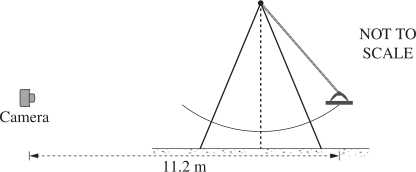
A camera films the motion of a swing in a park. Let \(x(t)\) be the horizontal distance, in metres, from the camera to the seat of the swing at \(t\) seconds. The seat is released from rest at a horizontal distance of 11.2 m from the camera. \(\dfrac{dx}{dt}=-1.5\pi\ \sin(\dfrac{5\pi}{4}t)\). --- 4 WORK AREA LINES (style=lined) --- --- 4 WORK AREA LINES (style=lined) ---
Calculus, 2ADV C3 2021 HSC 26
A particle is shot vertically upwards from a point 100 metres above ground level.
The position of the particle, `y` metres above the ground after `t` seconds, is given by
`y(t) =-5t^2 + 70t + 100`.
- Find the maximum height above ground level reached by the particle. (2 marks)
--- 4 WORK AREA LINES (style=lined) ---
- Find the velocity of the particle, in metres per second, immediately before it hits the ground, leaving your answer in the form `asqrtb`, where `a` and `b` are integers. (3 marks)
--- 6 WORK AREA LINES (style=lined) ---
Calculus, 2ADV C4 EQ-Bank 28
The velocity of a particle moving along the `x`-axis at `v` metres per second at `t` seconds, is shown in the graph below.
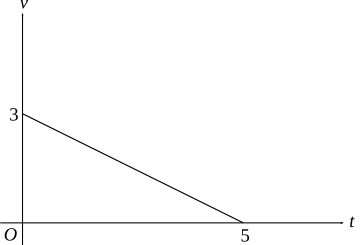
Initially, the displacement `x` is equal to 12 metres.
- Write an equation that describes the displacement, `x`, at time `t` seconds. (2 marks)
--- 4 WORK AREA LINES (style=lined) ---
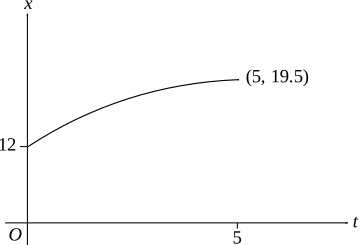
- Draw a graph that shows the displacement of the particle, `x` metres from the origin, at a time `t` seconds between `t= 0` and `t = 5`. Label the coordinates of the endpoints of your graph. (2 marks)
--- 8 WORK AREA LINES (style=lined) ---
Show Worked Solution
| a. | `m_v` | `=-(3)/(5)` |
| `v` | `= 3-(3)/(5) t` | |
| `x` | `= int v \ dt` | |
| `= int 3-(3)/(5) t \ dt` | ||
| `= 3t-(3)/(10) t^2 + c` |
`text(When) \ \ t = 0, x = 12 \ -> \ c = 12`
`:. \ x = 3t-(3)/(10) t ^2 + 12`
b. `text(When) \ \ t = 5:`
`x = 15-(3)/(10) xx 25 + 12 = 19.5`
Calculus, 2ADV C4 EQ-Bank 7 MC
A lift accelerates from rest at a constant rate until it reaches a speed of `3\ text(ms)^(-1)`. It continues at this speed for 10 seconds and then decelerates at a constant rate before coming to rest. The total travel time for the lift is 30 seconds.
The total distance, in metres, travelled by the lift is
- 45
- 60
- 75
- 90
Show Worked Solution
`text(Consider the velocity graph:)`
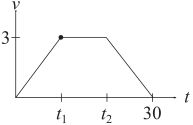
`t_1 -> t_2 = text(10 seconds)`
`:.\ text(Total distance travelled)`
`=\ text(Area of trapezium)`
`= 1/2 xx 3(10 + 30)= 60\ text(m)`
`=>\ B`
Calculus, 2ADV C4 2019 HSC 14a
A particle is moving along a straight line. The particle is initially at rest. The acceleration of the particle at time `t` seconds is given by `a = e^(2t)-4`, where `t >= 0`.
Find an expression, in terms of `t`, for the velocity of the particle. (2 marks)
--- 5 WORK AREA LINES (style=lined) ---
Calculus, 2ADV C1 2019 HSC 8 MC
A particle is moving along a straight line. The graph shows the acceleration of the particle.
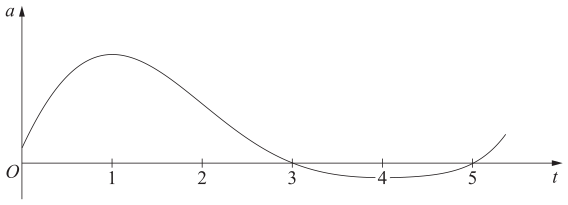
For what value of `t` is the velocity `v` a maximum?
- `1`
- `2`
- `3`
- `5`
Calculus, 2ADV C4 2007* HSC 10a
An object is moving on the `x`-axis. The graph shows the velocity, `(dx)/(dt)`, of the object, as a function of time, `t`. The coordinates of the points shown on the graph are `A (2, 1), B (4, 5), C (5, 0) and D (6, –5)`. The velocity is constant for `t >= 6`.

- The object is initially at the origin. During which time(s) is the displacement of the object decreasing? (1 mark)
--- 1 WORK AREA LINES (style=lined) ---
- If the object travels 7 units in the first 4 seconds, estimate the time at which the object returns to the origin. Justify your answer. (2 marks)
--- 5 WORK AREA LINES (style=lined) ---
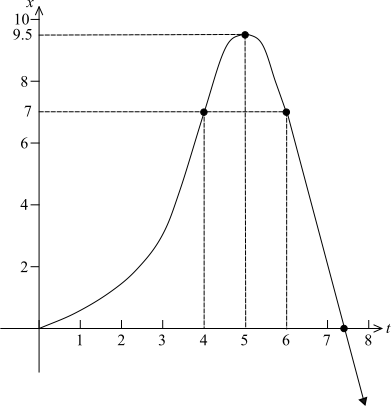
- Sketch the displacement, `x`, as a function of time. (2 marks)
--- 10 WORK AREA LINES (style=blank) ---
Show Answers Only
a. `t > 5\ \ text(seconds)`
b. `7.4\ \ text(seconds)`
c.
Show Worked Solution
a. `text(Displacement is reducing when the velocity is negative.)`
`:. t > 5\ \ text(seconds)`
b. `text(At)\ B,\ text(the displacement) = 7\ text(units)`
`text(Consider the displacement from)\ B\ text(to)\ D:`
`text(Since the area below the graph from)\ B\ text(to)\ C\ text(equals )`
`text(the area above the graph from)\ C\ text(to)\ D,\ text(there is no )`
`text(change in displacement from)\ B\ text(to)\ D.`
`text(Consider)\ t >= 6,`
`text(Time required to return to origin:)`
`t=d/v= 7/5= 1.4\ \ text(seconds)`
`:.\ text(The particle returns to the origin after 7.4 seconds.)`
c.
Calculus, 2ADV C1 2017 HSC 10 MC
A particle is moving along a straight line.
The graph shows the velocity, `v`, of the particle for time `t >= 0`.
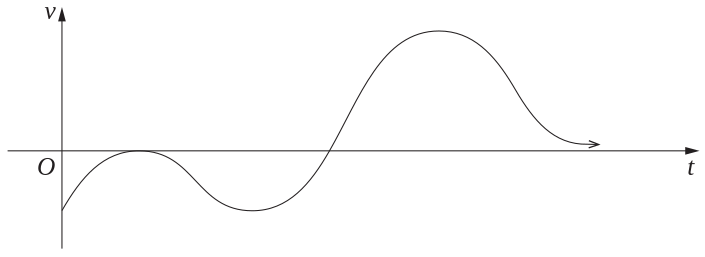
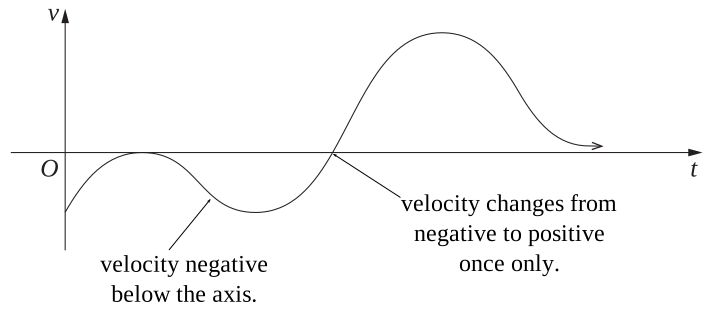
How many times does the particle change direction?
- 1
- 2
- 3
- 4
Show Worked Solution
♦♦♦ Mean mark 33%.
`=>A`
Calculus, 2ADV C4 2016 HSC 16a
A particle moves in a straight line. Its velocity `v\ text(ms)^-1` at time `t` seconds is given by
`v = 2-4/(t + 1).`
- Find the initial velocity. (1 mark)
--- 1 WORK AREA LINES (style=lined) ---
- Find the acceleration of the particle when the particle is stationary. (2 marks)
--- 4 WORK AREA LINES (style=lined) ---
- By considering the behaviour of `v` for large `t`, sketch a graph of `v` against `t` for `t >= 0`, showing any intercepts. (2 marks)
--- 4 WORK AREA LINES (style=lined) ---
- Find the exact distance travelled by the particle in the first 7 seconds. (3 marks)
--- 6 WORK AREA LINES (style=lined) ---
Show Answers Only
i. `-2\ text(ms)^-1`
ii. `1\ text(ms)^-2`
iii.
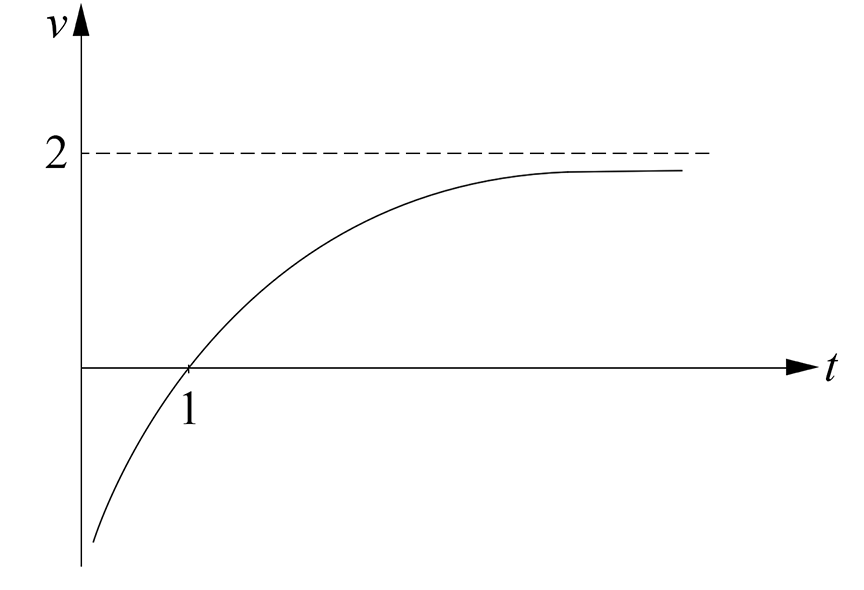
iv. `10-4 ln 2\ \ text(metres)`
Show Worked Solution
i. `text(Initial velocity when)\ \ t = 0`
Mean mark (i) 93%.
COMMENT: Great example of low hanging fruit late in the exam for students who progress efficiently.
COMMENT: Great example of low hanging fruit late in the exam for students who progress efficiently.
`v = 2-4/1 =-2\ text(ms)^-1`
| ii. | `v` | `= 2-4/(t + 1)` |
| `a` | `=(dv)/(dt)= 4/(t + 1)^2` |
`text(Particle is stationary when)\ \ v = 0,`
| `2-4/(t + 1)` | `= 0` |
| `2 (t + 1)` | `= 4` |
| `t` | `= 1` |
`text(When)\ \ t=1,`
| `:.a` | `= 4/(1 + 1)^2` |
| `= 1\ text(ms)^-2` |
iii. `v = 2-4/(t + 1)`
♦ Mean mark (iii) 47%.
`text(As)\ \ t -> oo,\ \ \ 4/(t + 1) -> 0`
`:. v -> 2`
♦♦ Mean mark (iv) 26%.
iv. `text(Distance travelled in 1st 7 seconds)`
`= |\ int_0^1 (2-4/(t + 1))\ dt\ | + int_1^7 (2-4/(t + 1))\ dt`
`= -[2t-4 ln (t + 1)]_0^1 + [2t-4 ln (t + 1)]_1^7`
`= -[(2-4 ln 2)-0] + [(14-4 ln 8)-(2-4 ln 2)]`
`= 4 ln 2-2 + 12-4 ln 2^3 + 4 ln 2`
`= 10 + 8 ln 2-12 ln 2`
`= 10-4 ln 2\ \ text(metres)`
Calculus, 2ADV C3 2004 HSC 5b
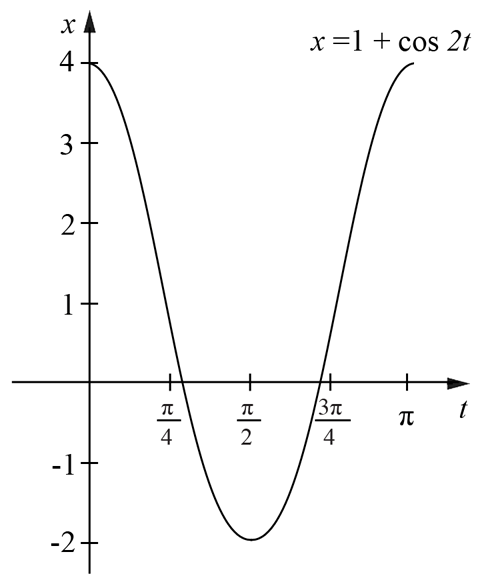
A particle moves along a straight line so that its displacement, `x` metres, from a fixed point `O` is given by `x = 1 + 3 cos 2t`, where `t` is measured in seconds.
- What is the initial displacement of the particle? (1 mark)
--- 2 WORK AREA LINES (style=lined) ---
- Sketch the graph of `x` as a function of `t` for `0 ≤ t ≤ pi`. (2 marks)
--- 8 WORK AREA LINES (style=lined) ---
- Hence, or otherwise, find when AND where the particle first comes to rest after `t = 0`. (2 marks)
--- 4 WORK AREA LINES (style=lined) ---
- Find a time when the particle reaches its greatest magnitude of velocity. What is this velocity? (2 marks)
--- 4 WORK AREA LINES (style=lined) ---
Show Worked Solution
a. `x = 1 + 3 cos 2t`
`text(When)\ \ t = 0,`
| `x` | `= 1 + 3 cos 0` |
| `= 1 + 3= 4` |
`:.\ text(Initial displacement is 4 m to the right of)\ O.`
b. `text(Period)\ = (2pi)/n = (2pi)/2 = pi`
`text(Considering the range)`
| `-1` | `<=cos 2t<=1` |
| `-3` | `<=3cos 2t<=3` |
| `-2` | `<=1 + 3 cos 2t<=4` |
| c. | `x` | `= 1 + 3 cos 2t` |
| `:.v` | `= -6 sin 2t` |
`text(The particle comes to rest when)\ \ v=0`
| `-6 sin 2t` | `= 0` |
| `sin 2t` | `= 0` |
| `2t` | `= 0, pi, 2pi…` |
| `t` | `= 0, pi/2, pi…` |
`:.\ text(After)\ \ t=0, text(particle first comes to rest when)`
`t = pi/2\ text(seconds.)`
`text(When)\ t = pi/2,`
| `x` | `= 1 + 3 cos 2(pi/2)` |
| `= 1 + 3 cos pi` | |
| `= 1 + 3(−1)` | |
| `= −2` |
`:.\ text(Particle first comes to rest at 2 m to the left of)\ O.`
d. `x = 1 + 3 cos 2t`
| `v` | `= -6 sin 2t` |
| `a` | `= -12 cos 2t` |
`text(MAX occurs when)\ \ a=0`
| `-12 cos 2t` | `= 0` |
| `cos 2t` | `= 0` |
| `2t` | `= pi/2, (3pi)/2, …` |
| `t` | `= pi/4, (3pi)/4, …` |
`:.\ text(Maximum at)\ \ t=pi/4,\ \ (3pi)/4, …\ text(seconds,)`
`text(When)\ \ t = pi/4\ text(seconds,)`
| `v` | `= -6 sin 2(pi/4)` |
| `= -6 sin(pi/2)` | |
| `= -6` |
`:.\ text(Maximum is 6 m s)^(−1).`
Calculus, 2ADV C4 2015 HSC 9 MC
A particle is moving along the `x`‑axis. The graph shows its velocity `v` metres per second at time `t` seconds.
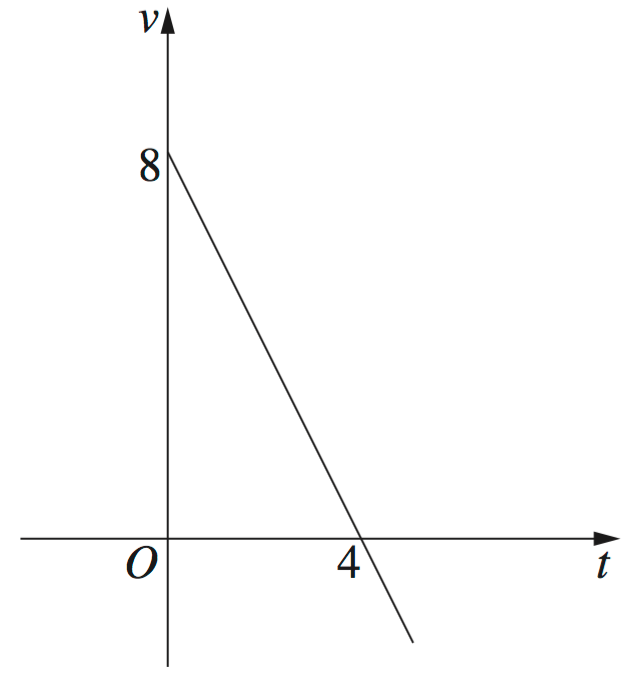
When `t = 0` the displacement `x` is equal to `2` metres.
What is the maximum value of the displacement `x`?
- 8 m
- 14 m
- 16 m
- 18 m
Calculus, 2ADV C4 2009 HSC 7a
The acceleration of a particle is given by
`a=8e^(-2t)+3e^(-t)`,
where `x` is the displacement in metres and `t` is the time in seconds.
Initially its velocity is `-6\ text(ms)^(-1)` and its displacement is 5 m.
- Show that the displacement of the particle is given by
- `qquad x=2e^(-2t)+3e^-t+t`. (2 marks)
--- 5 WORK AREA LINES (style=lined) ---
- Find the time when the particle comes to rest. (3 marks)
--- 7 WORK AREA LINES (style=lined) ---
- Find the displacement when the particle comes to rest. (1 mark)
--- 3 WORK AREA LINES (style=lined) ---
Calculus, 2ADV C4 2012 HSC 15b
The velocity of a particle is given by
`v=1-2cost`,
where `x` is the displacement in metres and `t` is the time in seconds. Initially the particle is 3 m to the right of the origin.
- Find the initial velocity of the particle. (1 mark)
--- 1 WORK AREA LINES (style=lined) ---
- Find the maximum velocity of the particle. (1 mark)
--- 1 WORK AREA LINES (style=lined) ---
- Find the displacement, `x`, of the particle in terms of `t`. (2 marks)
--- 4 WORK AREA LINES (style=lined) ---
- Find the position of the particle when it is at rest for the first time. (2 marks)
--- 4 WORK AREA LINES (style=lined) ---
Calculus, 2ADV C3 2011 HSC 7b
The velocity of a particle moving along the `x`-axis is given by
`v=8-8e^(-2t)`,
where `t` is the time in seconds and `x` is the displacement in metres.
- Show that the particle is initially at rest. (1 mark)
--- 1 WORK AREA LINES (style=lined) ---
- Show that the acceleration of the particle is always positive. (1 mark)
--- 2 WORK AREA LINES (style=lined) ---
- Explain why the particle is moving in the positive direction for all `t>0`. (2 marks)
--- 5 WORK AREA LINES (style=lined) ---
- As `t->oo`, the velocity of the particle approaches a constant.
Find the value of this constant. (1 mark)
--- 2 WORK AREA LINES (style=lined) ---
- Sketch the graph of the particle's velocity as a function of time. (2 marks)
--- 8 WORK AREA LINES (style=lined) ---
Show Worked Solution
a. `text(Initial velocity when)\ \ t=0`
`v=8-8e^0=0\ text(m/s)`
`:.\ text(Particle is initially at rest.)`
MARKER’S COMMENT: Students whose working showed `e^(-2t)` as `1/e^(2t)`, tended to score highly in this question.
b. `a=d/(dt) (v)=-2xx-8e^(-2t)=16e^(-2t)`
`text(S)text(ince)\ e^(-2t)=1/e^(2t)>0\ text(for all)\ t`.
`=>\ a=16e^(-2t)=16/e^(2t)>0\ text(for all)\ t`.
`:.\ text(Acceleration is positive for all)\ \ t>0`.
c. `text{S}text{ince the particle is initially at rest, and ALWAYS}`
♦♦♦ Mean mark (c) 22%
COMMENT: Students found part (iii) the most challenging part of this question by far.
COMMENT: Students found part (iii) the most challenging part of this question by far.
`text{has a positive acceleration.`
`:.\ text(It moves in a positive direction for all)\ t`.
d. `text(As)\ t->oo`, `e^(-2t)=1/e^(2t)->0`
`=>8/e^(2t)->0\ text(and)`
`=>v=8-8/e^(2t)->8\ text(m/s)`
`:.\ text(As)\ \ t->oo,\ text(velocity approaches 8 m/s.)`
IMPORTANT: Use previous parts to inform this diagram. i.e. clearly show velocity was zero at `t=0` and the asymptote at `v=8`.
| e. |
|

