SmarterEd

Aussie Maths & Science Teachers: Save your time with SmarterEd

  • Login
  • Get Help
  • About

Functions, 2ADV EQ-Bank 12

The braking distance of a car, in metres, is directly proportional to the square of its speed in km/h, and can be represented by the equation

`text{braking distance}\ = k xx text{(speed)}^2`

where `k` is the constant of variation.

The braking distance for a car travelling at 50 km/h is 20 m.

  1. Find the value of `k`.   (2 marks)

    --- 4 WORK AREA LINES (style=lined) ---

  2. What is the braking distance when the speed of the car is 90 km/h?   (1 mark)

    --- 2 WORK AREA LINES (style=lined) ---
Show Answers Only

a.    `k=0.008`

b.    `64.8\ text{m}`

Show Worked Solution

a.  `text{braking distance}\ = k xx text{(speed)}^2`

`20` `=k xx 50^2`  
`k` `=20/50^2=0.008`  

 
b.    `text{Find}\ d\ text{when speed = 90 km/h:}`

`d=0.008 xx 90^2=64.8\ text{m}`

Filed Under: Direct and Inverse Variation Tagged With: Band 3, smc-6383-10-\(\propto kx^{n}\), smc-6383-40-Stopping Distance

Functions, 2ADV EQ-Bank 5 MC

The time taken to clean a warehouse varies inversely with the number of cleaners employed.

It takes 8 cleaners 60 hours to clean a warehouse.

Working at the same rate, how many hours would it take 10 cleaners to clean the same warehouse.

  1. 45
  2. 48
  3. 62
  4. 75
Show Answers Only

`B`

Show Worked Solution

`text{Time to clean}\ (T) prop 1/text{Number of cleaners (C)}`

`T=k/C`

`text(When)\ \ T=60, C=8:`

`60` `=k/8`
`k` `=480`

 
`text{Find}\ \ T\ \ text(when)\ \ C=10:`

`T=480/10=48\ text(hours)`

`=>  B`

Filed Under: Direct and Inverse Variation Tagged With: Band 4, smc-6383-30-\(\propto \dfrac{k}{x^{n}} \), smc-6383-50-Real World Examples

Functions, 2ADV EQ-Bank 10

The number of trees that can be planted along the fence line of a paddock varies inversely with the distance between each tree.

There will be 108 trees if the distance between them is 5 metres.

  1. How many trees can be planted if the distance between them is 6 metres?   (2 marks)

    --- 4 WORK AREA LINES (style=lined) ---

  2. What is the distance between the trees if 120 trees are planted.   (1 mark)

    --- 1 WORK AREA LINES (style=lined) ---

Show Answers Only

a.   `90`

b.   `4.5\ text(metres)`

Show Worked Solution

a.   `t \prop 1/d \ \ =>\ \ t=k/d`

`108` `= k/5`
`k` `= 540`

 
`text(Find)\ t\ \text(when)\ \ d = 6:`

`t= 540/6= 90`
 

b.   `text(Find)\ d\ text(when)\ \ t = 120:`

`120` `= 540/d`
`d` `= 540/120= 4.5\ text(metres)`

Filed Under: Direct and Inverse Variation Tagged With: Band 4, smc-6383-30-\(\propto \dfrac{k}{x^{n}} \), smc-6383-50-Real World Examples

Functions, 2ADV EQ-Bank 9

It is known that the volume of a hailstone \((V)\) is directly proportional to the cube of its radius \((r)\).

A hailstone with a radius of 1.25 cm has a volume of 8.2 cm\(^3\).

  1. Find the equation relating \(V\) and \(r\).   (2 marks)

    --- 6 WORK AREA LINES (style=lined) ---

  2. What is the expected radius of a hailstone with a volume of 51.1 cm\(^3\) ? Give your answer to 1 decimal place.   (1 mark)

    --- 4 WORK AREA LINES (style=lined) ---

Show Answers Only

a.    \(V=4.1984 \times r^{3}\)

b.    \(2.3\ \text{cm (2 d.p.)}\)

Show Worked Solution

a.    \(V \propto r^3 \ \Rightarrow \ V=kr^3\)

\(\text{Find} \ k \ \text{given} \ \ V=8.2 \ \ \text{when}\ \  r=1.25:\)

\(8.2\) \(=k \times 1.25^3\)
\(k\) \(=\dfrac{8.2}{1.25^3}=4.1984\)

 
\(\therefore V=4.1984 \times r^{3}\)


b.    \(\text{Find \(r\) when \(\ V=51.1\):}\)

\(51.1\) \(=4.1984 \times r^3\)
\(r\) \(=\sqrt[3]{\dfrac{51.1}{4.1984}}=2.3\ \text{cm (1 d.p.)}\)

Filed Under: Direct and Inverse Variation Tagged With: Band 4, smc-6383-10-\(\propto kx^{n}\), smc-6383-50-Real World Examples

Functions, 2ADV EQ-Bank 8

The intensity of light \((I)\), measured in lux, from a lamp varies inversely with the square of the distance from the lamp \((d)\), measured in metres.

At a distance of 2.2 metres from the lamp, the light intensity is 400 lux.

What is the light intensity at a distance of 5.0 metres from the lamp?   (2 marks)

--- 6 WORK AREA LINES (style=lined) ---

Show Answers Only

\(77.44\ \text{lux}\)

Show Worked Solution

\(I \propto \dfrac{k}{d^2} \ \Rightarrow \ I=\dfrac{k}{d^2}\)

\(\text{Find k given} \ \ I=400 \ \ \text {when} \ \ d=2.2:\)

\(400=\dfrac{k}{2.2^2} \ \Rightarrow \ k=1936\)
 

\(\text{Find \(I\) when \(\ d=5\):}\)

\(I=\dfrac{1936}{5.0^2}=77.44\ \text{lux}\)

Filed Under: Direct and Inverse Variation Tagged With: Band 4, smc-6383-30-\(\propto \dfrac{k}{x^{n}} \), smc-6383-50-Real World Examples

Functions, 2ADV EQ-Bank 7

Energy \((E)\) stored in a spring, measured in joules, varies directly with the square of its compression distance \(d\), measured in centimetres.

When a spring is compressed by 4 cm, it stores 48 joules of energy.

How much energy is stored when the spring is compressed by 7 cm?   (3 marks)

--- 6 WORK AREA LINES (style=lined) ---

Show Answers Only

\(\text{147 joules}\)

Show Worked Solution

\(E \propto d^2 \ \Rightarrow \ E=k d^2\)

\(\text{Find \(k\) given  \(\ E=48 \ \)  when  \(\ d=4\):}\)

\(48\) \(=k \times 4^2\)
\(k\) \(=3\)

 
\(\text{Find \(E\) when  \(\ d=7\):}\)

\(E=3 \times 7^2=147 \ \text{joules}\)

Filed Under: Direct and Inverse Variation Tagged With: Band 3, smc-6383-10-\(\propto kx^{n}\), smc-6383-50-Real World Examples

Functions, 2ADV EQ-Bank 9

The quantity \(y\) varies inversely with the square of \(x\).

When  \(x = 4, \ y = 10\).

Find the value of \(y\) when \(x = 8\).   (2 marks)

--- 6 WORK AREA LINES (style=lined) ---

Show Answers Only

\(y=\dfrac{5}{2}\)

Show Worked Solution

\(y \propto \dfrac{1}{x^2}\ \ \Rightarrow\ \ y= \dfrac{k}{x^2}\)

\(\text{When}\ \ x=4, \ y=10:\)

\(10= \dfrac{k}{4^2}\ \ \Rightarrow\ \ k=160\)
 

\(\text{Find}\ y\ \text{when}\ x=8:\)

\(y=\dfrac{160}{8^2}=\dfrac{5}{2}\)

Filed Under: Direct and Inverse Variation, Further Functions and Relations (Y11) Tagged With: Band 4, smc-6383-30-\(\propto \dfrac{k}{x^{n}} \), smc-987-60-Proportional

Functions, 2ADV F1 2022 HSC 12

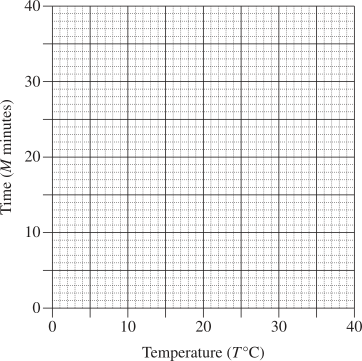
A student believes that the time it takes for an ice cube to melt (`M` minutes) varies inversely with the room temperature `(T^@ text{C})`. The student observes that at a room temperature of `15^@text{C}` it takes 12 minutes for an ice cube to melt.

  1. Find the equation relating `M` and `T`.    (2 marks)

    --- 2 WORK AREA LINES (style=lined) ---
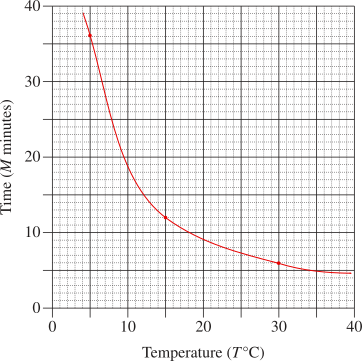
  2. By first completing this table of values, graph the relationship between temperature and time from `T=5^@C` to `T=30^@ text{C}`.   (2 marks)
     

\begin{array} {|c|c|c|c|}
\hline  \ \ T\ \  & \ \ 5\ \  & \ 15\  & \ 30\  \\
\hline M &  &  &  \\
\hline \end{array}


--- 0 WORK AREA LINES (style=lined) ---

Show Answers Only

a.    `M=180/T`

 b.    

\begin{array} {|c|c|c|c|}
\hline  \ \ T\ \  & \ \ 5\ \  & \ 15\  & \ 30\  \\
\hline M & 36 & 12 & 6 \\
\hline \end{array}       


Show Worked Solution
a.    `M` `prop 1/T`
  `M` `=k/T`
  `12` `=k/15`
  `k` `=15 xx 12`
    `=180`

 
`:.M=180/T`


♦ Mean mark (a) 49%.

b.   

\begin{array} {|c|c|c|c|}
\hline  \ \ T\ \  & \ \ 5\ \  & \ 15\  & \ 30\  \\
\hline M & 36 & 12 & 6 \\
\hline \end{array}

Filed Under: Direct and Inverse Variation, Further Functions and Relations (Y11), Variation and Rates of Change Tagged With: 2adv-std2-common, Band 4, Band 5, common-content, num-title-ct-patha, num-title-qs-hsc, smc-4239-30-a prop 1/b, smc-6383-30-\(\propto \dfrac{k}{x^{n}} \), smc-987-30-Reflections and Other Graphs, smc-987-60-Proportional

Functions, 2ADV F1 EQ-Bank 8

Jacques is a marine biologist and finds that the mass of a crab is directly proportional to the cube of the diameter of its shell.

If a crab with a shell diameter of 15 cm weighs 680 grams, what will be the diameter of a crab that weighs 1.1 kilograms? Give your answer to 1 decimal place.  (2 marks)

--- 5 WORK AREA LINES (style=lined) ---

Show Answers Only

`17.6\ text(cm)`

Show Worked Solution
`M` `prop d^3`  
`M` `= kd^3`  

 
`text(When)\ \ M=680, \ d=15`

`680` `=k xx 15^3`  
`k` `=0.201481…`  

 
`text(Find)\ \ d\ \ text(when)\ \ M=1100:`

`1100` `=0.20148… xx d^3`  
`d` `=root3(1100/(0.20148…))`  
  `=17.608…`  
  `=17.6\ text{cm  (to 1 d.p.)}`  

Filed Under: Direct and Inverse Variation, Further Functions and Relations (Y11) Tagged With: Band 4, smc-6383-10-\(\propto kx^{n}\), smc-987-60-Proportional

Functions, 2ADV F1 EQ-Bank 7

The current of an electrical circuit, measured in amps `(A)`, varies inversely with its resistance, measured in ohms `(R)`.

When the resistance of a circuit is 28 ohms, the current is 3 amps.

What is the current when the resistance is 8 ohms?   (2 marks)

--- 6 WORK AREA LINES (style=lined) ---

Show Answers Only

`10.5`

Show Worked Solution

`A \prop 1/R\ \ =>\ \ A=k/R`

`text(When)\ \ A=3, \ R=28:`

`3` `=k/28`  
`k` `=84`  

 
`text(Find)\ A\ \text{when}\ R=8:`

`A=84/8=10.5`

Filed Under: Direct and Inverse Variation, Further Functions and Relations (Y11) Tagged With: Band 4, smc-6383-30-\(\propto \dfrac{k}{x^{n}} \), smc-987-60-Proportional

Functions, 2ADV F1 EQ-Bank 27

The stopping distance of a car on a certain road, once the brakes are applied, is directly proportional to the square of the speed of the car when the brakes are first applied.

A car travelling at 70 km/h takes 58.8 metres to stop.

How far does it take to stop if it is travelling at 105 km/h?  (3 marks)

--- 6 WORK AREA LINES (style=lined) ---

Show Answers Only

`132.3\ text(metres)`

Show Worked Solution

`text(Let)\ \ d\ text(= stopping distance)`

`d \prop s^2\ \ =>\ \ d = ks^2`
 

`text(Find)\ k,`

`58.8` `= k xx 70^2`
`k` `= 58.8/(70^2)= 0.012`

 
`text(Find)\ \ d\ \ text(when)\ \ s = 105:`

`d` `= 0.012 xx 105^2`
  `= 132.3\ text(metres)`

Filed Under: Direct and Inverse Variation, Further Functions and Relations (Y11) Tagged With: Band 4, smc-6383-10-\(\propto kx^{n}\), smc-6383-40-Stopping Distance, smc-987-60-Proportional

Functions, 2ADV F1 EQ-Bank 26

Fuifui finds that for Giant moray eels, the mass of an eel is directly proportional to the cube of its length.

An eel of this species has a length of 25 cm and a mass of 4350 grams.

What is the expected length of a Giant moray eel with a mass of 6.2 kg? Give your answer to one decimal place.  (3 marks)

--- 7 WORK AREA LINES (style=lined) ---

Show Answers Only

`28.1\ text{cm}`

Show Worked Solution

`text(Mass) prop text(length)^3`

`m = kl^3`
 

`text(Find)\ k:`

`4350` `= k xx 25^3`
`k` `= 4350/25^3`
  `= 0.2784`

 
`text(Find)\ \ l\ \ text(when)\ \ m = 6200:`

`6200` `= 0.2784 xx l^3`
`l^3` `= 6200/0.2784`
`:. l` `= 28.13…`
  `= 28.1\ text{cm  (to 1 d.p.)}`

Filed Under: Direct and Inverse Variation, Further Functions and Relations (Y11) Tagged With: Band 4, smc-6383-10-\(\propto kx^{n}\), smc-987-60-Proportional

Copyright © 2014–2026 SmarterEd.com.au · Log in