SmarterEd

Aussie Maths & Science Teachers: Save your time with SmarterEd

  • Login
  • Get Help
  • About

v1 Algebra, STD2 A1 2012 HSC 15 MC

A car takes 5 hours to complete a journey when travelling at 75 km/h.

How long would the same journey take if the car were travelling at 100 km/h?

  1. 37.5 minutes
  2. 1 hour and 20 minutes
  3. 3 hours and 45 minutes
  4. 4 hours and 15 minutes
Show Answers Only

\(C\)

Show Worked Solution

\(T=\dfrac{D}{S}\)

\(\text{Since}\ \ \ T = 5\ \ \text{when}\ \ \ S = 75\)

\(5\) \(=\dfrac{D}{75}\)
\(D\) \(=5\times 75\)
  \(=375\ \text{km}\)


\(\text{Find}\ \ T\ \ \text{when}\ \ \ S = 100\ \ \text{ and}\ \ \ D = 375\)

\(T\) \(=\dfrac{375}{100}\)
  \(=3.75\ \text{hours}\)
  \(=3\ \text{hrs}\ \ 45\ \text{minutes}\)

  
\(\Rightarrow C\)

Filed Under: Applications: BAC, Medication and D=SxT (Std 2-X) Tagged With: Band 4, smc-5234-20-Speed Distance Time

v1 Algebra, STD2 A1 2011 HSC 21 MC

A train departs from Town A at 4.00 pm to travel to Town B. Its average speed for the journey is 80 km/h, and it arrives at 6.00 pm. A second train departs from Town A at 4.30 pm and arrives at Town B at 6.10 pm.

What is the average speed of the second train?

  1. 96 km/h
  2. 114 km/h
  3. 224 km/h
  4. 280 km/h
Show Answers Only

\(A\)

Show Worked Solution

\(\text{1st train:}\)

\(\text{Travels 2hrs at 80km/h}\)

\(\text{Distance}\) \(=\text{Speed}\times\text{Time}\)
  \(=80\times 2\)
  \(=160\ \text{km}\)

 
\(\text{2nd train:}\)

\(\text{Travels 160 km in 1 hr 40 min}\ \rightarrow\ \dfrac{5}{3}\ \text{hrs}\)

\(\text{Speed}\) \(=\dfrac{\text{Distance}}{\text{Time}}\)
  \(=160\ ÷\ \dfrac{5}{3}\)
  \(=160\times \dfrac{3}{5}\)
  \(=96\ \text{km/h}\)

\(\Rightarrow A\)


♦♦ Mean mark 49%.

Filed Under: Applications: BAC, Medication and D=SxT (Std 2-X) Tagged With: Band 5, smc-5234-20-Speed Distance Time

v1 Algebra, STD2 A1 2009 HSC 16 MC

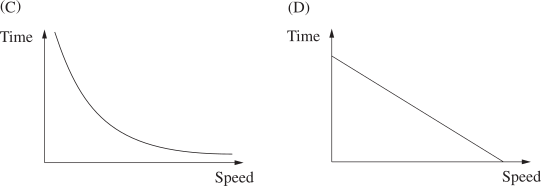
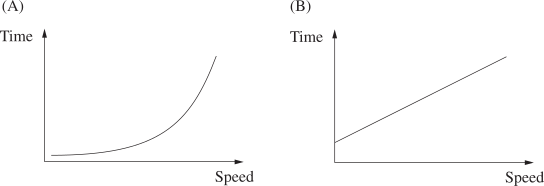
The time for a train to travel a certain distance varies inversely with its speed.

Which of the following graphs shows this relationship?
   

Show Answers Only

\(C\)

Show Worked Solution
\(T\) \(\propto \dfrac{1}{S}\)
\(T\) \(=\dfrac{k}{S}\)

 
\(\text{By elimination:}\)

\(\text{As   Speed} \uparrow \ \text{, Time}\downarrow\ \Rightarrow\ \text{cannot be A or B}\)

\(\text{D  is incorrect because it graphs a linear relationship}\)

\(\Rightarrow C\)


♦♦ Mean mark 38%.

Filed Under: Applications: BAC, Medication and D=SxT (Std 2-X), Linear Equations and Basic Graphs (Std 2-X) Tagged With: Band 5, smc-5234-20-Speed Distance Time, smc-5240-50-Other

v1 Algebra, STD2 A1 SM-Bank 1 MC

The blood alcohol content (\(BAC\)) of a male's blood is given by the formula;

\(BAC_{\text{male}}=\dfrac{10N - 7.5H}{6.8M}\)  , where

\(N\) is the number of standard drinks consumed,

\(H\) is the number of hours drinking and 

\(M\) is the person's mass in kgs. 

Calculate the  \(BAC\) of a male who consumed 5 standard drinks in 2.5 hours and weighs 72 kgs, correct to 2 decimal places. 

  1.    1.06
  2.    0.06
  3.    0.04
  4.    0.01
Show Answers Only

\(B\)

Show Worked Solution
\(BAC_{\text{male}}\) \(=\dfrac{10\times 5-7.5\times 2.5}{6.8\times 72}\)
  \(=\dfrac{31.25}{489.6}\)
  \(=0.0638\dots\)

\(\Rightarrow B\)

Filed Under: Applications: BAC, Medication and D=SxT (Std 2-X) Tagged With: Band 4, smc-5234-10-BAC

v1 Algebra, STD2 A1 2014 HSC 4 MC

Young’s formula below is used to calculate the required dosages of medicine for children aged 1–12 years.
  

 \(\text{Dosage}=\dfrac{\text{age of child (in years)}\ \times\ \text{adult dosage}}{\text{age of child (in years)}\ +\ 12}\)
  

How much of the medicine should be given to an 18-month-old child in a 24-hour period if each adult dosage is 27 mL? The medicine is to be taken every 8 hours by both adults and children.

  1. 3 mL
  2. 6 mL
  3. 9 mL
  4. 12 mL
Show Answers Only

\(C\)

Show Worked Solution

\(\text{Age of child} = 18\ \text{months}=1.5\ \text{years}\)

\(\text{Dosage}\) \(=\dfrac{1.5\times 27}{1.5+12}\)
  \(=3\ \text{mL}\)

 
\(\text{Dosage every 8 hrs}\)

\(\therefore\ \text{In 24 hours, medicine given} = 3\times 3=9\ \text{mL}\)
  
\(\Rightarrow C\)


♦♦ Mean mark 42%.

Filed Under: Applications: BAC, Medication and D=SxT (Std 2-X) Tagged With: Band 5, smc-5234-30-Medication Formulae

v1 Algebra, STD2 A1 2014 HSC 29b

Blood alcohol content of males can be calculated using the following formula

\(BAC_{\text{Male}} = \dfrac{10N-7.5H}{6.8M}\)

where    \(N\) is the number of standard drinks consumed

\(H\) is the number of hours drinking

\(M\) is the person's mass in kilograms 

What is the maximum number of standard drinks that Jacko, who has a mass of 75 kg, can consume over 5 hours in order to maintain a blood alcohol content (\(BAC\)) of less than 0.05?   (3 marks)

--- 6 WORK AREA LINES (style=lined) ---

Show Answers Only

\(6\)

Show Worked Solution

\(BAC_\text{male}=\dfrac{10N-7.5H}{6.8M}\)

\(\text{Find}\ \ N\ \text{for }BAC<0.05,\ \text{given}\ \ H=5\ \text{and}\ \ M = 75\)
 

\(\dfrac{10N-7.5\times 5}{6.8\times 75}\) \(< 0.05\)
\(10N-37.5\) \(< 0.05\times 6.8\times 75\)
\(10N\) \(< 25.5+37.5\)
\(10N\) \(<63\)
\(\therefore\ N\) \(< 6.3\)


\(\therefore\ \text{Max number of standard drinks is 6.}\)

Filed Under: Applications: BAC, Medication and D=SxT (Std 2-X) Tagged With: Band 4, smc-5234-10-BAC

v1 Algebra, STD2 A1 2015 HSC 23 MC

The number of ‘standard drinks’ in various glasses of wine is shown.
  

Number of standard drinks
White Wine Red Wine
small glass large glass small glass large glass
0.9 1.4 1.0 1.5
 

A woman weighing 58 kg drinks two small glasses of white wine and three small glasses of red wine between 7 pm and 11 pm.

Using the formula for calculating blood alcohol below, what would be her blood alcohol content (\(BAC\)) estimate at 11 pm, correct to three decimal places?
 

\(BAC_{\text{Female}}=\dfrac{10N-7.5H}{5.5M}\)
 

where    \(N\) is the number of standard drinks consumed

\(H\) is the number of hours drinking

\(M\) is the person's mass in kilograms
 

  1. 0.013
  2. 0.023
  3. 0.046
  4. 0.056
Show Answers Only

\(D\)

Show Worked Solution
\(N\) \(=2\times 0.9 + 3\times 1\)
  \(=4.8\ \text{standard drinks}\)
\(H\) \(=4\ \text{hours}\)
\(M\) \(=58\ \text{kg}\)


\(BAC_f\) \(=\dfrac{10\times 4.8-7.5\times 4}{5.5\times 58}\)
  \(=0.05642\dots\)

  
\(\Rightarrow D\)

Filed Under: Applications: BAC, Medication and D=SxT (Std 2-X) Tagged With: Band 4, smc-5234-10-BAC

v1 Algebra, STD2 A1 2005 HSC 24b

The formula  \(D=\dfrac{2A}{15}\)  is used to calculate the dosage of liquid paracetamol to be given to a child.

    • \(D\) is the dosage of liquid paracetamol in millilitres (mL).
    • \(A\) is the age of the child in months.
  1. If Charlotte is six months old, what dosage of liquid paracetamol should she be given?  (1 mark)

    --- 2 WORK AREA LINES (style=lined) ---

The correct dosage of liquid paracetamol for Teddy is 6 mL.

  1. What is the difference in the ages of Teddy and Charlotte, in months?  (3 marks)

    --- 6 WORK AREA LINES (style=lined) ---

Show Answers Only

i.    \(\text{0.8 mL}\)

ii.   \(39\)

Show Worked Solution
i.     \(D\) \(=\dfrac{2A}{15}\)
    \(=\dfrac{2\times 6}{15}\)
    \(=0.8\text{ mL}\)

  
\(\therefore\ \text{Charlotte should be given a dosage of 0.8 mL}\)


ii.   \(\text{Find}\ A\ \text{when}\ D=\text{6 mL}\)

\(6\) \(=\dfrac{2A}{15}\)
 \(2A\) \(=90\)
 \(A\) \(=45\)

  
\(\therefore\ \text{Teddy is 45 months old and is 39 months}\)

\(\text{older than Charlotte.}\)

Filed Under: Applications: BAC, Medication and D=SxT (Std 2-X) Tagged With: Band 4, smc-5234-30-Medication Formulae

v1 Algebra, STD2 A1 2015 HSC 30d

Monica is driving on a motorway at a speed of 105 kilometres per hour and has to brake suddenly. She has a reaction time of 1.3 seconds and a braking distance of 54.3 metres.

Stopping distance can be calculated using the following formula
 

\(\text{stopping distance = {reaction time distance} + {braking distance}}\)

 
What is Monica's stopping distance? Give your answer to 1 decimal place.  (2 marks)

--- 6 WORK AREA LINES (style=lined) ---

Show Answers Only

\(92.2\ \text{metres  (to 1 d.p.)}\)

Show Worked Solution
\(105\ \text{km/hr}\) \(=105\ 000\ \text{m/hr}\)
  \(=\dfrac{105\ 000}{60\times 60}\ \text{m/sec}\)
  \(=29.166\dots\ \text{m/sec}\)


\(\text{Reaction time distance}\) \(=1.3\times 29.166\dots\)
  \(=37.916\dots\ \text{metres}\)


\(\text{Stopping distance}\)

\(\text{ = {Reaction time distance} + {braking distance}}\)

\(=37.916…+54.3\)

\(=92.216\dots\)

\(=92.2\ \text{metres  (to 1 d.p.)}\)


♦ Mean mark 34%.

Filed Under: Applications: BAC, Medication and D=SxT (Std 2-X) Tagged With: Band 5, smc-5234-40-Stopping Distance

v1 Algebra, STD2 A1 2016 HSC 10 MC

Anika drinks two small bottles of wine over a four-hour period. Each of these bottles contains 2.4 standard drinks. Anika weighs 55 kg.

Using the formula below, what is Anika's approximate blood alcohol content (\(BAC\)) at the end of this period?
 

\(BAC_{\text{Female}}=\dfrac{10N - 7.5H}{5.5M}\)
 

where    \(N\) is the number of standard drinks consumed

\(H\) is the number of hours drinking

\(M\) is the person's mass in kilograms
 

  1. 0.013
  2. 0.060
  3. 0.0013
  4. 0.0060
Show Answers Only

\(B\)

Show Worked Solution
\(BAC_f\) \(=\dfrac{10N – 7.5H}{5.5M}\)
  \(=\dfrac{10(2\times 2.4) – 7.5\times 4}{5.5\times 55}\)
  \(= 0.0595\dots\approx 0.060\)

 
\(\Rightarrow B\)

Filed Under: Applications: BAC, Medication and D=SxT (Std 2-X) Tagged With: Band 4, smc-5234-10-BAC

v1 Algebra, STD2 A1 2017 HSC 2 MC

A car is travelling at 85 km/h.

How far will it travel in 3 hours and 30 minutes?

  1. \(24.3\ \text{km}\)
  2. \(25.8\ \text{km}\)
  3. \(280.5\ \text{km}\)
  4. \(297.5\ \text{km}\)
Show Answers Only

\(D\)

Show Worked Solution
\(\text{Distance}\) \(=85\times 3.5\)
   \(=297.5\ \text{km}\)

\(\Rightarrow D\)

Filed Under: Applications: BAC, Medication and D=SxT (Std 2-X) Tagged With: Band 3, smc-5234-20-Speed Distance Time

v1 Algebra, STD2 A1 2017 HSC 19 MC

Young’s formula, shown below, is used to calculate the dosage of medication for children aged 1−12 years based on the adult dosage.

\(D=\dfrac{yA}{y + 12}\)

where    \(D\)   = dosage for children aged 1−12 years
\(y\)   = age of child (in years)
\(A\)   = Adult dosage

 
A child’s dosage is calculated to be 15 mg, based on an adult dosage of 30 mg.

How old is the child in years?

  1. 6
  2. 8
  3. 10
  4. 12
Show Answers Only

\(D\)

Show Worked Solution
\(D\) \(=\dfrac{yA}{y+12}\)
\(15\) \(=\dfrac{30y}{y+12}\)
\(15(y+12)\) \(=30y\)
\(15y+180\) \(=30y\)
\(15y\) \(=180\)
\(y\) \(=12\)

  
\(\Rightarrow D\)

Filed Under: Applications: BAC, Medication and D=SxT (Std 2-X) Tagged With: Band 4, smc-5234-30-Medication Formulae

v1 Algebra, STD2 A1 2017 HSC 27e

Bryce is drinking low alcohol beer at a party over a four-hour period. He reads on the label of the low alcohol beer bottle that it is equivalent to 0.8 standard drinks.

Bryce weighs 85 kg.

The formula below  can be used to calculate a male's blood alcohol content.
 

\(BAC_{\text{Male}}=\dfrac{10N-7.5H}{6.8M}\)

where    \(N\) is the number of standard drinks consumed

\(H\) is the number of hours drinking

\(M\) is the person's mass in kilograms
 

What is the maximum number of complete bottles of the low alcohol beer Bryce can drink to remain under a Blood Alcohol Content (\(BAC\)) of 0.05?  (4 marks)

--- 8 WORK AREA LINES (style=lined) ---

Show Answers Only

\(7\)

Show Worked Solution
\(BAC_\text{male}\) \(=\dfrac{10N-7.5H}{6.8M}\)
\(0.05\) \(=\dfrac{10N-7.5\times 4}{6.8\times 85}\)
\(10N\) \(=0.05\times 6.8\times 85+7.5\times 4\)
\(10N\) \(=58.9\)
\(N\) \(=5.89\ \text{standard drinks}\)

  
\(\therefore\ \text{Number of low alcohol bottles}\)

\(=\dfrac{5.89}{0.8}\)

\(=7.3625\)
 

\(\therefore\ \text{Max complete bottles to stay under 0.05}\)

\(=7\)

Filed Under: Applications: BAC, Medication and D=SxT (Std 2-X) Tagged With: Band 4, smc-5234-10-BAC

v1 Algebra, STD2 A1 SM-Bank 4

Yuan is driving in a school zone at a speed of 30 kilometres per hour and needs to stop immediately to avoid an accident.

It takes him 1.4 seconds to react and his breaking distance is 6.2 metres.

Stopping distance can be calculated using the following formula
 

\(\text{stopping distance = {reaction time distance} + {braking distance}}\)
 

What is Yuan's total stopping distance? Give your answer to 1 decimal place.  (2 marks)

--- 4 WORK AREA LINES (style=lined) ---

Show Answers Only

\(17.9\ \text{metres  (to 1 d.p.)}\)

Show Worked Solution
\(30\ \text{km/hr}\) \(=30\ 000\ \text{m/hr}\)
  \(=\dfrac{30\ 000}{60\times 60}\ \text{m/sec}\)
  \(=8.33\dots\ \text{m/sec}\)


\(\therefore\ \text{Total stopping distance}\)

\(\text{ = {Reaction time distance} + {braking distance}}\)

\(=1.4\times 8.33…+6.2\)

\(=17.866\dots\)

\(=17.9\ \text{metres  (to 1 d.p.)}\)

Filed Under: Applications: BAC, Medication and D=SxT (Std 2-X) Tagged With: Band 5, smc-5234-40-Stopping Distance

v1 Algebra, STD2 A1 SM-Bank 5

Fried's formula is used to calculate the medicine dosages for children aged 1-2 years.
 

\(\text{Child dosage}=\dfrac{\text{Age(in months)}\times \text{adult dosage}}{150}\)
 

Liam is 1.75 years old and receives a daily dosage of 350 mg of a medicine.

According to Fried's formula, what would the appropriate adult daily dosage of the medicine be?  (2 marks)

Show Answers Only

\(2500\ \text{mg}\)

Show Worked Solution

\(1.75\ \text{years}=21\ \text{months}\)

\(350\) \(=\dfrac{21\times \text{adult dosage}}{150}\)
\(\therefore\ \text{adult dosage}\) \(=\dfrac{350\times 150}{21}\)
   \(=2500\ \text{mg}\)

Filed Under: Applications: BAC, Medication and D=SxT (Std 2-X) Tagged With: Band 3, smc-5234-30-Medication Formulae

v1 Algebra, STD2 A1 2018 HSC 26b

Clark’s formula, given below, is used to determine the dosage of medicine for children.
 

\(\text{Dosage}=\dfrac{\text{weight in kg × adult dosage}}{70}\)

 
For a particular medicine, the adult dosage is 220 mg and the correct dosage for a specific child is 45 mg.

How much does the child weigh, to the nearest kg?  (2 marks)

Show Answers Only

\(14\ \text{kg}\)

Show Worked Solution

\(45 =\dfrac{\text{weight}\times 220}{70}\)

\(\therefore\ \text{weight}\) \(=\dfrac{70\times 45}{220}\)
  \(=14.318\dots\)
  \(\approx 14\ \text{kg  (nearest kg)}\)

Filed Under: Applications: BAC, Medication and D=SxT (Std 2-X) Tagged With: Band 3, smc-5234-30-Medication Formulae

v1 Algebra, STD2 A1 2018 HSC 28e

Drake is driving at 80 km/h. He notices a branch on the road ahead and decides to apply the brakes. His reaction time is 1.2 seconds. His braking distance (\(D\) metres) is given by  \(D=0.01v^2\), where  \(v\) is speed in km/h.

Stopping distance can be calculated using the following formula
 

\(\text{stopping distance = {reaction time distance} + {braking distance}}\)
 

What is Drake’s stopping distance, to the nearest metre?  (3 marks)

--- 6 WORK AREA LINES (style=lined) ---

Show Answers Only

\(91\ \text{m  (nearest m)}\)

Show Worked Solution
\(\text{80 km/hr}\) \(=80\ 000\ \text{m/hr}\)
  \(=\dfrac{80\ 000}{60\times 60}\ \text{m/sec}\)
  \(=22.22\dots\ \text{m/sec}\)

  
\(\text{Total stopping distance}\)

\(\text{ = {reaction time distance} + {braking distance}}\)

\(=1.2\times 22.22\dots + 0.01\times 80^2\)

\(=90.66\dots\)

\(=91\ \text{m  (nearest m)}\)


♦ Mean mark 46%.

Filed Under: Applications: BAC, Medication and D=SxT (Std 2-X) Tagged With: Band 5, smc-5234-40-Stopping Distance

v1 Algebra, STD2 A1 2019 HSC 28

The formula below is used to calculate an estimate for blood alcohol content \((BAC)\) for females.

\(BAC_{\text{female}}=\dfrac{10N - 7.5H}{5.5M}\)

The number of hours required for a person to reach zero \(BAC\) after they stop consuming alcohol is given by the following formula.

\(\text{Time}=\dfrac{BAC}{0.015}\)

The number of standard drinks in a glass of wine and a glass of spirits is shown.
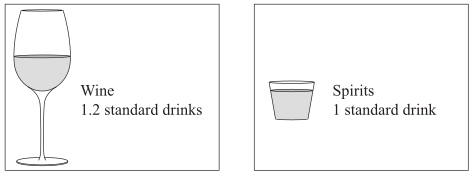
 

Georgie weighs 58 kg. She consumed 2 glasses of wine and 4 glasses of spirits between 7:45 pm and 12:15 am the following day. She then stopped drinking alcohol.

Using the given formulae, calculate the time in the morning when Georgie's \(BAC\) should reach zero.  (4 marks)

Show Answers Only

\(\text{6:34 am}\)

Show Worked Solution

\(\text{Standard drinks consumed}\ (N)=2\times 1.2+4=6.4\)

\(\text{Hours drinking}\ (H) = \text{4 h 30 min = 4.5 hours}\)

\(BAC_{\text{Georgie}}\) \(=\dfrac{10\times 6.4-7.5\times 4.5}{5.5\times 58}\)
  \(=0.09482\dots\)

COMMENT: Convert a decimal answer into hours and minutes using the calculator degree/minute function.

\(\text{Time (to zero)}\) \(=\dfrac{0.09482\dots}{0.015}\)
  \(=6.3218\dots\ \text{hours}\)
  \(\approx 6\ \text{hours 19 minutes}\)

 
\(\therefore\ \text{Georgie should reach zero}\ BAC\)

\(=12:15+6:19=6:34\ \text{am}\)

Filed Under: Applications: BAC, Medication and D=SxT (Std 2-X) Tagged With: Band 4, smc-5234-10-BAC

v1 Algebra, STD2 A1 SM-Bank 2 MC

Frank lives 45 kilometres from his work.

On Monday, he drove to work and averaged 60 kilometres per hour.

On Wednesday, he took the train which averaged 90 kilometres per hour.

What was the extra time of the car journey on Monday, in minutes, compared to when he caught the train on Wednesday?

  1.  15
  2.  30
  3.  45
  4.  75
Show Answers Only

\(A\)

Show Worked Solution

\(\text{Time}=\dfrac{\text{distance}}{\text{speed}}\)
  

\(\text{Time on Monday}\) \(=\dfrac{45}{60}\)
  \(=0.75\ \text{hour}\)
  \(=45\ \text{minutes}\)


\(\text{Time on Wednesday}\) \(=\dfrac{45}{90}\)
  \(=0.5\ \text{hour}\)
  \(=30\ \text{minutes}\)


\(\therefore\ \text{The extra time driving the car}=45-30=15\ \text{minutes}\)
 

\(\Rightarrow A\)

Filed Under: Applications: BAC, Medication and D=SxT (Std 2-X) Tagged With: Band 4, smc-5234-20-Speed Distance Time

v1 Algebra, STD2 A1 2023 HSC 36

The following formula can be used to calculate an estimate for blood alcohol content (\(BAC\)) for males.
 

\(BAC_{\text{male}}=\dfrac{10N-7.5H}{6.8M}\)

\(N\) is the number of standard drinks consumed

\(M\) is the person's weight in kilograms

\(H\) is the number of hours of drinking
 

Min weighs 70 kg. His \(BAC\) was zero when he began drinking alcohol. At 10:30 pm, after consuming 4 standard drinks, his \(BAC\) was 0.032.

Using the formula, estimate at what time Min began drinking alcohol, to the nearest minute.  (4 marks)

--- 8 WORK AREA LINES (style=lined) ---

Show Answers Only

\(7:12\text{ pm}\)

Show Worked Solution
\(BAC\) \(=\dfrac{10N-7.5H}{6.8M}\)
\(0.032\) \(=\dfrac{10\times 4-7.5\times H}{6.8\times 70}\)
\(0.032\times 476\) \(=40-7.5H\)
\(7.5H\) \(=40-15.232\)
\(H\) \(=\dfrac{24.768}{7.5}\)
  \(=3.3024\ \text{hours}\)
  \(\approx 3\ \text{hours}\ 18\ \text{minutes (nearest minute)}\)

 
\(\text{Time Min began drinking}\)

\(=10:30\text{ pm – 3 h 18 m}\)

\(=7:12\text{ pm}\)

Mean mark 56%.

Filed Under: Applications: BAC, Medication and D=SxT (Std 2-X) Tagged With: Band 4, smc-5234-10-BAC

v1 Algebra, STD2 A1 2015 HSC 26b

Clark’s formula is used to determine the dosage of medicine for children.
 

\(\text{Dosage}=\dfrac{\text{weight in kg × adult dosage}}{70}\)
 

The adult daily dosage of a medicine contains 1750 mg of a particular drug.

A child who weighs 30 kg is to be given tablets each containing 125 mg of this drug.

How many tablets should this child be given daily?  (2 marks)

--- 4 WORK AREA LINES (style=lined) ---

Show Answers Only

\(6\)

Show Worked Solution
\(\text{Dosage}\) \(=\dfrac{30\times 1750}{70}\)
  \(=750\ \text{mg}\)

  
\(\text{Number of tablets per day}\)

\(=\dfrac{\text{Dosage}}{\text{mg per tablet}}\)

\(=\dfrac{750}{125}\)

\(=6\)
  

\(\therefore\ \text{The child should be given 6 tablets per day.}\)

Filed Under: Applications: BAC, Medication and D=SxT (Std 2-X) Tagged With: Band 3, smc-5234-30-Medication Formulae

v1 Algebra, STD2 A1 SM-Bank 15

Alonso drove 400 km in \(5\frac{1}{2}\) hours.

His average speed for the first 240 km was 80 km per hour.

How long did he take to travel the last 160 km?  (2 marks)

--- 4 WORK AREA LINES (style=lined) ---

Show Answers Only

\(2\frac{1}{2}\ \text{hours}\)

Show Worked Solution

\(\text{Time for 1st 240 km}\)

\(=\dfrac{240}{80}\)

\(= 3\ \text{hours}\)


\(\therefore\ \text{Time for last 160 km}\)

\(=5\frac{1}{2}-3\)

\(=2\frac{1}{2}\ \text{hours}\)

Filed Under: Applications: BAC, Medication and D=SxT (Std 2-X) Tagged With: Band 3, smc-5234-20-Speed Distance Time

v1 Algebra, STD2 A1 2020 HSC 3 MC

The distance between the Yarra Valley and Ballarat is 150 km. A person travels from the Yarra Valley to Ballarat at an average speed of 90 km/h.

How long does it take the person to complete the journey?

  1.  60 minutes
  2.  66 minutes
  3.  1 hour 30 minutes
  4.  1 hour 40 minutes
Show Answers Only

\(D\)

Show Worked Solution
\(\text{Time}\) \(=\dfrac{\text{Distance}}{\text{Speed}}\)
  \(=\dfrac{150}{90}\)
  \(=1.\dot{6}\ \text{hours}\)
  \(=1\ \text{hour}\ 40\ \text{minutes}\)

 
\(\Rightarrow D\)

Filed Under: Applications: BAC, Medication and D=SxT (Std 2-X) Tagged With: Band 3, smc-5234-20-Speed Distance Time

v1 Algebra, STD2 A1 2020 HSC 13 MC

When Stuart stops drinking alcohol at 11:30 pm, he has a blood alcohol content (BAC) of 0.08625.

The number of hours required for a person to reach zero BAC after they stop consuming alcohol is given by the formula:

\(\text{Time}=\dfrac{BAC}{0.015}\).

At what time on the next day should Stuart expect his BAC to be 0.05?

  1.  1:33 am
  2.  1:55 am
  3.  2:15 am
  4.  5:15 am
Show Answers Only

\(B\)

Show Worked Solution

\(\text{Time from  0.08625 → 0}\ BAC\)

\(=\dfrac{0.08625}{0.015}\)

\(=5.75\ \text{hours}\)
 

\(\text{Time from  0.08625 → 0.05}\ BAC\)

\(=\dfrac{(0.08625 – 0.05)}{0.08625}\times 5.75\) 

\(=\dfrac{29}{69}\times 5.75\)

\(=2.41\dot{6}=2\ \text{h}\ 25\ \text{min}\)
 

\(\therefore\ \text{Time}\) \(=11:30\ \text{pm} \ + 2 \ \text{h} \ 25 \ \text{min}\)
  \(=1:55\ \text{am}\)

 
\(\Rightarrow B\)


♦♦♦ Mean mark 17%.
COMMENT: The rates aspect of this question proved extremely challenging.

Filed Under: Applications: BAC, Medication and D=SxT (Std 2-X) Tagged With: Band 6, smc-5234-10-BAC

Copyright © 2014–2025 SmarterEd.com.au · Log in