SmarterEd

Aussie Maths & Science Teachers: Save your time with SmarterEd

  • Login
  • Get Help
  • About

EXAMCOPY MattTest Indenting

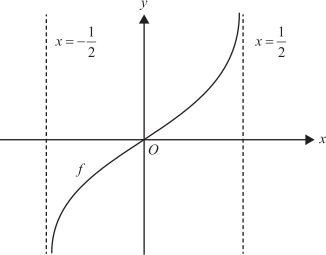
Consider the function `f`, where `f:\left(-\frac{1}{2}, \frac{1}{2}\right) \rightarrow R, f(x)=\log _e\left(x+\frac{1}{2}\right)-\log _e\left(\frac{1}{2}-x\right).`

Part of the graph of `y=f(x)` is shown below.
 

  1. State the range of `f(x)`.   (1 mark)

    --- 1 WORK AREA LINES (style=lined) ---

  2. Matt 1
    1. lskdjflsdkfj 
    2. sldkjfsldkfj 
    1. Something
    1. abc
    2. def
  3. slkflskdfj
    1. slkdfjlsdkfj
    2. sdlkjfsdlkfj
    1. lskjdflksd
    2. sdkjflsdkfj
  4. See the items below
    1. first
    2. second
    3. third
    4. fourth
    5. fifth
    1. Find `f^{\prime}(0)`.   (2 marks)

      --- 3 WORK AREA LINES (style=lined) ---

    2. State the maximal domain over which `f` is strictly increasing.   (1 mark)

      --- 2 WORK AREA LINES (style=lined) ---

    1. slkdjflskdfj 
    2. slkdfjlsdkfj
  5. lsksdlkfj
    1. sdflkjsd
    2. sdlfkj
    1. sdfsdlkf
  6. slkdfsldkfj
    1. slkdfjsldkfj
  7. Show that `f(x)+f(-x)=0`.   (1 mark)

    --- 3 WORK AREA LINES (style=lined) ---

  8. Find the domain and the rule of `f^{-1}`, the inverse of `f`.   (3 marks)

    --- 4 WORK AREA LINES (style=lined) ---

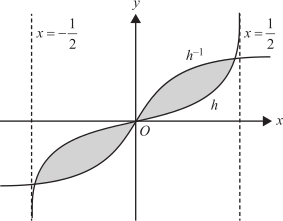
  9. Let `h` be the function `h:\left(-\frac{1}{2}, \frac{1}{2}\right) \rightarrow R, h(x)=\frac{1}{k}\left(\log _e\left(x+\frac{1}{2}\right)-\log _e\left(\frac{1}{2}-x\right)\right)`, where `k \in R` and `k>0`.
  1. The inverse function of `h` is defined by `h^{-1}: R \rightarrow R, h^{-1}(x)=\frac{e^{k x}-1}{2\left(e^{k x}+1\right)}`.
  2. The area of the regions bound by the functions `h` and `h^{-1}` can be expressed as a function, `A(k)`.
  3. The graph below shows the relevant area shaded.
     

  1. You are not required to find or define `A(k)`.
  1. Determine the range of values of `k` such that `A(k)>0`.   (1 mark)

    --- 2 WORK AREA LINES (style=lined) ---

  2. Explain why the domain of `A(k)` does not include all values of `k`.   (1 mark)

    --- 2 WORK AREA LINES (style=lined) ---

Show Answers Only
a.     `R`
b.i `f^{\prime}(0)=4`
b.ii `\left(-\frac{1}{2}, \frac{1}{2}\right)`
c. `0`
d. `x \in \mathbb{R}`
e.i  ` k > 4`
e.ii No bounded area for `0<k \leq 4`
Show Worked Solution

a.   `R` is the range.

b.i    `f(x)`
`= \log _e\left(x+\frac{1}{2}\right)-\log _e\left(\frac{1}{2}-x\right)`  
  `f^{\prime}(x)` `= \frac{1}{x+\frac{1}{2}}+\frac{1}{\frac{1}{2}-x}`  
    `= \frac{2}{2 x+1}-\frac{2}{2 x-1}`  
  `f^{\prime}(0)` `= \frac{2}{2 xx 0+1}-\frac{2}{2 xx 0-1}`  
    `= 4`  

 
b.ii 
`\left(-\frac{1}{2}, \frac{1}{2}\right)`

c.   `f(x)+f(-x)` `= \log _e\left(x+\frac{1}{2}\right)-\log _e\left(\frac{1}{2}-x\right)+\log _e\left(-x+\frac{1}{2}\right)-\log _e\left(\frac{1}{2}+x\right)`  
  `= 0`  

 
d.  
To find the inverse swap `x` and `y` in `y=f(x)`

`x` `= \log _e\left(y+\frac{1}{2}\right)-\log _e\left(\frac{1}{2}-y\right)`  
`x` `= \log _e\left(\frac{y+\frac{1}{2}}{\frac{1}{2}-y}\right)`  
`e^x` `=\frac{y+\frac{1}{2}}{\frac{1}{2}-y}`  
`y+\frac{1}{2}` `= e^x\left(-y+\frac{1}{2}\right)`  
`y+\frac{1}{2}` `= -e^x y+\frac{e^x}{2}`  
`y\left(e^x+1\right)` `= \frac{e^x-1}{2}`  
`:.\ f^(-1)(x)` `= \frac{e^x-1}{2(e^x + 1)}`  

 
  `:.`  Domain: `x \in \mathbb{R}`
  

e.i   The vertical dilation factor of  `f(x)` is  `1/k`

For `A(k)>=0` , `h^{\prime}(0)<1`

`\frac{1}{k}(4)<1`   [Using CAS]

`:.\  k > 4`


♦♦♦♦ Mean mark (e.i) 10%.
MARKER’S COMMENT: Incorrect responses included `k>0` and `4<k<33`.

e.ii  When `h \geq h^{-1}` for  `x>0` (or `h \leq h^{-1}` for  `x<0`) there is no bounded area.

`:.`  There will be no bounded area for `0<k \leq 4`.


♦♦♦♦ Mean mark (e.ii) 10%.

Filed Under: Test category Tagged With: Band 3, Band 4, Band 6, smc-2745-40-Log graphs, smc-2745-50-Find Domain/Range, smc-5204-80-Area between curves, smc-723-50-Log/Exponential, smc-723-80-Area between graphs, smc-723-95-Transformations

EXAMCOPY Functions, MET2 2022 VCAA 4

Consider the function `f`, where `f:\left(-\frac{1}{2}, \frac{1}{2}\right) \rightarrow R, f(x)=\log _e\left(x+\frac{1}{2}\right)-\log _e\left(\frac{1}{2}-x\right).`

Part of the graph of `y=f(x)` is shown below.
 

  1. State the range of `f(x)`.   (1 mark)

    --- 1 WORK AREA LINES (style=lined) ---

  2.  i. Find `f^{\prime}(0)`.   (2 marks)

    --- 3 WORK AREA LINES (style=lined) ---

  3. ii. State the maximal domain over which `f` is strictly increasing.   (1 mark)

    --- 2 WORK AREA LINES (style=lined) ---

  4. Show that `f(x)+f(-x)=0`.   (1 mark)

    --- 3 WORK AREA LINES (style=lined) ---

  5. Find the domain and the rule of `f^{-1}`, the inverse of `f`.   (3 marks)

    --- 4 WORK AREA LINES (style=lined) ---

  6. Let `h` be the function `h:\left(-\frac{1}{2}, \frac{1}{2}\right) \rightarrow R, h(x)=\frac{1}{k}\left(\log _e\left(x+\frac{1}{2}\right)-\log _e\left(\frac{1}{2}-x\right)\right)`, where `k \in R` and `k>0`.
  7. The inverse function of `h` is defined by `h^{-1}: R \rightarrow R, h^{-1}(x)=\frac{e^{k x}-1}{2\left(e^{k x}+1\right)}`.
  8. The area of the regions bound by the functions `h` and `h^{-1}` can be expressed as a function, `A(k)`.
  9. The graph below shows the relevant area shaded.
     

  1. You are not required to find or define `A(k)`.
  1. Determine the range of values of `k` such that `A(k)>0`.   (1 mark)

    --- 2 WORK AREA LINES (style=lined) ---

  2. Explain why the domain of `A(k)` does not include all values of `k`.   (1 mark)

    --- 2 WORK AREA LINES (style=lined) ---

Show Answers Only
a.     `R`
b.i `f^{\prime}(0)=4`
b.ii `\left(-\frac{1}{2}, \frac{1}{2}\right)`
c. `0`
d. `x \in \mathbb{R}`
e.i  ` k > 4`
e.ii No bounded area for `0<k \leq 4`
Show Worked Solution

a.   `R` is the range.

b.i    `f(x)`
`= \log _e\left(x+\frac{1}{2}\right)-\log _e\left(\frac{1}{2}-x\right)`  
  `f^{\prime}(x)` `= \frac{1}{x+\frac{1}{2}}+\frac{1}{\frac{1}{2}-x}`  
    `= \frac{2}{2 x+1}-\frac{2}{2 x-1}`  
  `f^{\prime}(0)` `= \frac{2}{2 xx 0+1}-\frac{2}{2 xx 0-1}`  
    `= 4`  

 
b.ii 
`\left(-\frac{1}{2}, \frac{1}{2}\right)`

c.   `f(x)+f(-x)` `= \log _e\left(x+\frac{1}{2}\right)-\log _e\left(\frac{1}{2}-x\right)+\log _e\left(-x+\frac{1}{2}\right)-\log _e\left(\frac{1}{2}+x\right)`  
  `= 0`  

 
d.  
To find the inverse swap `x` and `y` in `y=f(x)`

`x` `= \log _e\left(y+\frac{1}{2}\right)-\log _e\left(\frac{1}{2}-y\right)`  
`x` `= \log _e\left(\frac{y+\frac{1}{2}}{\frac{1}{2}-y}\right)`  
`e^x` `=\frac{y+\frac{1}{2}}{\frac{1}{2}-y}`  
`y+\frac{1}{2}` `= e^x\left(-y+\frac{1}{2}\right)`  
`y+\frac{1}{2}` `= -e^x y+\frac{e^x}{2}`  
`y\left(e^x+1\right)` `= \frac{e^x-1}{2}`  
`:.\ f^(-1)(x)` `= \frac{e^x-1}{2(e^x + 1)}`  

 
  `:.`  Domain: `x \in \mathbb{R}`
  

e.i   The vertical dilation factor of  `f(x)` is  `1/k`

For `A(k)>=0` , `h^{\prime}(0)<1`

`\frac{1}{k}(4)<1`   [Using CAS]

`:.\  k > 4`


♦♦♦♦ Mean mark (e.i) 10%.
MARKER’S COMMENT: Incorrect responses included `k>0` and `4<k<33`.

e.ii  When `h \geq h^{-1}` for  `x>0` (or `h \leq h^{-1}` for  `x<0`) there is no bounded area.

`:.`  There will be no bounded area for `0<k \leq 4`.


♦♦♦♦ Mean mark (e.ii) 10%.

Filed Under: Test category Tagged With: Band 3, Band 4, Band 6, smc-2745-40-Log graphs, smc-2745-50-Find Domain/Range, smc-5204-80-Area between curves, smc-723-50-Log/Exponential, smc-723-80-Area between graphs, smc-723-95-Transformations

Copyright © 2014–2025 SmarterEd.com.au · Log in