Let \(f: R \rightarrow R, \ f(x)=\dfrac{x}{2}+7\) and
\(g: R \rightarrow R, \ g(x)=A e^{k x}\) where \(A, k \in R\).
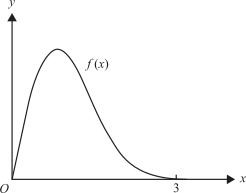
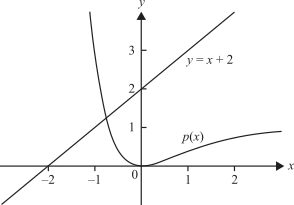
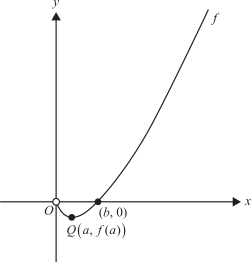
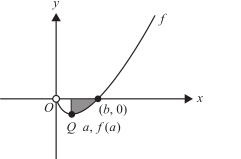
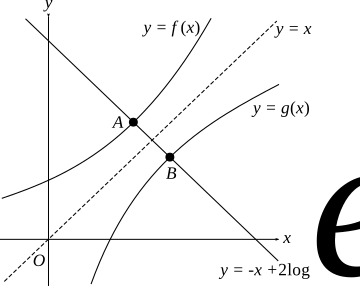
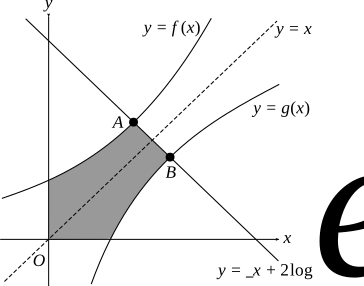
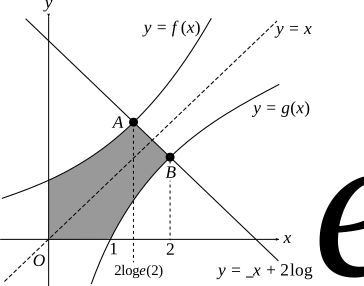
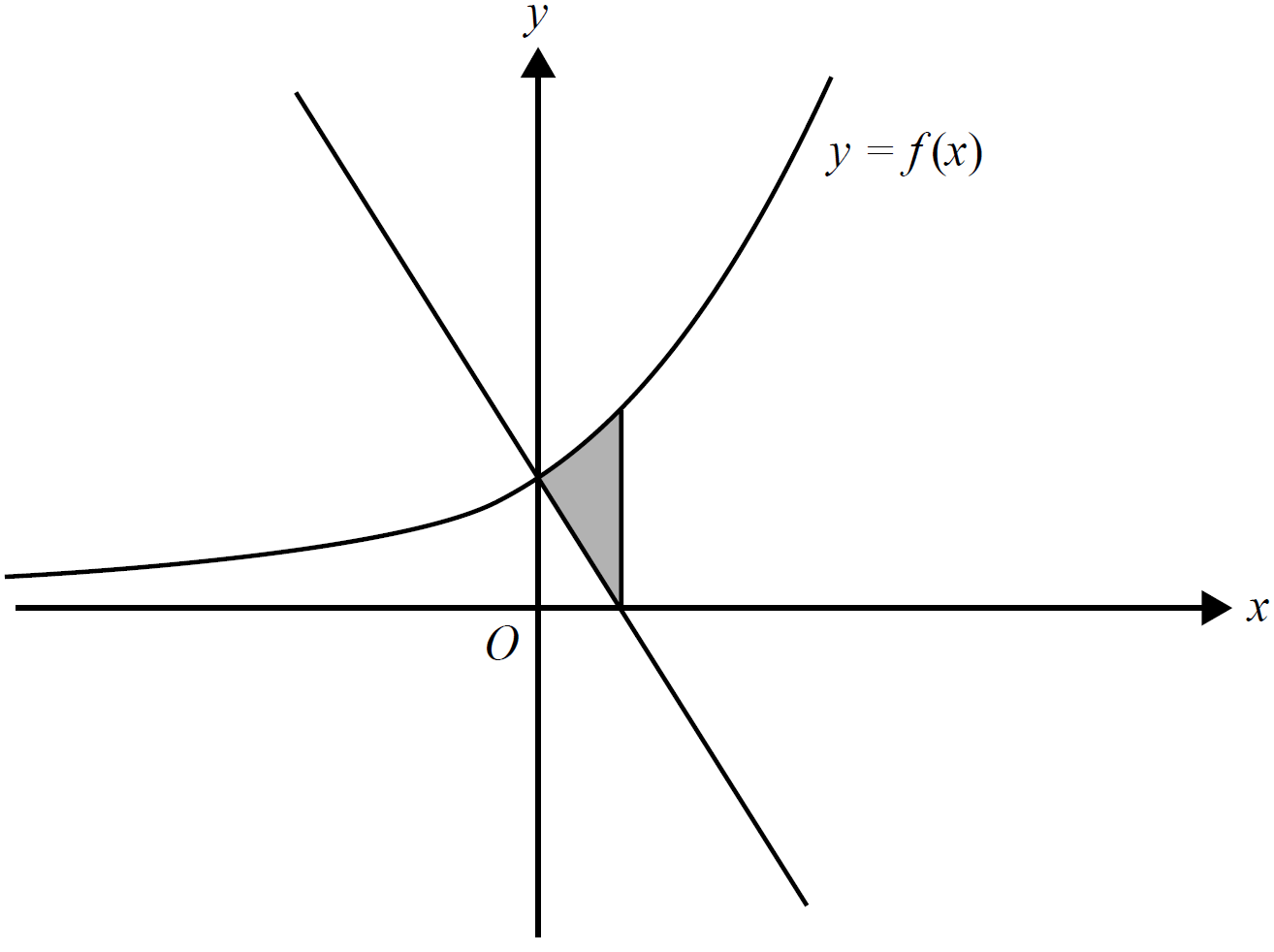
The graphs of \(y=f(x)\) and \(y=g(x)\) intersect at the points \((-12,1)\) and \((2,8)\), as shown below.
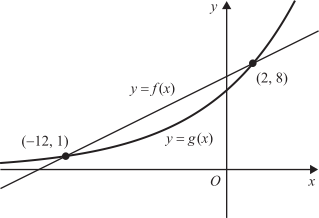
- Write down two simultaneous equations in terms of \(A\) and \(k\).
- Solve them, using algebra, to show that \(A=2^{\tfrac{18}{7}}\) and \(k=\dfrac{3}{14} \log _e(2)\). (3 marks)
--- 12 WORK AREA LINES (style=lined) ---
- Find the value of \(b\), where \(b \in R\), such that \(g(x)\) can be expressed in the form \(g(x)=A \times 2^{b x}\). (1 mark)
--- 3 WORK AREA LINES (style=lined) ---
- Use a definite integral to evaluate the area bounded by the graphs of \(y=f(x)\) and \(y=g(x)\), where \(x \in[-12,2]\).
- Give the area correct to two decimal places. (2 marks)
--- 5 WORK AREA LINES (style=lined) ---
- Let \(h(x)=f(x)-g(x)\).
- Write down an expression for the derivative of \(h(x)\). (1 mark)
--- 2 WORK AREA LINES (style=lined) ---
- Find the maximum value of \(h(x)\), where \(x \in[-12,2]\). (1 mark)
- Give your answer correct to two decimal places.
--- 2 WORK AREA LINES (style=lined) ---
- Write down an expression for the derivative of \(h(x)\). (1 mark)
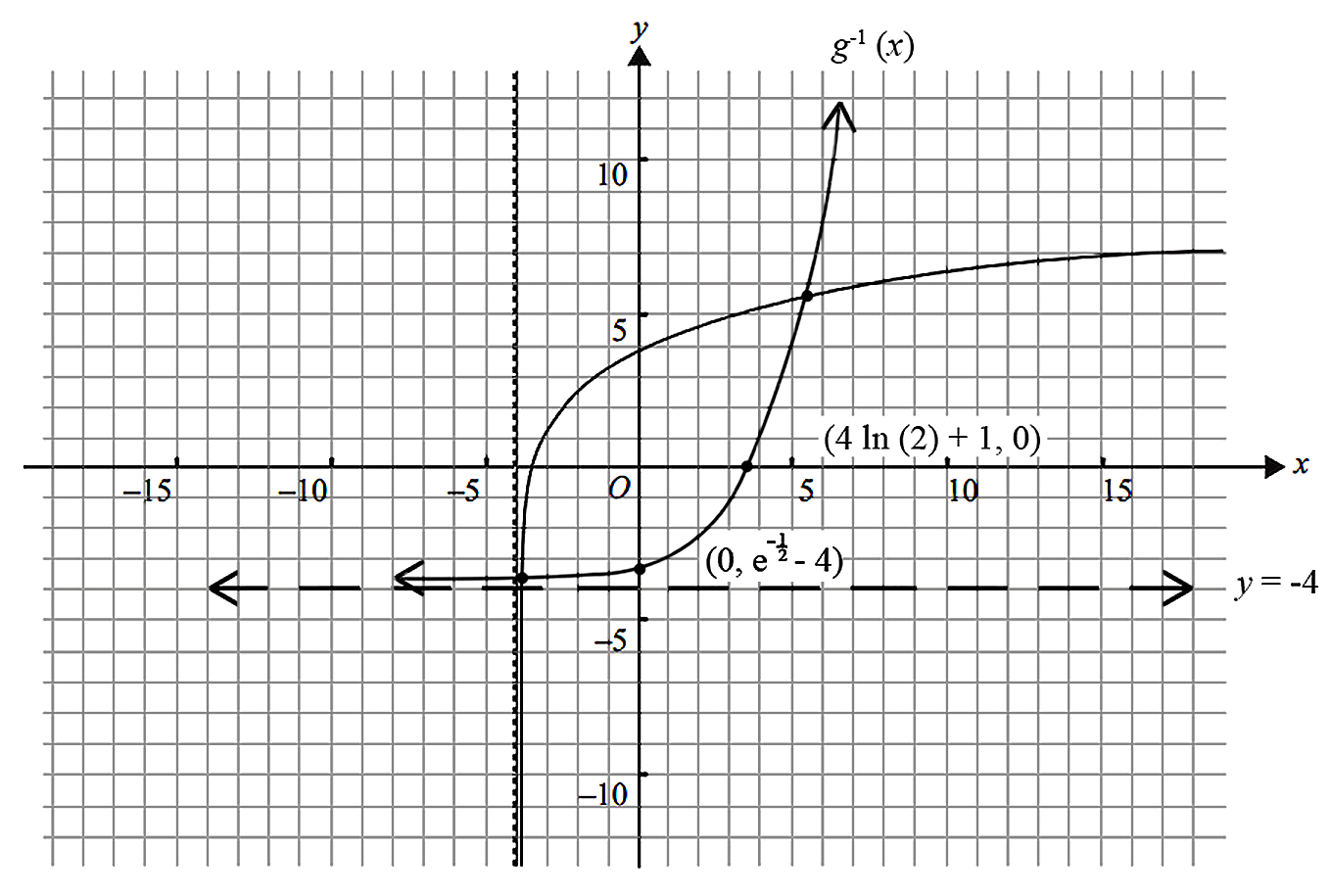
- Let \(g^{-1}\) be the inverse of \(g\).
- Find the points where the graph of \(y=g^{-1}(x)\) intersects with the graph of \(y=2(x-7)\). (2 marks)
--- 5 WORK AREA LINES (style=lined) ---
- Let \(F\) be an anti-derivative of \(f\) that passes through \((0, c)\), where \(c \in R\).
- Show that it is not possible for the graph of \(y=F(x)\) to pass through both \((-12,1)\) and \((2,8)\). (2 marks)
--- 9 WORK AREA LINES (style=lined) ---
- The graph of \(y=F(x)\) can be dilated by a factor of \(m\) from the \(x\)-axis such that its image passes through both \((-12,1)\) and \((2,8)\).
- Find the values of \(m\) and \(c\). (2 marks)
--- 6 WORK AREA LINES (style=lined) ---
- Show that it is not possible for the graph of \(y=F(x)\) to pass through both \((-12,1)\) and \((2,8)\). (2 marks)