SmarterEd

Aussie Maths & Science Teachers: Save your time with SmarterEd

  • Login
  • Get Help
  • About

HMS, HIC 2015 HSC 13 MC

Which of the following is a sociocultural determinant that explains the increased risk of respiratory diseases for some Australians?

  1. Being unemployed
  2. Affordability of medical care
  3. Exposure to smoking in the family
  4. Presence of hazardous chemicals at work
Show Answers Only

\(C\)

Show Worked Solution
  • C is correct: Family smoking exposure is a sociocultural determinant affecting behaviour.

Other Options:

  • A is incorrect: Unemployment is a socioeconomic not sociocultural determinant.
  • B is incorrect: Medical care affordability is socioeconomic not sociocultural.
  • D is incorrect: Workplace chemicals are environmental not sociocultural determinants.

Filed Under: Socioeconomic Tagged With: Band 3, smc-5805-80-Identify determinant

HMS, HIC 2016 HSC 3 MC

Which of the following is an example of a socioeconomic determinant that influences the health of Aboriginal and Torres Strait Islander peoples?

  1. Racism from peers and the community
  2. Remoteness of some of their communities
  3. Lower completion rate of Year 12 education
  4. Lack of access to appropriate health services
Show Answers Only

\(C\)

Show Worked Solution
  • C is correct: Education completion rates are a socioeconomic characteristic affecting health outcomes.

Other Options:

  • A is incorrect: This is a sociocultural determinant, not socioeconomic.
  • B is incorrect: This is an environmental/geographical determinant.
  • D is incorrect: This is an environmental/access determinant.

Filed Under: Socioeconomic Tagged With: Band 4, smc-5805-10-Education

HMS, HIC 2017 HSC 27a

Explain the determinants of ONE major health issue that affects young people.   (8 marks)

--- 24 WORK AREA LINES (style=lined) ---

Show Answers Only

Health Issue: Mental Health Issues in Young People

  • Socioeconomic determinants directly influence mental health outcomes amongst young Australians. This occurs because family income affects access to mental health services and educational opportunities. Low socioeconomic status leads to increased stress, housing instability, and reduced healthcare access. For instance, when families cannot afford private psychology sessions, young people rely on overstretched public services. This demonstrates why disadvantaged youth experience higher rates of anxiety and depression than their affluent peers.
  • Social media and technology create significant environmental pressures on young people’s mental wellbeing. This happens because constant online comparison and cyberbullying increase psychological distress. These platforms trigger feelings of inadequacy and social isolation amongst adolescents. Evidence of this includes research showing increased depression rates correlating with social media usage time. The result is young people experiencing body image issues and reduced self-esteem from unrealistic online portrayals.
  • Academic pressure generates substantial stress-related mental health problems in students. This works by creating intense competition for university places and career opportunities. Consequently, many young people develop anxiety disorders and burnout symptoms. A clear example is HSC students experiencing panic attacks during examination periods. This explains why perfectionist tendencies and fear of failure contribute significantly to youth mental health crises in Australia.

Show Worked Solution

Health Issue: Mental Health Issues in Young People

  • Socioeconomic determinants directly influence mental health outcomes amongst young Australians. This occurs because family income affects access to mental health services and educational opportunities. Low socioeconomic status leads to increased stress, housing instability, and reduced healthcare access. For instance, when families cannot afford private psychology sessions, young people rely on overstretched public services. This demonstrates why disadvantaged youth experience higher rates of anxiety and depression than their affluent peers.
  • Social media and technology create significant environmental pressures on young people’s mental wellbeing. This happens because constant online comparison and cyberbullying increase psychological distress. These platforms trigger feelings of inadequacy and social isolation amongst adolescents. Evidence of this includes research showing increased depression rates correlating with social media usage time. The result is young people experiencing body image issues and reduced self-esteem from unrealistic online portrayals.
  • Academic pressure generates substantial stress-related mental health problems in students. This works by creating intense competition for university places and career opportunities. Consequently, many young people develop anxiety disorders and burnout symptoms. A clear example is HSC students experiencing panic attacks during examination periods. This explains why perfectionist tendencies and fear of failure contribute significantly to youth mental health crises in Australia.

♦♦ Mean mark 54%.

Filed Under: Environmental, Research and Health Related Issues, Socioeconomic Tagged With: Band 4, Band 5, smc-5800-10-Youth health issue, smc-5804-10-Geographic location, smc-5805-30-Income

HMS, HIC 2019 HSC 28b

Explain the factors which may adversely affect the health of young people and the strategies implemented to overcome them.   (12 marks)

--- 25 WORK AREA LINES (style=lined) ---

Show Answers Only

  • Individual factors adversely affect young people’s health through predetermined characteristics and personal behaviours. Low self-esteem and risk-taking attitudes increase vulnerability to substance abuse and unsafe sexual practices. This occurs because adolescent brain development affects decision-making capacity. Male young people experience higher injury rates due to impulsivity and peer pressure influences. Consequently, motor vehicle accidents and sporting injuries represent leading causes of youth mortality and morbidity.
  • Socioeconomic factors create health disparities through family income and educational access. Low socioeconomic status limits access to healthy food choices and recreational facilities. This leads to higher rates of obesity and mental health issues among disadvantaged youth. Family breakdown and unemployment contribute to social isolation and stress-related conditions. Therefore, young people from lower socioeconomic backgrounds experience poorer health outcomes across multiple indicators.
  • Environmental factors influence health through geographical location and infrastructure availability. Rural and remote young people face reduced access to healthcare services and mental health support. This results in delayed treatment for chronic conditions and higher suicide rates. Poor housing conditions and overcrowding expose young people to infectious diseases and respiratory problems. Additionally, limited transport optirestrict ons participation in health-promoting activities and social connections.
  • Strategies address these factors through targeted interventions and policy changes. Youth mental health services like headspace provide accessible support for psychological wellbeing issues. These services work by offering early intervention and culturally appropriate care in community settings. School-based health education programs develop health literacy and decision-making skills among adolescents. This approach enables young people to make informed choices about substance use and sexual health practices, reducing risk-taking behaviours significantly.

Show Worked Solution

  • Individual factors adversely affect young people’s health through predetermined characteristics and personal behaviours. Low self-esteem and risk-taking attitudes increase vulnerability to substance abuse and unsafe sexual practices. This occurs because adolescent brain development affects decision-making capacity. Male young people experience higher injury rates due to impulsivity and peer pressure influences. Consequently, motor vehicle accidents and sporting injuries represent leading causes of youth mortality and morbidity.
  • Socioeconomic factors create health disparities through family income and educational access. Low socioeconomic status limits access to healthy food choices and recreational facilities. This leads to higher rates of obesity and mental health issues among disadvantaged youth. Family breakdown and unemployment contribute to social isolation and stress-related conditions. Therefore, young people from lower socioeconomic backgrounds experience poorer health outcomes across multiple indicators.
  • Environmental factors influence health through geographical location and infrastructure availability. Rural and remote young people face reduced access to healthcare services and mental health support. This results in delayed treatment for chronic conditions and higher suicide rates. Poor housing conditions and overcrowding expose young people to infectious diseases and respiratory problems. Additionally, limited transport optirestrict ons participation in health-promoting activities and social connections.
  • Strategies address these factors through targeted interventions and policy changes. Youth mental health services like headspace provide accessible support for psychological wellbeing issues. These services work by offering early intervention and culturally appropriate care in community settings. School-based health education programs develop health literacy and decision-making skills among adolescents. This approach enables young people to make informed choices about substance use and sexual health practices, reducing risk-taking behaviours significantly.

♦♦ Mean mark 50%.

Filed Under: Environmental, Research and Health Related Issues, Socioeconomic Tagged With: Band 5, smc-5800-10-Youth health issue, smc-5800-15-Protective/risk factors, smc-5800-20-Current strategies, smc-5800-25-Strategy dev and advocacy, smc-5804-10-Geographic location, smc-5804-45-Community resources, smc-5804-55-Inequities, smc-5805-30-Income, smc-5805-60-Risky health behaviours

HMS, HIC 2020 HSC 32aii

Explain how socioeconomic factors can contribute to health inequities experienced by different population groups in Australia.   (5 marks)

--- 18 WORK AREA LINES (style=lined) ---

Show Answers Only

  • Low income levels directly result in reduced access to healthcare services and nutritious food options. This occurs because families prioritise basic needs over preventive health measures. Homeless populations experience limited healthcare access, which leads to higher rates of chronic diseases and infectious conditions.
  • Educational attainment strongly influences health literacy and employment opportunities. This creates a cycle where lower education results in reduced income and poorer health choices. Aboriginal and Torres Strait Islander peoples face educational disadvantages that indirectly contribute to higher rates of diabetes and cardiovascular disease.
  • Employment status determines access to health insurance and stable income. This causes unemployed individuals to delay medical treatment and triggers worsening health conditions. Rural populations experience limited employment opportunities, which produces reduced access to specialist healthcare services.
  • Therefore, socioeconomic factors interact to create compound disadvantages. This means that lower socioeconomic status increases multiple health risks whilst reducing access to protective resources. As a result, persistent health inequities continue across different Australian population groups.

Show Worked Solution

  • Low income levels directly result in reduced access to healthcare services and nutritious food options. This occurs because families prioritise basic needs over preventive health measures. Homeless populations experience limited healthcare access, which leads to higher rates of chronic diseases and infectious conditions.
  • Educational attainment strongly influences health literacy and employment opportunities. This creates a cycle where lower education results in reduced income and poorer health choices. Aboriginal and Torres Strait Islander peoples face educational disadvantages that indirectly contribute to higher rates of diabetes and cardiovascular disease.
  • Employment status determines access to health insurance and stable income. This causes unemployed individuals to delay medical treatment and triggers worsening health conditions. Rural populations experience limited employment opportunities, which produces reduced access to specialist healthcare services.
  • Therefore, socioeconomic factors interact to create compound disadvantages. This means that lower socioeconomic status increases multiple health risks whilst reducing access to protective resources. As a result, persistent health inequities continue across different Australian population groups.

♦♦ Mean mark 52%.

Filed Under: Socioeconomic Tagged With: Band 5, smc-5805-80-Inequities

HMS, HIC 2020 HSC 32ai

Outline how the quality of the early years of life can contribute to health inequities in Australia.   (3 marks)

--- 7 WORK AREA LINES (style=lined) ---

Show Answers Only
  • Poor early childhood conditions create lasting health inequities by establishing disadvantage cycles.
  • Low-income families lacking quality prenatal care produce higher rates of low birth weight babies, creating lifelong health complications and increased healthcare needs.
  • Children in disadvantaged areas face environmental hazards and limited nutritious food access, leading to higher rates of chronic diseases like asthma and diabetes.
  • Educational disadvantage reduces future employment opportunities and health literacy, preventing families from breaking inequality cycles.
  • These early disadvantages compound over time, creating permanent health gaps between socioeconomic groups across Australian society.
Show Worked Solution
  • Poor early childhood conditions create lasting health inequities by establishing disadvantage cycles.
  • Low-income families lacking quality prenatal care produce higher rates of low birth weight babies, creating lifelong health complications and increased healthcare needs.
  • Children in disadvantaged areas face environmental hazards and limited nutritious food access, leading to higher rates of chronic diseases like asthma and diabetes.
  • Educational disadvantage reduces future employment opportunities and health literacy, preventing families from breaking inequality cycles.
  • These early disadvantages compound over time, creating permanent health gaps between socioeconomic groups across Australian society.

♦♦ Mean mark 47%.

Filed Under: Biomedical and Health Behaviours, Environmental, Socioeconomic Tagged With: Band 5, smc-5804-55-Inequities, smc-5805-80-Inequities, smc-5806-70-Inequities

HMS, HIC 2021 HSC 28b

Analyse how socioeconomic and environmental determinants can contribute to TWO major health issues affecting young people.   (12 marks)

--- 28 WORK AREA LINES (style=lined) ---

Show Answers Only

Overview Statement

  • Socioeconomic and environmental determinants interact significantly with mental health and substance use among young people.
  • These relationships create complex pathways that amplify health risks through multiple interconnected social and environmental factors.

Component Relationship 1: Mental Health

  • Low socioeconomic status directly influences young people’s mental health through reduced access to psychological services and increased family stress.
  • Educational disadvantage is associated with limited future employment prospects, which creates anxiety about economic security.
  • Environmental factors interact with these socioeconomic pressures when young people live in areas with poor infrastructure, limited recreational facilities and high crime rates.
  • Geographic isolation compounds mental health challenges by restricting access to counselling services, youth programs and peer support networks.
  • For instance, rural youth may wait months for specialist appointments while urban disadvantaged youth cannot afford private counselling/psychology sessions.
  • These combined determinants result in higher rates of depression and anxiety among disadvantaged youth because they face multiple stressors simultaneously without adequate coping resources.

Component Relationship 2: Substance Use

  • Socioeconomic disadvantage creates pathways to substance use through peer group influences and limited parental supervision.
  • Low family income correlates with parents working multiple jobs, reducing parental monitoring and increasing unsupervised time for risky behaviours.
  • Environmental determinants amplify these risks when young people live in areas with high availability of alcohol, cannabis and other substances.
  • Geographic location affects substance use patterns, with rural youth often experiencing higher alcohol consumption rates due to social isolation and limited recreational alternatives.
  • Additionally, disadvantaged urban areas often have greater drug accessibility and normalised substance use cultures.
  • The relationship between these determinants demonstrates how economic stress combines with environmental factors to increase vulnerability to substance experimentation and dependency.

Implications and Synthesis

  • These determinant relationships reveal that health issues among young people result from interconnected social and environmental systems rather than individual choices alone.
  • Effective interventions must therefore address multiple determinant levels simultaneously to achieve meaningful health improvements.
Show Worked Solution

Overview Statement

  • Socioeconomic and environmental determinants interact significantly with mental health and substance use among young people.
  • These relationships create complex pathways that amplify health risks through multiple interconnected social and environmental factors.

Component Relationship 1: Mental Health

  • Low socioeconomic status directly influences young people’s mental health through reduced access to psychological services and increased family stress.
  • Educational disadvantage is associated with limited future employment prospects, which creates anxiety about economic security.
  • Environmental factors interact with these socioeconomic pressures when young people live in areas with poor infrastructure, limited recreational facilities and high crime rates.
  • Geographic isolation compounds mental health challenges by restricting access to counselling services, youth programs and peer support networks.
  • For instance, rural youth may wait months for specialist appointments while urban disadvantaged youth cannot afford private counselling/psychology sessions.
  • These combined determinants result in higher rates of depression and anxiety among disadvantaged youth because they face multiple stressors simultaneously without adequate coping resources.

Component Relationship 2: Substance Use

  • Socioeconomic disadvantage creates pathways to substance use through peer group influences and limited parental supervision.
  • Low family income correlates with parents working multiple jobs, reducing parental monitoring and increasing unsupervised time for risky behaviours.
  • Environmental determinants amplify these risks when young people live in areas with high availability of alcohol, cannabis and other substances.
  • Geographic location affects substance use patterns, with rural youth often experiencing higher alcohol consumption rates due to social isolation and limited recreational alternatives.
  • Additionally, disadvantaged urban areas often have greater drug accessibility and normalised substance use cultures.
  • The relationship between these determinants demonstrates how economic stress combines with environmental factors to increase vulnerability to substance experimentation and dependency.

Implications and Synthesis

  • These determinant relationships reveal that health issues among young people result from interconnected social and environmental systems rather than individual choices alone.
  • Effective interventions must therefore address multiple determinant levels simultaneously to achieve meaningful health improvements.

♦♦ Mean mark 35%.

Filed Under: Environmental, Research and Health Related Issues, Socioeconomic Tagged With: Band 5, smc-5800-10-Youth health issue, smc-5804-10-Geographic location, smc-5804-60-Interaction of determinants, smc-5805-10-Education, smc-5805-60-Risky health behaviours, smc-5805-80-Inequities

HMS, HIC EQ-Bank 124

Outline how the interaction of socioeconomic and biomedical determinants could adversely affect the health of an individual.   (3 marks)

--- 7 WORK AREA LINES (style=lined) ---

Show Answers Only
  • Low-income individuals with genetic predisposition to diabetes cannot afford regular blood glucose monitoring or healthy food options. This leads to poor disease management and increased risk of complications such as kidney disease and cardiovascular problems.
  • A person with lower limb amputation from a low socioeconomic background may lack access to quality prosthetics and rehabilitation services. This causes reduced mobility, increased risk of secondary injuries and social isolation affecting mental health.
  • Individuals with hereditary high cholesterol in financially disadvantaged families cannot afford cholesterol-lowering medications or heart-healthy diets. This increases their risk of cardiovascular disease and stroke at younger ages.
Show Worked Solution
  • Low-income individuals with genetic predisposition to diabetes cannot afford regular blood glucose monitoring or healthy food options. This leads to poor disease management and increased risk of complications such as kidney disease and cardiovascular problems.
  • A person with lower limb amputation from a low socioeconomic background may lack access to quality prosthetics and rehabilitation services. This causes reduced mobility, increased risk of secondary injuries and social isolation affecting mental health.
  • Individuals with hereditary high cholesterol in financially disadvantaged families cannot afford cholesterol-lowering medications or heart-healthy diets. This increases their risk of cardiovascular disease and stroke at younger ages.

Filed Under: Biomedical and Health Behaviours, Socioeconomic Tagged With: Band 4, smc-5805-70-Interaction of factors, smc-5806-20-Biomedical, smc-5806-80-Interaction of factors

HMS, HIC EQ-Bank 119

Describe an inequity related to socioeconomic factors of health in Australia and suggest ways in which it could be addressed.   (4 marks)

--- 10 WORK AREA LINES (style=lined) ---

Show Answers Only

Sample answer:

  • An inequity related to socioeconomic factors is the significant gap in educational attainment between Australians from high and low socioeconomic backgrounds.
  • Only 60% of students from low socioeconomic backgrounds complete Year 12 compared to 90% from high socioeconomic backgrounds.
  • This educational inequity leads to reduced employment opportunities, lower income, and poorer health outcomes.

Strategies to address this issue could include:

  • Targeted early intervention programs in disadvantaged schools.
  • Financial support for low-income families for educational costs.
  • Mentoring programs connecting disadvantaged students with educational and career pathways.
Show Worked Solution

Sample answer:

  • An inequity related to socioeconomic factors is the significant gap in educational attainment between Australians from high and low socioeconomic backgrounds.
  • Only 60% of students from low socioeconomic backgrounds complete Year 12 compared to 90% from high socioeconomic backgrounds.
  • This educational inequity leads to reduced employment opportunities, lower income, and poorer health outcomes.

Strategies to address this issue could include:

  • Targeted early intervention programs in disadvantaged schools.
  • Financial support for low-income families for educational costs.
  • Mentoring programs connecting disadvantaged students with educational and career pathways.

Filed Under: Socioeconomic Tagged With: Band 4, smc-5805-10-Education, smc-5805-80-Inequities

HMS, HIC EQ-Bank 113

Outline how a young person living in a rural community with limited income might experience the interaction of socioeconomic and environmental determinants affecting their health.   (3 marks)

--- 7 WORK AREA LINES (style=lined) ---

Show Answers Only
  • A young person in a rural community faces compounding health challenges as distance from services (environmental factor) combines with financial constraints (socioeconomic factor) to restrict healthcare access.
  • Their family’s socioeconomic status may limit transport options which makes geographical isolation a larger problem. This can reduce participation in sport and physical activities, resulting in decreased physical health outcomes.
  • Educational opportunities (socioeconomic factor) may be restricted by both remoteness (environmental factor) and family income (socioeconomic). This interaction can lead to reduced health literacy and less preventative healthcare by young people.
Show Worked Solution
  • A young person in a rural community faces compounding health challenges as distance from services (environmental factor) combines with financial constraints (socioeconomic factor) to restrict healthcare access.
  • Their family’s socioeconomic status may limit transport options which makes geographical isolation a larger problem. This can reduce participation in sport and physical activities, resulting in decreased physical health outcomes.
  • Educational opportunities (socioeconomic factor) may be restricted by both remoteness (environmental factor) and family income (socioeconomic). This interaction can lead to reduced health literacy and less preventative healthcare by young people.

Filed Under: Socioeconomic Tagged With: Band 4, smc-5805-30-Income, smc-5805-70-Interaction of factors

HMS, HIC EQ-Bank 112

Analyse how socioeconomic determinants contribute to health inequities experienced by young Australians.   (8 marks)

--- 22 WORK AREA LINES (style=lined) ---

Show Answers Only

*PEEL – Solution is structured using an adjusted PEEL method; [P] Identify components and their relationship, [E] explain the interaction/influence between them, [Ev] provide evidence showing the relationship in action, [L] linking sentence back to question.

  • [P] Education quality and parental income operate together to shape health outcomes.
  • [E] The relationship between school resources and family wealth shows disadvantaged students receive less health education due to this combination of factors.
  • [Ev] Low-income schools lack nutrition programs and sports facilities, resulting in higher obesity rates.
  • [L] This interaction demonstrates how education systematically compounds existing socioeconomic health gaps.
     
  • [P] Employment instability connects directly to mental health challenges and physical wellbeing.
  • [E] Casual work is associated with increased stress due to unpredictable work schedules, income insecurity and limited sick leave.
  • [Ev] Young people in this type of work report anxiety at double the rate of permanent employees and frequently delay medical appointments.
  • [L] This establishes a cause-effect pattern linking casual work to deteriorating psychological and physical health.
     
  • [P] Housing affordability influences an individual’s physical environment and other social health determinants.
  • [E] The interplay between rental stress and living conditions shows young people sacrifice health necessities for shelter.
  • [Ev] 40% of young renters live in overcrowded, mouldy housing, causing respiratory issues and social isolation.
  • [L] These elements combine to produce environment-driven health inequities affecting multiple dimensions.
     
  • [P] Digital access functions through the interaction of income, location and education.
  • [E] This component can influence health information access, telehealth participation and social connections.
  • [Ev] Rural youth without reliable internet miss 50% more mental health appointments than urban peers.
  • [L] The broader impact shows technology barriers compound existing disadvantages, creating deeper health divides.
Show Worked Solution

*PEEL – Solution is structured using an adjusted PEEL method; [P] Identify components and their relationship, [E] explain the interaction/influence between them, [Ev] provide evidence showing the relationship in action, [L] linking sentence back to question.

  • [P] Education quality and parental income operate together to shape health outcomes.
  • [E] The relationship between school resources and family wealth shows disadvantaged students receive less health education due to this combination of factors.
  • [Ev] Low-income schools lack nutrition programs and sports facilities, resulting in higher obesity rates.
  • [L] This interaction demonstrates how education systematically compounds existing socioeconomic health gaps.
     
  • [P] Employment instability connects directly to mental health challenges and physical wellbeing.
  • [E] Casual work is associated with increased stress due to unpredictable work schedules, income insecurity and limited sick leave.
  • [Ev] Young people in this type of work report anxiety at double the rate of permanent employees and frequently delay medical appointments.
  • [L] This establishes a cause-effect pattern linking casual work to deteriorating psychological and physical health.
     
  • [P] Housing affordability influences an individual’s physical environment and other social health determinants.
  • [E] The interplay between rental stress and living conditions shows young people sacrifice health necessities for shelter.
  • [Ev] 40% of young renters live in overcrowded, mouldy housing, causing respiratory issues and social isolation.
  • [L] These elements combine to produce environment-driven health inequities affecting multiple dimensions.
     
  • [P] Digital access functions through the interaction of income, location and education.
  • [E] This component can influence health information access, telehealth participation and social connections.
  • [Ev] Rural youth without reliable internet miss 50% more mental health appointments than urban peers.
  • [L] The broader impact shows technology barriers compound existing disadvantages, creating deeper health divides.

Filed Under: Socioeconomic Tagged With: Band 4, Band 5, Band 6, smc-5805-10-Education, smc-5805-20-Employment, smc-5805-50-Interconnection, smc-5805-80-Inequities

HMS, HIC EQ-Bank 093 MC

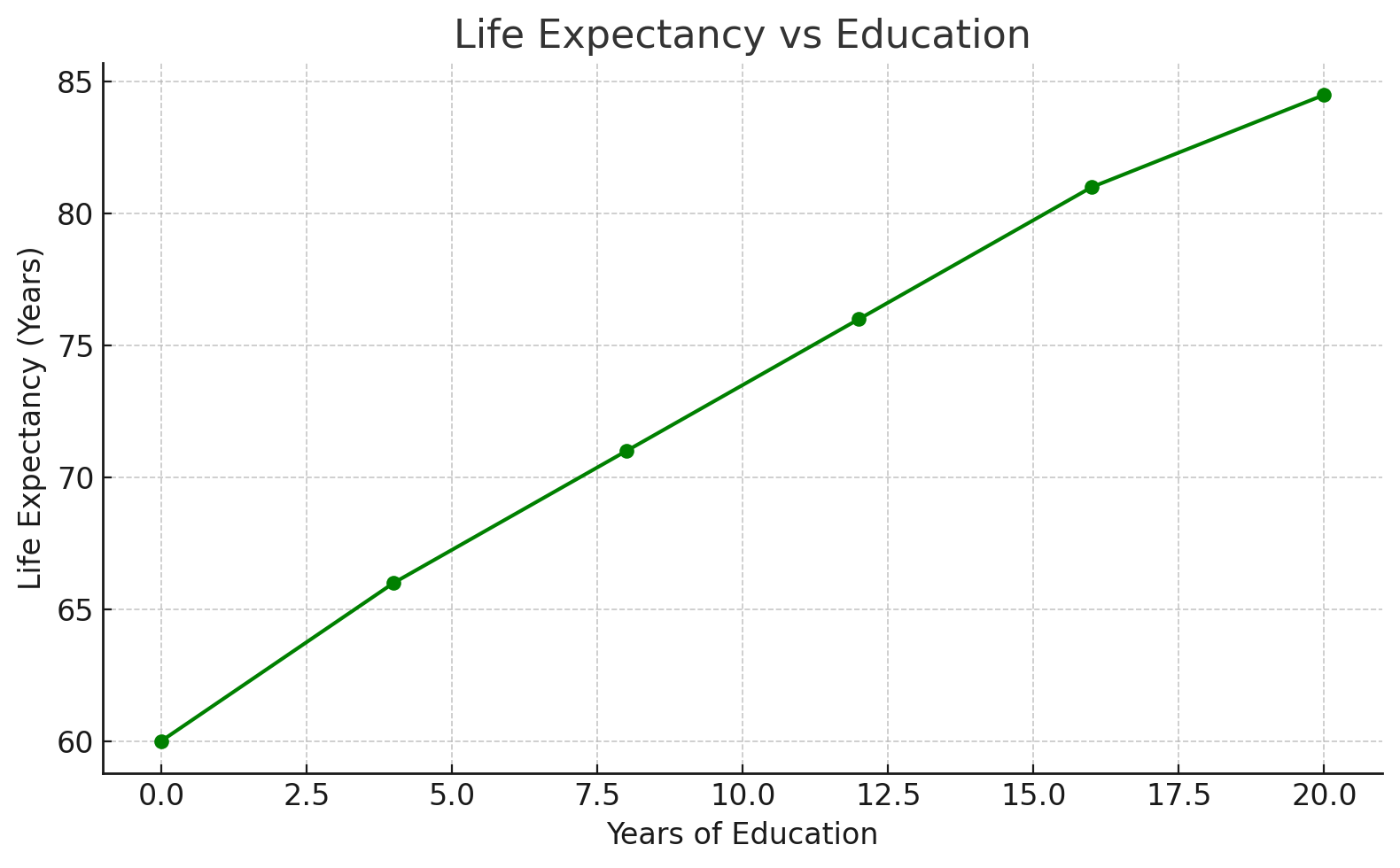
The graph below shows the relationship between educational attainment and life expectancy in a given population.
 

Which of the following would be the most effective intervention to improve health outcomes for the group with the lowest life expectancy?

  1. Providing subsidised healthcare services to all citizens regardless of income.
  2. Implementing strict workplace health and safety regulations.
  3. Increasing access to quality education and retention in schools.
  4. Offering tax benefits to individuals who maintain private health insurance.
Show Answers Only

\(D\)

Show Worked Solution
  • C is correct because increasing access to quality education addresses a root cause of poor health outcomes. By improving health literacy, employment prospects and income potential both improve, contributing to higher life expectancy.

Other options:

  • A is incorrect because while healthcare access is important, it addresses symptoms rather than the underlying factors that lead to poor health.
  • B is incorrect because workplace regulations only benefit those who are employed and don’t address the broader socioeconomic determinants.
  • D is incorrect because tax benefits for private health insurance primarily benefit those who already have sufficient income to afford insurance, not those in the lowest socioeconomic brackets .

Filed Under: Socioeconomic Tagged With: Band 5, smc-5805-10-Education

HMS, HIC EQ-Bank 092 MC

A young person living in a low socioeconomic area has completed Year 10 but is considering leaving school to work full-time. According to socioeconomic determinants of health, what is the most likely long-term health outcome of this decision?

  1. Improved mental health due to financial independence.
  2. Equivalent health outcomes to those who complete Year 12 education.
  3. Temporary physical health challenges that resolve once stable employment is found.
  4. Reduced access to employment opportunities that provide health benefits.
Show Answers Only

\(D\)

Show Worked Solution
  • D is correct because lower educational attainment generally leads to reduced access to employment opportunities that provide health benefits.

Other options:

  • A is incorrect because while employment may provide some financial independence, leaving school early often limits long-term earning potential, which can increase financial stress.
  • B is incorrect because research shows that those who complete higher levels of education generally have better health outcomes than those who leave school early.
  • C is incorrect because the health challenges associated with lower educational attainment are often persistent rather than temporary.

Filed Under: Socioeconomic Tagged With: Band 4, smc-5805-10-Education, smc-5805-20-Employment, smc-5805-50-Interconnection

HMS, HIC EQ-Bank 091 MC

Which of the following BEST describes the relationship between education, employment and income as socioeconomic determinants of health?

  1. They are independent factors that separately influence different dimensions of health.
  2. Income is the primary determinant that directly influences education and employment outcomes.
  3. They operate in a cyclical manner where each can influence and reinforce the others.
  4. They primarily affect physical health but have minimal impact on other health dimensions.
Show Answers Only

\(C\)

Show Worked Solution
  • C is correct because education affects employment opportunities, which affects income, which in turn affects access to education for the next generation, creating an interconnected cycle.

Other options:

  • A is incorrect because these determinants are not independent; they are closely interrelated.
  • B is incorrect because income is not the primary determinant; all three work together, with education often being the initial factor.
  • D is incorrect because socioeconomic determinants affect all dimensions of health including mental and emotional health.

Filed Under: Socioeconomic Tagged With: Band 4, smc-5805-50-Interconnection

HMS, HIC EQ-Bank 63

Complete the following table that identifies the determinants of health of young people and provides examples of each.   (3 marks)

--- 0 WORK AREA LINES (style=lined) ---

\begin{array} {|l|l|}
\hline
\rule{0pt}{2.5ex} \text{Determinant of Health}\ \ \ \ \ \ \  \rule[-1ex]{0pt}{0pt} & \text{Example}\ \ \ \ \ \ \ \ \ \ \ \ \ \ \ \ \ \  \\
\hline
\rule{0pt}{2.5ex} \text{Health behaviour} \rule[-1ex]{0pt}{0pt} &  \\
\hline
\rule{0pt}{2.5ex}  \rule[-1ex]{0pt}{0pt} & \text{Blood pressure} \\
\hline
\rule{0pt}{2.5ex}  \rule[-1ex]{0pt}{0pt} & \text{Proximity to support networks}\ \ \ \ \ \ \ \ \ \ \ \ \ \ \ \ \ \ \ \ \ \ \ \ \ \  \\
\hline
\rule{0pt}{2.5ex}  \rule[-1ex]{0pt}{0pt} & \text{Homelessness} \\
\hline
\end{array}
Show Answers Only
\begin{array} {|l|l|}
\hline
\rule{0pt}{2.5ex} \textbf{Determinant of Health} \rule[-1ex]{0pt}{0pt} & \textbf{Example} \\
\hline
\rule{0pt}{2.5ex} \text{Health behaviour} \rule[-1ex]{0pt}{0pt} &  \text{Physical activity/sedentary behaviour} \\
\hline
\rule{0pt}{2.5ex}  \text{Biomedical factor} \rule[-1ex]{0pt}{0pt} & \text{Blood pressure} \\
\hline
\rule{0pt}{2.5ex}  \text{Environmental factor}  \rule[-1ex]{0pt}{0pt} & \text{Proximity to support networks} \\
\hline
\rule{0pt}{2.5ex} \text{Socioeconomic factor} \rule[-1ex]{0pt}{0pt} & \text{Homelessness} \\
\hline
\end{array}
Show Worked Solution

\begin{array} {|l|l|}
\hline
\rule{0pt}{2.5ex} \textbf{Determinant of Health} \rule[-1ex]{0pt}{0pt} & \textbf{Example} \\
\hline
\rule{0pt}{2.5ex} \text{Health behaviour} \rule[-1ex]{0pt}{0pt} &  \text{Physical activity/sedentary behaviour} \\
\hline
\rule{0pt}{2.5ex}  \text{Biomedical factor} \rule[-1ex]{0pt}{0pt} & \text{Blood pressure} \\
\hline
\rule{0pt}{2.5ex}  \text{Environmental factor}  \rule[-1ex]{0pt}{0pt} & \text{Proximity to support networks} \\
\hline
\rule{0pt}{2.5ex} \text{Socioeconomic factor} \rule[-1ex]{0pt}{0pt} & \text{Homelessness} \\
\hline
\end{array}

Filed Under: Biomedical and Health Behaviours, Broad features of society, Environmental, Socioeconomic Tagged With: Band 4, smc-5504-80-Identify determinant, smc-5803-80-Identify determinant, smc-5805-80-Identify determinant, smc-5806-80-Identify determinant

HMS, HIC EQ-Bank 022

Describe how socioeconomic status can contribute to risky health behaviours for Australians, and provide three specific examples.   (5 marks)

--- 15 WORK AREA LINES (style=lined) ---

Show Answers Only

Sample Answer

  • Lower socioeconomic status often correlates with reduced access to health information, leading to lower health literacy and fewer resources to make informed health decisions.
  • Example 1: Individuals from lower socioeconomic backgrounds may engage in higher rates of tobacco smoking as a coping mechanism for financial and social stressors. 
  • Financial constraints can limit access to healthier food options, recreational facilities, and preventative healthcare, creating barriers to adopting protective health behaviours.
  • Example 2: Food insecurity in lower-income households can lead to reliance on nutrient-poor foods that are often cheaper and more accessible. This can contribute to higher rates of obesity and related health conditions in these communities.
  • Living environments associated with socioeconomic disadvantage often feature higher density of alcohol outlets and gambling venues, resulting in increased exposure and normalisation of these activities.
  • Example 3: Young people in disadvantaged communities have greater access to alcohol and gambling facilities, leading to earlier initiation and higher rates of binge drinking and excess alcohol consumption.

Show Worked Solution

Sample Answer

  • Lower socioeconomic status often correlates with reduced access to health information, leading to lower health literacy and fewer resources to make informed health decisions.
  • Example 1: Individuals from lower socioeconomic backgrounds may engage in higher rates of tobacco smoking as a coping mechanism for financial and social stressors. 
  • Financial constraints can limit access to healthier food options, recreational facilities, and preventative healthcare, creating barriers to adopting protective health behaviours.
  • Example 2: Food insecurity in lower-income households can lead to reliance on nutrient-poor foods that are often cheaper and more accessible. This can contribute to higher rates of obesity and related health conditions in these communities.
  • Living environments associated with socioeconomic disadvantage often feature higher density of alcohol outlets and gambling venues, resulting in increased exposure and normalisation of these activities.
  • Example 3: Young people in disadvantaged communities have greater access to alcohol and gambling facilities, leading to earlier initiation and higher rates of binge drinking and excess alcohol consumption.

Filed Under: Socioeconomic Tagged With: Band 4, Band 5, smc-5805-60-Risky health behaviours

HMS, HIC EQ-Bank 015

Explain how socioeconomic characteristics can affect the health behaviours of Australians.    (5 marks)

--- 15 WORK AREA LINES (style=lined) ---

Show Answers Only

*PEEL – Solution is structured using an adjusted PEEL method to show cause and effect: [P] State the cause/factor [E] Show how it causes the effect [Ev] Evidence demonstrating why/how [L] Reinforce the causal relationship.

**Language highlighting the cause-effect relationship is bolded in the answer below.

  • [P] Education levels determine health literacy.
  • [E] This leads to different abilities among individuals to understand health information.
  • [Ev] As a result, university graduates are more likely to correctly interpret nutrition labels while those with limited education are at greater risk of misunderstand things like dosage instructions.
  • [L] This shows a connection between education and health decision-making ability.
     
  • [P] Employment provides structure and resources.
  • [E] This promotes regular health routines and provides greater access to workplace health programs.
  • [Ev] This happens when employers provide programs that offer gym discounts and mental health support, improving their employees overall wellbeing.
  • [L] These elements work together to create healthier lifestyle patterns.
     
  • [P] Income constraints can limit health choices.
  • [E] This results in prioritising immediate essential needs such as rent over preventative care.
  • [Ev] The reason for this is low-income families spend, on average, 40% of household income on housing, leaving little or nothing for things like for gym memberships or quality (expensive) food.
  • [L] This demonstrates why poverty directly impacts health behaviours through restricted options.

Show Worked Solution

*PEEL – Solution is structured using an adjusted PEEL method to show cause and effect: [P] State the cause/factor [E] Show how it causes the effect [Ev] Evidence demonstrating why/how [L] Reinforce the causal relationship.

**Language highlighting the cause-effect relationship is bolded in the answer below.

  • [P] Education levels determine health literacy.
  • [E] This leads to different abilities among individuals to understand health information.
  • [Ev] As a result, university graduates are more likely to correctly interpret nutrition labels while those with limited education are at greater risk of misunderstand things like dosage instructions.
  • [L] This shows a connection between education and health decision-making ability.
     
  • [P] Employment provides structure and resources.
  • [E] This promotes regular health routines and provides greater access to workplace health programs.
  • [Ev] This happens when employers provide programs that offer gym discounts and mental health support, improving their employees overall wellbeing.
  • [L] These elements work together to create healthier lifestyle patterns.
     
  • [P] Income constraints can limit health choices.
  • [E] This results in prioritising immediate essential needs such as rent over preventative care.
  • [Ev] The reason for this is low-income families spend, on average, 40% of household income on housing, leaving little or nothing for things like for gym memberships or quality (expensive) food.
  • [L] This demonstrates why poverty directly impacts health behaviours through restricted options.

Filed Under: Socioeconomic Tagged With: Band 4, Band 5, smc-5805-50-Interconnection

HMS, HIC EQ-Bank 014

Outline how TWO different health determinants could interact to influence the health of an individual.   (3 marks)

--- 7 WORK AREA LINES (style=lined) ---

Show Answers Only

Environmental and health behaviour interaction:

  • Environmental factors and health behaviours can interact when a person living in an area with limited access to fresh food (environmental factor) is more likely to consume processed foods (health behaviour), potentially leading to nutritional deficiencies.

Socioeconomic and biomedical interaction:

  • Socioeconomic characteristics and biomedical factors interact when a person with low income (socioeconomic factor) may have limited resources to manage a genetic predisposition to diabetes (biomedical factor), resulting in poorer disease management.

Show Worked Solution

Environmental and health behaviour interaction:

  • Environmental factors and health behaviours can interact when a person living in an area with limited access to fresh food (environmental factor) is more likely to consume processed foods (health behaviour), potentially leading to nutritional deficiencies.

Socioeconomic and biomedical interaction:

  • Socioeconomic characteristics and biomedical factors interact when a person with low income (socioeconomic factor) may have limited resources to manage a genetic predisposition to diabetes (biomedical factor), resulting in poorer disease management.

Filed Under: Environmental, Socioeconomic Tagged With: Band 4, smc-5506-80-Interaction of factors, smc-5805-70-Interaction of factors

HMS, HIC EQ-Bank 012 MC

Research shows that Australian adults with a university education are less likely to smoke than those who completed only secondary education.

This relationship best demonstrates which determinant of health?

  1. Broad features of society
  2. Environmental factors
  3. Socioeconomic characteristics
  4. Biomedical factors

Show Answers Only

\(A\)

Show Worked Solution
  • C is correct. Education level is a key socioeconomic characteristic that influences health outcomes and behaviours. The relationship between university education and lower smoking rates demonstrates this.

Other options:

  • A is incorrect since broad features of society would relate to wider cultural norms or policies.
  • B is incorrect as environmental factors relate to the physical or social environment.
  • D is incorrect because biomedical factors look at physiological or genetic factors.

Filed Under: Socioeconomic Tagged With: Band 4, smc-5506-85-Identify factor

Copyright © 2014–2025 SmarterEd.com.au · Log in