SmarterEd

Aussie Maths & Science Teachers: Save your time with SmarterEd

  • Login
  • Get Help
  • About

HMS, BM 2012 HSC 25

Outline the influence of prior experience on skill acquisition.   (3 marks)

--- 9 WORK AREA LINES (style=lined) ---

Show Answers Only
  • Prior experience accelerates skill acquisition through transfer of learning from similar movements. Athletes with related sport backgrounds progress more quickly through cognitive and associative learning stages.
  • For example, hockey players learning cricket benefit from existing hand-eye coordination and striking techniques. Basketball players transitioning to netball utilise established passing and spatial awareness skills.
  • Previous movement patterns provide a foundation for new skill development. Experienced athletes demonstrate better motor control and coordination when learning related skills compared to complete beginners.

Show Worked Solution
  • Prior experience accelerates skill acquisition through transfer of learning from similar movements. Athletes with related sport backgrounds progress more quickly through cognitive and associative learning stages.
  • For example, hockey players learning cricket benefit from existing hand-eye coordination and striking techniques. Basketball players transitioning to netball utilise established passing and spatial awareness skills.
  • Previous movement patterns provide a foundation for new skill development. Experienced athletes demonstrate better motor control and coordination when learning related skills compared to complete beginners.

Filed Under: Characteristics of learners, Characteristics of skills Tagged With: Band 3, smc-5534-25-Prior experience, smc-5921-10-Cognitive, smc-5921-20-Associative

HMS, BM 2012 HSC 14 MC

What type of skill is a defensive player performing when executing a tackle during a game?

  1. Closed and self-paced
  2. Closed and externally paced
  3. Open and externally paced
  4. Open and self-paced
Show Answers Only

\(C\)

Show Worked Solution
  • C is correct: Tackling is open (unpredictable environment) and externally paced (opponent timing).

Other Options:

  • A is incorrect: Tackling involves unpredictable opponents, not closed predictable environment.
  • B is incorrect: Tackling is open skill due to changing game conditions.
  • D is incorrect: Tackle timing depends on opponent movements, not self-pacing.

Filed Under: Characteristics of skills Tagged With: Band 4, smc-5922-10-Open/Closed, smc-5922-40-Self and externally paced

HMS, BM 2014 HSC 14 MC

Which group of physical skills is best acquired using massed practice?

  1. Skills learnt in an open environment
  2. Skills that require extensive external feedback
  3. Skills that require a high degree of coordination
  4. Skills that have a distinctive beginning and end
Show Answers Only

\(D\)

Show Worked Solution
  • D is correct: Discrete skills with clear start/finish benefit from massed practice.

Other Options:

  • A is incorrect: Open skills need distributed practice for environmental adaptation.
  • B is incorrect: Skills needing feedback require distributed practice for processing.
  • C is incorrect: Complex coordination skills need distributed practice for learning.

♦♦♦ Mean mark 39%.

Filed Under: Characteristics of skills, Practice methods Tagged With: Band 5, smc-5922-30-Discrete/Serial/Continuous, smc-5924-10-Massed/Distributed

HMS, BM 2014 HSC 13 MC

In basketball, players can be awarded a ‘free throw’ whereby they are allowed to attempt a shot without any defenders.

Which set of motor skills is used in a basketball free throw?

  1. Closed and fine
  2. Closed and gross
  3. Open and fine
  4. Open and gross
Show Answers Only

\(B\)

Show Worked Solution
  • B is correct: Free throw is closed skill in controlled environment using gross motor skills.

Other Options:

  • A is incorrect: Basketball shooting uses gross not fine motor skills.
  • C is incorrect: Free throw is closed skill not open skill.
  • D is incorrect: Free throw environment is predictable making it closed skill.

♦♦ Mean mark 46%.

Filed Under: Characteristics of skills Tagged With: Band 5, smc-5922-10-Open/Closed, smc-5922-20-Gross/Fine

HMS, BM 2015 HSC 2 MC

An individual is required to perform a discrete, open and externally paced skill.

Which of the following would meet this description?

  1. Putting in golf
  2. Running 800 m
  3. Throwing a discus
  4. Returning a tennis serve
Show Answers Only

\(D\)

Show Worked Solution
  • D is correct: Tennis serve return is discrete, open and externally paced.

Other Options:

  • A is incorrect: Golf putting is closed and self-paced skill.
  • B is incorrect: Running 800m is continuous rather than discrete.
  • C is incorrect: Discus throwing is closed and self-paced skill.

Filed Under: Characteristics of skills Tagged With: Band 4, smc-5922-10-Open/Closed, smc-5922-30-Discrete/Serial/Continuous, smc-5922-40-Self and externally paced

HMS, BM 2017 HSC 9 MC

What is the nature of the skill required by a dart thrower?

  1. Open, self-paced
  2. Open, externally paced
  3. Closed, externally paced
  4. Closed, self-paced
Show Answers Only

\(D\)

Show Worked Solution
  • D is correct: Dart throwing is closed (predictable environment) and self-paced (performer controls timing).

Other Options:

  • A is incorrect: Dart throwing occurs in a predictable environment, making it closed.
  • B is incorrect: Environment is predictable (closed) and performer controls timing (self-paced).
  • C is incorrect: Dart thrower controls when to throw, making it self-paced.

Filed Under: Characteristics of skills Tagged With: Band 3, smc-5922-10-Open/Closed, smc-5922-40-Self and externally paced

HMS, BM 2019 HSC 6 MC

Which of the following could be classified as a discrete, closed and self-paced skill?

  1. Running 800 m
  2. Batting in cricket
  3. Pitching in softball
  4. Defending a penalty shot in hockey
Show Answers Only

\(C\)

Show Worked Solution
  • C is correct: Pitching is discrete (clear beginning/end), closed (predictable environment), self-paced (pitcher controls timing).

Other Options:

  • A is incorrect: Running 800m is continuous, not discrete.
  • B is incorrect: Batting is open (unpredictable bowler) and externally paced.
  • D is incorrect: Defending is open (unpredictable shooter) and externally paced.

♦ Mean mark 55%.

Filed Under: Characteristics of skills Tagged With: Band 5, smc-5922-10-Open/Closed, smc-5922-30-Discrete/Serial/Continuous, smc-5922-40-Self and externally paced

HMS, BM 2020 HSC 6 MC

Which of the following best describes the nature of the skill when an athlete performs a long jump?

  1. Open, self-paced, gross
  2. Open, externally paced, continuous
  3. Closed, self-paced, gross
  4. Closed, externally paced, continuous
Show Answers Only

\(C\)

Show Worked Solution
  • C is correct: Predictable environment, athlete controls timing, uses large muscle groups.

Other Options:

  • A is incorrect: Long jump occurs in predictable not unpredictable environment.
  • B is incorrect: Athlete controls timing and skill is discrete not continuous.
  • D is incorrect: Athlete controls timing and skill is discrete not continuous.

♦♦ Mean mark 44%.

Filed Under: Characteristics of skills Tagged With: Band 5, smc-5922-10-Open/Closed, smc-5922-20-Gross/Fine, smc-5922-40-Self and externally paced

HMS, BM 2022 HSC 5 MC

Which of the following is classified as a serial, open and externally paced skill?

  1. Serving in tennis
  2. Throwing a discus
  3. Catching a basketball
  4. Downhill mountain biking
Show Answers Only

\( D \)

Show Worked Solution

D is correct: Downhill mountain biking involves multiple linked movements, environmental changes, and external timing control.

Other Options:

  • A is incorrect: Tennis serve is discrete and self-paced.
  • B is incorrect: Discus throw is discrete and self-paced.
  • C is incorrect: Basketball catch is discrete movement.

Filed Under: Characteristics of skills Tagged With: Band 3, smc-5922-30-Discrete/Serial/Continuous

HMS, BM 2024 HSC 15 MC

The diagram shows the order of three sport skills on a continuum, representing both the precision and size of muscular movement involved in the skill.

Which skills are represented by \(X\), \(Y\) and \(Z\)?

\begin{align*}
\begin{array}{c}
\rule{0pt}{2.5ex} \ \rule[-1ex]{0pt}{0pt}& \\
\rule{0pt}{2.5ex}\textbf{A.}\\
\textbf{}\rule[-1ex]{0pt}{0pt}\\
\rule{0pt}{2.5ex}\textbf{B.}\\
\textbf{}\rule[-1ex]{0pt}{0pt}\\
\rule{0pt}{2.5ex}\textbf{C.}\rule[-1ex]{0pt}{0pt}\\
\rule{0pt}{2.5ex}\textbf{D.}\rule[-1ex]{0pt}{0pt}\\
\end{array}
\begin{array}{|l|l|l|}
\hline
\rule{0pt}{2.5ex} X\rule[-1ex]{0pt}{0pt}& Y & Z \\
\hline
\rule{0pt}{2.5ex}\text{Basketball free-throw}&\text{Pedalling in cycling} &\text{Accelerating from a block }\\
\text{}\rule[-1ex]{0pt}{0pt}&\text{} &\text{start in athletics}\\
\hline
\rule{0pt}{2.5ex}\text{Shooting in archery}& \text{Accelerating from a block} &\text{Paddling in kayaking}\\
\text{}\rule[-1ex]{0pt}{0pt}& \text{start in athletics} &\text{}\\
\hline
\rule{0pt}{2.5ex}\text{Paddling in kayaking}\rule[-1ex]{0pt}{0pt}& \text{Tumble turn in swimming} &\text{Shooting in archery} \\
\hline
\rule{0pt}{2.5ex}\text{Tumble turn in swimming}\rule[-1ex]{0pt}{0pt}& \text{Basketball free-throw}  &\text{Pedalling in cycling}\\
\hline
\end{array}
\end{align*}

Show Answers Only

\(A\)

Show Worked Solution
  • A is correct: Basketball free-throw being the most precise/fine, pedalling intermediate, and block start acceleration the most gross motor movement.

Other Options:

  • B, C and D all incorrect: All ordered incorrectly on the fine-gross continuum.

♦♦♦ Mean mark 33%.

Filed Under: Characteristics of skills Tagged With: Band 5, smc-5922-60-Skill continuum

HMS, BM EQ-Bank 568

Basketball involves various skills that can be classified according to their motor characteristics.

  1. Select TWO basketball skills and classify each according to whether they are:
    • gross or fine motor skills
    • open or closed skills
    • discrete, serial or continuous skills   (2 marks) 

--- 6 WORK AREA LINES (style=lined) ---

  1. For ONE of the skills you classified in part (a), explain how its motor characteristics influence specific training methods that would be used when coaching developing players.   (4 marks)

    --- 12 WORK AREA LINES (style=lined) ---

Show Answers Only

a.   Two basketball skills (of many possibilities):

Skill 1: Free throw shooting:

  • Gross motor skill (involves large muscle groups though with fine control elements)
  • Closed skill (stable, predictable environment)
  • Discrete skill (clear beginning and end)

Skill 2: Dribbling past defenders:

  • Gross motor skill (involves large muscle groups)
  • Open skill (changing, unpredictable environment with defenders)
  • Continuous skill (ongoing without clear beginning/end during execution)

 
b. 
  Free throw shooting

As a closed skill:

  • Consistent practice environment allows for blocked practice (repetition without variation)
  • Example: Secondary school players practicing 20 consecutive shots with focus on technique

As a discrete skill:

  • Pre-performance routine development is essential
  • Example: Local club coaches teaching consistent pre-shot sequence (e.g., three dribbles, deep breath)

As a gross motor skill:

  • Whole body coordination required despite precision elements
  • Example: Junior players learning to align feet, hips and shoulders before developing arm action

Progressive training approach:

  • Begin with technique focus in non-fatigued state
  • Add pressure elements gradually (fatigue, noise, time constraints)
  • Example: Representative team players practising free throws after sprint drills to simulate game conditions

OR

Dribbling past defenders

As an open skill:

  • Variable practice environments are essential
  • Example: Primary school players progressing from stationary dribbling to moving against passive then active defenders

As a continuous skill:

  • Focus on maintaining technique during extended execution
  • Example: Community club players practicing sustained dribbling under increasing pressure without breaks

As a gross motor skill:

  • Coordination of multiple body segments while in motion
  • Example: Junior players developing coordinated hand-eye control while maintaining proper running mechanics

Progressive training approach:

  • Begin with basic technique in closed environments (no defenders)
  • Gradually introduce decision-making elements and defensive pressure
  • Example: State-level players practicing against multiple defensive scenarios with increasing complexity and intensity
Show Worked Solution

a.   Two basketball skills (of many possibilities):

Skill 1: Free throw shooting:

  • Gross motor skill (involves large muscle groups though with fine control elements)
  • Closed skill (stable, predictable environment)
  • Discrete skill (clear beginning and end)

Skill 2: Dribbling past defenders:

  • Gross motor skill (involves large muscle groups)
  • Open skill (changing, unpredictable environment with defenders)
  • Continuous skill (ongoing without clear beginning/end during execution)

 
b. 
  Free throw shooting

As a closed skill:

  • Consistent practice environment allows for blocked practice (repetition without variation)
  • Example: Secondary school players practicing 20 consecutive shots with focus on technique

As a discrete skill:

  • Pre-performance routine development is essential
  • Example: Local club coaches teaching consistent pre-shot sequence (e.g., three dribbles, deep breath)

As a gross motor skill:

  • Whole body coordination required despite precision elements
  • Example: Junior players learning to align feet, hips and shoulders before developing arm action

Progressive training approach:

  • Begin with technique focus in non-fatigued state
  • Add pressure elements gradually (fatigue, noise, time constraints)
  • Example: Representative team players practising free throws after sprint drills to simulate game conditions

OR

Dribbling past defenders

As an open skill:

  • Variable practice environments are essential
  • Example: Primary school players progressing from stationary dribbling to moving against passive then active defenders

As a continuous skill:

  • Focus on maintaining technique during extended execution
  • Example: Community club players practicing sustained dribbling under increasing pressure without breaks

As a gross motor skill:

  • Coordination of multiple body segments while in motion
  • Example: Junior players developing coordinated hand-eye control while maintaining proper running mechanics

Progressive training approach:

  • Begin with basic technique in closed environments (no defenders)
  • Gradually introduce decision-making elements and defensive pressure
  • Example: State-level players practicing against multiple defensive scenarios with increasing complexity and intensity

Filed Under: Characteristics of skills Tagged With: Band 3, Band 5, smc-5922-10-Open/Closed, smc-5922-20-Gross/Fine, smc-5922-30-Discrete/Serial/Continuous, smc-5922-80-X-topic

HMS, BM EQ-Bank 567

Describe the main characteristics of continuous skills and explain why they present unique challenges for beginners.   (3 marks)

--- 7 WORK AREA LINES (style=lined) ---

Show Answers Only

Sample Answer

  • Continuous skills involve repetitive movement patterns with no definite beginning or end during execution, such as cycling or rowing, requiring sustained application of technique throughout the performance duration.
  • These skills present unique challenges for beginners because they demand simultaneous development of technical efficiency and physical conditioning, making fatigue management a significant factor in early skill acquisition.
  • Continuous skills require establishment of appropriate movement rhythm and pacing, which beginners often struggle to maintain, leading to inconsistent technique application as seen in novice runners who frequently alter their stride pattern and pace during longer distances.
Show Worked Solution

Sample Answer

  • Continuous skills involve repetitive movement patterns with no definite beginning or end during execution, such as cycling or rowing, requiring sustained application of technique throughout the performance duration.
  • These skills present unique challenges for beginners because they demand simultaneous development of technical efficiency and physical conditioning, making fatigue management a significant factor in early skill acquisition.
  • Continuous skills require establishment of appropriate movement rhythm and pacing, which beginners often struggle to maintain, leading to inconsistent technique application as seen in novice runners who frequently alter their stride pattern and pace during longer distances.

Filed Under: Characteristics of skills Tagged With: Band 3, smc-5922-30-Discrete/Serial/Continuous

HMS, BM EQ-Bank 566

How does the classification of a skill as fine or gross motor affect skill acquisition and retention for both recreational and elite athletes. Provide specific examples in your response.   (6 marks)

--- 18 WORK AREA LINES (style=lined) ---

Show Answers Only

*Cause-and-effect language that directly addresses the “How” (unofficial) keyword is bolded in the answer below.

  • Fine motor skills require longer acquisition periods because precision demands necessitate extensive neural programming. Recreational archers need 6-12 months to develop consistent release technique due to complex finger coordination. Further, elite dart players spend years perfecting their throw. This demonstrates the time investment needed for precision.
  • Gross motor skills are acquired rapidly since they build on existing movements. Basketball players learn layups in weeks because the action uses familiar running and jumping patterns. This leads to faster progress than less natural actions required in sports like archery or darts.
  • Practice structure also differ due to attention demands. Fine motor skills, used in activities like golf putting, benefit from short daily sessions as concentration fades quickly. Conversely, swimmers train for 90 minutes because large muscle groups handle extended work. In this way, session length must match skill demands.
  • Feedback requirements vary because of movement complexity. Archery coaches focus on finger position which enables precise corrections. Rugby coaches address overall tackling form since movement patterns matter more than minute details.
  • Fine motor skills can deteriorate quickly under pressure because stress disrupts control, causing issue such as putting yips. In contrast, swimmers maintain stroke technique under pressure as gross patterns remain stable. This clearly demonstrates the different retention characteristics between skill types.
Show Worked Solution

*Cause-and-effect language that directly addresses the “How” (unofficial) keyword is bolded in the answer below.

  • Fine motor skills require longer acquisition periods because precision demands necessitate extensive neural programming. Recreational archers need 6-12 months to develop consistent release technique due to complex finger coordination. Further, elite dart players spend years perfecting their throw. This demonstrates the time investment needed for precision.
  • Gross motor skills are acquired rapidly since they build on existing movements. Basketball players learn layups in weeks because the action uses familiar running and jumping patterns. This leads to faster progress than less natural actions required in sports like archery or darts.
  • Practice structure also differ due to attention demands. Fine motor skills, used in activities like golf putting, benefit from short daily sessions as concentration fades quickly. Conversely, swimmers train for 90 minutes because large muscle groups handle extended work. In this way, session length must match skill demands.
  • Feedback requirements vary because of movement complexity. Archery coaches focus on finger position which enables precise corrections. Rugby coaches address overall tackling form since movement patterns matter more than minute details.
  • Fine motor skills can deteriorate quickly under pressure because stress disrupts control, causing issue such as putting yips. In contrast, swimmers maintain stroke technique under pressure as gross patterns remain stable. This clearly demonstrates the different retention characteristics between skill types.

Filed Under: Characteristics of skills Tagged With: Band 4, Band 5, smc-5922-20-Gross/Fine

HMS, BM EQ-Bank 565

Explain how the open or closed nature of skills affects practice methods for developing movement efficiency.   (4 marks)

--- 10 WORK AREA LINES (style=lined) ---

Show Answers Only

Sample Answer

  • Closed skills like bowling in cricket benefit from consistent practice environments focusing on technique refinement through repetition, enabling athletes to develop highly efficient movement patterns through minimal variation in practice conditions.
  • Open skills such as returning a serve in tennis require variable practice methods that incorporate decision-making elements, with deliberate exposure to different stimuli developing both movement efficiency and adaptability.
  • The transfer from practice to performance differs significantly, with closed skills showing more direct transfer when technical efficiency is established through consistent repetition, while open skills require progressive introduction of contextual variability to develop efficient adaptability.
  • Practice feedback for closed skills typically focuses on movement consistency and technical parameters, whereas open skill feedback emphasises decision-making quality and movement adaptability while maintaining core technique elements.
Show Worked Solution

Sample Answer

  • Closed skills like bowling in cricket benefit from consistent practice environments focusing on technique refinement through repetition, enabling athletes to develop highly efficient movement patterns through minimal variation in practice conditions.
  • Open skills such as returning a serve in tennis require variable practice methods that incorporate decision-making elements, with deliberate exposure to different stimuli developing both movement efficiency and adaptability.
  • The transfer from practice to performance differs significantly, with closed skills showing more direct transfer when technical efficiency is established through consistent repetition, while open skills require progressive introduction of contextual variability to develop efficient adaptability.
  • Practice feedback for closed skills typically focuses on movement consistency and technical parameters, whereas open skill feedback emphasises decision-making quality and movement adaptability while maintaining core technique elements.

Filed Under: Characteristics of skills Tagged With: Band 4, smc-5922-10-Open/Closed

HMS, BM EQ-Bank 564

Outline the key characteristics of gross motor skills and provide THREE examples from different sports.   (3 marks)

--- 7 WORK AREA LINES (style=lined) ---

Show Answers Only

Sample Answer

  • Gross motor skills utilise large muscle groups and require coordinated whole-body movements
  • They typically produce significant force as seen in activities like tackling in rugby where the legs, core, and upper body work together.
  • These skills often form the foundation for more complex sport movements and are generally less precise than fine motor skills.
  • This is demonstrated in running technique which forms the basis for many sport-specific movement patterns.
  • Examples of gross motor skills include:-
    • the butterfly stroke in swimming which requires coordinated movement of the arms, legs, and torso;
    • a basketball layup involving whole-body coordination while moving at speed;
    • the long jump which utilises powerful leg muscles and full-body momentum.
Show Worked Solution

Sample Answer

  • Gross motor skills utilise large muscle groups and require coordinated whole-body movements
  • They typically produce significant force as seen in activities like tackling in rugby where the legs, core, and upper body work together.
  • These skills often form the foundation for more complex sport movements and are generally less precise than fine motor skills.
  • This is demonstrated in running technique which forms the basis for many sport-specific movement patterns.
  • Examples of gross motor skills include:-
    • the butterfly stroke in swimming which requires coordinated movement of the arms, legs, and torso;
    • a basketball layup involving whole-body coordination while moving at speed;
    • the long jump which utilises powerful leg muscles and full-body momentum.

Filed Under: Characteristics of skills Tagged With: Band 3, smc-5922-20-Gross/Fine

HMS, BM EQ-Bank 563

Analyse how the classification of skills as discrete, serial or continuous affects the practice methods and performance strategies for elite athletes. Use specific examples from different sports in your response.   (12 marks)

--- 30 WORK AREA LINES (style=lined) ---

Show Answers Only

*Recommended words/phrases to convey relationships and implications are bolded.

Overview Statement

  • Skill classification as discrete, serial, or continuous determines practice design and performance strategies for elite athletes.
  • These classifications interact with training methods, feedback timing, and mental preparation to shape optimal development pathways.

Discrete Skills and Practice

  • Discrete skills have a clear beginning and end when practiced. This enables concentrated repetition with immediate feedback.
  • For example, basketball free throws use blocked practice initially for technique refinement. This can result in 200+ repetitions per session focusing on consistent motor patterns.
  • Similarly, Olympic weightlifters perform multiple clean and jerks with identical weight.
  • These training patterns show discrete skills benefit from high-volume, focused practice.
  • Consequently, coaches can provide detailed feedback after each attempt. This combination means that athletes develop precise, repeatable movements through intensive repetition.

Serial Skills and Transitional Complexity

  • Serial skills involve complex actions. This creates practice demands that must focus on transitioning actions.
  • Figure skaters must master individual jumps before connecting them into combinations while gymnasts spend extensive time linking tumbling passes smoothly.
  • This shows how part-practice leads to whole-practice progressions.
  • The relationship between individual elements and transitions determines overall performance quality.
  • Therefore, coaches emphasise rhythm development across complete sequences.
  • This interaction demonstrates why serial skills require both component mastery and flow.

Continuous Skills and Endurance Factors

  • The need for continuous skill in any activity influences how coaches must design their practice sessions.
  • Marathon runners use long training runs that develop technique maintenance under fatigue while swimmers employ progressive distance sets that build endurance.
  • These practice methods benefit from concurrent feedback during performance. Rowing coaches, for example, provide real-time corrections from alongside boats.
  • As a result, athletes learn to self-monitor technique while maintaining rhythm.
  • This reveals that continuous skills demand sustained quality in training sessions over extended periods.

Implications and Synthesis

  • These classifications form a framework that shapes all aspects of elite training design.
  • Discrete skills enable pressure-proofing through repeated single executions.
  • Serial skills require anxiety management for transitional elements.
  • Continuous skills depend on pacing strategies and efficiency under fatigue.
  • The significance is that understanding skill classification transforms generic training into targeted preparation.
  • Coaches who match methods to skill types achieve superior athlete development.
Show Worked Solution

*Recommended words/phrases to convey relationships and implications are bolded.

Overview Statement

  • Skill classification as discrete, serial, or continuous determines practice design and performance strategies for elite athletes.
  • These classifications interact with training methods, feedback timing, and mental preparation to shape optimal development pathways.

Discrete Skills and Practice

  • Discrete skills have a clear beginning and end when practiced. This enables concentrated repetition with immediate feedback.
  • For example, basketball free throws use blocked practice initially for technique refinement. This can result in 200+ repetitions per session focusing on consistent motor patterns.
  • Similarly, Olympic weightlifters perform multiple clean and jerks with identical weight.
  • These training patterns show discrete skills benefit from high-volume, focused practice.
  • Consequently, coaches can provide detailed feedback after each attempt. This combination means that athletes develop precise, repeatable movements through intensive repetition.

Serial Skills and Transitional Complexity

  • Serial skills involve complex actions. This creates practice demands that must focus on transitioning actions.
  • Figure skaters must master individual jumps before connecting them into combinations while gymnasts spend extensive time linking tumbling passes smoothly.
  • This shows how part-practice leads to whole-practice progressions.
  • The relationship between individual elements and transitions determines overall performance quality.
  • Therefore, coaches emphasise rhythm development across complete sequences.
  • This interaction demonstrates why serial skills require both component mastery and flow.

Continuous Skills and Endurance Factors

  • The need for continuous skill in any activity influences how coaches must design their practice sessions.
  • Marathon runners use long training runs that develop technique maintenance under fatigue while swimmers employ progressive distance sets that build endurance.
  • These practice methods benefit from concurrent feedback during performance. Rowing coaches, for example, provide real-time corrections from alongside boats.
  • As a result, athletes learn to self-monitor technique while maintaining rhythm.
  • This reveals that continuous skills demand sustained quality in training sessions over extended periods.

Implications and Synthesis

  • These classifications form a framework that shapes all aspects of elite training design.
  • Discrete skills enable pressure-proofing through repeated single executions.
  • Serial skills require anxiety management for transitional elements.
  • Continuous skills depend on pacing strategies and efficiency under fatigue.
  • The significance is that understanding skill classification transforms generic training into targeted preparation.
  • Coaches who match methods to skill types achieve superior athlete development.

Filed Under: Characteristics of skills Tagged With: Band 5, Band 6, smc-5922-30-Discrete/Serial/Continuous

HMS, BM EQ-Bank 562

Compare and contrast self-paced and externally paced skills, using examples from individual and team sports to illustrate your answer.   (5 marks)

--- 15 WORK AREA LINES (style=lined) ---

Show Answers Only

Sample Answer

  • Self-paced skills such as a golf swing allow the performer complete control over when to initiate the movement, whereas externally paced skills like a football goalkeeper saving a penalty must respond to external timing dictated by the opponent’s actions.
  • Learning progression typically occurs more rapidly with self-paced skills as beginners can concentrate fully on technique without time pressure, which explains why novice golfers can develop basic putting skills more quickly than novice tennis players can master returning serves.
  • The psychological pressure differs significantly, with self-paced skills creating potential for overthinking and anxiety during pre-performance routines, as evident in elite golfers who sometimes experience “yips” when putting, whereas externally paced skills create pressure through required rapid decision-making.
  • Practice methods differ, with self-paced skills benefiting from consistent repetition focusing on technique refinement, while externally paced skills require variable practice conditions that develop reaction time and anticipation.
  • In team sports, players must often transition between self-paced skills (like a free kick in soccer) and externally paced skills (like intercepting a pass), requiring adaptable attentional focus and timing capabilities that elite athletes develop through specialised training.
Show Worked Solution

Sample Answer

  • Self-paced skills such as a golf swing allow the performer complete control over when to initiate the movement, whereas externally paced skills like a football goalkeeper saving a penalty must respond to external timing dictated by the opponent’s actions.
  • Learning progression typically occurs more rapidly with self-paced skills as beginners can concentrate fully on technique without time pressure, which explains why novice golfers can develop basic putting skills more quickly than novice tennis players can master returning serves.
  • The psychological pressure differs significantly, with self-paced skills creating potential for overthinking and anxiety during pre-performance routines, as evident in elite golfers who sometimes experience “yips” when putting, whereas externally paced skills create pressure through required rapid decision-making.
  • Practice methods differ, with self-paced skills benefiting from consistent repetition focusing on technique refinement, while externally paced skills require variable practice conditions that develop reaction time and anticipation.
  • In team sports, players must often transition between self-paced skills (like a free kick in soccer) and externally paced skills (like intercepting a pass), requiring adaptable attentional focus and timing capabilities that elite athletes develop through specialised training.

Filed Under: Characteristics of skills Tagged With: Band 4, Band 5, smc-5922-40-Self and externally paced

HMS, BM EQ-Bank 561

Explain how the classification of swimming freestyle in a pool differs from swimming in the ocean according to the characteristics of motor skills.   (5 marks)

--- 15 WORK AREA LINES (style=lined) ---

Show Answers Only

Sample Answer

  • Swimming freestyle in a pool is classified as a closed skill because the environment is stable with controlled water temperature, no currents, and clear lane markings.
  • Ocean swimming is an open skill requiring constant adaptation to waves, currents, and changing conditions.
  • Both activities are continuous skills as they involve repetitive movement patterns with no defined beginning or end during execution, though ocean swimming requires more frequent technique adjustments due to environmental variability.
  • Pool swimming is primarily self-paced during practise as the swimmer controls the timing of movements, but becomes externally paced during competitions when responding to starting signals and maintaining pace with competitors.
  • Ocean swimming requires greater gross motor coordination due to the need for more powerful movements to overcome natural water resistance and environmental challenges compared to the more technically refined movements possible in controlled pool conditions.
Show Worked Solution

Sample Answer

  • Swimming freestyle in a pool is classified as a closed skill because the environment is stable with controlled water temperature, no currents, and clear lane markings.
  • Ocean swimming is an open skill requiring constant adaptation to waves, currents, and changing conditions.
  • Both activities are continuous skills as they involve repetitive movement patterns with no defined beginning or end during execution, though ocean swimming requires more frequent technique adjustments due to environmental variability.
  • Pool swimming is primarily self-paced during practise as the swimmer controls the timing of movements, but becomes externally paced during competitions when responding to starting signals and maintaining pace with competitors.
  • Ocean swimming requires greater gross motor coordination due to the need for more powerful movements to overcome natural water resistance and environmental challenges compared to the more technically refined movements possible in controlled pool conditions.

Filed Under: Characteristics of skills Tagged With: Band 4, smc-5922-10-Open/Closed

HMS, BM EQ-Bank 560

Using the example of a basketball free throw, identify THREE ways it can be classified according to the characteristics of motor skills.   (3 marks)

--- 7 WORK AREA LINES (style=lined) ---

Show Answers Only

Sample Answer

  • A basketball free throw is classified as a discrete skill because it has a clear beginning when the player receives the ball and a definite end when the ball is released toward the basket.
  • It is categorised as a closed skill as it is performed in a stable environment where conditions such as distance to the basket, basket height, and ball size remain constant.
  • The free throw is self-paced because the player controls when to release the ball, having up to 10 seconds to shoot after receiving it from the referee.
Show Worked Solution

Sample Answer

  • A basketball free throw is classified as a discrete skill because it has a clear beginning when the player receives the ball and a definite end when the ball is released toward the basket.
  • It is categorised as a closed skill as it is performed in a stable environment where conditions such as distance to the basket, basket height, and ball size remain constant.
  • The free throw is self-paced because the player controls when to release the ball, having up to 10 seconds to shoot after receiving it from the referee.

Filed Under: Characteristics of skills Tagged With: Band 3, smc-5922-70-Combinations

HMS, BM EQ-Bank 559 MC

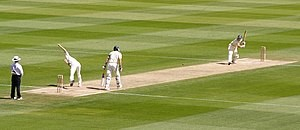
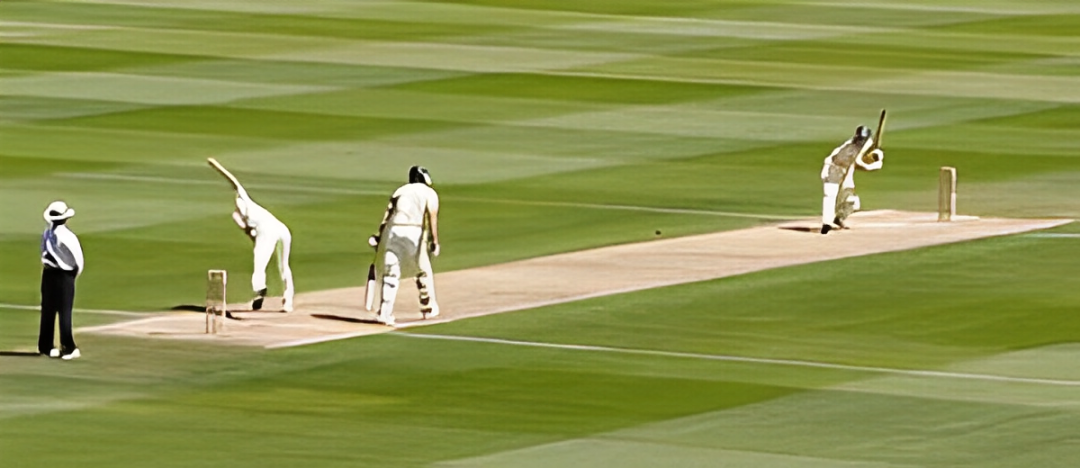
The image below shows a cricket batter facing a fast bowler.

Which skill classification would MOST accurately describe the batter's action in this scenario?

  1. Closed, self-paced, discrete
  2. Open, self-paced, continuous
  3. Closed, externally paced, serial
  4. Open, externally paced, discrete
Show Answers Only

\(D\)

Show Worked Solution
  • D is correct: The batter must adapt to the varying delivery from the bowler (open), the timing is determined by when and how the ball is bowled (externally paced), and the batting stroke has a clear beginning and end (discrete).

Other Options:

  • A is incorrect: Batting occurs in a changing environment due to variations in bowling (open, not closed) and the timing is determined by the bowler’s delivery (externally paced, not self-paced).
  • B is incorrect: Batting involves distinct actions with clear beginning and end points (discrete, not continuous).
  • C is incorrect: The environment is constantly changing based on the bowler’s delivery (open, not closed) and batting is primarily a discrete skill rather than a sequence of movements (not serial).

Filed Under: Characteristics of skills Tagged With: Band 3, smc-5922-70-Combinations

HMS, BM EQ-Bank 558 MC

A gymnast performs a floor routine combining tumbling runs, leaps, and balance elements into a choreographed sequence set to music.

According to the characteristics of motor skills, which row in the table correctly identifies ALL classifications for this activity?

\begin{align*}
\begin{array}{l}
\rule{0pt}{2.5ex} \ \rule[-1ex]{0pt}{0pt}& \\
\rule{0pt}{2.5ex}\textbf{A.}\rule[-1ex]{0pt}{0pt}\\
\rule{0pt}{2.5ex}\textbf{B.}\rule[-1ex]{0pt}{0pt}\\
\rule{0pt}{2.5ex}\textbf{C.}\rule[-1ex]{0pt}{0pt}\\
\rule{0pt}{2.5ex}\textbf{D.}\rule[-1ex]{0pt}{0pt}\\
\end{array}
\begin{array}{|l|l|l|l|}
\hline
\rule{0pt}{2.5ex}\textbf{Muscle Group}\rule[-1ex]{0pt}{0pt}& \textbf{Environment}\rule[-1ex]{0pt}{0pt}& \textbf{Timing}\rule[-1ex]{0pt}{0pt}& \textbf{Movement } \\
\textbf{Size} &  & \textbf{Control} & \textbf{Continuity} \\
\hline
\rule{0pt}{2.5ex}\text{Gross}\rule[-1ex]{0pt}{0pt}&\text{Closed}\rule[-1ex]{0pt}{0pt}&\text{Self-paced}\rule[-1ex]{0pt}{0pt}&\text{Serial}\\
\hline
\rule{0pt}{2.5ex}\text{Gross}\rule[-1ex]{0pt}{0pt}& \text{Open}\rule[-1ex]{0pt}{0pt}&\text{Self-paced}\rule[-1ex]{0pt}{0pt}&\text{Continuous}\\
\hline
\rule{0pt}{2.5ex}\text{Fine}\rule[-1ex]{0pt}{0pt}& \text{Closed}\rule[-1ex]{0pt}{0pt}&\text{Externally Paced}\rule[-1ex]{0pt}{0pt}&\text{Serial} \\
\hline
\rule{0pt}{2.5ex}\text{Fine}\rule[-1ex]{0pt}{0pt}& \text{Open}\rule[-1ex]{0pt}{0pt}&\text{Externally Paced}\rule[-1ex]{0pt}{0pt}&\text{Serial} \\
\hline
\end{array}
\end{align*}

Show Answers Only

\(A\)

Show Worked Solution
  • A is correct: A gymnastics floor routine primarily uses large muscle groups (gross), occurs in a stable environment (closed), the gymnast controls the timing (self-paced), and consists of discrete elements performed in sequence (serial).

Other Options:

  • B is incorrect: The environment in gymnastics floor routines is stable with consistent conditions (closed, not open).
  • C is incorrect: Gymnastics primarily uses large muscle groups (gross, not fine), the gymnast controls timing (self-paced, not externally paced), and consists of discrete elements in sequence (serial, not continuous).
  • D is incorrect: Gymnastics uses large muscle groups (gross, not fine), occurs in a stable environment (closed, not open), and the gymnast controls timing (self-paced, not externally paced).

Filed Under: Characteristics of skills Tagged With: Band 6, smc-5922-70-Combinations

HMS, BM EQ-Bank 557 MC

The table shows characteristics of four different sport skills.

Sport Skill    Environment  Pacing Beginning and End
W Stable Self-determined   Clear start and finish
X Changing External factors  Ongoing with no clear endpoints  
Y Changing Self-determined  Series of connected movements
Z Stable External factors  Clear start and finish

Which sport skill would BEST exemplify classification W?

  1. Returning a serve in tennis
  2. Rugby lineout throw
  3. Free throw in basketball
  4. Freestyle swimming in a race
Show Answers Only

\(C\)

Show Worked Solution
  • C is correct: Performed in a stable environment (closed), the player controls when to shoot (self-paced), and the action has a clear beginning and end (discrete).

Other Options:

  • A is incorrect: Returning a serve is externally paced (timing determined by opponent’s serve) and occurs in a changing environment (open).
  • B is incorrect: While a lineout throw has a clear beginning and end, the environment includes opponents and timing is influenced by referee whistles (not fully self-determined).
  • D is incorrect: Freestyle swimming is a continuous skill without clear beginning and end points during execution.

Filed Under: Characteristics of skills Tagged With: Band 5, smc-5922-70-Combinations

HMS, BM EQ-Bank 556 MC

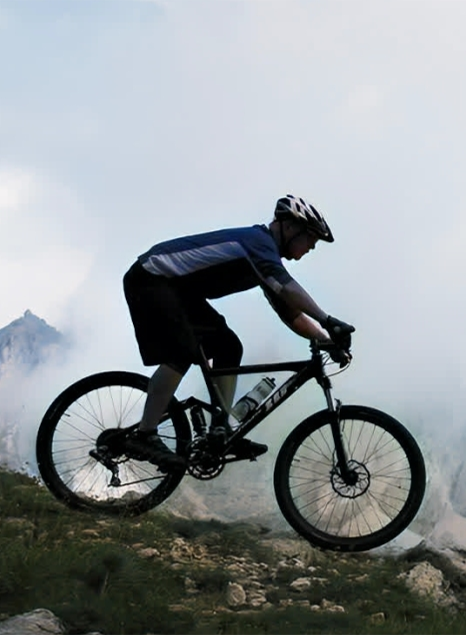
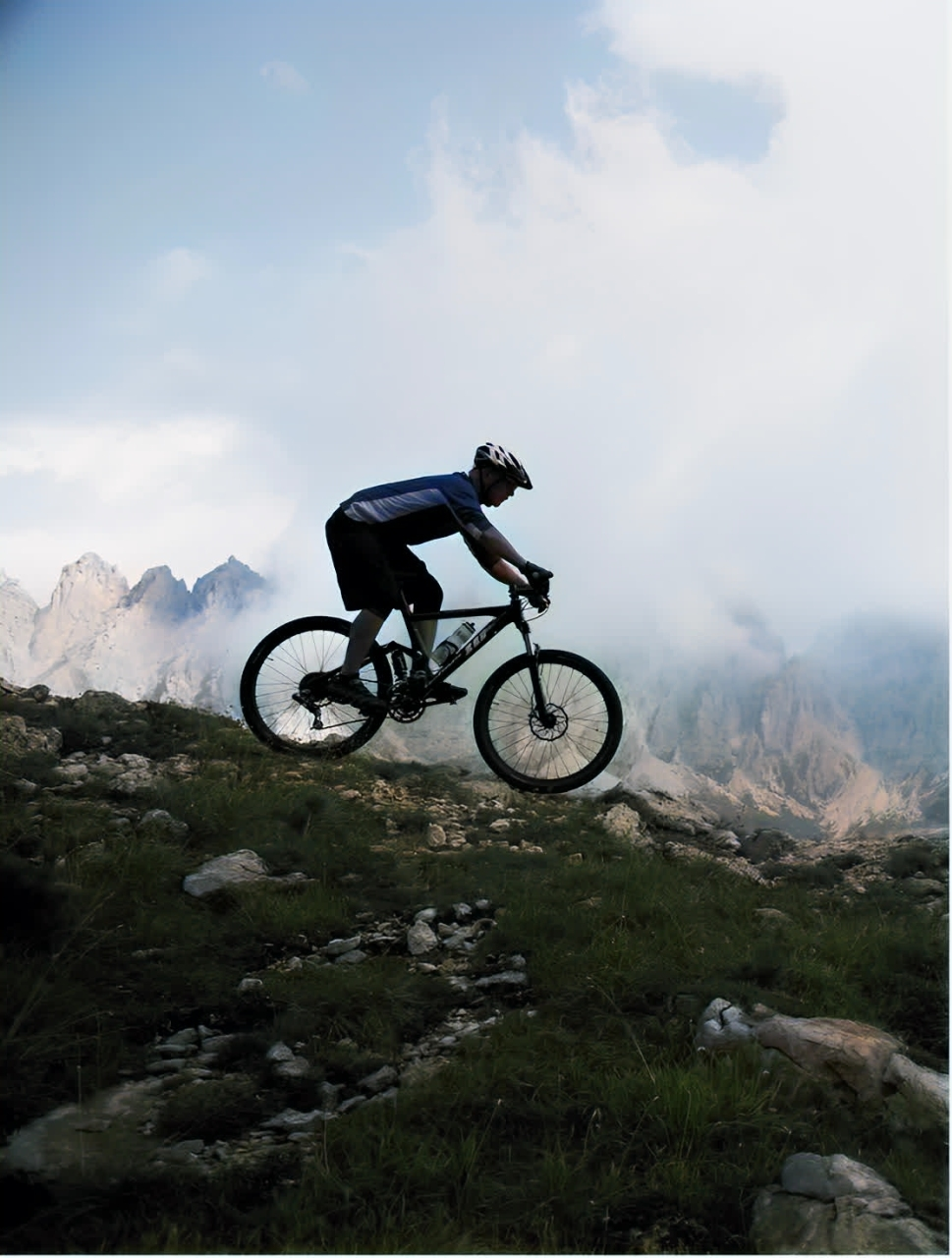
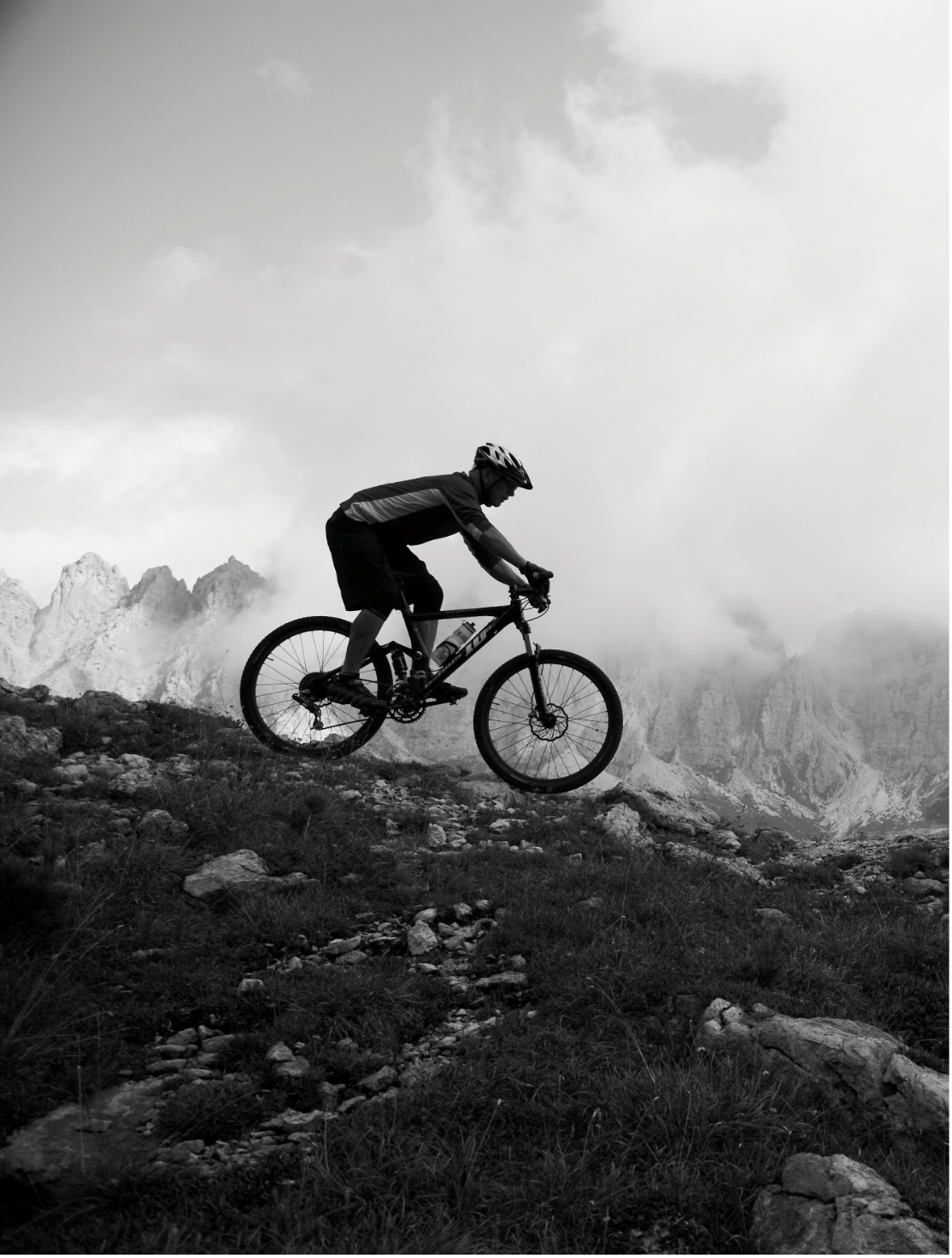
The image below shows a mountain bike rider navigating a rocky downhill trail.

Based on this activity, which classification is MOST accurate for this skill?

  1. Open, externally paced, continuous
  2. Open, self-paced, continuous
  3. Closed, externally paced, serial
  4. Closed, self-paced, serial
Show Answers Only

\(A\)

Show Worked Solution
  • A is correct: Mountain biking on a rocky trail occurs in an unstable environment that requires constant adaptation (open), the timing is influenced by the terrain features (externally paced), and the riding motion consists of ongoing adjustments without clear beginning or end points (continuous).

Other Options:

  • B is incorrect: While mountain biking is open and continuous, the timing of movements is dictated by approaching terrain features rather than being fully controlled by the rider (externally paced, not self-paced).
  • C is incorrect: The environment is unstable (open, not closed), and the skill involves ongoing movements rather than a sequence of discrete skills (continuous, not serial).
  • D is incorrect: The environment is unstable (open, not closed), and the skill does not consist of discrete elements combined in sequence (continuous, not serial).

Filed Under: Characteristics of skills Tagged With: Band 4, smc-5922-70-Combinations

HMS, BM EQ-Bank 555 MC

A netball player catches the ball, pivots, and passes to a teammate during a match.

Which of the following best describes this skill according to motor characteristics?

  1. Fine motor, closed, self-paced
  2. Gross motor, open, externally paced
  3. Fine motor, open, externally paced
  4. Gross motor, closed, self-paced
Show Answers Only

\(B\)

Show Worked Solution
  • B is correct: Catching, pivoting and passing involves large muscle groups (gross motor), occurs in a changing environment with defenders (open), and timing is influenced by opponents’ positions and movements (externally paced).

Other Options:

  • A is incorrect: Netball passing primarily uses large muscle groups (gross motor, not fine motor) and occurs in a changing environment (open, not closed).
  • C is incorrect: Netball passing primarily uses large muscle groups (gross motor, not fine motor).
  • D is incorrect: Netball passing occurs in a changing environment (open, not closed) and timing is influenced by game conditions (externally paced, not self-paced).

Filed Under: Characteristics of skills Tagged With: Band 3, smc-5922-70-Combinations

Copyright © 2014–2025 SmarterEd.com.au · Log in