SmarterEd

Aussie Maths & Science Teachers: Save your time with SmarterEd

  • Login
  • Get Help
  • About

Displaying Data, SM-Bank 043

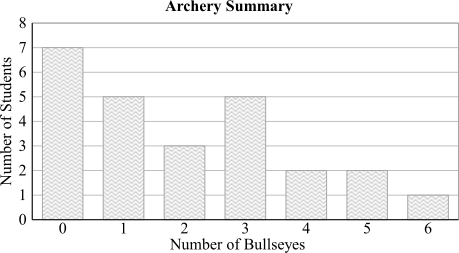
While working at the Year 7 camp, Gene counted how many bullseyes the archery group achieved during the afternoon activity.

He summarised the data in the table below.
  

\begin{array} {|l|c|c|c|c||}
\hline
\rule{0pt}{2.5ex} \textbf{Number of Bullseyes} \rule[-1ex]{0pt}{0pt} & \  0\   &  \  1\   & \  2\   & \  3\   & \  4\   & \  5\   & \  6  \\
\hline
\rule{0pt}{2.5ex} \textbf{Number of Students} \rule[-1ex]{0pt}{0pt} &7 &5&3&5&2&2&1 \\
\hline
\end{array}

  1. How many students were in the afternoon session of archery?  (1 mark)

    --- 3 WORK AREA LINES (style=lined) ---

  2. How many students scored zero bullseyes?  (1 mark)

    --- 1 WORK AREA LINES (style=lined) ---

  3. Assuming all shots were bullseye attempts, how many shots at the bullseye were made?  (1 mark)

    --- 2 WORK AREA LINES (style=lined) ---

  4. Display this data in a vertical column graph using the grid below.  (2 marks)
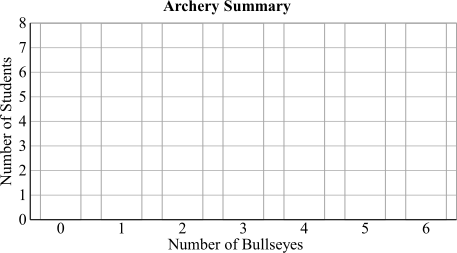
     

    --- 0 WORK AREA LINES (style=lined) ---

Show Answers Only

a.    \(25\)

b.    \(7\)

c.    \(57\)

d.   

Show Worked Solution

a.    \(\text{Number of students} = 25\)

b.    \(\text{Zero bullseyes} = 7\)

c.   
\(\text{Total shots at bullseye}\) \(=7+5\times 1+3\times 2+5\times 3+2\times 4+2\times 5+1\times 6\)
    \(=57\)

\(\text{NOTE:  The question asks for total shots NOT total value of shots,}\)

\(\text{therefore, the 7 who score 0 bullseyes must be added in.}\)

d.
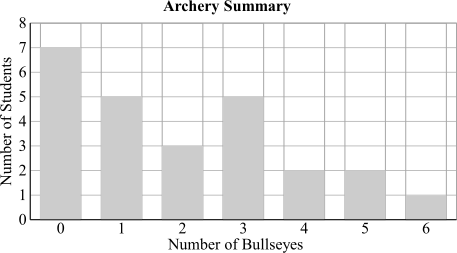
Filed Under: Displaying Data Tagged With: num-title-ct-core, smc-5076-10-Column graphs and histograms

Displaying Data, SM-Bank 042

The marks below were recorded by Ms Smith for her students in a recent statistics quiz. The highest possible score was 5.
 

\(3,\ 1,\ 5,\ 2,\ 1,\ 3,\ 4,\ 1,\ 4,\ 2,\ 4,\ 5,\ 3,\ 4,\ 2,\ 4,\ 3,\ 0,\ 5,\ 1,\ 4\)
 

  1. Summarise the data using the table below.  (1 mark)
    \begin{array} {|l|c|c|c|c||}
    \hline
    \rule{0pt}{2.5ex} \textbf{Score} \rule[-1ex]{0pt}{0pt} & \  0\   &  \  1\   & \  2\   & \  3\   & \  4\   & \  5\   \\
    \hline
    \rule{0pt}{2.5ex} \textbf{Number of Students} \rule[-1ex]{0pt}{0pt} & &&&&& \\
    \hline
    \end{array}

    --- 0 WORK AREA LINES (style=lined) ---

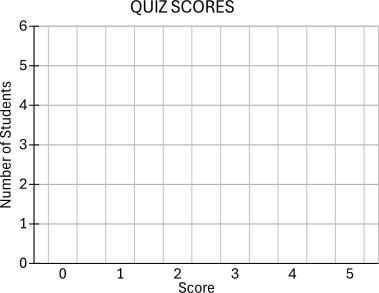
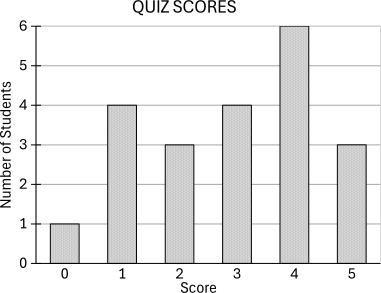
  2. Represent this data as a column graph using the grid below.  (2 marks)


    --- 0 WORK AREA LINES (style=lined) ---

  3. How many students sat for the quiz?  (1 mark)

    --- 1 WORK AREA LINES (style=lined) ---

  4. If the pass mark was 60%, how many students passed the quiz?  ( 1 mark)

    --- 1 WORK AREA LINES (style=lined) ---

  5. What was the average score achieved in the quiz? Give your answer correct to one decimal place.  (1 mark)

    --- 3 WORK AREA LINES (style=lined) ---

Show Answers Only

a.

\begin{array} {|l|c|c|c|c||}
\hline
\rule{0pt}{2.5ex} \textbf{Score} \rule[-1ex]{0pt}{0pt} & 0&1&2&3&4&5 \\
\hline
\rule{0pt}{2.5ex} \textbf{Number of Students} \rule[-1ex]{0pt}{0pt} & 1&4&3&4&6&3 \\
\hline
\end{array}

b.   

c.    \(21\)

d.    \(13\)
e.    \(2.9\)

Show Worked Solution

a.

\begin{array} {|l|c|c|c|c||}
\hline
\rule{0pt}{2.5ex} \textbf{Score} \rule[-1ex]{0pt}{0pt} & 0&1&2&3&4&5 \\
\hline
\rule{0pt}{2.5ex} \textbf{Number of Students} \rule[-1ex]{0pt}{0pt} & 1&4&3&4&6&3 \\
\hline
\end{array}

b.   


c.    \(21\)


d.    \(60\%\ \text{pass mark}\) \(=5\times \dfrac{60}{100}\)
    \(=3\)

 
\(\therefore\ 4+6+3 = 13\ \text{students passed the quiz}\)


e.    \(\text{Average score}\) \(=\dfrac{1\times 0+4\times 1+3\times 2+4\times 3+6\times 4+3\times 5}{21}\)
    \(=\dfrac{61}{21}\)
    \(=2.904\dots\approx 2.9\ \text{(1 d.p.)}\)

Filed Under: Displaying Data Tagged With: num-title-ct-core, smc-5076-10-Column graphs and histograms

Displaying Data, SM-Bank 041

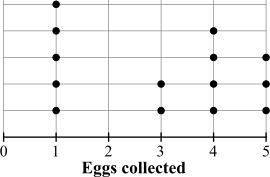
Stuart collected the eggs from his free range chickens and recorded the number of eggs he collected each day for two weeks.
 

\(3,\ 1,\ 5,\ 5,\ 1,\ 3,\ 4,\ 1,\ 4,\ 1,\ 4,\ 5,\ 1,\ 4\)
 

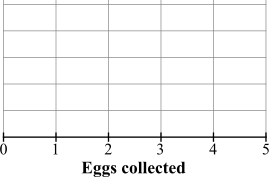
  1. Represent this data as a dot plot using the grid below.  (2 marks)
     

    --- 0 WORK AREA LINES (style=lined) ---

  2. How many eggs were collected altogether?  ( 1 mark)

    --- 1 WORK AREA LINES (style=lined) ---

  3. What is the average number of eggs Stuart collected?  (1 mark)

    --- 3 WORK AREA LINES (style=lined) ---

Show Answers Only

a.

b.    \(42\)  

c.    \(3\)

Show Worked Solution

a.


b.    \(\text{Total eggs}\) \(=5\times 1+2\times 3+4\times 4+3\times 5\)
    \(=42\)


c.    \(\text{Average number of eggs}\) \(=\dfrac{42}{14}\)
    \(=3\)

Filed Under: Displaying Data Tagged With: num-title-ct-core, smc-5076-18-Dot plots

Displaying Data, SM-Bank 040

The heights, in centimetres, of David's hockey side are as follows:
 

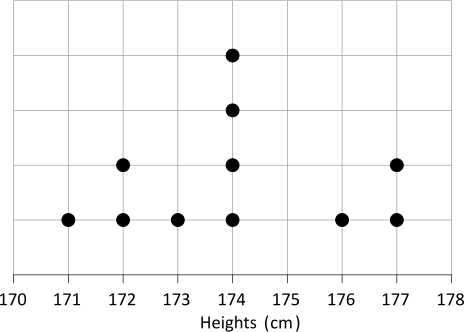
\(172,\ 177,\ 171,\ 174,\ 174,\ 176,\ 173,\ 177,\ 174,\ 172,\ 174\)
 

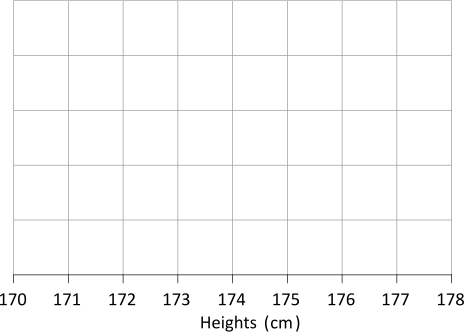
  1. Represent this data as a dot plot using the grid below.  (2 marks)
     

    --- 0 WORK AREA LINES (style=lined) ---

  2. What is the average height of the players in David's hockey team?  (2 marks)

    --- 3 WORK AREA LINES (style=lined) ---

Show Answers Only

a.

b.    \(174\ \text{cm}\)

Show Worked Solution

a.


b.    \(\text{Average height}\) \(=\dfrac{171+2\times 172+173+4\times 174+176+2\times 177}{11}\)
    \(=\dfrac{1914}{11}\)
    \(=174\ \text{cm}\)

Filed Under: Displaying Data Tagged With: num-title-ct-core, smc-5076-18-Dot plots

Displaying Data, SM-Bank 039 MC

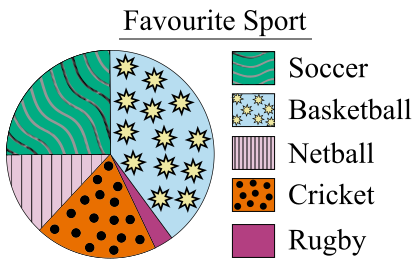
Joseph asked children in his class what their favourite sport was.

Their answers were used to draw the sector graph below.


Around a quarter of the students preferred which sport?

  1. Netball
  2. Soccer
  3. Cricket
  4. Basketball
Show Answers Only

\(B\)

Show Worked Solution

\(\text{Soccer represents one quarter of the graph.}\)

\(\Rightarrow B\)

Filed Under: Displaying Data Tagged With: num-title-ct-core, smc-5076-15-Sector graphs and Divided Bar graphs

Displaying Data, SM-Bank 038 MC

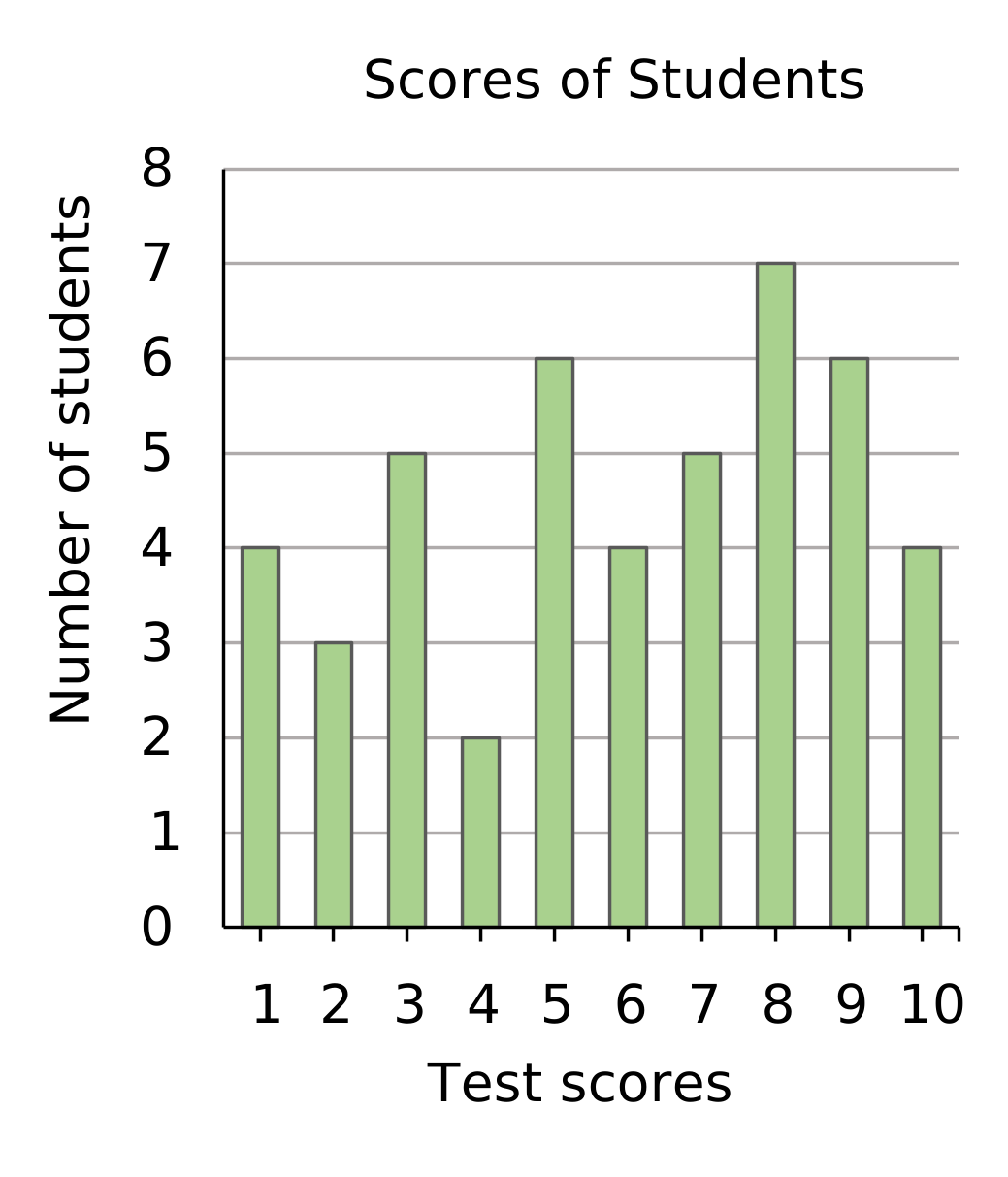
The results of a reading test are shown in the graph below.

If the test was out of 10, how many students scored 70% or more?

  1. 22
  2. 17
  3. 10
  4. 5
Show Answers Only

\(A\)

Show Worked Solution
\(70\%\ \text{of total}\) \(=70\%\times 10\)
  \(=7\)


\(\text{Number who scored 7, 8, 9 or 10}\) \(=5+7+6+4\)
  \(=22\)

\(\Rightarrow A\)

Filed Under: Displaying Data Tagged With: num-title-ct-core, smc-5076-10-Column graphs and histograms

Displaying Data, SM-Bank 037 MC

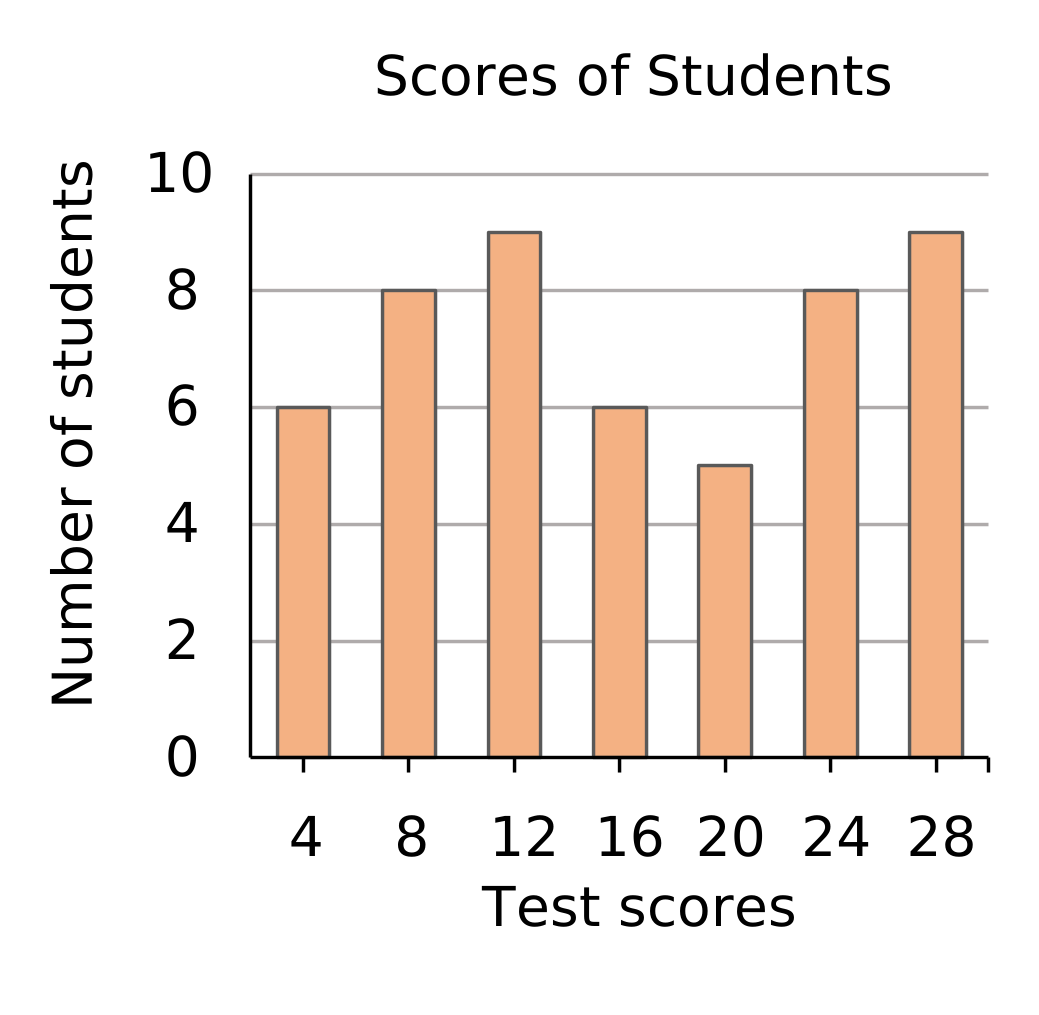
The results of a mathematics test are shown in the graph below.

If the test was out of 30, how many students scored less than 50%?

  1. 3
  2. 20
  3. 23
  4. 29
Show Answers Only

\(C\)

Show Worked Solution
\(50\%\ \text{of total}\) \(=50\%\times 30\)
  \(=15\)


\(\text{Number who scored less than 15}\) \(=6+8+9\)
  \(=23\)

\(\Rightarrow C\)

Filed Under: Displaying Data Tagged With: num-title-ct-core, smc-5076-10-Column graphs and histograms

Displaying Data, SM-Bank 036 MC

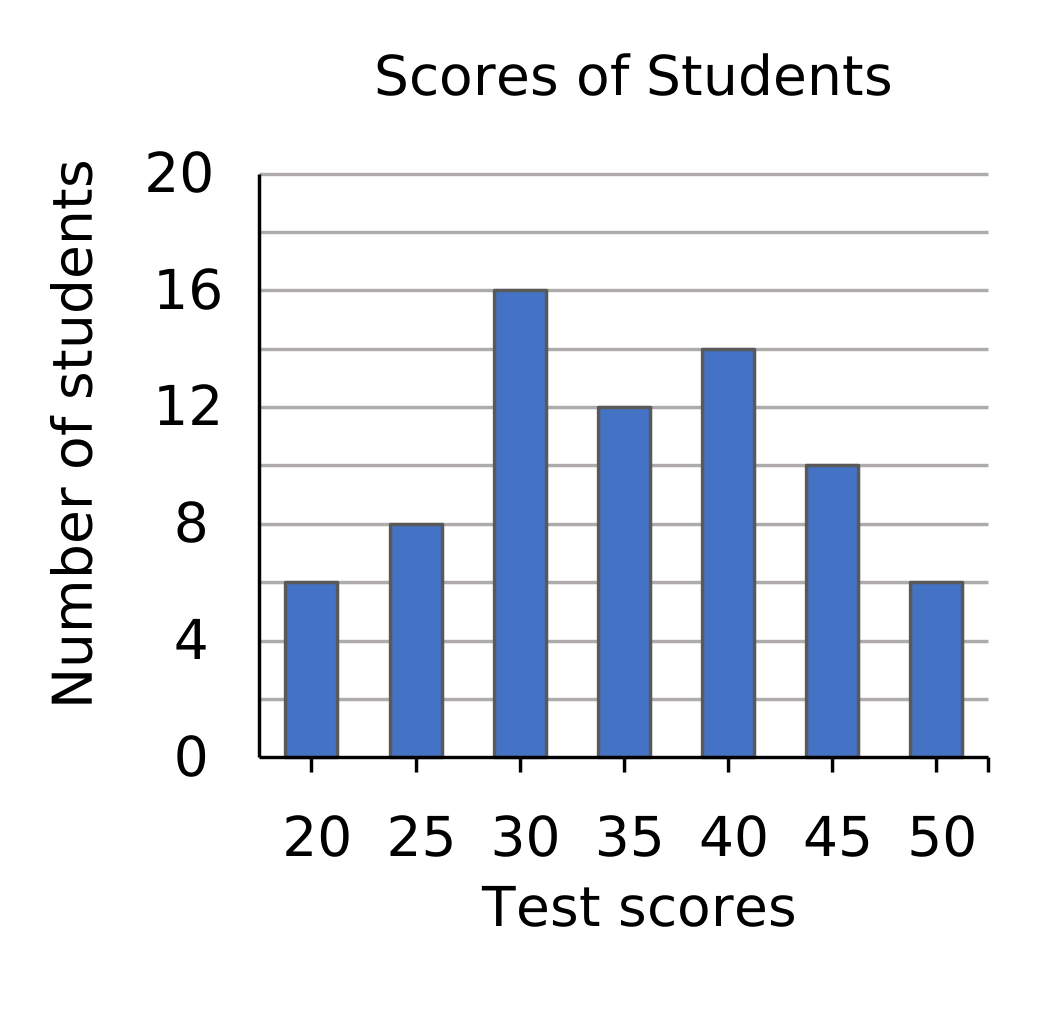
The results of a spelling quiz are shown in the graph below.

How many students scored 35 or more?

  1. 4
  2. 14
  3. 30
  4. 42
Show Answers Only

\(D\)

Show Worked Solution
\(\text{Number of students who scored 35 or more}\) \(=12+14+10+6\)
  \(=42\)

 
\(\Rightarrow D\)

Filed Under: Displaying Data Tagged With: num-title-ct-core, smc-5076-10-Column graphs and histograms

Displaying Data, SM-Bank 035

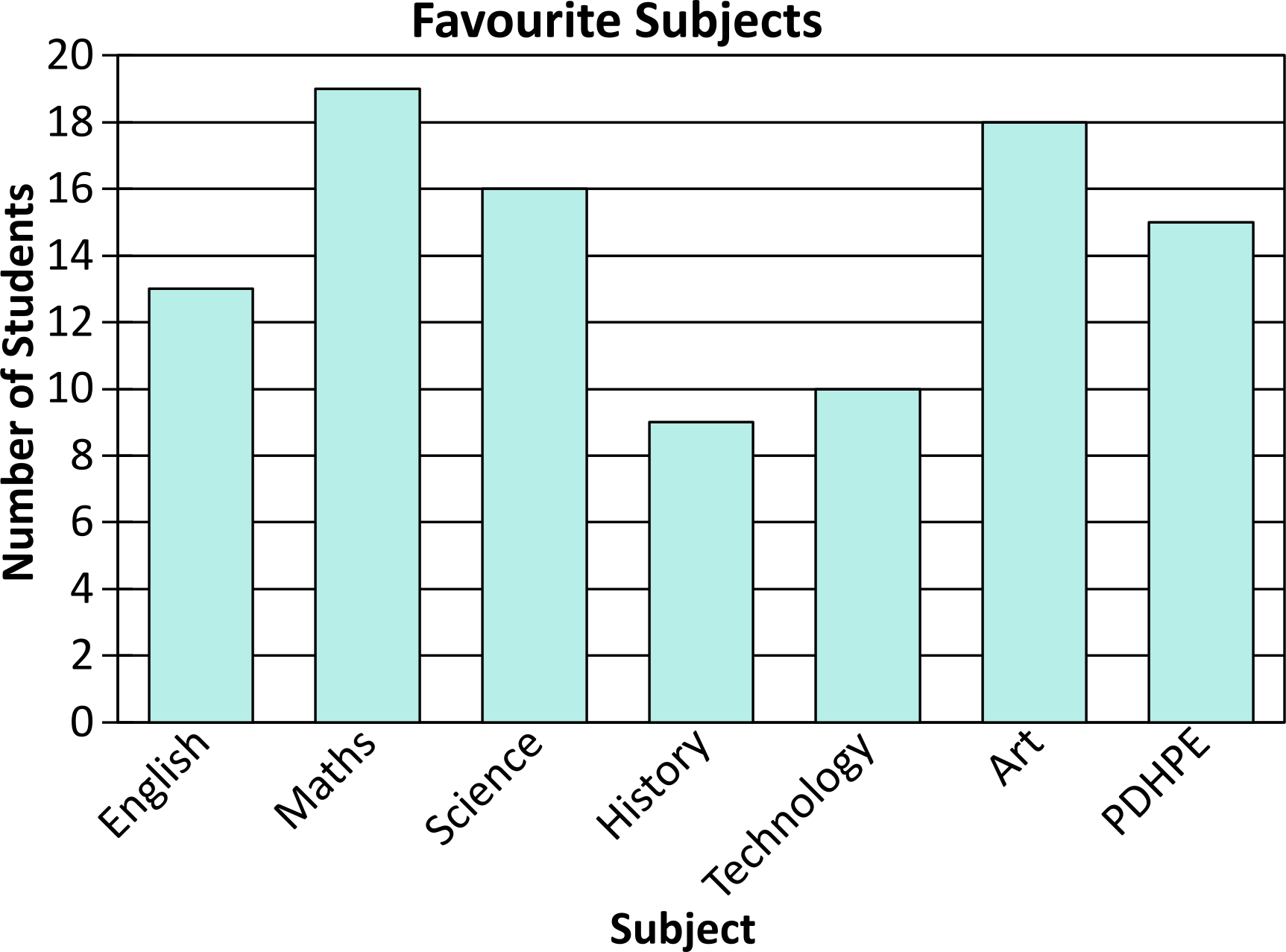
The graph below shows the favourite subjects of a group of 100 students.


  1. How many students in total chose either Technology or English as their favourite subject?  (1 mark)

    --- 2 WORK AREA LINES (style=lined) ---

  2. What percentage of students preferred either Science or PDHPE?  (2 marks)

    --- 3 WORK AREA LINES (style=lined) ---

  3. How many more students chose Maths as their favourite subject than History?  (1 mark)

    --- 2 WORK AREA LINES (style=lined) ---

Show Answers Only

a.    \(23\ \text{students}\)

b.    \(31\%\)

c.    \(10\ \text{students}\)

Show Worked Solution
a.     \(\text{Technology or English}\) \(=10+13\)
    \(=23\ \text{students}\)


b.     \(\text{Percentage Science or PDHPE}\) \(=\dfrac{16+15}{100}\times 100%\)
    \(=31\%\)


c.     \(\text{Difference}\) \(=19-9\)
    \(=10\ \text{students}\)

Filed Under: Displaying Data Tagged With: num-title-ct-core, smc-5076-10-Column graphs and histograms

Displaying Data, SM-Bank 034

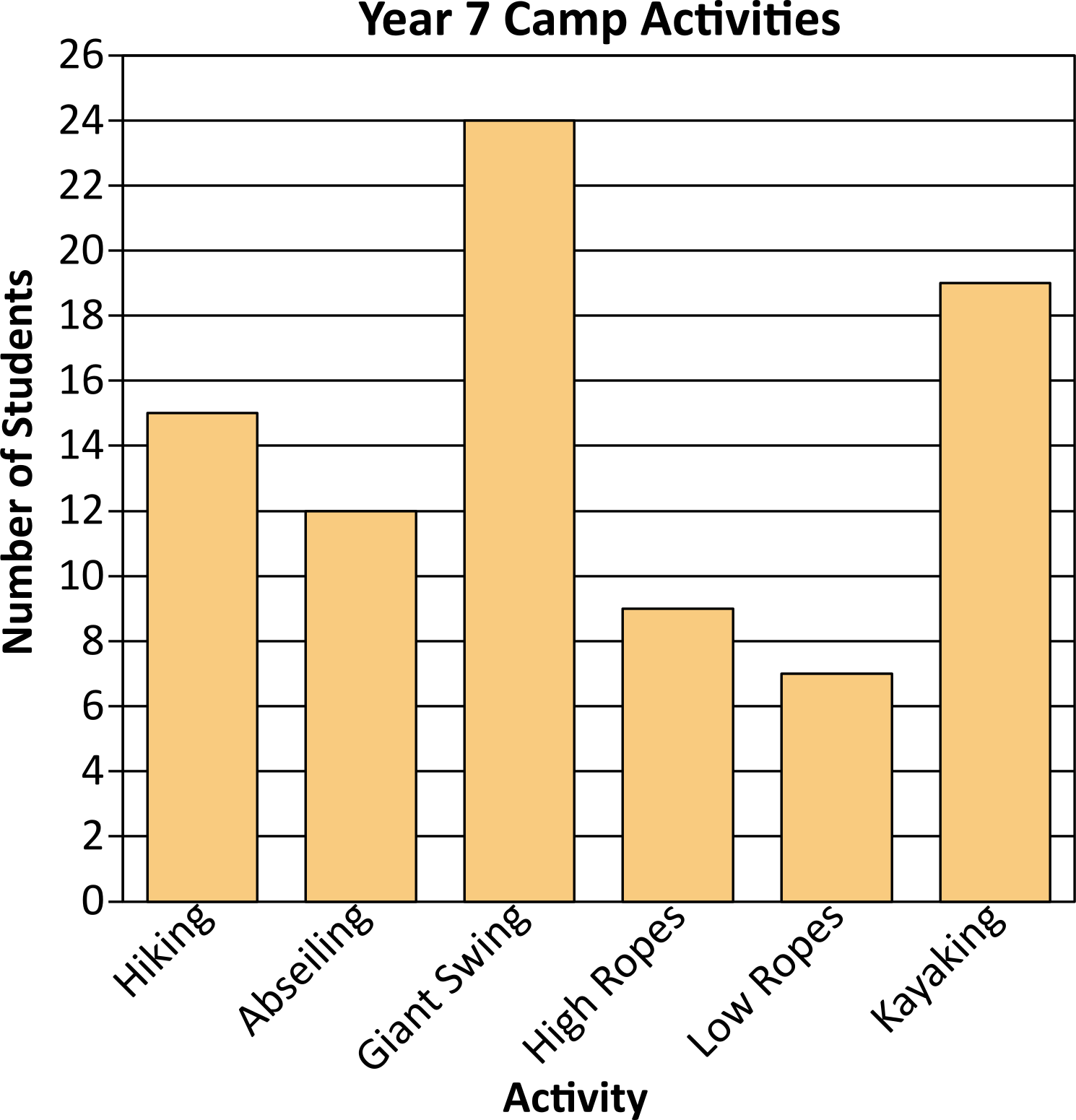
The graph below shows the outdoor activities chosen by students at the Year 7 camp.


  1. How many students in total chose either high ropes or abseiling?  (1 mark)

    --- 2 WORK AREA LINES (style=lined) ---

  2. What was the average number of students participating in each of the activities? Give your answer correct to the nearest whole number.  (2 marks)

    --- 3 WORK AREA LINES (style=lined) ---

  3. How many more students chose the Giant Swing than Hiking? (1 mark)

    --- 2 WORK AREA LINES (style=lined) ---

Show Answers Only

a.   \(21\ \text{students}\)

b.   \(14\ \text{students (nearest whole number)}\)

c.    \(9\ \text{students}\)

Show Worked Solution
a.     \(\text{High ropes and abseiling}\) \(=9+12\)
    \(=21\ \text{students}\)


b.     \(\text{Average students/activity}\) \(=\dfrac{15+12+24+9+7+19}{6}\)
    \(=\dfrac{86}{6}\)
    \(=14.333\dots\)
    \(=14\ \text{students (nearest whole number)}\)


c.     \(\text{Difference}\) \(=24-15\)
    \(=9\ \text{students}\)

Filed Under: Displaying Data Tagged With: num-title-ct-core, smc-5076-10-Column graphs and histograms

Displaying Data, SM-Bank 033

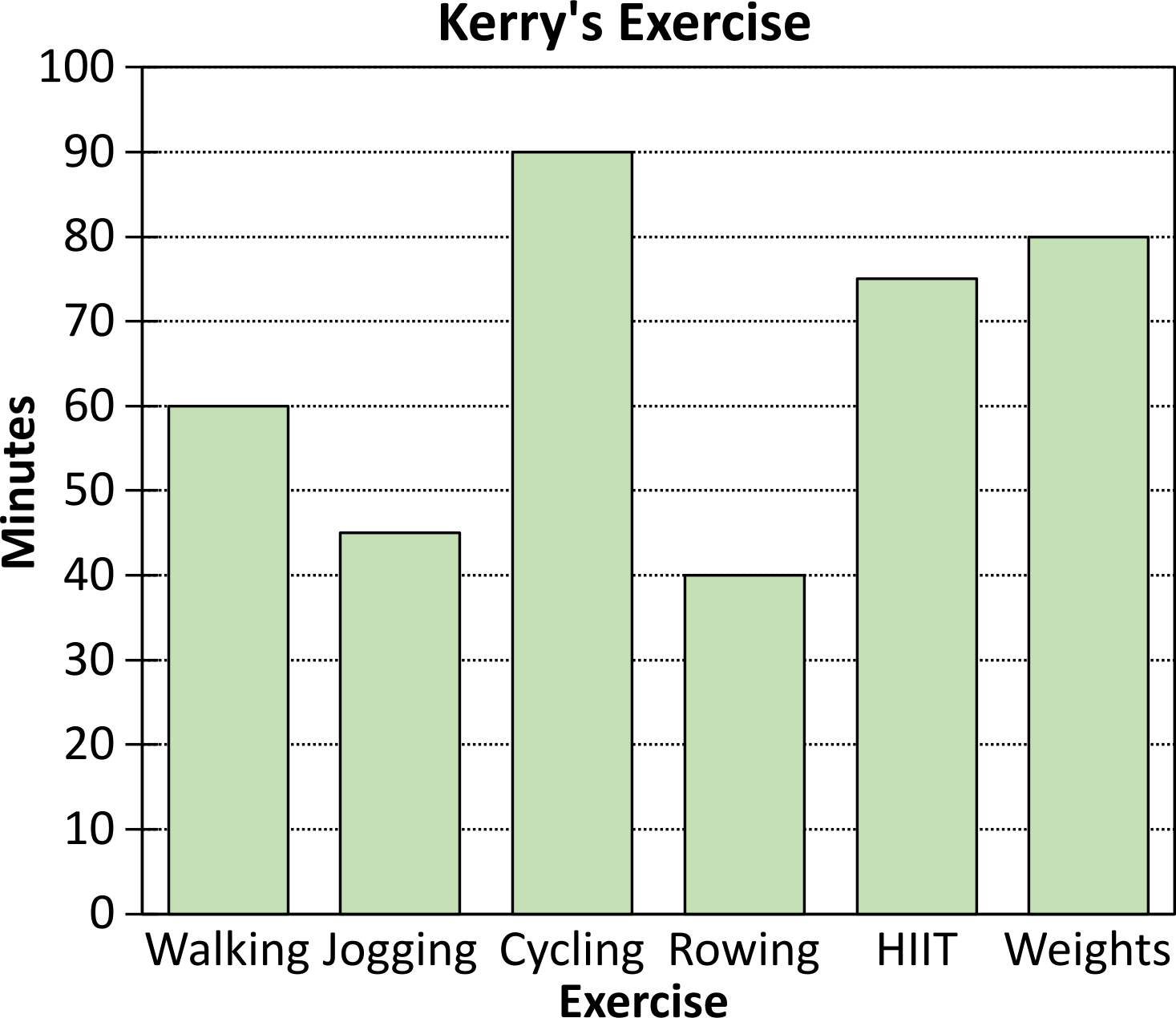
The graph below shows the times Kerry spent, in minutes, performing different exercises at the gym over the last fortnight.


  1. How many minutes in total did Kerry spend cycling and walking? (1 mark)

    --- 2 WORK AREA LINES (style=lined) ---

  2. What was the average time per day that Kerry spent exercising over the last fortnight? Give your answer correct to the nearest minute.  (2 marks)

    --- 3 WORK AREA LINES (style=lined) ---

  3. How many more minutes did Kerry spend doing HIIT than rowing?  (1 mark)

    --- 2 WORK AREA LINES (style=lined) ---

Show Answers Only

a.   \(\text{150 minutes}\)

b.   \(28\text{ minutes (nearest minute)}\)

c.    \(35\text{ minutes}\)

Show Worked Solution
a.     \(\text{Cycling and walking}\) \(=90+60\)
    \(=150\ \text{minutes}\)


b.     \(\text{Average exercise minutes/day}\) \(=\dfrac{60+45+90+40+75+80}{14}\)
    \(=\dfrac{390}{14}\)
    \(=27.857\dots\)
    \(=28\text{ minutes (nearest minute)}\)


c.     \(\text{Difference}\) \(=75-40\)
    \(=35\ \text{minutes}\)

Filed Under: Displaying Data Tagged With: num-title-ct-core, smc-5076-10-Column graphs and histograms

Displaying Data, SM-Bank 032

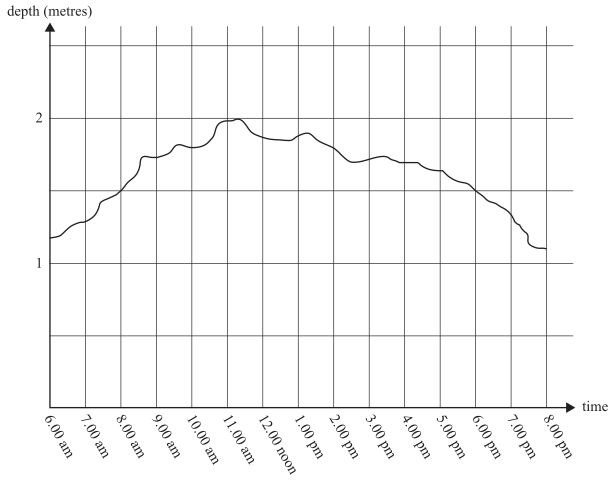
The graph below shows the depth of water in a sea bath from 6.00 am to 8.00 pm.


  1. What was the maximum depth, in metres, of water in the sea bath?  (1 mark)

    --- 1 WORK AREA LINES (style=lined) ---

  2. The sea bath was open to the public when the depth of water was above 1.5 m.


    Between which times was the sea bath open?  (1 mark)

    --- 1 WORK AREA LINES (style=lined) ---


Show Answers Only

a.   \(\text{2 metres}\)

b.   \(\text{8 am – 6 pm}\)

Show Worked Solution

a.   \(\text{2 metres}\)

b.   \(\text{8 am – 6 pm}\)

Filed Under: Displaying Data Tagged With: num-title-ct-core, smc-5076-12-Line Graphs

Displaying Data, SM-Bank 031

  1. Draw an ordered stem-and-leaf plot for the following set of scores.
     
    \(51\ \ \ \ \ 56\ \ \ \ \ 58\ \ \ \ \ 36\ \ \ \ \ 28\ \ \ \ \ 45\ \ \ \ \ 53\ \ \ \ \ 69\ \ \ \ \ 47\ \ \ \ \ 52\)     (2 marks)

    --- 6 WORK AREA LINES (style=blank) ---

  2. What is the median of the set of scores?   (1 mark)

    --- 2 WORK AREA LINES (style=lined) ---

  3. Comment on the skewness of the set of scores.   (1 mark)

    --- 2 WORK AREA LINES (style=lined) ---

Show Answers Only
a.    \begin{array} {r|lll} \textbf{Stem} & \textbf{Leaf} \\ \hline 2 & 8 \\ 3 & 6 \ \\ 4 & 5\ 7\\ 5 & 1\ 2\ 3\ 6 \ 8 \\ 6 & 9 \\ \end{array}

b.    \(51.5\)

c.    \(\text{The data has a tail that stretches to the left}\)

\(\therefore\ \text{Data is negatively skewed.}\)

Show Worked Solution
a.    \begin{array} {r|lll} \textbf{Stem} & \textbf{Leaf} \\ \hline 2 & 8 \\ 3 & 6 \ \\ 4 & 5\ 7\\ 5 & 1\ 2\ 3\ 6 \ 8 \\ 6 & 9 \\ \end{array}


b.    \(\text{10 scores}\)

\(\therefore\ \text{Median}\) \(=\dfrac{\text{(5th + 6th)}}{2}\)
  \(=\dfrac{51 + 52}{2}\)
  \(=51.5\)


c.    \(\text{The data has a tail that stretches to the left}\)

\(\therefore\ \text{Data is negatively skewed.}\)

Filed Under: Displaying Data Tagged With: num-title-ct-core, smc-5076-20-Stem and Leaf

Displaying Data, SM-Bank 030

A random sample of people were asked what is their favourite winter sport.

The table below recorded the results.

\begin{array} {|l|c|}
\hline
\rule{0pt}{2.5ex} \textbf{Sport} \rule[-1ex]{0pt}{0pt} & \textbf{Number of People} \\
\hline
\rule{0pt}{2.5ex} \text{Netball} \rule[-1ex]{0pt}{0pt} & \text{25} \\
\hline
\rule{0pt}{2.5ex} \text{Aussie Rules} \rule[-1ex]{0pt}{0pt} & \text{35} \\
\hline
\rule{0pt}{2.5ex} \text{Rugby League} \rule[-1ex]{0pt}{0pt} & \text{30} \\
\hline
\rule{0pt}{2.5ex} \text{Ice Hockey} \rule[-1ex]{0pt}{0pt} & \text{10} \\
\hline
\end{array}

  1. Use the information in the table to construct a divided bar graph on the template below. Remember to include a title and labels.  (2 marks)


  2. Using the data from the survey, predict how many people would choose Aussie Rules if 2000 people were surveyed. (2 marks)

    --- 2 WORK AREA LINES (style=lined) ---

Show Answers Only

a. 

b.    \(700\)

Show Worked Solution
 

a.    \(\text{Total Number Sampled}\) \(=25+35+30+10\)
    \(=100\)

 
\(\text{Division on the template}=\dfrac{100}{20}=5\ \text{people}\)

b.    \(\text{Aussie rules}\) \(=\dfrac{35}{100}\times 2000\)
    \(=700\)

 
\(\therefore\ \text{700 people would be predicted to choose Aussie Rules}\)

Filed Under: Displaying Data Tagged With: num-title-ct-core, smc-5076-15-Sector graphs and Divided Bar graphs

Displaying Data, SM-Bank 029

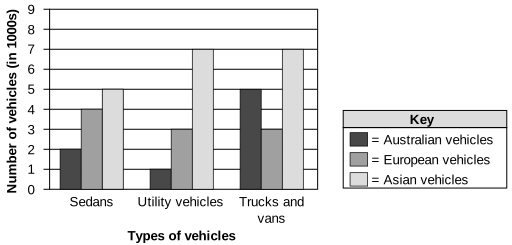
The graph shows the origin and type of all vehicles in a city.
 

  1.  Complete the table below using the graph.  (2 marks)
    \begin{array} {|l|c|c|c|}
    \hline
    \rule{0pt}{2.5ex} \ \rule[-1ex]{0pt}{0pt} &\ \ \ \ \ \ \  \textbf{Sedans}\ \ \ \ \ \ \  \rule[-1ex]{0pt}{0pt} & \textbf{Utility vehicles}\rule[-1ex]{0pt}{0pt} & \textbf{Trucks and vans}\\
    \hline
    \rule{0pt}{2.5ex} \textbf{Australian vehicles} \rule[-1ex]{0pt}{0pt} & \\
    \hline
    \rule{0pt}{2.5ex} \textbf{European vehicles} \rule[-1ex]{0pt}{0pt} &  \\
    \hline
    \rule{0pt}{2.5ex} \textbf{Asian vehicles} \rule[-1ex]{0pt}{0pt} &\\
    \hline
    \end{array}
  2. What was the total number of Asian vehicles in the city?  (1 mark)

    --- 2 WORK AREA LINES (style=lined) ---

  3. What was the total number of Trucks and vans in the city?  (1 mark)

    --- 2 WORK AREA LINES (style=lined) ---

  4. What percentage of all vehicles in the city were Australian vehicles? Give your answer correct to 1 decimal place.  (2 marks)

    --- 3 WORK AREA LINES (style=lined) ---

Show Answers Only

a.

\begin{array} {|l|c|c|c|}
\hline
\rule{0pt}{2.5ex} \ \rule[-1ex]{0pt}{0pt} &\ \ \ \ \ \ \  \textbf{Sedans}\ \ \ \ \ \ \  \rule[-1ex]{0pt}{0pt} & \textbf{Utility vehicles}\rule[-1ex]{0pt}{0pt} & \textbf{Trucks and vans}\\
\hline
\rule{0pt}{2.5ex} \textbf{Australian vehicles} \rule[-1ex]{0pt}{0pt} & 2000 & 1000 & 5000\\
\hline
\rule{0pt}{2.5ex} \textbf{European vehicles} \rule[-1ex]{0pt}{0pt} & 4000 & 3000 & 3000 \\
\hline
\rule{0pt}{2.5ex} \textbf{Asian vehicles} \rule[-1ex]{0pt}{0pt} & 5000 & 7000 & 7000\\
\hline
\end{array}

b.    \(19\ 000\)

c.    \(15\ 000\)

d.    \(21.6\%\)
Show Worked Solution

a.

\begin{array} {|l|c|c|c|}
\hline
\rule{0pt}{2.5ex} \ \rule[-1ex]{0pt}{0pt} &\ \ \ \ \ \ \  \textbf{Sedans}\ \ \ \ \ \ \  \rule[-1ex]{0pt}{0pt} & \textbf{Utility vehicles}\rule[-1ex]{0pt}{0pt} & \textbf{Trucks and vans}\\
\hline
\rule{0pt}{2.5ex} \textbf{Australian vehicles} \rule[-1ex]{0pt}{0pt} & 2000 & 1000 & 5000\\
\hline
\rule{0pt}{2.5ex} \textbf{European vehicles} \rule[-1ex]{0pt}{0pt} & 4000 & 3000 & 3000 \\
\hline
\rule{0pt}{2.5ex} \textbf{Asian vehicles} \rule[-1ex]{0pt}{0pt} & 5000 & 7000 & 7000\\
\hline
\end{array}

b.    \(\text{Total Asian vehicles}\)

\(=5000+7000+7000=19\ 000\)

c.    \(\text{Total Trucks and vans}\)

\(=5000+3000+7000=15\ 000\)

d.    \(\text{% Australian vehicles}\) \(=\Bigg(\dfrac{\text{Total Australian vehicles}}{\text{Total Sedans + Utilities + Trucks and vans}}\Bigg)\times 100\%\)
    \(=\Bigg(\dfrac{2000+1000+5000}{11\ 000+11\ 000+15\ 000}\Bigg)\times 100\%\)
    \(=\dfrac{8000}{37\ 000}\times 100\%\)
    \(=21.621\dots\%\)
    \(\approx 21.6\%\ \text{(1 d.p.)}\)

Filed Under: Displaying Data Tagged With: num-title-ct-core, smc-5076-10-Column graphs and histograms

Displaying Data, SM-Bank 028

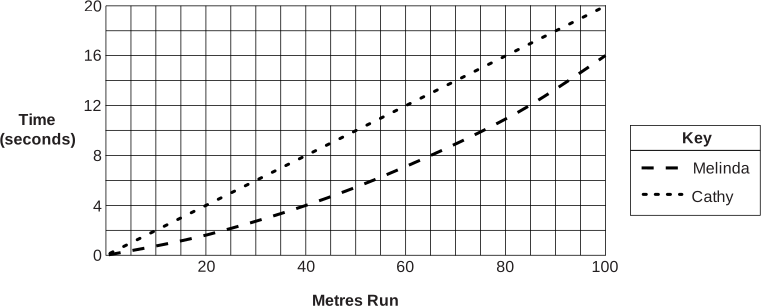
Melinda and Cathy run the 100 metre sprint in their school athletics carnival.

A device tracks their progress and the results are shown in separate line graphs below.


Melinda starts quickly and passes the 75 metre mark after 10 seconds, slowing down as the race progresses.

Cathy is slower but runs the whole race at the same speed.

Approximately how long after Melinda did Cathy pass the 75 metre mark in the race?  (2 marks)

--- 2 WORK AREA LINES (style=lined) ---

Show Answers Only

\(5\ \text{seconds}\)

Show Worked Solution

\(\text{Melinda passes 75 metre mark at 10 seconds.}\)

\(\text{Cathy passes at approximately 15 seconds.}\)

\(\therefore\ \text{Cathy passes approximately 5 seconds after Melinda.}\)

Filed Under: Displaying Data Tagged With: num-title-ct-core, smc-5076-12-Line Graphs

Displaying Data, SM-Bank 027

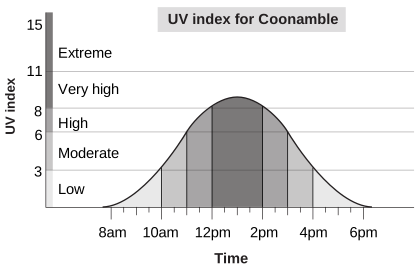
This graph shows the UV index for the town of Coonamble during one day.


Between which hours was the UV index always in the high range?  (1 mark)

--- 1 WORK AREA LINES (style=lined) ---

​

Show Answers Only

\(\text{11 am – 12 pm, 2 pm – 3 pm}\)

Show Worked Solution

\(\text{UV index is on high:}\)

\(\text{between 11 am – 12 pm and between 2 pm – 3 pm}\)

Filed Under: Displaying Data Tagged With: num-title-ct-core, smc-5076-12-Line Graphs

Displaying Data, SM-Bank 026

Tom collected data on the number of big game animals in an African wildlife park.

This graph shows how many big game animals lived in the park.


There were 16 more elephants than rhinos in the wildlife park.

  1. What fraction of the animals were elephants?  (1 mark)

    --- 1 WORK AREA LINES (style=lined) ---

  2. What fraction of the animals were rhinos?  (1 mark)

    --- 1 WORK AREA LINES (style=lined) ---

  3. How many big game animals were in the park in total?  (2 marks)

    --- 3 WORK AREA LINES (style=lined) ---

Show Answers Only

a.    \(\dfrac{7}{20}\)

b.    \(\dfrac{3}{20}\)

c.    \(80\)

Show Worked Solution

a.    \(\text{There are 20 divisions on the sector graph}\)

\(\text{Elephants}=\dfrac{7}{20}\)

b.    \(\text{Rhinos}=\dfrac{3}{20}\)

c.    \(\text{Let}\ \ n =\ \text{total big games animals in the park}\)

\(\text{Elephants – Rhinos}\) \(=16\)
\(\dfrac{7}{20} n-\dfrac{3}{20}n\) \(=16\)
\(\dfrac{4}{20}n\) \(=16\)
\(n\) \(=\dfrac{16\times 20}{4}\)
  \(= 80\)

 
\(\therefore\ \text{There are 80 big game animals in the park}\)

Filed Under: Displaying Data Tagged With: num-title-ct-core, smc-5076-15-Sector graphs and Divided Bar graphs

Displaying Data, SM-Bank 025

Bradley's class were asked to choose their favourite colour among four choices.

  • 5 voted for red which represented 90° on the sector graph
  • 2 voted for orange
  • 6 voted for blue
  • The rest voted for green


How many students in Bradley's class chose green?  (2 marks)

--- 3 WORK AREA LINES (style=lined) ---

Show Answers Only

`7`

Show Worked Solution

\(\text{Since red is 90° it is one-quarter of the sector graph}\)

\(\rightarrow\ \text{There are 20 students in Bradley’s class.}\)

\(\therefore\ \text{Votes for green}\)

\(=20-(5+2+6)\)

\(=7\)

Filed Under: Displaying Data Tagged With: num-title-ct-core, smc-5076-15-Sector graphs and Divided Bar graphs

Displaying Data, SM-Bank 024

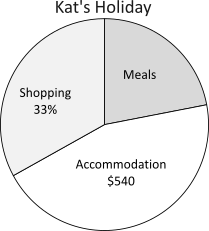
Kat went on her annual holiday and spent her money on accommodation, meals and shopping.

She spent $1200 in total and the pie chart below shows how she spent it.


  1. How much money did Kat spend on shopping?  (2 marks)

    --- 3 WORK AREA LINES (style=lined) ---

  2. How much money did Kat spend on meals?  (2 marks)

    --- 4 WORK AREA LINES (style=lined) ---

Show Answers Only

a.    \($396\)

b.    \($264\)

Show Worked Solution

a.    \(\text{Money spent on shopping}\)

\(=33\%\times 1200\)

\(=$396\)

 
b.    \(\text{Money spent on meals}\)

\(=1200-(540+396)\)

\(=$264\)

Filed Under: Displaying Data Tagged With: num-title-ct-core, smc-5076-15-Sector graphs and Divided Bar graphs

Displaying Data, SM-Bank 023 MC

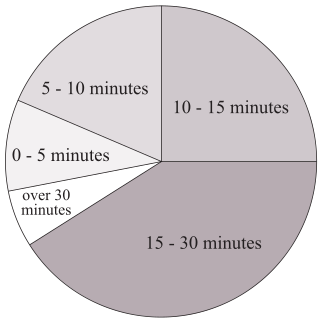
A survey was conducted that asked students how long it took them to travel to school. This graph show the results.


What percentage of students had a commute between \(15-30\) minutes?

  1. less that 25%
  2. between 25% and 50%
  3. between 50% and 75%
  4. more than 75%
Show Answers Only

\(B\)

Show Worked Solution

\(\text{Section (15 – 30 minutes) is more than one quarter}\)

\(\text{of the chart and less than half.}\)

\(\therefore\ \text{between 25% and 50%}\)
 

\(\Rightarrow B\)

Filed Under: Displaying Data Tagged With: num-title-ct-core, smc-5076-15-Sector graphs and Divided Bar graphs

Displaying Data, SM-Bank 022 MC

This diagram shows the proportion of milkshake flavours sold by a corner store over a 1 month period.


Which flavour makes up 55% of the milkshakes sold?

  1. vanilla
  2. strawberry
  3. caramel
  4. chocolate
Show Answers Only

\(D\)

Show Worked Solution

\(\text{Chocolate takes up slightly more than half the sector graph.}\)

\(\Rightarrow D\)

Filed Under: Displaying Data Tagged With: num-title-ct-core, smc-5076-15-Sector graphs and Divided Bar graphs

Displaying Data, SM-Bank 021 MC

Anne taught a kindergarten class and asked her students what their favorite fruit is.

Their answers were used to draw the pie chart below.


Around a quarter of her students preferred which fruit?

  1. Banana
  2. Apple
  3. Mango
  4. Grapes
Show Answers Only

\(B\)

Show Worked Solution

\(\text{A quarter of students will represent a sector that}\)

\(\text{is the size of a quarter of the circle }\rightarrow\ \text{Apple}\) 
 

\(\Rightarrow B\)

Filed Under: Displaying Data Tagged With: num-title-ct-core, smc-5076-15-Sector graphs and Divided Bar graphs

Displaying Data, SM-Bank 020 MC

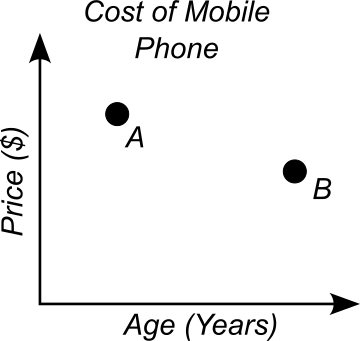
A store sells second hand mobile phones.

The graph below shows the price of 2 similar second-hand phones.


Which of the following is true based on the graph shown?

  1. Phone A is older and less expensive than Phone B
  2. Phone B is older and more expensive than phone A
  3. Phone A is newer and more expensive than Phone B
  4. Phone A is older and more expensive than Phone B

Show Answers Only

\(C\)

Show Worked Solution

\(\text{Phone A is left of Phone B }\rightarrow\ \text{ it is newer.}\)

\(\text{Phone A is higher than Phone B }\rightarrow\ \text{it is more expensive.}\)
 

\(\therefore\ \text{Phone A is newer and more expensive than Phone B.}\)
 

\(\Rightarrow C\)

Filed Under: Displaying Data Tagged With: num-title-ct-core, smc-5076-7-Other Graphs

Displaying Data, SM-Bank 019 MC

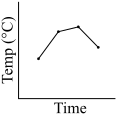
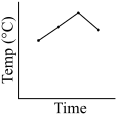
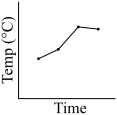
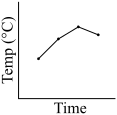
Christie measured the temperature every 3 hours from 6:00 am to 3:00 pm.
 

\begin{array} {|l|c|c|c|c|}
\hline
\rule{0pt}{2.5ex} \text{Time of the day} \rule[-1ex]{0pt}{0pt} & \text{6 a.m.} \rule[-1ex]{0pt}{0pt} & \text{9 a.m.} \rule[-1ex]{0pt}{0pt} & \text{12 p.m.} \rule[-1ex]{0pt}{0pt} & \text{3 p.m.} \\
\hline
\rule{0pt}{2.5ex} \text{Temperature (°C)} \rule[-1ex]{0pt}{0pt} & \text{22} \rule[-1ex]{0pt}{0pt} & \text{27} \rule[-1ex]{0pt}{0pt} & \text{32} \rule[-1ex]{0pt}{0pt} & \text{26} \\
\hline
\end{array}

 
Which graph shows Christie's results?
 

A.   B.
 
C.   D.
 
Show Answers Only

\(B\)

Show Worked Solution

\(\text{1st increase } = 27-22 = 5^{\circ}\)

\(\text{2nd increase } = 32-27 = 5^{\circ}\)
 

\(\longrightarrow\ \text{Temperature then drops 6° to 26°}\)
 

\(\Rightarrow B\)

Filed Under: Displaying Data Tagged With: num-title-ct-core, smc-5076-12-Line Graphs

Displaying Data, SM-Bank 018 MC

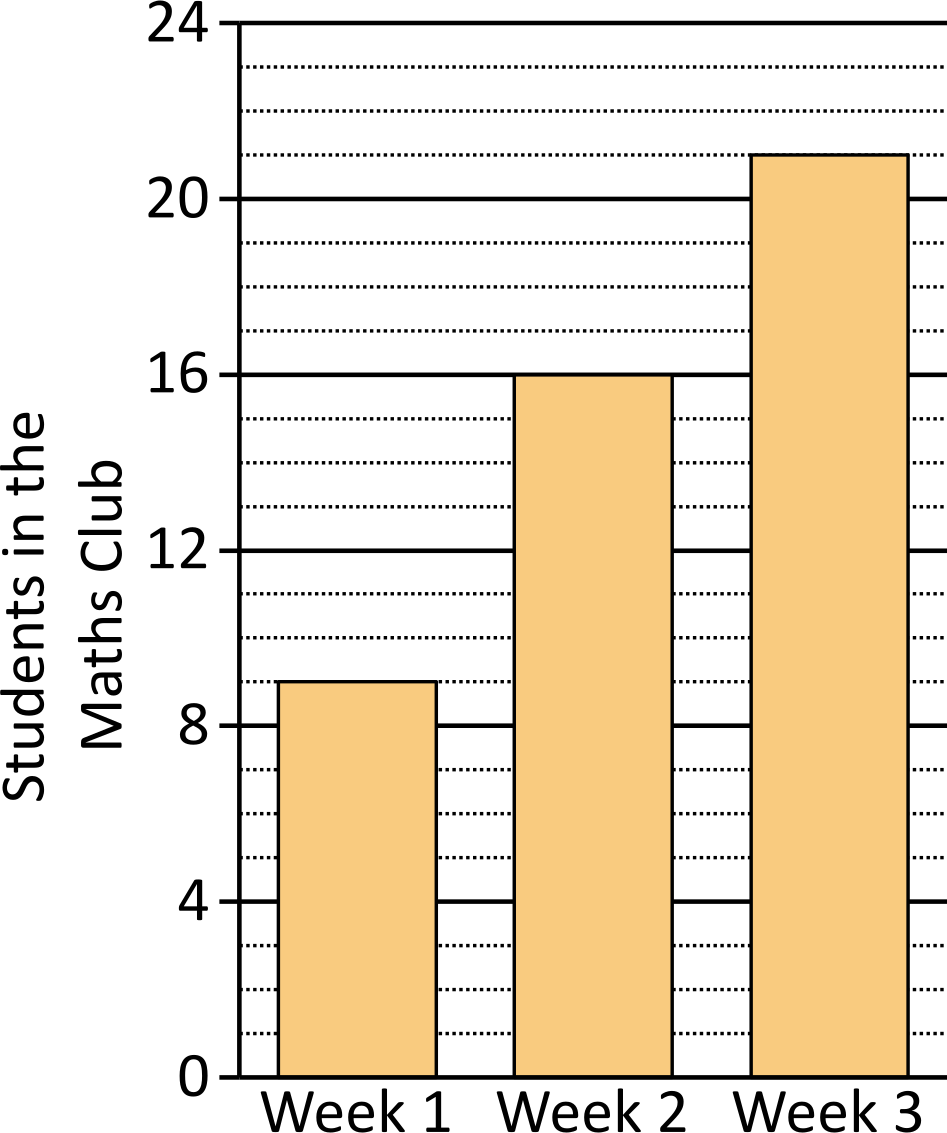
Natalie is the supervisor of the Maths club and keeps a record of the number of students in the club at the end of each week.


If no students have left the club, how many joined in Week 3?

  1. 5
  2. 7
  3. 9
  4. 21
Show Answers Only

\(A\)

Show Worked Solution

\(\text{Students in club:}\)

\(\text{At the end of week 2 = 16}\)

\(\text{At the end of week 3 = 21}\)

\(\therefore\ \text{Students who joined in week 3}\)

\(=21-16\)

\(=5\)

\(\Rightarrow A\)

Filed Under: Displaying Data Tagged With: num-title-ct-core, smc-5076-10-Column graphs and histograms

Displaying Data, SM-Bank 017 MC

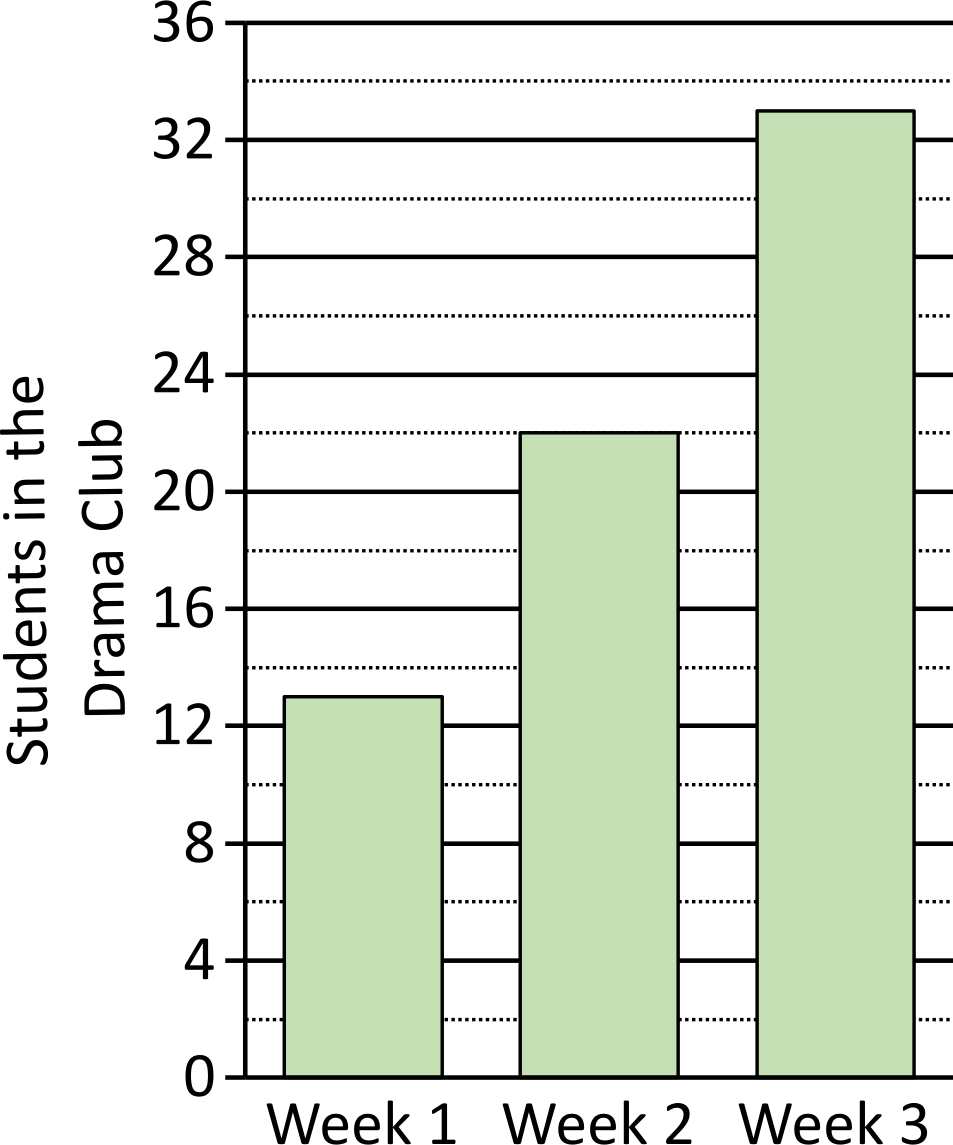
Mathew is captain of the drama club and keeps a record of the number of students in the club at the end of each week.


If no students have left the club, how many joined in Week 3?

  1. 3
  2. 8
  3. 11
  4. 33
Show Answers Only

\(C\)

Show Worked Solution

\(\text{Students in club:}\)

\(\text{At the end of week 2 = 22}\)

\(\text{At the end of week 3 = 33}\)

\(\therefore\ \text{Students who joined in week 3}\)

\(=33-22\)

\(=11\)

\(\Rightarrow C\)

Filed Under: Displaying Data Tagged With: num-title-ct-core, smc-5076-10-Column graphs and histograms

Displaying Data, SM-Bank 016

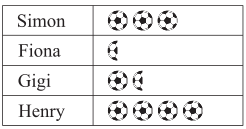
The goals scored by 4 players in a season of soccer were recorded in the graph below.
 

Simon scored 6 goals in the season.

Gigi scored 3 goals.

How many more goals did Henry score than Fiona?  (2 marks)

--- 2 WORK AREA LINES (style=lined) ---

Show Answers Only

\(7\ \text{goals}\)

Show Worked Solution

\(\text{Since Simon scored 6 goals}\)

\(\longrightarrow\ \text{1 soccer ball = 2 goals}\)

\(\longrightarrow\ \text{Henry scored 8 goals.}\)

\(\longrightarrow\ \text{Fiona scored 1 goals.}\)
 

\(\therefore\ \text{Extra goals}\) \(=8-1\)
  \(=7\ \text{goals}\)

Filed Under: Displaying Data Tagged With: num-title-ct-core, smc-5076-5-Picture Graphs

Displaying Data, SM-Bank 015

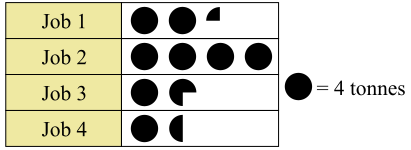
The picture graph shows how many tonnes of concrete are needed for 4 jobs.


How many more tonnes of concrete does Job 1 need than Job 3?  (2 marks)

--- 2 WORK AREA LINES (style=lined) ---

Show Answers Only

\(2\ \text{tonnes}\)

Show Worked Solution

\(\text{Job 1 needs 9 tonnes}\)

\(\text{Job 2 needs 7 tonnes}\)
 

\(\therefore\ \text{Extra tonnes}\) \(=9-7\)
  \(=2\ \text{tonnes}\)

Filed Under: Displaying Data Tagged With: num-title-ct-core, smc-5076-5-Picture Graphs

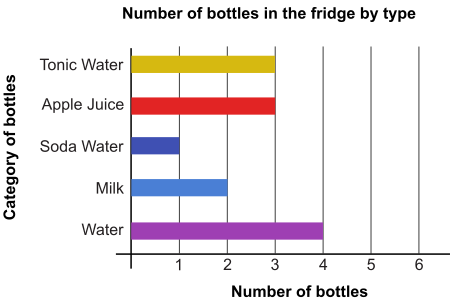
Displaying Data, SM-Bank 014 MC

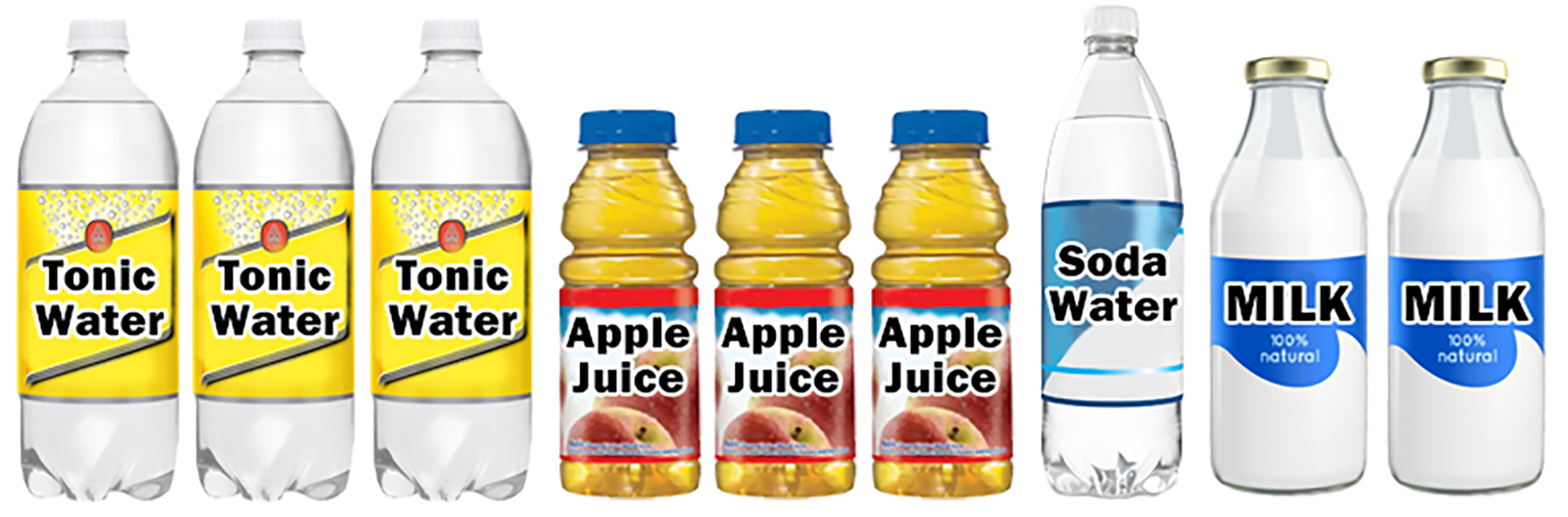
The bottles in Leisa's fridge are pictured below.


Leisa decides to make a graph where each bar represents one type of bottle in her fridge.


Leisa makes an error when creating the graph.

What should Leisa do to correct the error?

  1. Change the 'Number of bottles' label to 'Volume of bottles'.
  2. Change the title to 'Number of bottles in the fridge by volume'.
  3. The thickness of each bar should vary, depending on the number of bottles.
  4. Remove the 'Water' category since tonic water and soda water are already shown.
Show Answers Only

\(D\)

Show Worked Solution

\(\text{Remove the ‘Water’ category since tonic water and}\)

\(\text{soda water are already shown.}\)

\(\Rightarrow D\)

Filed Under: Displaying Data Tagged With: num-title-ct-core, smc-5076-5-Picture Graphs

Displaying Data, SM-Bank 013 MC

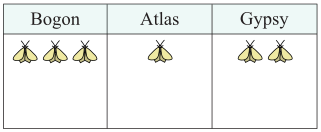
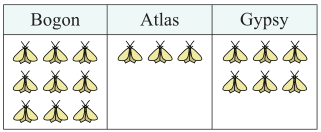
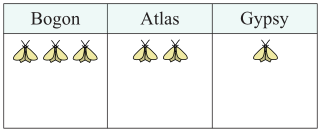
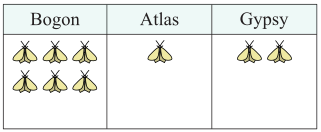
Patrick counts the number of moths he has collected.

  • 9 Bogon moths
  • 3 Atlas moths
  • 6 Gypsy moths

In each picture graph below,  = 3 moths

Select the picture graph that shows the number of moths Patrick counts.

A.   B.
 
C.   D.
 
Show Answers Only

\(A\)

Show Worked Solution
  \(\text{= 3 moths}\)
    \(\text{= 6 moths}\)
     \(\text{= 9 moths}\)


\(\Rightarrow A\)

Filed Under: Displaying Data Tagged With: num-title-ct-core, smc-5076-5-Picture Graphs

Displaying Data, SM-Bank 012 MC

During picking season, four groups of people were hired to pick apples.

A group will receive a bonus if they pick more than 24 apples per person in a 10-minute period.

The table below shows the total amount of apples picked by each group in the first 10 minutes.


Which group would have received a bonus in the first 10-minute period?

  1. Group A
  2. Group B
  3. Group C
  4. Group D
Show Answers Only

\(C\)

Show Worked Solution

\(\text{Calculate apples picked per person (in 10 mins) for each group:}\)

\(\text{A} = 68\ ÷\ 3=22.67\dots\)

\(\text{B} = 95\ ÷\ 4 = 23.75\)

\(\text{C} = 122\ ÷\ 5 = 24.4\)

\(\text{D} = 143\ ÷\ 6 = 23.83\dots\)
 

\(\Rightarrow C\)

Filed Under: Displaying Data Tagged With: num-title-ct-core, smc-5076-5-Picture Graphs

Displaying Data, SM-Bank 011 MC

Chris did a survey of the number of female toilets in four shopping centres.

The results were recorded in the table below but the key has been left off the graph?

The total number of female toilets was 44.

How many toilets does represent in the graph?
  1. 1
  2. 2
  3. 4
  4. 5
Show Answers Only

\(B\)

Show Worked Solution

\(\text{Total number of female symbols}\)

\(=5+4.5+5.5+7\)

\(=22\)
 

\(\therefore\ \text{The number of toilets one symbol represents}\)

\(=\dfrac{44}{22}\)

\(=2\)

 
\(\Rightarrow B\)

Filed Under: Displaying Data Tagged With: num-title-ct-core, smc-5076-5-Picture Graphs

Displaying Data, SM-Bank 010 MC

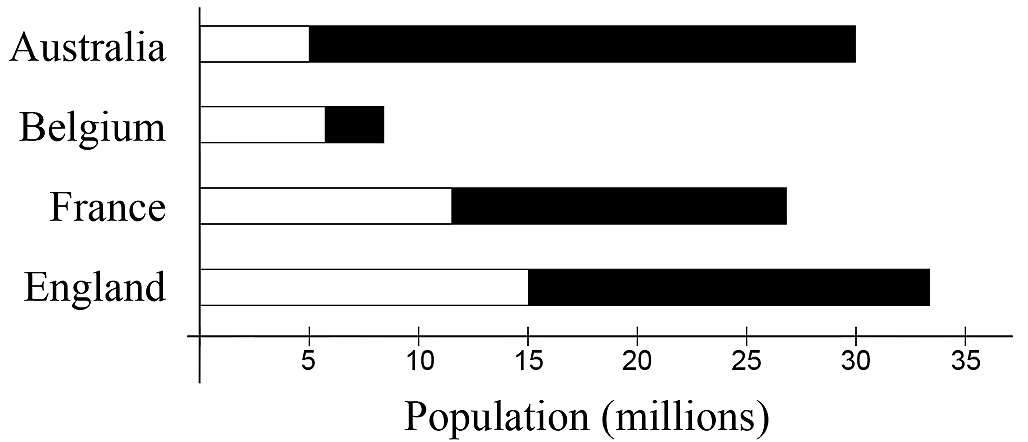
Each bar on this graph shows the population of a country and the population of its capital city.

The white section is the population that lives in the capital city.

The black section is the population that lives outside the capital city.


Which of the following countries has the highest percentage of its population living in its capital city?

  1. Australia
  2. Belgium
  3. France
  4. England
Show Answers Only

\(B\)

Show Worked Solution

\(\text{Considering the length of the white section of each}\)

\(\text{bar and comparing it to the length of the total bar,}\)

\(\text{Belgium easily has the highest percentage living in}\)

\(\text{its capital city.}\)

\(\Rightarrow B\)

Filed Under: Displaying Data Tagged With: num-title-ct-core, smc-5076-15-Sector graphs and Divided Bar graphs

Displaying Data, SM-Bank 009

Angus asked all the students in his primary school how far away they lived from school.

He used the results to create the column graph below but left off some labels.


Angus' primary school has 100 students.

How many students lived over 8 km from school?  (2 marks)

--- 4 WORK AREA LINES (style=lined) ---

Show Answers Only

\(18\ \text{students}\)

Show Worked Solution

\(\text{Since there are 5 columns and 100 students, the }\)

\(\text{average number of students per column is 20.}\)
 

\(\longrightarrow\ \text{Each interval = 4 students}\)
 

\(\therefore\ \text{Number of students living over 8 km away}\)

\(=4.5\times 4\)

\(=18\ \text{students}\)

Filed Under: Displaying Data Tagged With: num-title-ct-core, smc-5076-10-Column graphs and histograms

Displaying Data, SM-Bank 008

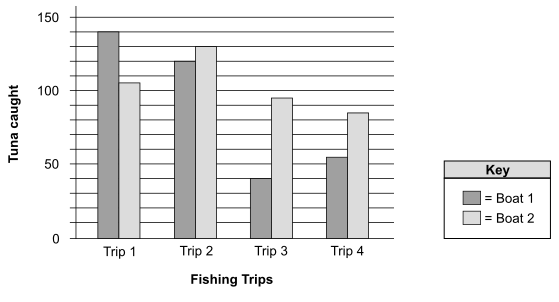
Two fishing boats record the number of tuna they catch on four fishing trips.


How many more tuna did Boat 2 catch than Boat 1 in total over the four trips.  (2 marks)

--- 5 WORK AREA LINES (style=lined) ---

Show Answers Only

\(60\)

Show Worked Solution
\(\text{Boat 1 tuna}\) \(=140+120+40+55\)
  \(=355\)


\(\text{Boat 2 tuna}\) \(=105+130+95+85\)
  \(=415\)

 
\(\therefore\ \text{Extra tuna caught by Boat 2}\)

\(=415-355\)

\(=60\)

Filed Under: Displaying Data Tagged With: num-title-ct-core, smc-5076-10-Column graphs and histograms

Displaying Data, SM-Bank 007 MC

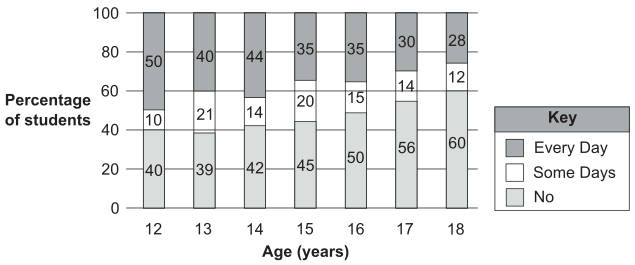
Students at a high school were surveyed to find whether they did exercise before school.

The graph below shows the results.


There were 150 17-year-old students at the high school.

How many 17-year-old students responded 'Every Day'?

  1. 14
  2. 30
  3. 45
  4. 60
Show Answers Only

\(C\)

Show Worked Solution

\(\text{30% of 17-year-old students responded ‘Every Day’.}\)

\(\therefore\ \text{Number}\) \(=0.3\times 150\)
  \(=45\)

\(\Rightarrow C\)

Filed Under: Displaying Data Tagged With: num-title-ct-core, smc-5076-15-Sector graphs and Divided Bar graphs

Displaying Data, SM-Bank 006 MC

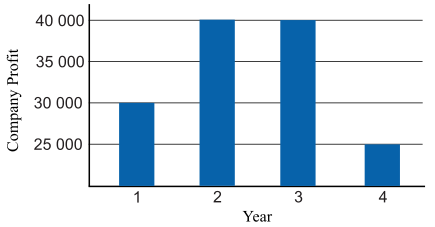
This graph shows a company's profit over a four year period.


Which conclusion can be reached from the graph?

  1. The profit in Year 2 was double of the profit in Year 1.
  2. The profits were greater than $20 000 in the period between Year 1 and Year 4.
  3. The profit in Year 4 was one quarter the profit in Year 3.
  4. The profits were positive in Years 2 and 3, and negative in Years 1 and 4.
Show Answers Only

\(B\)

Show Worked Solution

\(\text{Important to note that profits in this table begin at }$25\ 000, \text{not zero.}\)

\(\therefore\ \text{Profits were greater than }$20\ 000 \text{ in the period}\)

\(\text{between Year 1 and Year 4.}\)

\(\Rightarrow B\)

Filed Under: Displaying Data Tagged With: num-title-ct-core, smc-5076-10-Column graphs and histograms

Displaying Data, SM-Bank 005

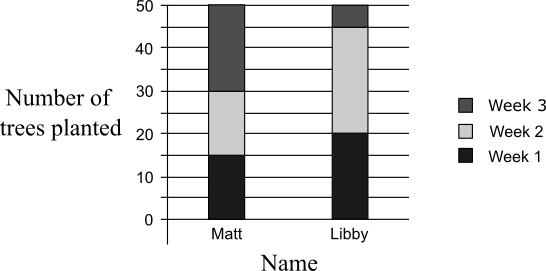
Matt and Libby love nature and planted 50 trees each over 3 weeks.

The bar chart below shows the number of trees each of them planted in each week.
 

How many more trees did Libby plant than Matt in Week 2.  (2 marks)

--- 5 WORK AREA LINES (style=lined) ---

Show Answers Only

\(5\)

Show Worked Solution

\(\text{Trees planted by Matt in Week 2}\)

\(= 35-15\)

\(= 20\)

\(\text{Trees planted by Libby in Week 2}\)

\(= 45-20\)

\(= 25\)
 

\(\therefore\ \text{Libby planted 5 more trees than Matt in Week 2.}\)

Filed Under: Displaying Data Tagged With: num-title-ct-core, smc-5076-15-Sector graphs and Divided Bar graphs

Displaying Data, SM-Bank 004 MC

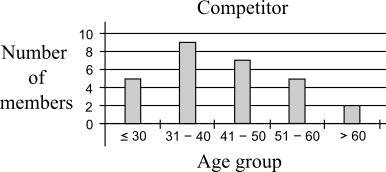
A local triathlon club gathers data on its members and displays it in a graph below.


How many members in the triathlon club are 50 or younger?

  1. 7
  2. 9
  3. 14
  4. 21
Show Answers Only

\(D\)

Show Worked Solution

\(\text{Number of members 50 or younger}\)

\(=5+9+7\)

\(=21\)

\(\Rightarrow D\)

Filed Under: Displaying Data Tagged With: num-title-ct-core, smc-5076-10-Column graphs and histograms

Displaying Data, SM-Bank 003 MC

The graph shows the origin and type of all vehicles in a city.


Which statement is most accurate based on the graph?

  1. There are more utility vehicles than trucks and vans.
  2. Utility vehicles are the most common type of vehicles
  3. There are more Australian vehicles than European vehicles.
  4. There are more Asian vehicles than European vehicles.
Show Answers Only

\(D\)

Show Worked Solution

\(\text{Consider the 4th option:}\)

\(\text{Total Asian vehicles}\)

\(=5+7+7=19\)

\(\text{Total European vehicles}\)

\(=4+3+3=10\)

\(\therefore\ \text{There are more Asian vehicles than European vehicles.}\)

\(\Rightarrow D\)

Filed Under: Displaying Data Tagged With: num-title-ct-core, smc-5076-10-Column graphs and histograms

Displaying Data, SM-Bank 002 MC

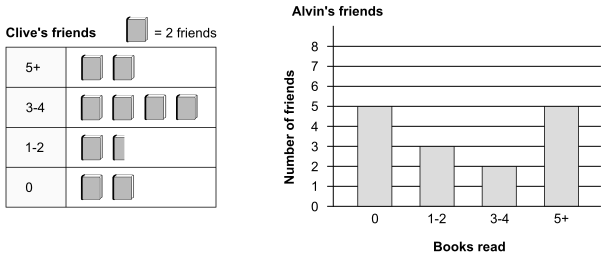
Clive and Alvin asked their friends how many books they had read in the past month.

Clive draws a picture graph to show the results for his friends.

Alvin draws a column graph to show the results for his friends.


How many more of Clive's friends read 3-4 books in the last month than Alvin's friends?

  1. 0
  2. 4
  3. 6
  4. 8
Show Answers Only

\(C\)

Show Worked Solution

\(\text{Number of Clive’s friends}\)

\(=4\times 2\)

\(=8\)

\(\text{Number of Alvin’s friends}\)

\(=2\)

\(\therefore\ \text{6 more of Clive’s friends.}\)

\(\Rightarrow C\)

Filed Under: Displaying Data Tagged With: num-title-ct-core, smc-5076-10-Column graphs and histograms, smc-5076-5-Picture Graphs

Displaying Data, SM-Bank 001 MC

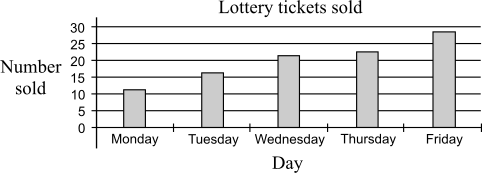
This graph shows the number of lottery tickets sold by a newsagent on each day of a given week.
 

On which days did the newsagent sell 23 lottery tickets?

  1. Tuesday
  2. Wednesday
  3. Thursday
  4. Friday
Show Answers Only

\(C\)

Show Worked Solution

\(\text{Thursday}\)

\(\Rightarrow C\)

Filed Under: Displaying Data Tagged With: num-title-ct-core, smc-5076-10-Column graphs and histograms

Statistics, STD2 S1 2005 HSC 24d

The sector graph shows the proportion of people, as a percentage, living in each region of Sumcity. There are 24 000 people living in the Eastern Suburbs.
 

2UG-2005-24d1
 

  1. Show that the total number of people living in Sumcity is  160 000.  (1 mark)

    --- 1 WORK AREA LINES (style=lined) ---

Jake used the information above to draw a column graph.
 

2UG-2005-24d2

  1. The column graph height is incorrect for one region.


    Identify this region and justify your answer.   (2 marks)

    --- 4 WORK AREA LINES (style=lined) ---

Show Answers Only
  1. `160\ 000`
  2. `text(Western Suburbs population)`
Show Worked Solution

i.   `text(Let the population of Sumcity =)\ P`

`text(15%)× P` `= 24\ 000`
`:.P`  `= (24\ 000)/0.15` 
  `= 160\ 000\ …\ text(as required)` 


ii.  `text(Western Suburbs population)`

`= text(10%) × 160\ 000`

`= 16\ 000`

`text(The column graph has this population as)`

`text(12 000 people which is incorrect.)`

Filed Under: Bar Charts and Histograms, Bar Charts and Histograms (Std 2), Bar Charts and Histograms (Std2-2027), Bar Charts and Histograms (Y12), Bar Charts, Histograms and Other Graphs (Std 1), Displaying Data, Other Chart Types (Y12), Other Charts (Std 2), Other Charts (Std2-2027), Other Graphs Tagged With: Band 4, common-content, num-title-ct-core, num-title-qs-hsc, smc-1128-10-Bar Charts, smc-5076-15-Sector graphs and Divided Bar graphs, smc-5077-10-Misleading graphs, smc-6310-10-Bar Charts, smc-6311-30-Other Charts, smc-821-10-Bar Charts, smc-822-40-Other Charts, smc-997-10-Bar Charts, smc-998-40-Other Charts

Statistics, STD2 S1 2005 HSC 24a

  1. Draw a stem-and-leaf plot for the following set of scores.
  2.  


    `21\ \ \ 45\ \ \ 29\ \ \ 27\ \ \ 19\ \ \ 35\ \ \ 23\ \ \ 58\ \ \ 34\ \ \ 27`  (2 marks)

    --- 6 WORK AREA LINES (style=blank) ---

  3. What is the median of the set of scores?   (1 mark)

    --- 2 WORK AREA LINES (style=lined) ---

  4. Comment on the skewness of the set of scores.   (1 mark)

    --- 2 WORK AREA LINES (style=lined) ---

Show Answers Only
  1.  
  2. `28`
  3. `text(The data has a tail that stretches to the right)`
  4.  

    `:.\ text(Data is positively Skewed.)`

Show Worked Solution
i.    HSC 2005 24a


ii.  `text(10 scores)`

`:.\ text(Median)` `= text{(5th + 6th)}/2`
  `= (27 + 29)/2`
  `= 28`


iii.  `text(The data has a tail that stretches to the right)`

`:.\ text(Data is positively skewed.)`

Filed Under: Bar Charts, Histograms and Other Graphs (Std 1), Displaying Data, Other Chart Types (Y12), Other Charts (Std 2), Other Charts (Std2-2027), Stem & Leaf, Box & Whisker Tagged With: Band 4, Band 5, common-content, num-title-ct-core, num-title-qs-hsc, smc-1128-24-Stem and Leaf, smc-5076-20-Stem and Leaf, smc-6311-10-Stem-and-Leaf, smc-822-20-Stem and Leaf, smc-998-20-Stem and Leaf

Statistics, STD2 S1 2004 HSC 8 MC

This sector graph shows the distribution of 116 prizes won by three schools: X, Y and Z.


How many prizes were won by School X?

  1.   26
  2.   32
  3.   81
  4.   99
Show Answers Only

`B`

Show Worked Solution

`text(Centre angle of School X sector)`

`= 100^@\ text{(by measurement)}`
 

`:.\ text(Prizes won by school X)`

`= 100/360 xx 116`

`= 32.22\ …`

`=> B`

Filed Under: Bar Charts, Histograms and Other Graphs (Std 1), Displaying Data, Other Chart Types (Y12), Other Charts (Std 2), Other Charts (Std2-2027), Other Graphs Tagged With: Band 3, common-content, num-title-ct-core, num-title-qs-hsc, smc-1128-28-Other Charts, smc-5076-15-Sector graphs and Divided Bar graphs, smc-6311-30-Other Charts, smc-822-40-Other Charts, smc-998-40-Other Charts

Statistics, STD2 S1 2008 HSC 23e

In a survey, 450 people were asked about their favourite takeaway food. The results are displayed in the bar graph.

2008 23e
 
How many people chose pizza as their favourite takeaway food?   (2 marks)

Show Answers Only

`175`

Show Worked Solution

`text(Number of people who chose pizza)`

COMMENT: This question required measurement of the actual image on the exam. The same methodology works here.

`= text{Length of pizza section}/text{Total length of bar} xx 450`

`~~ 7/18 xx 450`

`~~ 175`
 

`:.\ 175\ text(people chose pizza.)`

Filed Under: Bar Charts, Histograms and Other Graphs (Std 1), Displaying Data, Other Chart Types (Y12), Other Charts (Std 2), Other Graphs Tagged With: Band 4, common-content, num-title-ct-core, num-title-qs-hsc, smc-1128-28-Other Charts, smc-5076-15-Sector graphs and Divided Bar graphs, smc-822-40-Other Charts, smc-998-40-Other Charts

Statistics, STD2 S1 2011 HSC 25b

The graph below displays data collected at a school on the number of students
in each Year group, who own a mobile phone.
 

2UG 2011 25b
 

  1. Which Year group has the highest percentage of students with mobile phones? (1 mark)

    --- 1 WORK AREA LINES (style=lined) ---

  2. Two students are chosen at random, one from Year 9 and one from Year 10.


    Which student is more likely to own a mobile phone?


    Justify your answer with suitable calculations. (2 marks)

    --- 4 WORK AREA LINES (style=lined) ---

  3. Identify a trend in the data shown in the graph. (1 mark)

    --- 2 WORK AREA LINES (style=lined) ---

Show Answers Only
  1. `text{Year 12 (100%)}`
  2. `text(Year 10)`
  3. `text(See Worked Solutions for detail)`
Show Worked Solution

i.   `text(Year 12 (100%))`

MARKER’S COMMENT: Many students ignore the instruction to use calculations and lose marks as a result.
 

ii.     `text(% Ownership in Year 9)` `=55/70`
    `=\ text{78.6%  (1d.p.)}`
      `text(% Ownership in Year 10)` `=50/60`
    `=\ text{83.3%  (1d.p.)}`

  
`:.\ text(The Year 10 student is more likely to own a mobile phone.)`


iii.   `text(% Ownership increases as students)`

 `text(progress from Year 7 to Year 12.)`

Filed Under: Bar Charts and Histograms, Bar Charts and Histograms (Std 2), Bar Charts and Histograms (Std2-2027), Bar Charts and Histograms (Y12), Bar Charts, Histograms and Other Graphs (Std 1), Displaying Data, Relative Frequency Tagged With: Band 3, Band 4, common-content, num-title-ct-core, num-title-qs-hsc, smc-1128-10-Bar Charts, smc-5076-10-Column graphs and histograms, smc-6310-10-Bar Charts, smc-821-10-Bar Charts, smc-997-10-Bar Charts

Copyright © 2014–2025 SmarterEd.com.au · Log in