SmarterEd

Aussie Maths & Science Teachers: Save your time with SmarterEd

  • Login
  • Get Help
  • About

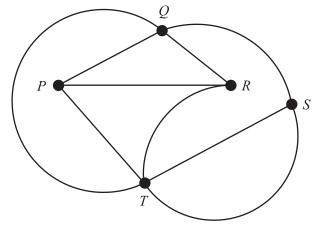
Networks, STD1 N1 HSC 2025 3 MC

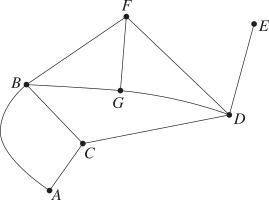
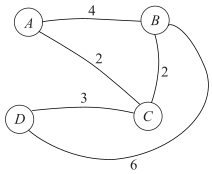
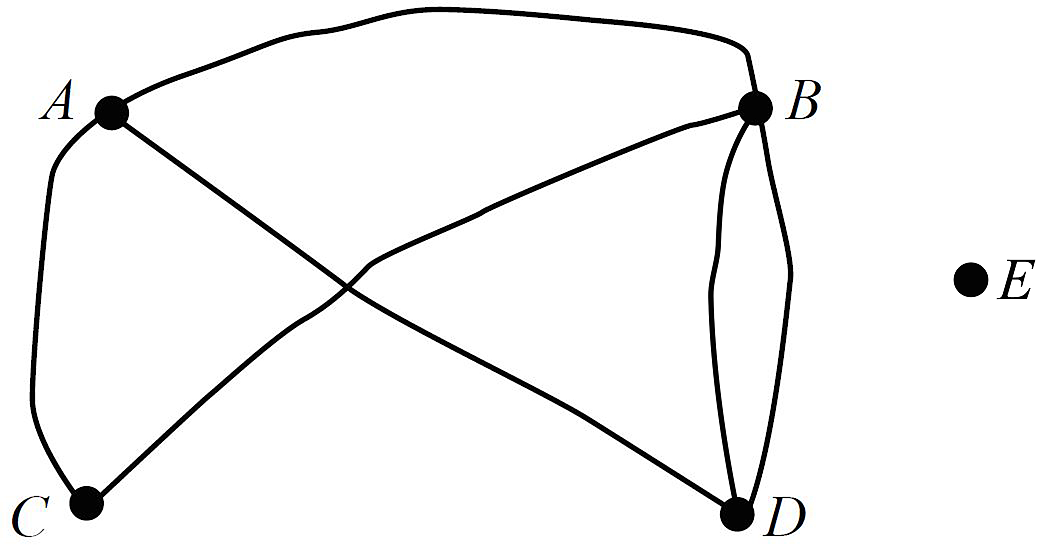
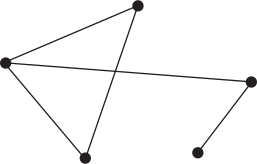
Consider the network diagram.
 

Which vertex has degree 4?
  1. \(A\)
  2. \(B\)
  3. \(C\)
  4. \(D\)
Show Answers Only

\(B\)

Show Worked Solution

\(\text{Vertex }B\ \text{has 4 edges leading from it so has degree 4.}\)

\(\Rightarrow B\)

Filed Under: Basic Concepts, Network Concepts (Std1-2027) Tagged With: Band 2, smc-1136-40-Degrees of Vertices, smc-6526-50-Degree of Vertices, std2-std1-common

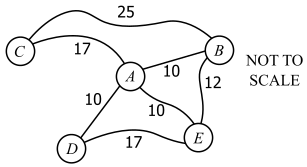
Networks, STD1 N1 2024 NHT 33 MC

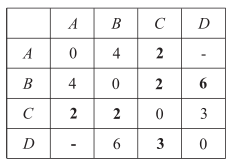
In the graph shown above, the number of vertices of even degree is:

  1. 1
  2. 2
  3. 3
  4. 4
Show Answers Only

\(C\)

Show Worked Solution

\(\Rightarrow C\)

Filed Under: Basic Concepts, Network Concepts (Std1-2027) Tagged With: Band 3, smc-1136-40-Degrees of Vertices, smc-6526-50-Degree of Vertices

Networks, STD2 N2 2024 GEN2 13*

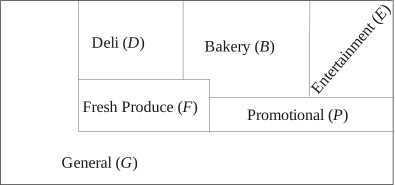
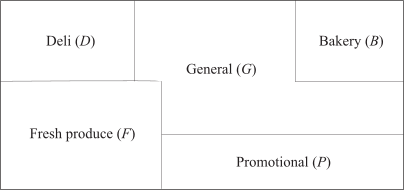
A supermarket has five departments, with areas allocated as shown on the floorplan below.
 

The floorplan is represented by the network diagram below.

On this network diagram, vertices represent departments and edges represent boundaries between two departments.

This network diagram is incomplete.
 

Draw the missing vertex and missing edges on the diagram above. Include a label.   (2 marks)

--- 0 WORK AREA LINES (style=lined) ---
Show Answers Only

Show Worked Solution

Filed Under: Basic Concepts, Network Concepts (Std1-2027), Network Concepts (Std2-2027) Tagged With: Band 4, smc-6307-30-Map to Network, smc-6526-30-Map to Network, smc-912-25-Map to Network

Networks, STD1 N1 2024 HSC 6 MC

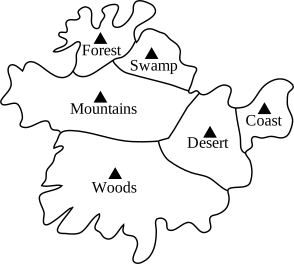
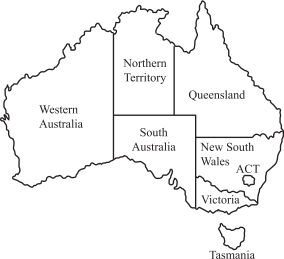
The map shows regions within a country.
 

A network diagram is to be drawn to represent this map. Vertices will be used to indicate each region and edges will be used to represent a border shared between two regions.

How many edges will there be in the network diagram?

  1. \(8\)
  2. \(7\)
  3. \(6\)
  4. \(5\)
Show Answers Only

\(B\)

Show Worked Solution

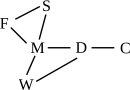
\(\text{Network diagram:}\)
 

\(\text{Network has 7 edges.}\)

\(\Rightarrow B\)

♦♦ Mean mark 30%.

Filed Under: Basic Concepts, Network Concepts (Std1-2027) Tagged With: Band 5, smc-1136-25-Map to Network, smc-1136-45-Number of Edges, smc-6526-30-Map to Network, smc-6526-55-Number of Edges

Networks, STD2 N2 SM-Bank 40

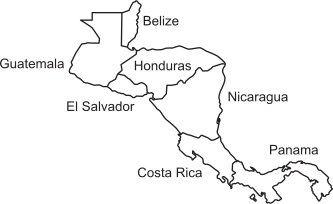
The map below shows seven countries within Central America.
 

Draw a network diagram of the map where seven vertices represent each of the countries on the map and edges represent a border shared between two countries.   (2 marks)

--- 5 WORK AREA LINES (style=lined) ---

Show Answers Only

Show Worked Solution

Filed Under: Basic Concepts, Network Concepts (Std1-2027), Network Concepts (Std2-2027) Tagged With: Band 5, smc-6307-30-Map to Network, smc-6526-30-Map to Network, smc-912-25-Map to Network

Networks, STD1 N1 2023 HSC 15

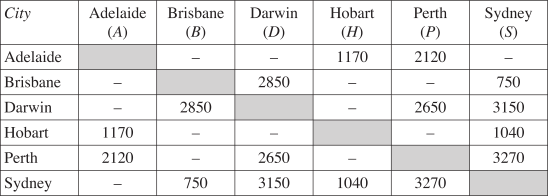
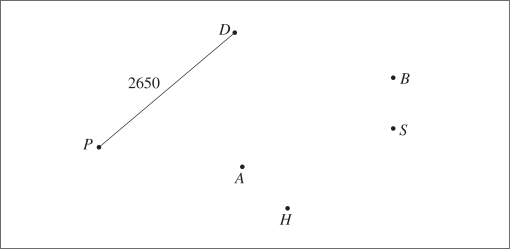
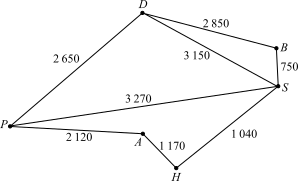
The table shows some of the flight distances (rounded to the nearest 10 km between various Australian cities.

  1. Use the information in the table to complete the network diagram where the edges are labelled with distances.  (2 marks)


  1. Mahsa wants to travel from Hobart to Darwin. She wants to change planes only once.
  2. Using the network diagram, calculate how many kilometres she will travel by plane.  (1 mark)

    --- 1 WORK AREA LINES (style=lined) ---

Show Answers Only

a.  

b.    \(4190\text{ km}\)

Show Worked Solution

a.

b.    \(\text{Changing planes only once}\Rightarrow H\rightarrow S\rightarrow D\)

\(\text{Kilometres travelled}=1040+3150=4190\text{ km}\)

Filed Under: Basic Concepts, Network Concepts (Std1-2027) Tagged With: Band 3, Band 4, smc-1136-10-Table to Network, smc-6526-10-Table to Network, std2-std1-common

Networks, STD1 N1 2022 HSC 20

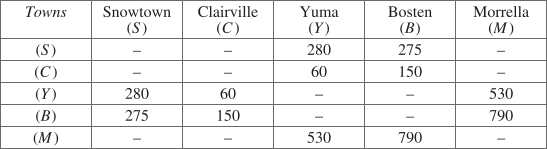
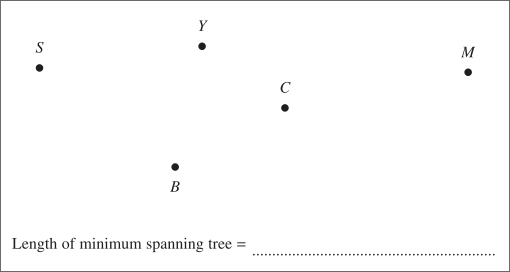
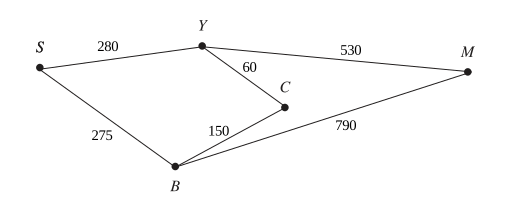
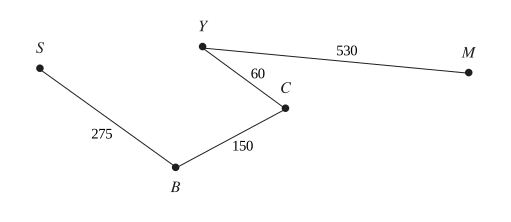
The table below shows the distances, in kilometres, between a number of towns.
 

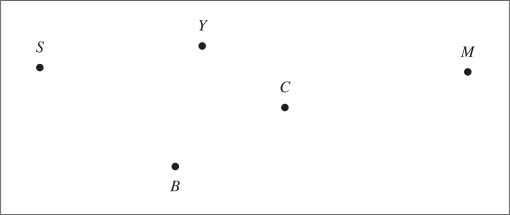
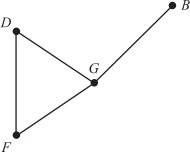
  1. Using the vertices given, draw a weighted network diagram to represent the information shown in the table.  (2 marks)


  2. A tourist wishes to visit each town.
  3. Draw the minimum spanning tree which will allow for this AND determine its length.  (3 marks)
     

    --- 0 WORK AREA LINES (style=lined) ---
Show Answers Only
  1.  
     
     
  2.   
     
  3. `1015\ text{km}`
Show Worked Solution

a. 

b.   `text{Using Prim’s algorithm (starting at}\ Y):`

`text{1st edge:}\ YC`

`text{2nd edge:}\ CB`

`text{3rd edge:}\ SB`

`text{4th edge:}\ YM`

`text{Length of minimum spanning tree}`

`=275 + 150+60+530`

`=1015\ text{km}`

Filed Under: Basic Concepts, Minimum Spanning Trees, Network Concepts (Std1-2027) Tagged With: Band 3, Band 4, smc-1136-10-Table to Network, smc-1138-20-Distance, smc-1138-40-Draw Tree, smc-6526-10-Table to Network, smc-6528-20-Distance, smc-6528-40-Draw Tree, std2-std1-common

Networks, STD1 N1 2022 HSC 2 MC

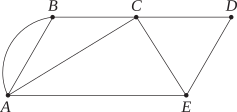
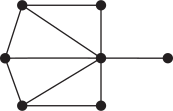
A network diagram is shown.


What is the number of edges in this network?

  1. 6
  2. 7
  3. 9
  4. 10
Show Answers Only

`D`

Show Worked Solution

There are 10 connection points (lines) between the nodes in the diagram.

`=>D`


♦ Mean mark 48%.

Filed Under: Basic Concepts, Network Concepts (Std1-2027) Tagged With: Band 5, smc-1136-45-Number of Edges, smc-6526-55-Number of Edges

Networks, STD1 N1 2021 HSC 1 MC

A network diagram is shown.
 

How many vertices are in this network?

  1. 5
  2. 6
  3. 7
  4. 8
Show Answers Only

`B`

Show Worked Solution

`text(Vertices = 6)`

`=> B`

Filed Under: Basic Concepts, Basic Concepts, Network Concepts (Std1-2027) Tagged With: Band 2, num-title-ct-path, num-title-qs-hsc, smc-1136-30-Definitions, smc-4788-10-Definitions

Networks, STD1 N1 2021 HSC 3 MC

Consider the network diagram.
 

What is the sum of the degrees of all the vertices in this network?

  1.  5
  2.  8
  3.  14
  4.  16
Show Answers Only

`D`

Show Worked Solution

♦♦ Mean mark 31%.
`text{Sum of degrees}` `= 4 + 3 + 4 + 2 + 3`
  `= 16`

`=> D`

Filed Under: Basic Concepts, Network Concepts (Std1-2027) Tagged With: Band 4, smc-1136-40-Degrees of Vertices, smc-6526-50-Degree of Vertices, std2-std1-common

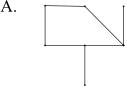
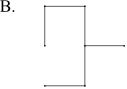
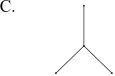
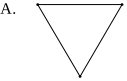
Networks, STD1 N1 2020 HSC 5 MC

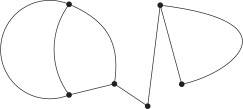
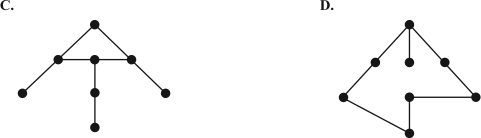
Which of the following network diagrams is NOT a tree?


Show Answers Only

`A`

Show Worked Solution

♦ Mean mark 45%.

`text{A tree cannot have a loop.}`

`=> \ A`


Filed Under: Basic Concepts, Network Concepts (Std1-2027) Tagged With: Band 5, smc-1136-30-Definitions, smc-6526-40-Definitions

Networks, STD1 N1 2020 HSC 1 MC

Which of the following networks has more vertices than edges?


Show Answers Only

`C`

Show Worked Solution

`text{Consider C:}`

`text{Graph has 5 vertices and 4 edges.}`

`=> \ C`

Filed Under: Basic Concepts, Basic Concepts, Network Concepts (Std1-2027) Tagged With: Band 3, num-title-ct-path, num-title-qs-hsc, smc-1136-40-Degrees of Vertices, smc-4788-20-Degrees of vertices, smc-4788-20-Number of edges, smc-6526-50-Degree of Vertices, smc-6526-55-Number of Edges

Networks, STD1 N1 2019 HSC 17

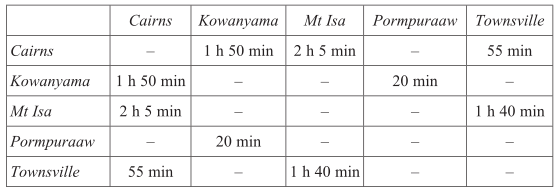
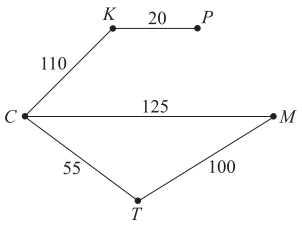
A regional airline operates flights in Queensland. Flight times between connected towns are shown in the table.


Draw a network diagram to show how the towns are connected, with weights on the edges showing the flight times.  (2 marks)

Show Answers Only

Show Worked Solution

`text(Edge weights are in minutes duration.)`

Filed Under: Basic Concepts, Basic Concepts, Network Concepts (Std1-2027), Network Concepts (Std2-2027) Tagged With: Band 4, smc-1136-10-Table to Network, smc-6307-10-Table to Network, smc-6526-10-Table to Network, smc-912-10-Table to Network

Networks, STD1 N1 2019 HSC 1 MC

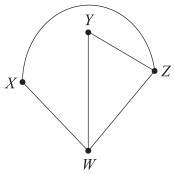
A network diagram is given.
 

What is the degree of vertex `W`?

  1. 1
  2. 2
  3. 3
  4. 4
Show Answers Only

`C`

Show Worked Solution

`text(Vertex)\ W\ text(has 3 edges connected and is therefore degree 3.)`

`=> C`

Filed Under: Basic Concepts, Basic Concepts, Network Concepts (Std1-2027) Tagged With: Band 2, num-title-ct-path, num-title-qs-hsc, smc-1136-40-Degrees of Vertices, smc-4788-20-Degrees of vertices, smc-6526-50-Degree of Vertices

Networks, STD2 N2 2018 FUR1 4 MC

Consider the graph below.


Which one of the following is not a path for this graph?

  1. `PRQTS`
  2. `PRTSQ`
  3. `PTQSR`
  4. `PTRQS`
Show Answers Only

`C`

Show Worked Solution

`text(By trial and error:)`

`text(Consider option)\ C,`

`PTQSR\ text(is not a path because)\ S\ text(to)\ R`

`text(must go through another vertex.)`

`=> C`

Filed Under: Basic Concepts, Basic Concepts, Network Concepts (Std1-2027), Network Concepts (Std2-2027), Trails, Paths and Cycles Tagged With: Band 3, num-title-ct-path, smc-1136-30-Definitions, smc-6307-40-Definitions, smc-6526-40-Definitions, smc-912-30-Definitions

Networks, STD2 N2 SM-Bank 28

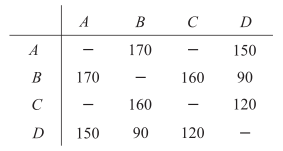
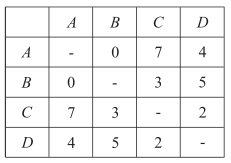
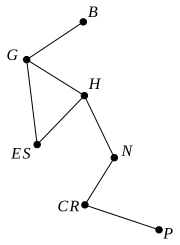
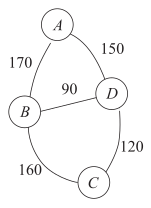
In central Queensland, there are four petrol stations `A`, `B`, `C` and `D`. The table shows the length, in kilometres, of roads connecting these petrol stations.


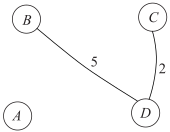
  1. Construct a network diagram to represent the information in the table.  (2 marks)

    --- 5 WORK AREA LINES (style=lined) ---
  2. A petrol tanker needs to refill each station. It starts at Station `A` and visits each station.


    Calculate the shortest distance that can be travelled by the petrol tanker. In your answer, include the order the petrol stations are refilled.  (2 marks)

    --- 4 WORK AREA LINES (style=lined) ---

Show Answers Only
  1.  
  2. `380\ text(km)`
Show Worked Solution
a.   


b.   `text(Shortest Path from)\ A\ (text(visiting all stations))`

`A – B – D – C`

`text(Distance)` `= 170 + 90 + 120`
  `= 380\ text(km)`

Filed Under: Basic Concepts, Basic Concepts, Network Concepts (Std1-2027), Network Concepts (Std2-2027), Shortest Path (Std1-2027), Shortest Paths, Shortest Paths, Shortest Paths (Std2-2027) Tagged With: Band 3, Band 4, smc-1136-10-Table to Network, smc-1137-20-Table, smc-6307-10-Table to Network, smc-6308-20-Tables, smc-6526-10-Table to Network, smc-6527-20-Tables, smc-912-10-Table to Network, smc-913-20-Table

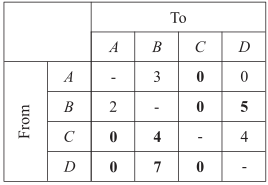
Networks, STD2 N2 SM-Bank 23

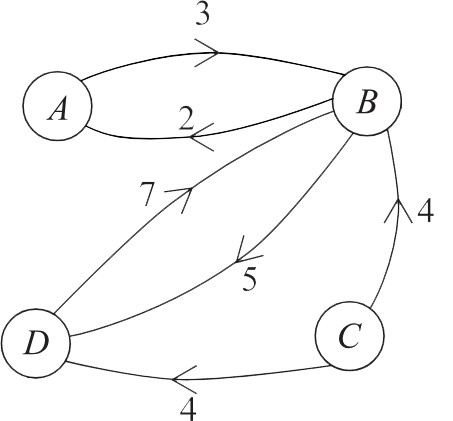
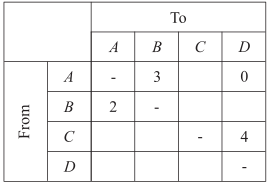
A directed network diagram is pictured below.


The information in the network diagram is used to complete the network table below, with a "0" used to signify that no connection exists. Complete the table.  (2 marks)
 

--- 0 WORK AREA LINES (style=lined) ---
Show Answers Only

Show Worked Solution

Filed Under: Basic Concepts, Basic Concepts, Network Concepts (Std1-2027), Network Concepts (Std2-2027) Tagged With: Band 4, smc-1136-20-Network to Table, smc-6307-20- Network to Table, smc-6526-20- Network to Table, smc-912-20-Network to Table

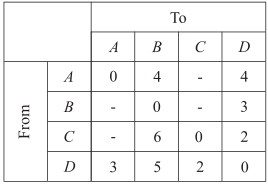
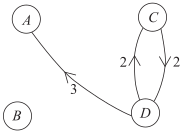
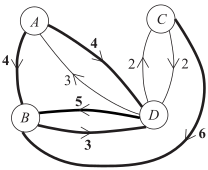
Networks, STD2 N2 SM-Bank 22

The table below represents a directed network.


Complete the network diagram below to accurately reflect the network described in the above table.  (2 marks)
 

--- 0 WORK AREA LINES (style=lined) ---
Show Answers Only


Show Worked Solution

Filed Under: Basic Concepts, Basic Concepts, Network Concepts (Std1-2027), Network Concepts (Std2-2027) Tagged With: Band 4, smc-1136-10-Table to Network, smc-6307-10-Table to Network, smc-6526-10-Table to Network, smc-912-10-Table to Network

Networks, STD2 N2 SM-Bank 21

The table below represents a network.


Complete the network diagram below to accurately reflect the information in the above table.  (2 marks)
 

--- 0 WORK AREA LINES (style=lined) ---

Show Answers Only

Show Worked Solution

Filed Under: Basic Concepts, Basic Concepts, Network Concepts (Std1-2027), Network Concepts (Std2-2027) Tagged With: Band 4, smc-1136-10-Table to Network, smc-6307-10-Table to Network, smc-6526-10-Table to Network, smc-912-10-Table to Network

Networks, STD2 N2 SM-Bank 20

A table is constructed to represent the network diagram below.


Complete the table.  (2 marks)
 

--- 0 WORK AREA LINES (style=lined) ---

Show Answers Only

Show Worked Solution

Filed Under: Basic Concepts, Basic Concepts, Network Concepts (Std1-2027), Network Concepts (Std2-2027) Tagged With: Band 3, smc-1136-20-Network to Table, smc-6307-20- Network to Table, smc-6526-20- Network to Table, smc-912-20-Network to Table

Networks, STD2 N2 SM-Bank 11

A network of roads between towns shows the travelling times in minutes between towns that are directly connected.


Complete the shaded cells in the following table so that it represents the information in this network.  (2 marks) 
 

--- 0 WORK AREA LINES (style=lined) ---

Show Answers Only

Show Worked Solution


`text(Note the symmetry in this table across the diagonal.)`

Filed Under: Basic Concepts, Basic Concepts, Network Concepts (Std1-2027), Network Concepts (Std2-2027) Tagged With: Band 4, smc-1136-20-Network to Table, smc-6307-20- Network to Table, smc-6526-20- Network to Table, smc-912-20-Network to Table

Networks, STD2 N2 2009 FUR2 1

The city of Robville is divided into five suburbs labelled as `A` to `E` on the map below. 

A lake which is situated in the city is shaded on the map.


NETWORKS, FUR2 2009 VCAA 11

A table is constructed to represent the number of land borders between suburbs.

If there is no land border between two suburbs, the table records a '0'. If there is a single land border between two suburbs, the table records a '1', and if there are two separate land borders between the same two suburbs, the table records a '2'.
 

`{:({:\ qquadAquadBquadCquadDquadE:}),({:(A),(B),(C),(D),(E):}[(0,1,1,1,0),(1,0,1,2,0),(1,1,0,0,0),(1,2,0,0,0),(0,0,0,0,0)]):}`


  1. Explain why all values in the final row and final column of the table are zero.  (1 mark)

    --- 2 WORK AREA LINES (style=lined) ---

In the network diagram below, vertices represent suburbs and edges represent land borders between suburbs. 

The diagram has been started but is not finished.


Networks, FUR2 2009 VCAA 1_1

  1. The network diagram is missing one edge and one vertex. 


    On the diagram

    1. draw the missing edge  (1 mark)
    2. draw and label the missing vertex.  (1 mark)

      --- 0 WORK AREA LINES (style=lined) ---

Show Answers Only
  1. `E\ text(has no land borders with other suburbs.)`
  2. i. & ii.
    Networks, FUR2 2009 VCAA 1 Answer
Show Worked Solution

a.   `E\ text(has no land borders with other suburbs.)`


b.i. & ii.    Networks, FUR2 2009 VCAA 1 Answer

Filed Under: Basic Concepts, Basic Concepts, Network Concepts (Std1-2027), Network Concepts (Std2-2027) Tagged With: Band 4, smc-6307-10-Table to Network, smc-6526-10-Table to Network, smc-912-10-Table to Network

Networks, STD2 N2 SM-Bank 37

The map of Australia shows the six states, the Northern Territory and the Australian Capital Territory (ACT).
  

In the network diagram below, each of the vertices `A` to `H` represents one of the states or territories shown on the map of Australia. The edges represent a border shared between two states or between a state and a territory.
 

  1. In the network diagram, what is the order of the vertex that represents the Australian Capital Territory (ACT)?  (1 mark)

    --- 1 WORK AREA LINES (style=lined) ---

  2. In the network diagram, Queensland is represented by which letter? Explain why.  (2 marks)

    --- 4 WORK AREA LINES (style=lined) ---
Show Answers Only

a.    `1`

b.    `text{NSW is Vertex B (it is connected to the ACT – Vertex D)}`

`=> C\ text{is Victoria as it has degree 2}`

`:.\ text(Queensland is vertex)\ A\ text(as it is connected to)\ B\ text(and has degree 3.)`

Show Worked Solution

a.     `text {ACT has 1 border (with NSW)}`

`:.\ text(Degree of ACT’s vertex = 1)`
 

b.    `text{NSW is Vertex B (it is connected to the ACT – Vertex D)}`

`=> C\ text{is Victoria as it has degree 2}`

`:.\ text(Queensland is vertex)\ A\ text(as it is connected to)\ B\ text(and has degree 3.)`

Filed Under: Basic Concepts, Basic Concepts, Basic Concepts, Network Concepts (Std1-2027), Network Concepts (Std2-2027) Tagged With: Band 4, num-title-ct-extension, smc-1136-40-Degrees of Vertices, smc-1136-50-Other, smc-4788-60-Connected graphs, smc-4788-70-Applications, smc-6307-30-Map to Network, smc-6307-50-Degree of Vertices, smc-6526-30-Map to Network, smc-6526-50-Degree of Vertices, smc-912-25-Map to Network, smc-912-40-Degrees of Vertices

Networks, STD2 N2 2015 FUR1 5 MC

The graph below represents a friendship network. The vertices represent the four people in the friendship network: Kwan (K), Louise (L), Milly (M) and Narelle (N).

An edge represents the presence of a friendship between a pair of these people. For example, the edge connecting K and L shows that Kwan and Louise are friends.
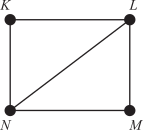
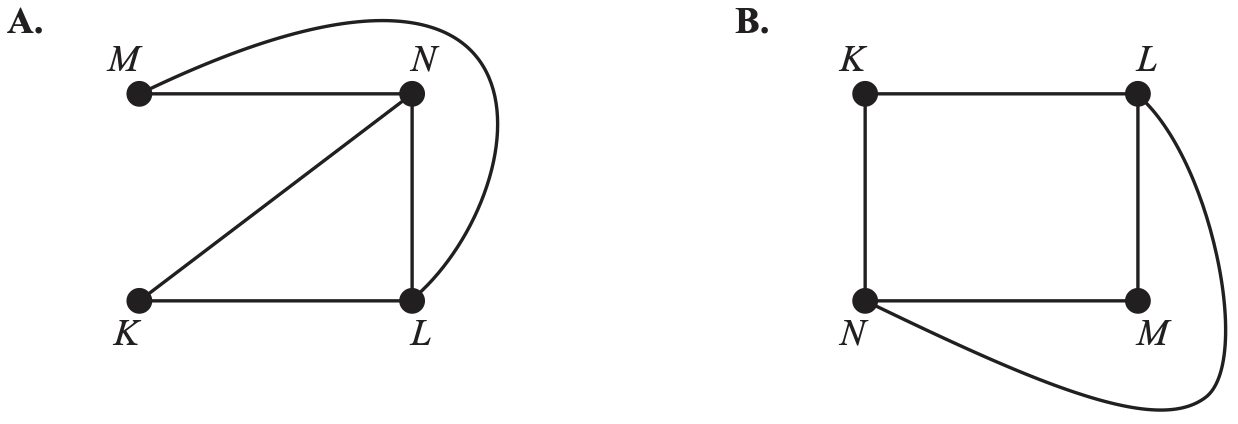
Which one of the following graphs does not contain the same information.


Show Answers Only

`D`

Show Worked Solution

`text(Option D has Kwan and Milly as friends which is not correct.)`

`=> D`

Filed Under: Basic Concepts, Basic Concepts, Basic Concepts, Network Concepts (Std1-2027), Network Concepts (Std2-2027) Tagged With: Band 2, num-title-ct-path, smc-1136-50-Other, smc-4788-40-Planar graphs, smc-6307-60-Other, smc-6526-60-Other, smc-912-50-Other

Networks, STD2 N2 2011 FUR1 1 MC

In the network shown, the number of vertices of even degree is

  1. `2`
  2. `3`
  3. `4`
  4. `5`
Show Answers Only

`B`

Show Worked Solution

`text{Vertices with even degrees: 2, 2, 6}`

`=>  B`

Filed Under: Basic Concepts, Basic Concepts, Basic Concepts, Network Concepts (Std1-2027), Network Concepts (Std2-2027) Tagged With: Band 4, num-title-ct-path, smc-1136-40-Degrees of Vertices, smc-4788-20-Degrees of vertices, smc-6307-50-Degree of Vertices, smc-6526-50-Degree of Vertices, smc-912-40-Degrees of Vertices

Networks, STD2 N2 2017 FUR1 2 MC

Two graphs, labelled Graph 1 and Graph 2, are shown below.


The sum of the degrees of the vertices of Graph 1 is

  1. two less than the sum of the degrees of the vertices of Graph 2.
  2. one less than the sum of the degrees of the vertices of Graph 2.
  3. equal to the sum of the degrees of the vertices of Graph 2.
  4. two more than the sum of the degrees of the vertices of Graph 2.
Show Answers Only

`C`

Show Worked Solution

`text(Graph 1)`

`∑\ text(degrees)\ = 3 + 3 + 3 + 3 = 12`

`text(Graph 2)`

`∑\ text(degrees)\ = 2 + 2 + 2 + 2 + 2 + 2 = 12`

`=> C`

Filed Under: Basic Concepts, Basic Concepts, Basic Concepts, Network Concepts (Std1-2027), Network Concepts (Std2-2027) Tagged With: Band 3, num-title-ct-path, smc-1136-40-Degrees of Vertices, smc-4788-20-Degrees of vertices, smc-6307-50-Degree of Vertices, smc-6526-50-Degree of Vertices, smc-912-40-Degrees of Vertices

Networks, STD2 N2 SM-Bank 3 MC

A store manager is directly in charge of five department managers.

Each department manager is directly in charge of six sales people in their department.

This staffing structure could be represented graphically by

A.   a tree.

B.   a path.

C.   a cycle.

D.   a weighted graph.
Show Answers Only

`A`

Show Worked Solution

`=>  A`

Filed Under: Basic Concepts, Basic Concepts, Network Concepts (Std1-2027), Network Concepts (Std2-2027) Tagged With: Band 3, smc-1136-30-Definitions, smc-6307-40-Definitions, smc-6526-40-Definitions, smc-912-30-Definitions

Networks, STD2 N2 SM-Bank 32 MC

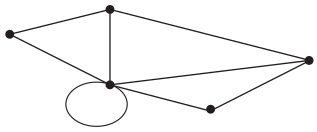
The number of vertices with an odd degree in the network above is
  1. `2`
  2. `3`
  3. `4`
  4. `5`
Show Answers Only

`A`

Show Worked Solution

`rArr A`

`text{(Note a loop creates 2 extra degrees to a vertex.)}`

Filed Under: Basic Concepts, Basic Concepts, Network Concepts (Std1-2027), Network Concepts (Std2-2027) Tagged With: Band 3, smc-1136-40-Degrees of Vertices, smc-6307-50-Degree of Vertices, smc-6526-50-Degree of Vertices, smc-912-40-Degrees of Vertices

Networks, STD2 N2 2015 FUR1 1 MC

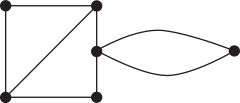
In the graph above, the number of vertices of odd degree is

  1. `1`
  2. `2`
  3. `3`
  4. `4`
Show Answers Only

`B`

Show Worked Solution

`=> B`

Filed Under: Basic Concepts, Basic Concepts, Network Concepts (Std1-2027), Network Concepts (Std2-2027) Tagged With: Band 2, smc-1136-40-Degrees of Vertices, smc-6307-50-Degree of Vertices, smc-6526-50-Degree of Vertices, smc-912-40-Degrees of Vertices

Networks, STD2 N2 2013 FUR1 1 MC

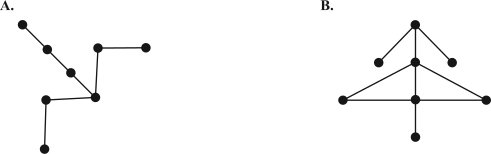
Which one of the following graphs is a tree?
  

Show Answers Only

`A`

Show Worked Solution

`text(A tree cannot contain a cycle.)`

`=>  A`

Filed Under: Basic Concepts, Basic Concepts, Basic Concepts, Network Concepts (Std1-2027), Network Concepts (Std2-2027) Tagged With: Band 2, num-title-ct-path, smc-1136-30-Definitions, smc-4788-10-Definitions, smc-6307-40-Definitions, smc-6526-40-Definitions, smc-912-30-Definitions

Networks, STD2 N2 2010 FUR1 2 MC

 vcaa-networks-fur1-2010-2 

The number of edges in the graph above is

  1. `5`
  2. `7`
  3. `8`
  4. `10`
Show Answers Only

`C`

Show Worked Solution

`text{Edges are represented by lines between vertices.}`

`=>  C`

Filed Under: Basic Concepts, Basic Concepts, Basic Concepts, Network Concepts (Std1-2027), Network Concepts (Std2-2027) Tagged With: Band 2, smc-1136-30-Definitions, smc-1136-45-Number of Edges, smc-4788-10-Definitions, smc-4788-20-Number of edges, smc-6307-40-Definitions, smc-6526-40-Definitions, smc-912-30-Definitions

Networks, STD2 N2 2012 FUR1 1 MC

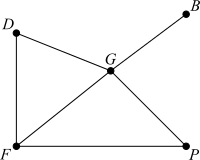
The sum of the degrees of all the vertices in the graph above is

A.    `6`

B.    `9`

C.   `11`

D.   `12`
Show Answers Only

`D`

Show Worked Solution

`text(Total Degrees)`

`=1 + 3 + 2 + 2 + 2 + 2`

`=12`

`rArr D`

Filed Under: Basic Concepts, Basic Concepts, Network Concepts (Std1-2027), Network Concepts (Std2-2027) Tagged With: Band 2, smc-1136-40-Degrees of Vertices, smc-6307-50-Degree of Vertices, smc-6526-50-Degree of Vertices, smc-912-40-Degrees of Vertices

Copyright © 2014–2025 SmarterEd.com.au · Log in