SmarterEd

Aussie Maths & Science Teachers: Save your time with SmarterEd

  • Login
  • Get Help
  • About

Statistics, 2ADV S2 2025 HSC 14

In a research study, participants were asked to record the number of minutes they spent watching television and the number of minutes they spent exercising each day over a period of 3 months. The averages for each participant were recorded and graphed.
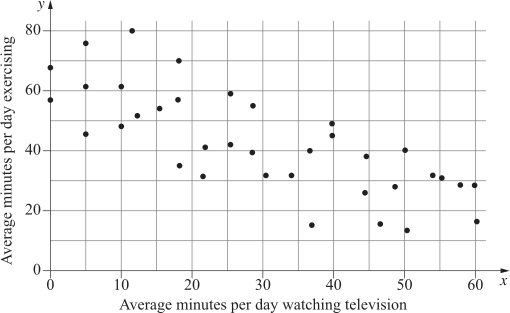


  1. Describe the bivariate dataset in terms of its form and direction.   (2 marks)
  2. Form:  ..................................................................
  3. Direction:  ............................................................

    --- 0 WORK AREA LINES (style=lined) ---

The equation of the least-squares regression line for this dataset is

\(y=64.3-0.7 x\)

  1. Interpret the values of the slope and \(y\)-intercept of the regression line in the context of this dataset.   (2 marks)

    --- 6 WORK AREA LINES (style=lined) ---

  2. Jo spends an average of 42 minutes per day watching television.
  3. Use the equation of the regression line to determine how many minutes on average Jo is expected to exercise each day.   (1 mark)

    --- 4 WORK AREA LINES (style=lined) ---

  4. Explain why it is NOT appropriate to extrapolate the regression line to predict the average number of minutes of exercise per day for someone who watches an average of 2 hours of television per day.   (1 mark)

    --- 4 WORK AREA LINES (style=lined) ---
Show Answers Only

a.    \(\text{Form: Linear}\)

\(\text{Direction: Negative}\)
 

b.    \(\text{Slope}=-0.7\)

\(\text{This means that for each added minute of watching television per day, a participant, on average,}\)

\(\text{will exercise for 0.7 minutes less.}\)

\(y \text{-intercept}=64.3\)

\(\text{If someone watches no television, the LSRL predicts they will exercise for 64.3 minutes per day.}\)
 

c.    \(\text{34.9 minutes}\)
 

d.    \(\text{At} \ \  x=120\ \text{(2 hours),} \ \ y=64.3-0.7 \times 120=-19.7\)

\(\text{The model predicts a negative value for time spent exercising, which is not possible.}\)

Show Worked Solution

a.    \(\text{Form: Linear}\)

\(\text{Direction: Negative}\)
 

b.    \(\text{Slope}=-0.7\)

\(\text{This means that for each added minute of watching television per day, a participant, on average,}\)

\(\text{will exercise for 0.7 minutes less.}\)

\(y \text{-intercept}=64.3\)

\(\text{If someone watches no television, the LSRL predicts they will exercise for 64.3 minutes per day.}\)
 

c.    \(\text{At} \ \ x=42:\)

\(y=64.3-0.7 \times 42=34.9\)

\(\therefore \ \text{Jo is expected to exercise for 34.9 minutes}\)
 

d.    \(\text{At} \ \  x=120\ \text{(2 hours),} \ \ y=64.3-0.7 \times 120=-19.7\)

\(\text{The model predicts a negative value for time spent exercising, which is not possible.}\)

Filed Under: Bivariate Data Analysis (Y12) Tagged With: 2adv-std2-common, Band 3, Band 4, Band 5, smc-1001-20-Least-Squares Regression Line, smc-1001-50-Gradient Interpretation, smc-1001-60-Limitations

Statistics, 2ADV S2 2024 HSC 21

A researcher is studying anacondas (a type of snake).

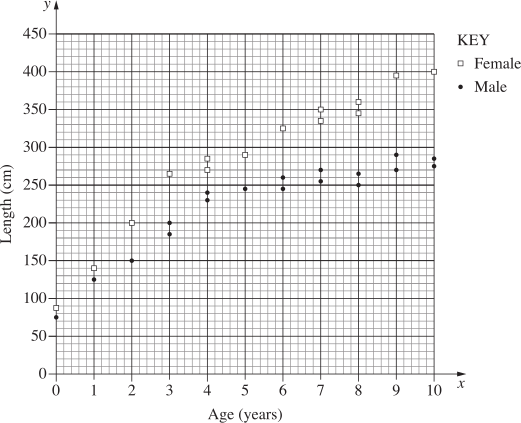
A dataset recording the age (in years) and length (in cm) of female and male anacondas is displayed on the graph.

Anacondas reach maturity at about 4 years of age.
 

Write THREE observations about anacondas that may be made from the scatterplot. (Note: No calculations are required.)   (3 marks)

--- 6 WORK AREA LINES (style=lined) ---

Show Answers Only

\(\text{Answers could include any three of the following:}\)

\(→\ \text{Female anacondas are longer than males of the equivalent age.}\)

\(→\ \text{Female anacondas grow more quickly than male anacondas from birth until}\)

\(\text{maturity which can be seen by the steeper gradient of the LOBF for each dataset}\)

\(\text{over this period.}\)

\(→\ \text{Female anacondas continue to grow to at least 10 years of age, well past their}\)

\(\text{age of maturity at 4 years of age.}\)

\(→\ \text{Male anacondas’ growth slows noticeably and flattens out once they hit their}\)

\(\text{age of maturity at 4 years old.}\)

Show Worked Solution

\(\text{Answers could include any three of the following:}\)

\(→\ \text{Female anacondas are longer than males of the equivalent age.}\)

\(→\ \text{Female anacondas grow more quickly than male anacondas from birth until}\)

\(\text{maturity which can be seen by the steeper gradient of the LOBF for each dataset}\)

\(\text{over this period.}\)

\(→\ \text{Female anacondas continue to grow to at least 10 years of age, well past their}\)

\(\text{age of maturity at 4 years of age.}\)

\(→\ \text{Male anacondas’ growth slows noticeably and flattens out once they hit their}\)

\(\text{age of maturity at 4 years old.}\)

Filed Under: Bivariate Data Analysis (Y12) Tagged With: 2adv-std2-common, Band 3, smc-1001-50-Gradient Interpretation, smc-1001-90-Data observations

Statistics, 2ADV S2 2022 HSC 24

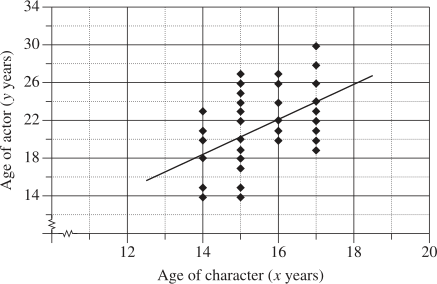
Jo is researching the relationship between the ages of teenage characters in television series and the ages of actors playing these characters.

After collecting the data, Jo finds that the correlation coefficient is 0.4564.

A scatterplot showing the data is drawn. The line of best fit with equation  `y=-7.51+1.85 x`, is also drawn.


Describe and interpret the data and other information provided, with reference to the context given.  (4 marks)

--- 8 WORK AREA LINES (style=lined) ---

Show Answers Only

`text{Correlation coefficient}\ (r) = 0.4564`

    • `text{Moderate and positive correlation}`

`text{Gradient of LOBF}\ = 1.85`

    • `text{On average, each extra year of a character’s age results}`
      `text{in the actor being 1.85 years older.}`

`text{Mode of data set = 15 years}`
  

`text{Limitations}`

    • `text{Data set is very restricted with just a 4 year range of}`
      `text{character ages.}`
    • `text{LOBF not useful when extrapolated to the left as it drops}`
      `text{below zero (on y-axis).}`
    • `text{Relationship describes correlation only, not causation.}`
Show Worked Solution

`text{Correlation coefficient}\ (r) = 0.4564`

    • `text{Moderate and positive correlation}`

`text{Gradient of LOBF}\ = 1.85`

    • `text{On average, each extra year of a character’s age results}`
      `text{in the actor being 1.85 years older.}`

`text{Mode of data set = 15 years}`
  

`text{Limitations}`

    • `text{Data set is very restricted with just a 4 year range of}`
      `text{character ages.}`
    • `text{LOBF not useful when extrapolated to the left as it drops}`
      `text{below zero (on y-axis).}`
    • `text{Relationship describes correlation only, not causation.}`

Filed Under: Bivariate Data Analysis (Y12) Tagged With: 2adv-std2-common, Band 4, common-content, smc-1001-30-Correlation, smc-1001-50-Gradient Interpretation, smc-1001-60-Limitations

Statistics, 2ADV S2 2021 HSC 17

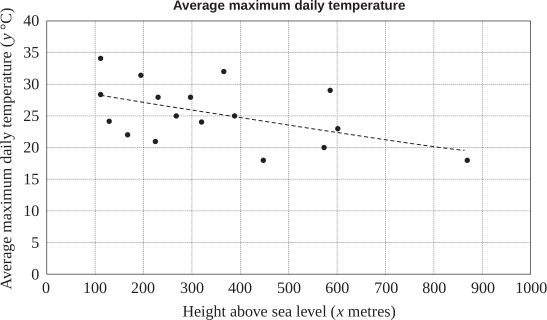
For a sample of 17 inland towns in Australia, the height above sea level, `x` (metres), and the average maximum daily temperature, `y` (°C), were recorded.

The graph shows the data as well as a regression line.


The equation of the regression line is  `y = 29.2 − 0.011x`.

The correlation coefficient is  `r = –0.494`.

  1. i.  By using the equation of the regression line, predict the average maximum daily temperature, in degrees Celsius, for a town that is 540 m above sea level. Give your answer correct to one decimal place.  (1 mark)

    --- 1 WORK AREA LINES (style=lined) ---

  2. ii. The gradient of the regression line is −0.011. Interpret the value of this gradient in the given context.  (2 marks)

    --- 5 WORK AREA LINES (style=lined) ---

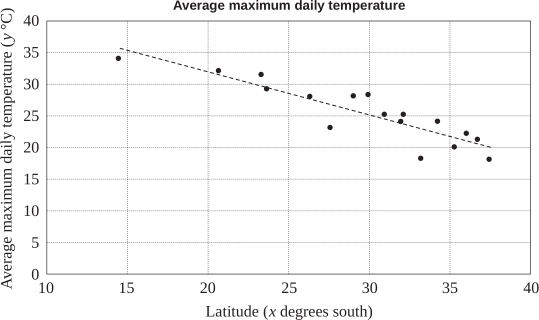
  3. The graph below shows the relationship between the latitude, `x` (degrees south), and the average maximum daily temperature, `y` (°C), for the same 17 towns, as well as a regression line.


    The equation of the regression line is  `y = 45.6 − 0.683x`.
  4. The correlation coefficient is  `r = − 0.897`.
  5. Another inland town in Australia is 540 m above sea level. Its latitude is 28 degrees south.
  6. Which measurement, height above sea level or latitude, would be better to use to predict this town’s average maximum daily temperature? Give a reason for your answer.  (1 mark)

    --- 3 WORK AREA LINES (style=lined) ---

Show Answers Only
  1. i.  `23.3°text(C)`
  2. ii. `text(See Worked Solutions)`
  3. `text(Latitude. Correlation coefficient shows a stronger relationship.)`
Show Worked Solution
a.i.    `y` `=29.2 – 0.011(540)`
    `=23.26`
    `=23.3°text{C  (1 d.p.)`
 

a.ii.  `text(On average, the average maximum daily temperature of)`

`text(inland towns drops by 0.011 of a degree for every metre)`

`text(above sea level the town is situated.)`
 

b.  `text(The correlation co-efficient of the regression line using)`

`text(latitude is significantly stronger than the equivalent)`

`text(co-efficient for the regression line using height above sea)`

`text(level.)`

`:.\ text(The equation using latitude is preferred.)`

Filed Under: Bivariate Data Analysis (Y12) Tagged With: 2adv-std2-common, Band 3, Band 4, common-content, smc-1001-20-Least-Squares Regression Line, smc-1001-30-Correlation, smc-1001-50-Gradient Interpretation

Statistics, 2ADV S2 EQ-Bank 1

The arm spans (in cm) and heights (in cm) for a group of 13 boys have been measured. The results are displayed in the table below.
 

CORE, FUR2 2008 VCAA 4

The aim is to find a linear equation that allows arm span to be predicted from height.

  1. What will be the independent variable in the equation?  (1 mark)

    --- 1 WORK AREA LINES (style=lined) ---

  2. Assuming a linear association, determine the equation of the least squares regression line that enables arm span to be predicted from height. Write this equation in terms of the variables arm span and height. Give the coefficients correct to two decimal places.  (2 marks)

    --- 4 WORK AREA LINES (style=lined) ---
  3. Using the equation that you have determined in part b., interpret the slope of the least squares regression line in terms of the variables height and arm span.  (1 mark)

    --- 2 WORK AREA LINES (style=lined) ---

Show Answers Only
  1. `text(Height)`
  2. `text(Arm span)\ = 1.09 xx text(height) – 15.63`
  3. `text(On average, arm span increases by 1.09 cm)`
    `text(for each 1 cm increase in height.)`
Show Worked Solution

a.   `text(Height)`

COMMENT: Calculator skills for finding the least squares regression line were required in NESA sample exam – know this critical skill well!


b.   `text(By calculator,)`

`text(Arm span)\ = 1.09 xx text(height) – 15.63`


c.   `text(On average, arm span increases by 1.09 cm)`

`text(for each 1 cm increase in height.)`

Filed Under: Bivariate Data Analysis (Y12), S4 Bivariate Data Analysis (Y12) Tagged With: Band 3, Band 4, common-content, smc-1001-20-Least-Squares Regression Line, smc-1001-50-Gradient Interpretation, smc-1001-70-Calculator (Stats Mode), smc-785-20-Least-Squares Regression Line, smc-785-50-Gradient Interpretation, smc-785-70-Calculator (Stats Mode)

Algebra, STD2 A2 2016 HSC 29e

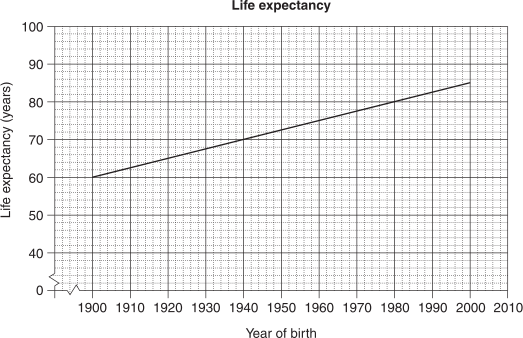
The graph shows the life expectancy of people born between 1900 and 2000.


  1. According to the graph, what is the life expectancy of a person born in 1932?  (1 mark)

    --- 1 WORK AREA LINES (style=lined) ---

  2. With reference to the value of the gradient, explain the meaning of the gradient in this context.  (2 marks)

    --- 4 WORK AREA LINES (style=lined) ---
Show Answers Only
  1. `text(68 years)`
  2. `text(After 1900, life expectancy increases 0.25 years for each later year someone is born.)`
Show Worked Solution

i.    \(\text{68 years}\)

ii.    \(\text{Using (1900,60), (1980,80):}\)

\(\text{Gradient}\) \(= \dfrac{y_2-y_1}{x_2-x_1}\)
  \(= \dfrac{80-60}{1980-1900}\)
  \(= 0.25\)

 
\(\text{After 1900, life expectancy increases by 0.25 years for}\)

\(\text{each year later that someone is born.}\)

♦♦ Mean mark (ii) 33%.

Filed Under: Applications: Currency, Fuel and Other Problems (Std 1), Applications: Currency, Fuel and Other Problems (Std 2), Applications: Currency, Fuel and Other Problems (Std2-2027), Bivariate Data Analysis (Y12), Life Expectancy, Other Linear Modelling, S3 Further Statistical Analysis (Y12), S4 Bivariate Data Analysis (Y12) Tagged With: Band 3, Band 5, common-content, smc-1001-10-Line of Best Fit, smc-1001-50-Gradient Interpretation, smc-1113-10-Line of Best Fit, smc-1113-50-Gradient, smc-1119-30-Other Linear Applications, smc-6256-30-Other Linear Applications, smc-785-10-Line of Best Fit, smc-785-50-Gradient Interpretation, smc-793-30-Other Linear Applications

Statistics, STD2 S4 2013 HSC 28b

Ahmed collected data on the age (`a`) and height (`h`) of males aged 11 to 16 years.

He created a scatterplot of the data and constructed a line of best fit to model the relationship between the age and height of males.
 

  1. Determine the gradient of the line of best fit shown on the graph.   (1 mark)

    --- 2 WORK AREA LINES (style=lined) ---
  2. Explain the meaning of the gradient in the context of the data.   (1 mark)

    --- 2 WORK AREA LINES (style=lined) ---

  3. Determine the equation of the line of best fit shown on the graph.  (2 marks)

    --- 5 WORK AREA LINES (style=lined) ---

  4. Use the line of best fit to predict the height of a typical 17-year-old male.   (1 mark)

    --- 1 WORK AREA LINES (style=lined) ---

  5. Why would this model not be useful for predicting the height of a typical 45-year-old male?   (1 mark)

    --- 2 WORK AREA LINES (style=lined) ---

Show Answers Only
  1. `text(Gradient = 6)`
  2. `text(Males should grow 6 cm per)`


    `text(year between the ages 11-16.)`

  3. `h = 6a + 80`
  4. `text(182 cm)`
  5. `text(People slow and eventually stop growing)`
  6.  

    `text(after they become adults.)`

Show Worked Solution

i.    `text{Gradient}\ =(176-146)/(16-11)=30/5=6`
 

ii.   `text{Males should grow 6cm per year between the}`

`text{ages 11–16.}`
 

♦♦ Mean marks of 38%, 26% and 25% respectively for parts (i)-(iii).
MARKER’S COMMENT: Interpreting gradients has been consistently examined in recent history and almost always poorly answered. 

iii.   `text{Gradient = 6,  Passes through (11, 146)}`

`y-y_1` `=m(x-x_1)`
`h-146` `=6(a-11)`
`:. h` `=6a-66+146`
  `=6a + 80`


iv.   `text{Substitue}\ \ a=17\ \ \text{into equation from part (iii):}`

`h=(6 xx 17) +80=182`

`:.\ text{A typical 17 year old is expected to be 182cm.}`
  

v.    `text(People slow and eventually stop growing)`
  `text(after they become adults.)`

Filed Under: Bivariate Data Analysis (Y12), Life Expectancy, Other Linear Modelling, S3 Further Statistical Analysis (Y12), S4 Bivariate Data Analysis (Y12) Tagged With: Band 4, Band 5, common-content, smc-1001-10-Line of Best Fit, smc-1001-50-Gradient Interpretation, smc-1001-60-Limitations, smc-1113-10-Line of Best Fit, smc-1113-50-Gradient, smc-1113-60-Limitations, smc-785-10-Line of Best Fit, smc-785-50-Gradient Interpretation, smc-785-60-Limitations

Copyright © 2014–2025 SmarterEd.com.au · Log in