SmarterEd

Aussie Maths & Science Teachers: Save your time with SmarterEd

  • Login
  • Get Help
  • About

Statistics, STD2 S4 EQ-Bank 4

Ten high school students have their height and the length of their right foot measured.

The results are recorded in the table below.



  1. Using technology, calculate Pearson's correlation coefficient for the data. Give your answer to 3 decimal places.  (1 mark)

    --- 1 WORK AREA LINES (style=lined) ---

  2. Describe the strength of the association between height and length of right foot for these students.  (1 mark)

    --- 2 WORK AREA LINES (style=lined) ---

  3. Using technology, determine the least squares regression line that allows height to be predicted from right foot length.  (1 mark)

    --- 1 WORK AREA LINES (style=lined) ---
Show Answers Only
  1. `0.941\ \ (text(to 3 d.p.))`
  2. `text(The association is positive and strong.)`
  3. `text(Height) =47.4 + 4.7 xx text(foot length)`
Show Worked Solution

i.   `text(By calculator,)`

COMMENT: Issues here? YouTube has short and excellent help videos – search your calculator model and topic – eg. “fx-82 correlation” .

`r` `= 0.94095…`
  `= 0.941\ \ (text(to 3 d.p.))`


ii.   `text(The association is positive and strong.)`


iii.   `x\ text(value ⇒ foot length (independent variables))`

`y\ text(value ⇒ height.)`

`text(By calculator:)`

`text(Height) = 47.4 + 4.7 xx text(foot length)`

Filed Under: Bivariate Data Analysis (Y12), S4 Bivariate Data Analysis (Y12) Tagged With: Band 4, common-content, smc-1001-20-Least-Squares Regression Line, smc-1001-30-Correlation, smc-1001-40-Pearson's, smc-1001-70-Calculator (Stats Mode), smc-785-20-Least-Squares Regression Line, smc-785-30-Correlation, smc-785-40-Pearson's, smc-785-70-Calculator (Stats Mode)

Statistics, 2ADV S2 EQ-Bank 3

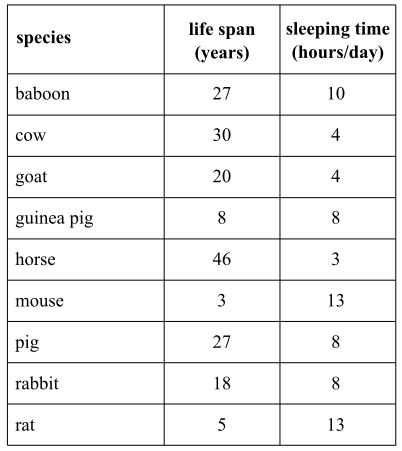
The table below lists the average life span (in years) and average sleeping time (in hours/day) of 9 animal species.


  1. Using sleeping time as the independent variable, calculate the least squares regression line. (1 mark)

    --- 1 WORK AREA LINES (style=lined) ---

  2. A wallaby species sleeps for 4.5 hours, on average, each day.


    Use your equation from part i to predict its expected life span, to the nearest year.   (1 mark)

    --- 1 WORK AREA LINES (style=lined) ---

Show Answers Only
  1. `text(life span) = 42.89 – 2.85 xx text(sleeping time)`
  2. `30\ text(years)`
Show Worked Solution

i.    `text(By calculator:)`

COMMENT: Issues here? YouTube has short and excellent help videos – search your calculator model and topic – eg. “fx-82 regression line” .

`text(life span) = 42.89 – 2.85 xx text(sleeping time)`
 

ii.   `text(Predicted life span of wallaby)`

`= 42.89 – 2.85 xx 4.5` 

`= 30.06…`

`= 30\ text(years)`

Filed Under: Bivariate Data Analysis (Y12), S4 Bivariate Data Analysis (Y12) Tagged With: Band 3, Band 4, common-content, smc-1001-20-Least-Squares Regression Line, smc-1001-70-Calculator (Stats Mode), smc-785-20-Least-Squares Regression Line, smc-785-70-Calculator (Stats Mode)

Statistics, 2ADV S2 EQ-Bank 2

The table below lists the average body weight (in kilograms) and average brain weight (in grams) of nine animal species.


A least squares regression line is fitted to the data using body weight as the independent variable.

  1. Calculate the equation of the least squares regression line. (1 mark)

    --- 2 WORK AREA LINES (style=lined) ---

  2. If dingos have an average body weight of 22.3 kilograms, calculate the predicted average brain weight of a dingo using your answer to part i.   (1 mark)

    --- 1 WORK AREA LINES (style=lined) ---
Show Answers Only
  1. `text(brain weight) = 49.4 + 2.68 xx text(body weight)`
  2. `109\ text(grams)`
Show Worked Solution

i.   `text(By calculator:)`

COMMENT: Know this critical calculator skill!.

`text(brain weight) = 49.4 + 2.68 xx text(body weight)`


ii.   `text(Predicted brain weight of a dingo)`

`= 49.4 + 2.68 xx 22.3` 

`=109.164`

`= 109\ text(grams)`

Filed Under: Bivariate Data Analysis (Y12), S4 Bivariate Data Analysis (Y12) Tagged With: Band 3, Band 4, common-content, smc-1001-20-Least-Squares Regression Line, smc-1001-70-Calculator (Stats Mode), smc-785-20-Least-Squares Regression Line, smc-785-70-Calculator (Stats Mode)

Statistics, 2ADV S2 EQ-Bank 1

The arm spans (in cm) and heights (in cm) for a group of 13 boys have been measured. The results are displayed in the table below.
 

CORE, FUR2 2008 VCAA 4

The aim is to find a linear equation that allows arm span to be predicted from height.

  1. What will be the independent variable in the equation?  (1 mark)

    --- 1 WORK AREA LINES (style=lined) ---

  2. Assuming a linear association, determine the equation of the least squares regression line that enables arm span to be predicted from height. Write this equation in terms of the variables arm span and height. Give the coefficients correct to two decimal places.  (2 marks)

    --- 4 WORK AREA LINES (style=lined) ---

  3. Using the equation that you have determined in part b., interpret the slope of the least squares regression line in terms of the variables height and arm span.  (1 mark)

    --- 2 WORK AREA LINES (style=lined) ---

Show Answers Only
  1. `text(Height)`
  2. `text(Arm span)\ = 1.09 xx text(height) – 15.63`
  3. `text(On average, arm span increases by 1.09 cm)`
    `text(for each 1 cm increase in height.)`
Show Worked Solution

a.   `text(Height)`

COMMENT: Calculator skills for finding the least squares regression line were required in NESA sample exam – know this critical skill well!


b.   `text(By calculator,)`

`text(Arm span)\ = 1.09 xx text(height) – 15.63`


c.   `text(On average, arm span increases by 1.09 cm)`

`text(for each 1 cm increase in height.)`

Filed Under: Bivariate Data Analysis (Y12), S4 Bivariate Data Analysis (Y12) Tagged With: Band 3, Band 4, common-content, smc-1001-20-Least-Squares Regression Line, smc-1001-50-Gradient Interpretation, smc-1001-70-Calculator (Stats Mode), smc-785-20-Least-Squares Regression Line, smc-785-50-Gradient Interpretation, smc-785-70-Calculator (Stats Mode)

Statistics, STD2 S4 2019 HSC 23

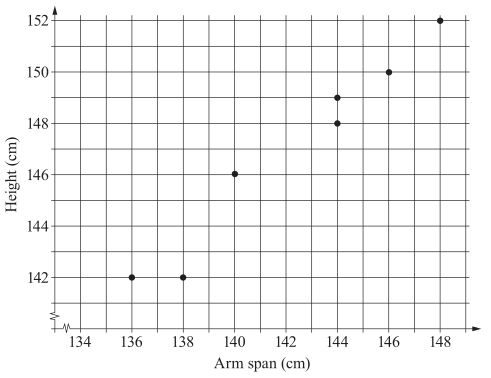
A set of bivariate data is collected by measuring the height and arm span of seven children. The graph shows a scatterplot of these measurements.


  1. Calculate Pearson's correlation coefficient for the data, correct to two decimal places.  (1 mark)

    --- 1 WORK AREA LINES (style=lined) ---

  2. Identify the direction and the strength of the linear association between height and arm span.  (1 mark)

    --- 2 WORK AREA LINES (style=lined) ---

  3. The equation of the least-squares regression line is shown.
     
               Height = 0.866 × (arm span) + 23.7
     
    A child has an arm span of 143 cm.


    Calculate the predicted height for this child using the equation of the least-squares regression line.  (1 mark)

    --- 1 WORK AREA LINES (style=lined) ---

Show Answers Only
  1. `0.98\ \ (text(2 d.p.))`
  2. `text(Direction: positive)`
    `text(Strength: strong)`
  3. `147.538\ text(cm)`
Show Worked Solution

a.   `text{Use  “A + Bx”  function (fx-82 calc):}`

♦ Mean mark 40%.
COMMENT: Issues here? YouTube has short and excellent help videos – search your calculator model and topic – eg. “fx-82 correlation” .

`r` `= 0.9811…`
  `= 0.98\ \ (text(2 d.p.))`


b.   `text(Direction: positive)`

`text(Strength: strong)`


c.    `text(Height)` `= 0.866 xx 143 + 23.7`
    `= 147.538\ text(cm)`

Filed Under: Bivariate Data Analysis (Y12), S4 Bivariate Data Analysis (Y12) Tagged With: Band 3, Band 4, Band 5, common-content, smc-1001-30-Correlation, smc-1001-40-Pearson's, smc-1001-70-Calculator (Stats Mode), smc-785-30-Correlation, smc-785-40-Pearson's, smc-785-70-Calculator (Stats Mode)

Copyright © 2014–2025 SmarterEd.com.au · Log in