SmarterEd

Aussie Maths & Science Teachers: Save your time with SmarterEd

  • Login
  • Get Help
  • About

Calculus, EXT1 C2 2025 HSC 14d

The function  \(f(x)\)  is defined by  \(f(x)=\cos ^{-1}(\sin x)\)  in the domain \((0, \pi)\).

Find  \(f^{\prime}(x)\)  for those values of \(x\) where it is defined.   (3 marks)

--- 6 WORK AREA LINES (style=lined) ---

Show Answers Only

\(f^{\prime}(x)=-1 \ \text{for} \ \ x \in\left(0, \dfrac{\pi}{2}\right)\)

\(f^{\prime}(x)=1 \ \text{for} \ \ x \in\left(\dfrac{\pi}{2}, \pi\right)\)

Show Worked Solution
\(f(x)\) \(=\cos ^{-1}(\sin x)\)
\(f^{\prime}(x)\) \(=-\dfrac{\cos x}{\sqrt{1-\sin ^2 x}}\)
  \(=-\dfrac{\cos x}{\abs{\cos x}}\)
  \(= \pm 1\)

 
\(\text{Consider limitations:}\)

\(1-\sin ^2 x \neq 0 \ \Rightarrow \ \sin x \neq \pm 1 \ \Rightarrow \ x \neq \dfrac{\pi}{2}\)

\(\text{In lst quadrant:} \ \ -\dfrac{\cos x}{\abs{\cos x}}=-1\)

\(\text{In 2nd quadrant:}\ \  -\dfrac{\cos x}{\abs{\cos x}}=1\)

\(f^{\prime}(x)=-1 \ \ \text{for} \ \ x \in\left(0, \dfrac{\pi}{2}\right)\)

\(f^{\prime}(x)=1 \ \ \text{for} \ \ x \in\left(\dfrac{\pi}{2}, \pi\right)\)

Filed Under: Inverse Functions Calculus (Ext1) Tagged With: Band 6, smc-1037-10-Sin/Cos Differentiation

Calculus, EXT1 C2 EQ-Bank 1

Given  \(y=\dfrac{\cos 2 x}{x^2}\),  find the gradient of the tangent of its inverse function at  \(\left(\dfrac{8 \sqrt{2}}{\pi^2}, \dfrac{\pi}{4}\right)\).   (3 marks)

--- 7 WORK AREA LINES (style=lined) ---

Show Answers Only

\(-\dfrac{\pi^2}{32}\)

Show Worked Solution

\(y=\dfrac{\cos2x}{x^2}\)

\(\text{Inverse: Swap} \ \ x \leftrightarrow y\)

\(x=\dfrac{\cos 2 y}{y^2}\)

\(u=\cos 2 y \ \ \quad \quad \quad v=y^2\)

\(v^{\prime}=-2 \sin 2 y \ \ \quad v^{\prime}=2 y\)

\(\dfrac{dx}{dy}=\dfrac{-2 y^2 \sin 2 y-2 y\, \cos 2 y}{y^4}\)

\(\dfrac{dy}{dx}=\dfrac{y^4}{-2 y^2 \sin 2 y-2 y\, \cos 2 y}\)
 

\(\text{At}\ \ y=\dfrac{\pi}{4}:\)

\(\dfrac{d y}{d x}\) \(=\dfrac{\left(\dfrac{\pi}{4}\right)^4}{-2\left(\dfrac{\pi}{4}\right)^2 \sin \left(\dfrac{\pi}{2}\right)-2\left(\dfrac{\pi}{4}\right) \cos \left(\dfrac{\pi}{2}\right)}\)
  \(=-\dfrac{\pi^4}{256} \times \dfrac{8}{\pi^2}\)
  \(=-\dfrac{\pi^2}{32}\)

Filed Under: Inverse Functions Calculus (Ext1) Tagged With: Band 5, smc-1037-10-Sin/Cos Differentiation, smc-1037-60-Tangents

Calculus, EXT1 C2 2024 HSC 11e

Differentiate the function  \(f(x)=\arcsin \left(x^5\right)\).   (1 mark)

--- 3 WORK AREA LINES (style=lined) ---

Show Answers Only

\(f^{\prime}(x)=\dfrac{5 x^4}{\sqrt{1-x^{10}}}\)

Show Worked Solution

\(f(x)=\sin ^{-1}\left(x^5\right)\)

\(f^{\prime}(x)=5 x^4 \times \dfrac{1}{\sqrt{1-\left(x^5\right)^2}}=\dfrac{5 x^4}{\sqrt{1-x^{10}}}\)

Filed Under: Inverse Functions Calculus (Ext1) Tagged With: Band 3, smc-1037-10-Sin/Cos Differentiation

Calculus, EXT1 C2 2020 HSC 13c

Suppose  `f(x) = tan(cos^(-1)(x))`  and  `g(x) = (sqrt(1-x^2))/x`.

The graph of  `y = g(x)`  is given.
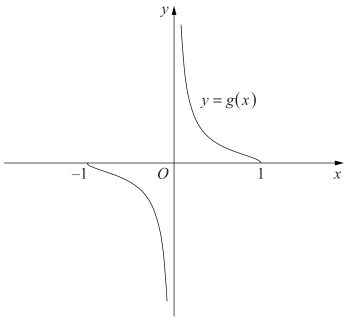
 

  1. Show that  `f^(′)(x) = g^(′)(x)`.  (4 marks)

    --- 8 WORK AREA LINES (style=lined) ---

  2. Using part (i), or otherwise, show that  `f(x) = g(x)`.  (3 marks) 

    --- 6 WORK AREA LINES (style=lined) ---

Show Answers Only
  1. `text(See Worked Solutions)`
  2. `text(See Worked Solutions)`
Show Worked Solution

i.   `f(x) = tan(cos^(-1)(x))`

♦ Mean mark (i) 50%.
`f^(′)(x)` `= -1/sqrt(1-x^2) · sec^2(cos^(-1)(x))`
  `= -1/sqrt(1-x^2) · 1/(cos^2(cos^(-1)(x)))`
  `= -1/(x^2sqrt(1-x^2))`

 
`g(x) = (1-x^2)^(1/2) · x^(-1)`

`g^(′)(x)` `= 1/2 · -2x(1-x^2)^(-1/2) · x^(-1)-(1-x^2)^(1/2) · x^(-2)`
  `= (-x)/(x sqrt(1-x^2))-sqrt(1-x^2)/(x^2)`
  `= (-x^2-sqrt(1-x^2) sqrt(1-x^2))/(x^2 sqrt(1-x^2))`
  `= (-x^2-(1-x^2))/(x^2sqrt(1-x^2))`
  `= -1/(x^2sqrt(1-x^2))`
  `=f^(′)(x)`


ii.   `f^(′)(x) = g^(′)(x)`

♦♦♦ Mean mark (ii) 15%.

`=> f(x) = g(x) + c`
 

`text(Find)\ c:`

`f(1)` `= tan(cos^(-1) 1)`
  `= tan 0`
  `= 0`

`g(1) = sqrt(1-1)/0 = 0`

`f(1) = g(1) + c`

`:. c = 0`

`:. f(x) = g(x)`

Filed Under: Harder Trig Calculus (Ext1), Inverse Functions Calculus (Ext1) Tagged With: Band 5, Band 6, smc-1037-10-Sin/Cos Differentiation, smc-1037-20-Tan Differentiation, smc-1038-60-Other

Calculus, EXT1 C2 2018 HSC 12c

Let  `f(x) = sin^(-1) x + cos^(-1) x`.

  1. Show that  `f^{′}(x) = 0`  (1 mark)

    --- 2 WORK AREA LINES (style=lined) ---

  2. Hence, or otherwise, prove
     
    `qquad sin^(-1) x + cos^(-1) x = pi/2`.  (1 mark)

    --- 4 WORK AREA LINES (style=lined) ---

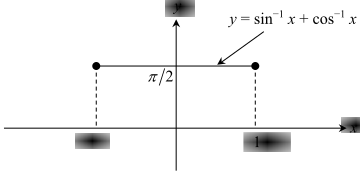
  3. Hence, sketch
     
    `qquad f(x) = sin^(-1) x + cos^(-1) x`.  (1 mark)

    --- 8 WORK AREA LINES (style=lined) ---

Show Answers Only
  1. `text(Proof)\ \ text{(See Worked Solutions)}`
  2. `text(Proof)\ \ text{(See Worked Solutions)}`
  3. `text(See Worked Solutions)`
Show Worked Solution

i.    `f^{′}(x) = 1/sqrt(1-x^2) + (-1/sqrt (1-x^2)) = 0`


ii.  `text(S)text(ince)\ \ f^{′}(x) = 0\ \ => f(x)\ \ text(is a constant.)`

♦ Mean mark (ii) 37%.

`text(Substituting)\ \ x=1\ \ text{into the equation  (any value works)}`

  `sin^(-1) 1 + cos^(-1) 1` `= pi/2 + 0`
    `= pi/2\ \ text(… as required)`


iii.  `text(Domain restrictions require:)\ \ -1<x<1`

♦ Mean mark (iii) 40%.


Filed Under: Inverse Functions Calculus (Ext1), Inverse Trig Functions EXT1 Tagged With: Band 3, Band 5, smc-1037-10-Sin/Cos Differentiation

Calculus, EXT1 C2 2004 HSC 2b

Find  `d/(dx)\ cos^(−1)\ (3x^2).`  (2 marks)

Show Answers Only

`(−6x)/(sqrt(1 − 9x^4))`

Show Worked Solution

`d/(dx)\ cos^(−1)\ (3x^2)`

`= (−1)/sqrt(1 − (3x^2)^2) xx d/(dx) (3x^2)`

`= (−6x)/(sqrt(1 − 9x^4))`

Filed Under: Inverse Functions Calculus (Ext1), Inverse Trig Functions EXT1 Tagged With: Band 4, smc-1037-10-Sin/Cos Differentiation

Calculus, EXT1 C2 2006 HSC 2a

Let  `f(x) = sin^-1 (x + 5).`

  1. State the domain and range of the function  `f(x).`  (2 marks)

    --- 4 WORK AREA LINES (style=lined) ---

  2. Find the gradient of the graph of  `y = f(x)`  at the point where  `x = -5.`  (2 marks)

    --- 4 WORK AREA LINES (style=lined) ---

  3. Sketch the graph of  `y = f(x).`  (2 marks)

    --- 8 WORK AREA LINES (style=lined) ---

Show Answers Only
  1. `text(Domain):\ -6 <= x <= -4, \ \ \ text(Range):\ -pi/2 <= y <= pi/2`
  2. `1`
  3.  

Show Worked Solution

i.  `f(x) = sin^-1 (x + 5)`

`text(Domain)`

`-1 <= x + 5 <= 1`

`-6 <= x <= -4`

`text(Range)`

`-pi/2 <= y <= pi/2`


ii.  `y = sin^-1 (x + 5)`

`(dy)/(dx) = 1/sqrt(1-(x + 5)^2)`
 

`text(When)\ \ x = -5`

`(dy)/(dx)` `= 1/sqrt(1-(-5 + 5)^2)`
  `= 1/sqrt(1-0)`
  `= 1`

 
`:.\ text(Gradient of)\ \ y = f(x)\ \ text(at)\ \ x = -5\ \ text(is)\ \ 1.`


iii.

EXT1 2006 2a

Filed Under: Inverse Functions Calculus (Ext1), Inverse Trig Functions EXT1, T1 Inverse Trig Functions (Y11) Tagged With: Band 3, Band 4, smc-1024-10-arcsin Graphs, smc-1037-10-Sin/Cos Differentiation

Calculus, EXT1 C2 2005 HSC 2a

Find  `d/(dx) (2 sin^-1 5x).`  (2 marks)

Show Answers Only

`10/(sqrt (1 – 25x^2))`

Show Worked Solution
`d/(dx) (2 sin^-1 5x)` `= 2 xx d/(dx) (sin^-1 5x)`
  `= 2 xx 1/(sqrt(1 – (5x)^2)) xx d/(dx) (5x)`
  `= 2/(sqrt (1 – 25x^2)) xx 5`
  `= 10/(sqrt(1 – 25 x^2))`

Filed Under: Inverse Functions Calculus (Ext1), Inverse Trig Functions EXT1 Tagged With: Band 4, smc-1037-10-Sin/Cos Differentiation

Calculus, EXT1 C2 2015 HSC 13d

Let  `f(x) = cos^(-1)\ (x) + cos^(-1)\ (-x)`, where  `-1 ≤ x ≤ 1`.

  1. By considering the derivative of  `f(x)`, prove that  `f(x)`  is constant.  (2 marks)

    --- 4 WORK AREA LINES (style=lined) ---

  2. Hence deduce that  `cos^(-1)\ (-x) = pi - cos^(-1)\ (x)`.  (1 mark)

    --- 4 WORK AREA LINES (style=lined) ---

Show Answers Only
  1. `text(See Worked Solutions.)`
  2. `text(See Worked Solutions.)`
Show Worked Solution

i.  `text(Prove)\ f(x)\ text(is a constant)`

`f(x)` `= cos^(-1)(x) + cos^(-1)(-x), \ \ -1 ≤ x ≤ 1`
`f′(x)` `= (-1)/sqrt(1 – x^2) + (-1)/sqrt(1 -(-x)^2) xx d/(dx) (-x)`
  `= (-1)/sqrt(1 – x^2) + 1/sqrt(1 – x^2)`
  `= 0`

 
`:.\ text(S)text(ince)\ \ f′(x) = 0,  f(x)\ text(must be a constant.)`
 

♦ Mean mark 35%.
ii.   `f(0)` `= cos^(−1)(0) + cos^(−1)(0)`
    `= pi/2 + pi/2`
    `= pi`

 
`:.f(x) = pi`

`pi = cos^(−1)(x) + cos^(−1)(−x)`

`:.cos^(−1)(−x) = pi – cos^(−1)(x)\ \ …text(as required)`

Filed Under: Inverse Functions Calculus (Ext1), Inverse Trig Functions EXT1 Tagged With: Band 4, Band 5, smc-1037-10-Sin/Cos Differentiation

Calculus, EXT1 C2 2008 HSC 1b

Differentiate  `cos^(–1) (3x)`  with respect to  `x`.   (2 marks)

Show Answers Only

`(-3)/sqrt(1 – 9x^2)`

Show Worked Solution
`y` `= cos^(-1) (3x)`
`dy/dx` `= – 1/sqrt(1 – (3x)^2) * d/(dx) (3x)`
  `= (-3)/sqrt(1 – 9x^2)`

Filed Under: Inverse Functions Calculus (Ext1), Inverse Trig Functions EXT1 Tagged With: Band 3, smc-1037-10-Sin/Cos Differentiation

Calculus, EXT1 C2 2014 HSC 6 MC

What is the derivative of  `3 sin^(-1)\ x/2`?

  1. `6/sqrt(4 - x^2)`
  2. `3/sqrt(4 - x^2)`
  3. `3/(2sqrt(4 - x^2))` 
  4. `3/(4sqrt(4 - x^2))`
Show Answers Only

`B`

Show Worked Solution

`y = 3 sin^(-1)\ x/2`

`dy/dx = 3 xx 1/sqrt(4 – x^2)`

`=>  B`

Filed Under: 8. Differentiation and 1st Principles EXT1, Inverse Functions Calculus (Ext1), Inverse Trig Functions EXT1 Tagged With: Band 3, smc-1037-10-Sin/Cos Differentiation

Calculus, EXT1 C2 2013 HSC 11g

Differentiate  `x^2 sin^(–1) 5x`.   (2 marks)

Show Answers Only

`(5x^2)/sqrt(1\ – 25x^2) + 2x sin^(-1) 5x`

Show Worked Solution
`y` `= x^2 sin^(-1) 5x`
`text(Using the product rule)`
`(dy)/(dx)` `= x^2 xx 1/sqrt(1\ – (5x)^2) xx d/(dx)(5x) + 2x sin^(-1) 5x`
  `= (5x^2)/sqrt(1\ – 25x^2) + 2x sin^(-1) 5x`

Filed Under: 8. Differentiation and 1st Principles EXT1, Inverse Functions Calculus (Ext1), Inverse Trig Functions EXT1 Tagged With: Band 3, smc-1037-10-Sin/Cos Differentiation

Calculus, EXT1 C2 2012 HSC 9 MC

What is the derivative of  `cos^(–1) (3x)`?
  1. `1/(3 sqrt(1 - 9x^2))`  
  2. `(-1)/(3 sqrt(1 - 9x^2))`  
  3. `3/sqrt(1 - 9x^2)`  
  4. `(-3)/sqrt(1 - 9x^2)`  
Show Answers Only

`D`

Show Worked Solution

`y = cos^(-1) (3x)`

`dy/dx` `= (-1)/sqrt(1\ – (3x)^2) xx d/dx (3x)`
  `= (-3)/sqrt(1\ – 9x^2)`

`=>  D`

Filed Under: 8. Differentiation and 1st Principles EXT1, Inverse Functions Calculus (Ext1), Inverse Trig Functions EXT1 Tagged With: Band 3, smc-1037-10-Sin/Cos Differentiation

Copyright © 2014–2025 SmarterEd.com.au · Log in