SmarterEd

Aussie Maths & Science Teachers: Save your time with SmarterEd

  • Login
  • Get Help
  • About

Calculus, EXT1 C2 2024 HSC 14b

For what values of the constant \(k\) would the function  \(f(x)=\dfrac{k x}{1+x^2}+\arctan x\)  have an inverse?   (3 marks)

--- 7 WORK AREA LINES (style=lined) ---

Show Answers Only

\(f(x)\ \text{has an inverse for}\ \ -1 \leqslant k \leqslant 1\)

Show Worked Solution

  \(f(x)\) \(=\dfrac{k x}{1+x^2}+\arctan x\)
  \(f^{\prime}(x)\) \(=\dfrac{k\left(1+x^2\right)-k x(2 x)}{\left(1+x^2\right)^2}+\dfrac{1}{1+x^2}\)
    \(=\dfrac{k+k x^2-2 k x^2+1+x^2}{\left(1+x^2\right)^2}\)
    \(=\dfrac{x^2(1-k)+k+1}{\left(1+x^2\right)^2}\)
♦♦♦ Mean mark 26%.

\(\text{Inverse function } \Rightarrow f(x) \text { has no SPs}\)

\(x^2(1-k)+k+1 \neq 0\)

\(\text {No solution if } \ \Delta<0:\)

  \(-4(1-k)(k+1)\) \(<0\)
  \((1-k)(k+1)\) \(>0\)

 
\(f(x)\ \text{has an inverse for}\ \ -1 \leq k \leq 1\)

Filed Under: Inverse Functions Calculus (Ext1) Tagged With: Band 5, smc-1037-20-Tan Differentiation

Calculus, EXT1 C2 2022 HSC 12c

Find the equation of the tangent to the curve  `y=x  text{arctan}(x)`  at the point with coordinates `(1,(pi)/(4))`. Give your answer in the form  `y=mx+c`  (3 marks)

--- 6 WORK AREA LINES (style=lined) ---

Show Answers Only

`y=((2+pi)/4)x-1/2`

Show Worked Solution
`y` `=xtan^(-1)(x)`  
`dy/dx` `=x xx 1/(1+x^2)+tan^(-1)(x)`  

 
`text{When}\ \ x=1:`

`dy/dx=1/2+tan^(-1)(1)=1/2+pi/4=(2+pi)/4`
 

`text{Equation of tangent}\ \ m=(2+pi)/4,\ text{through}\ \ (1,(pi)/(4)):`

`y-pi/4` `=(2+pi)/4 (x-1)`  
`y` `=((2+pi)/4)x-(2+pi)/4+pi/4`  
`y` `=((2+pi)/4)x-1/2`  

Filed Under: Inverse Functions Calculus (Ext1) Tagged With: Band 4, smc-1037-20-Tan Differentiation, smc-1037-60-Tangents

Calculus, EXT1 C2 2020 SPEC1 6

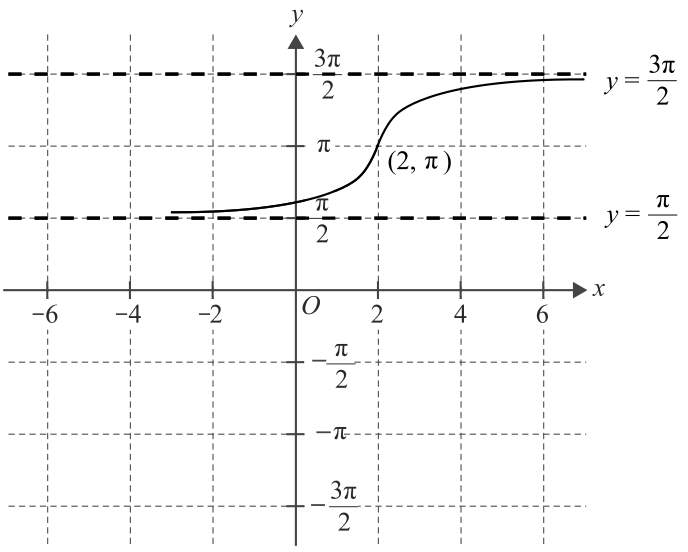
Let  `f(x) = tan^(-1) (3x - 6) + pi`.

  1. Show that  `f^{prime}(x) = 3/(9x^2 - 36x + 37)`.  (1 mark)

    --- 2 WORK AREA LINES (style=lined) ---

  2. Hence, show that the graph of  `f`  has a point of inflection at  `x = 2`.  (2 marks)

    --- 6 WORK AREA LINES (style=lined) ---

  3. Sketch the graph of  `y = f(x)`  on the axes provided below. Label any asymptotes with their equations and the point of inflection with its coordinates.   (2 marks)

--- 0 WORK AREA LINES (style=lined) ---

Show Answers Only
  1. `text(Proof)\ text{(See Worked Solutions)}`
  2. `text(Proof)\ text{(See Worked Solutions)}`
  3. `text(See Worked Solutions)`
Show Worked Solution
a.    `f^{\prime}(x)` `= (d/(dx) (3x – 6))/(1 + (3x – 6)^2)`
    `= 3/(9x^2 – 36x + 37)`


b.   `f^{\prime\prime}(x) = (3(18x – 36))/(9x^2 – 36x + 37)^2`

`f^{\prime\prime}(x) = 0\ \ text(when)\ \ 18x – 36 = 0 \ => \ x = 2`

`text(If)\ \ x < 2, 18x – 36 < 0 \ => \ f^{\prime\prime}(x) < 0`

`text(If)\ \ x > 2, 18x – 36 > 0 \ => \ f^{\prime\prime}(x) > 0`

`text(S) text(ince)\ \ f^{\prime\prime}(x)\ \ text(changes sign about)\ \ x = 2,`

`text(a POI exists at)\ \ x = 2`


c.   

Filed Under: Inverse Functions Calculus (Ext1) Tagged With: Band 3, Band 4, smc-1037-20-Tan Differentiation

Calculus, EXT1 C2 2020 HSC 13c

Suppose  `f(x) = tan(cos^(-1)(x))`  and  `g(x) = (sqrt(1-x^2))/x`.

The graph of  `y = g(x)`  is given.
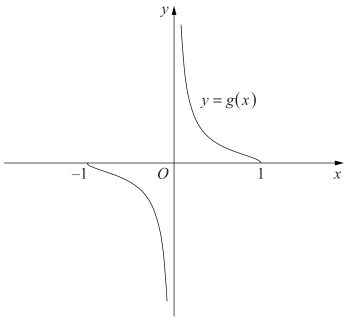
 

  1. Show that  `f^(′)(x) = g^(′)(x)`.  (4 marks)

    --- 8 WORK AREA LINES (style=lined) ---

  2. Using part (i), or otherwise, show that  `f(x) = g(x)`.  (3 marks) 

    --- 6 WORK AREA LINES (style=lined) ---

Show Answers Only
  1. `text(See Worked Solutions)`
  2. `text(See Worked Solutions)`
Show Worked Solution

i.   `f(x) = tan(cos^(-1)(x))`

♦ Mean mark (i) 50%.
`f^(′)(x)` `= -1/sqrt(1-x^2) · sec^2(cos^(-1)(x))`
  `= -1/sqrt(1-x^2) · 1/(cos^2(cos^(-1)(x)))`
  `= -1/(x^2sqrt(1-x^2))`

 
`g(x) = (1-x^2)^(1/2) · x^(-1)`

`g^(′)(x)` `= 1/2 · -2x(1-x^2)^(-1/2) · x^(-1)-(1-x^2)^(1/2) · x^(-2)`
  `= (-x)/(x sqrt(1-x^2))-sqrt(1-x^2)/(x^2)`
  `= (-x^2-sqrt(1-x^2) sqrt(1-x^2))/(x^2 sqrt(1-x^2))`
  `= (-x^2-(1-x^2))/(x^2sqrt(1-x^2))`
  `= -1/(x^2sqrt(1-x^2))`
  `=f^(′)(x)`


ii.   `f^(′)(x) = g^(′)(x)`

♦♦♦ Mean mark (ii) 15%.

`=> f(x) = g(x) + c`
 

`text(Find)\ c:`

`f(1)` `= tan(cos^(-1) 1)`
  `= tan 0`
  `= 0`

`g(1) = sqrt(1-1)/0 = 0`

`f(1) = g(1) + c`

`:. c = 0`

`:. f(x) = g(x)`

Filed Under: Harder Trig Calculus (Ext1), Inverse Functions Calculus (Ext1) Tagged With: Band 5, Band 6, smc-1037-10-Sin/Cos Differentiation, smc-1037-20-Tan Differentiation, smc-1038-60-Other

Calculus, EXT1 C2 2019 HSC 3 MC

What is the derivative of  `tan^(-1)\ x/2`?

A.     `1/(2(4 + x^2))`

B.     `1/(4 + x^2)`

C.     `2/(4 + x^2)`

D.     `4/(4 + x^2)`

Show Answers Only

`C`

Show Worked Solution
`y` `= tan^(-1)\ x/2`
`(dy)/(dx)` `= (1/2)/(1 + (x/2)^2)`
  `= 1/(2(1 + x^2/4))`
  `= 2/(4 + x^2)`

 
`=>  C`

Filed Under: Inverse Functions Calculus (Ext1) Tagged With: Band 4, smc-1037-20-Tan Differentiation

Calculus, EXT1 C2 2016 HSC 11c

Differentiate  `3tan^(−1)(2x)`.  (2 marks)

Show Answers Only

`6/(1 + 4x^2)`

Show Worked Solution
`y` `= 3 tan^-1 (2x)`
`(dy)/(dx)` `= 3/(1 + (2x)^2) xx 2`
  `= 6/(1 + 4x^2)`

Filed Under: 8. Differentiation and 1st Principles EXT1, Inverse Functions Calculus (Ext1), Inverse Trig Functions EXT1 Tagged With: Band 4, smc-1037-20-Tan Differentiation

Calculus, EXT1 C2 2007 HSC 1c

Differentiate  `tan^(–1)(x^4)`  with respect to  `x`.  (2 marks)

Show Answers Only

`(4x^3)/(1 + x^8)`

Show Worked Solution
`y` `= tan^(−1)(x^4)`
`(dy)/(dx)` `= 1/(1 + (x^4)^2) xx d/(dx) (x^4)`
  `= (4x^3)/(1 + x^8)`

Filed Under: 8. Differentiation and 1st Principles EXT1, Inverse Functions Calculus (Ext1), Inverse Trig Functions EXT1 Tagged With: Band 3, smc-1037-20-Tan Differentiation

Calculus, EXT1 C2 2010 HSC 5b

Let  `f(x) = tan^(-1)(x) + tan^(-1)(1/x)`  for  `x != 0`. 

  1. By differentiating  `f(x)`, or otherwise, show that  `f(x) = pi/2`  for  `x > 0`.   (3 marks)

    --- 6 WORK AREA LINES (style=lined) ---

  2. Given that  `f(x)`  is an odd function, sketch the graph  `y = f(x)`.     (1 mark)

    --- 6 WORK AREA LINES (style=lined) ---

Show Answers Only
  1. `text(Proof)\ \ text{(See Worked Solutions)}`
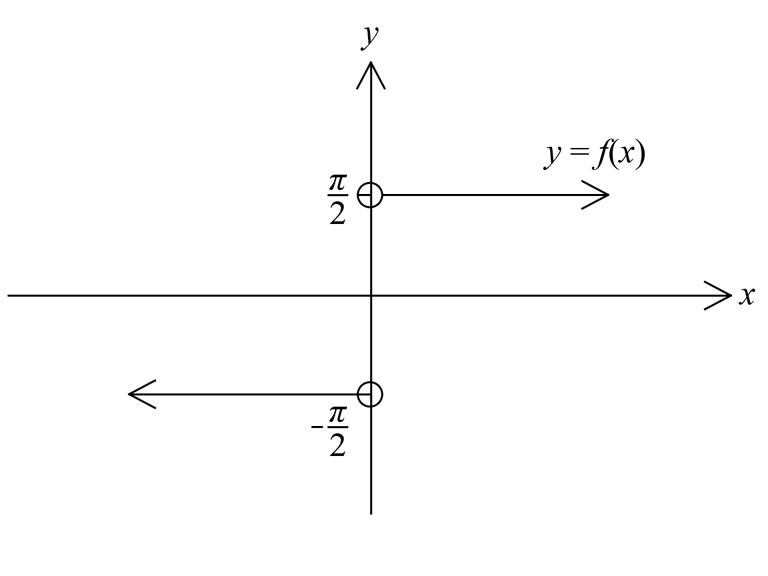
  2. Inverse Functions, EXT1 2010 HSC 5b Answer


Show Worked Solution
♦ Mean mark 48%
MARKER’S COMMENT: The most common errors were not being able to differentiate `tan^(-1) (1/x)` and not recognising the significance of `f′(x)=0`.
i.    `f(x)` `= tan^(-1) (x) + tan^(-1) (1/x)\ text(for)\ x != 0`
  `f prime (x)` `= 1/(1 + x^2) + 1/(1 + (1/x)^2) xx d/(dx) (1/x)`
    `= 1/(1 + x^2) + 1/(1 + 1/(x^2)) xx -1/(x^2)`
    `= 1/(1 + x^2)\ – 1/(x^2 + 1)`
    `= 0`


`text(S)text(ince)\ \ f prime (x) = 0`

`=> f(x)\ text(is a constant)`


`text(Substitute)\ \ x = 1\ \ text(into)\ \ f(x)` 

`f(1)` `= tan^(-1) 1 + tan^(-1) (1/1)`
  `= pi/4 + pi/4`
  `= pi/2`


`:.\ f(x) = pi/2\ \ text(for)\ \ x > 0\ \ \ …\ text(as required)`


♦ Mean mark 35%
ii.    `text(Given)\ \ f(x)\ \ text(is odd)`
  `f(–x) = -f(x)`

Inverse Functions, EXT1 2010 HSC 5b Answer

Filed Under: Inverse Functions Calculus (Ext1), Inverse Trig Functions EXT1 Tagged With: Band 5, smc-1037-20-Tan Differentiation

Copyright © 2014–2025 SmarterEd.com.au · Log in