SmarterEd

Aussie Maths & Science Teachers: Save your time with SmarterEd

  • Login
  • Get Help
  • About

Calculus, EXT1 C2 2025 HSC 11c

Find \(\displaystyle \int \sin 3x \, \cos x \, dx\).   (2 marks)

--- 5 WORK AREA LINES (style=lined) ---

Show Answers Only

\(-\dfrac{1}{8} \cos 4 x-\dfrac{1}{4} \cos 2 x+c\)

Show Worked Solution
\(\displaystyle\int \sin3x \, \cos x \, dx\) \(=\displaystyle\frac{1}{2} \int \sin 4 x+\sin2x \,dx\)
  \(=-\dfrac{1}{8} \cos 4 x-\dfrac{1}{4} \cos 2 x+c\)

Filed Under: Harder Trig Calculus (Ext1) Tagged With: Band 4, smc-1038-30-Compound angles

Calculus, EXT1 C2 2020 HSC 12d

Find  `int_0^(pi/2) cos 5x\ sin 3x\ dx`.  (3 marks)

Show Answers Only

`−1/2`

Show Worked Solution
`int_0^(pi/2) cos 5x\ sin 3x\ dx` `= 1/2 int_0^(pi/2) 2cos 5x\ sin 3x\ dx`
  `= 1/2 int_0^(pi/2) sin 8x-sin 2x\ dx`
  `= 1/2[−1/8 cos 8x + 1/2 cos 2x]_0^(pi/2)`
  `= 1/2[(−1/8 cos 4pi + 1/2 cospi)-(−1/8 cos0 + 1/2 cos0)]`
  `= 1/2(−1/8-1/2 + 1/8-1/2)`
  `= −1/2`

Filed Under: Harder Trig Calculus (Ext1) Tagged With: Band 4, smc-1038-30-Compound angles

Calculus, EXT1 C2 2019 HSC 14c

The diagram shows the two curves  `y = sin x`  and  `y = sin(x - alpha) + k`, where  `0 < alpha < pi`  and  `k > 0`. The two curves have a common tangent at `x_0` where  `0 < x_0 < pi/2`.
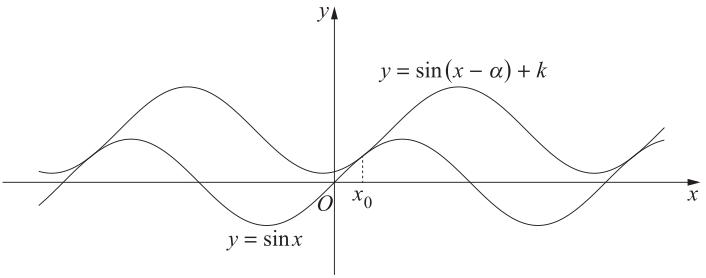


  1. Explain why   `cos x_0 = cos (x_0 - alpha)`.  (1 mark)

    --- 4 WORK AREA LINES (style=lined) ---

  2. Show that  `sin x_0 = -sin(x_0 - alpha)`.  (2 marks)

    --- 5 WORK AREA LINES (style=lined) ---

  3. Hence, or otherwise, find  `k`  in terms of  `alpha`.  (2 marks)

    --- 8 WORK AREA LINES (style=lined) ---

Show Answers Only
  1. `text(See Worked Solutions)`
  2. `text(Proof)\ text{(See Worked Solutions)}`
  3. `k = 2 sin\ alpha/2`
Show Worked Solution
i.    `y_1` `= sin x`
  `(dy_1)/(dx)` `= cos x`
  `y_2` `= sin(x – alpha) + k`
  `(dy_2)/(dx)` `= cos (x – alpha)`

 
`text(At)\ \ x = x_0,\ \ text(tangent is common)`

♦ Mean mark part (i) 47%.

`:. cos x_0 = cos(x_0 – alpha)`


ii.   `x_0\ \ text{is in 1st quadrant (given)}`

`text{Using part  (i):}`

`cos\ x_0 = cos(x_0 – alpha) >0`

♦♦♦ Mean mark part (ii) 19%.

`=> x_0 – alpha\ \ \ text(is in 4th quadrant)\ \ (0 < alpha < pi)`

`text(S)text(ince sin is positive in 1st quadrant and)`

`text(negative in 4th quadrant)`

`=> sin x_0 = -sin(x_0 – alpha)`


iii.   

`text(When)\ \ x = x_0,`

`y_1` `=sin x_0`  
`y_2` `=sin(x_0 – alpha) + k`  
`sin x_0` `=sin (x_0 – alpha) + k`  
  `= -sin x_0 + k`  
`k` `== 2\ sin x_0`  


♦♦ Mean mark part (iii) 21%.

`text(S)text(ince)\ \ cos x_0` `= cos(x_0 – alpha)`
`x_0` `= -(x_0 – alpha)`
`2x_0` `= alpha`
`x_0` `= alpha/2`

 
 `:. k = 2 sin\ alpha/2`

Filed Under: Harder Trig Calculus (Ext1), T2 Further Trigonometric Identities (Y11) Tagged With: Band 5, Band 6, smc-1025-20-Compound Angles, smc-1038-30-Compound angles

Calculus, EXT1 C2 2005 HSC 3b

  1. By expanding the left-hand side, show that
  2. `qquad sin(5x + 4x) + sin(5x-4x) = 2 sin (5x) cos(4x)`  (1 mark)

    --- 3 WORK AREA LINES (style=lined) ---

  3. Hence find  `int sin(5x) cos (4x)\ dx.`  (2 marks)

    --- 6 WORK AREA LINES (style=lined) ---

Show Answers Only
  1. `text(Proof)\ \ text{(See Worked Solutions)}`
  2. `-1/18 cos(9x)-1/2 cos(x) + c`
Show Worked Solution

i.   `sin (5x + 4x) + sin (5x-4x) = 2 sin(5x) cos(4x)`

`text(LHS)` `= sin (5x) cos (4x)-sin(4x) cos (5x) + sin (5x) cos (4x)+ sin (4x) cos (5x)`
  `= 2 sin (5x) cos (4x)\ \ text(…  as required)`


ii.  `int sin (5x) cos (4x)\ dx`

`= 1/2 int 2 sin (5x) cos (4x)\ dx`

`= 1/2 int sin (5x + 4x) + sin (5x-4x)\ dx`

`= 1/2 int sin (9x) + sin (x)\ dx`

`= 1/2 [-1/9 cos(9x)-cos(x)] + c`

`= -1/18 cos(9x)-1/2 cos(x) + c`

Filed Under: 11. Integration EXT1, 5. Trig Ratios EXT1, Harder Trig Calculus (Ext1), Identities, Equations and 't' formulae (Ext1) Tagged With: Band 3, Band 4, smc-1038-30-Compound angles, smc-1076-20-Other Identities/Equations

Copyright © 2014–2025 SmarterEd.com.au · Log in