SmarterEd

Aussie Maths & Science Teachers: Save your time with SmarterEd

  • Login
  • Get Help
  • About

Calculus, EXT1 C3 2024 HSC 12b

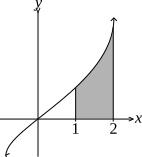
The region, \(R\), is bounded by the function, \(y=x^3\), the \(x\)-axis and the lines  \(x=1\)  and  \(x=2\).

What is the volume of the solid of revolution obtained when the region \(R\) is rotated about the \(x\)-axis?   (3 marks)

--- 6 WORK AREA LINES (style=lined) ---

Show Answers Only

\(V=\dfrac{127 \pi}{7} \ \ \text{u}^3\)

Show Worked Solution

  \(V\) \(=\pi \displaystyle \int_1^2 y^2\, d x\)
    \(=\pi \displaystyle \int_1^2 x^6\,d x\)
    \(=\pi\left[\dfrac{x^7}{7}\right]_1^2\)
    \(=\pi\left(\dfrac{2^7-1}{7}\right)\)
    \(=\dfrac{127 \pi}{7} \ \ \text{u}^3\)

Filed Under: Further Area and Solids of Revolution (Ext1) Tagged With: Band 3, smc-1039-10-Polynomial, smc-1039-60-x-axis Rotation

Calculus, EXT1 C3 2021 HSC 13a

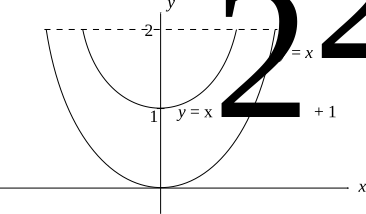
A 2-metre-high sculpture is to be made out of concrete. The sculpture is formed by rotating the region between  `y = x^2, y = x^2 + 1`  and  `y = 2`  around the `y`-axis.
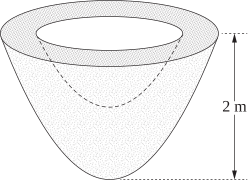


Find the volume of concrete needed to make the sculpture.  (3 marks)

--- 6 WORK AREA LINES (style=lined) ---

Show Answers Only

`(3pi)/2\ text(u³)`

Show Worked Solution

`V` `= pi int_0^2 y\ dy-pi int_1^2 y-1\ dy`
  `= pi [(y^2)/2]_0^2-pi [(y^2)/2-y]_1^2`
  `= pi(2-0)-pi[(2-2)-(1/2-1)]`
  `= 2pi-pi(1/2)`
  `= (3pi)/2\ text(u³)`

Filed Under: Further Area and Solids of Revolution (Ext1) Tagged With: Band 4, smc-1039-10-Polynomial, smc-1039-61-y-axis Rotation

Calculus, EXT1 C3 SM-Bank 2

The parabola with equation  `y = 9 - x^2`  cuts the `y`-axis at  `P(0,9)`  and the `x`-axis at  `Q(3,0)`.

Find the exact volume of the solid of revolution formed when the area between the line  `PQ`  and the parabola is rotated about the `y`-axis.  (4 marks)

--- 8 WORK AREA LINES (style=lined) ---

Show Answers Only

`(27pi)/2\ text(units³)`

Show Worked Solution

`text(Equation of)\ PQ:`

`m = −3,\ \ ytext(-intercept) = 9`

`y = 9 – 3x`
 

`text(Rotating about the)\ ytext(-axis:)`

`x_1^(\ 2)` `= 9 – y\ \ \ text{(parabola)}`
`y` `= 9 – 3x_2\ \ \ (text{line}\ PQ)`
`3x_2` `= 9 – y`
`x_2` `= 3 – y/3`
`x_2^(\ 2)` `= (3 – y/3)^2`


`V` `= pi int_0^9 x_1^(\ 2) – x_2^(\ 2)\ dy`
  `= pi int_0^9 9 – y – (3 – y/3)^2\ dy`
  `= pi int_0^9 9 – y – (9 – 2y + (y^2)/9)\ dy`
  `= pi int_0^9 y – (y^2)/9\ dy`
  `= pi [(y^2)/2 – (y^3)/27]_0^9`
  `= pi(81/2 – 27)`
  `= (27pi)/2\ text(units³)`

Filed Under: Further Area and Solids of Revolution (Ext1) Tagged With: Band 4, smc-1039-10-Polynomial, smc-1039-61-y-axis Rotation

Calculus, EXT1* C3 2019 HSC 13d

The diagram shows the region bounded by the curve  `y = x - x^3`, and the `x`-axis between  `x = 0`  and  `x = 1`. The region is rotated about the `x`-axis to form a solid.
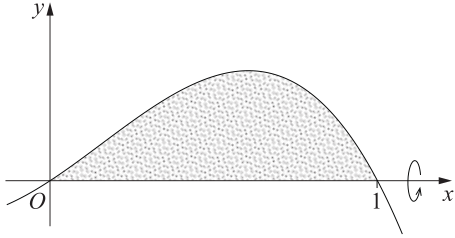


Find the exact value of the volume of the solid formed.  (3 marks)

Show Answers Only

`(8 pi)/105\ text(u³)`

Show Worked Solution
`V` `= pi int_0^1 (x – x^3)^2 dx`
  `= pi int_0^1 x^2 – 2x^4 + x^6\ dx`
  `= pi [x^3/3 – 2/5 x^5 + 1/7 x^7]_0^1`
  `= pi(1/3 – 2/5 + 1/7)`
  `= (8 pi)/105\ text(u³)`

Filed Under: Further Area and Solids of Revolution (Ext1) Tagged With: Band 4, smc-1039-10-Polynomial, smc-1039-60-x-axis Rotation

Calculus, EXT1* C3 2018 HSC 14b

The shaded region shown in the diagram is bounded by the curve  `y = x^4 + 1`, the `y`-axis and the line  `y = 10`.
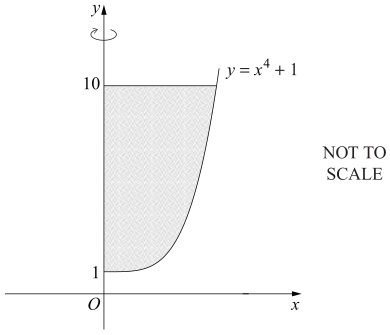


Find the volume of the solid of revolution formed when the shaded region is rotated about the `y`-axis.  (3 marks)

--- 6 WORK AREA LINES (style=lined) ---

Show Answers Only

`18 pi\ text(units²)`

Show Worked Solution

`y = x^4 + 1`

`x^4 = y – 1`

`x^2 = +- (y – 1)^(1/2)`

`text(When)\ \ x = 0,\ \ y = 1`

`=> x^2 = (y – 1)^(1/2)`
 

`:.\ text(Volume)` `= pi int_1^10 x^2\ dy`
  `= pi int_1^10 (y – 1)^(1/2)\ dy`
  `= pi xx 2/3 [(y – 1)^(3/2)]_1^10`
  `= (2 pi)/3 [9^(3/2) – 0]`
  `= (2 pi)/3 (27)`
  `= 18 pi\ \ text(units²)`

Filed Under: Further Area and Solids of Revolution (Ext1), Volumes of Solids of Rotation Tagged With: Band 4, smc-1039-10-Polynomial, smc-1039-61-y-axis Rotation

Calculus, EXT1* C3 2007 HSC 9a

2007 9a
  

The shaded region in the diagram is bounded by the curve  `y = x^2 + 1`, the `x`-axis, and the lines  `x = 0`  and  `x = 1.`

Find the volume of the solid of revolution formed when the shaded region is rotated about the `x`-axis.  (3 marks)

Show Answers Only

`(28 pi)/15\ \ text(u³)`

Show Worked Solution
`V` `= pi int_0^1 y^2\ dx`
  `= pi int_0^1 (x^2 + 1)^2\ dx`
  `= pi int_0^1 x^4 + 2x^2 + 1\ dx`
  `= pi [1/5 x^5 + 2/3 x^3 + x]_0^1`
  `= pi[(1/5 + 2/3 + 1) – 0]`
  `= pi [3/15 + 10/15 + 1]`
  `= (28 pi)/15\ \ text(u³)`

Filed Under: Further Area and Solids of Revolution (Ext1), Volumes of Solids of Rotation Tagged With: Band 3, Band 4, HSC, smc-1039-10-Polynomial, smc-1039-60-x-axis Rotation

Calculus, EXT1* C3 2006 HSC 4b

2006 4b

In the diagram, the shaded region is bounded by the parabola  `y = x^2 + 1`, the `y`-axis and the line  `y = 5`.

Find the volume of the solid formed when the shaded region is rotated about the `y`-axis.  (3 marks)

--- 6 WORK AREA LINES (style=lined) ---

Show Answers Only

`8 pi\ \ text(u³)`

Show Worked Solution

`y = x^2 + 1`

`x^2 = y – 1`

`V` `= pi int_1^5 x^2 \ dy`
  `= pi int_1^5 y-1 \ dy`
  `= pi [y^2/2 – y]_1^5`
  `= pi[(25/2 – 5) – (1/2 – 1)]`
  `= pi[15/2 – (-1/2)]`
  `= 8 pi\ \ text(u³)`

Filed Under: Further Area and Solids of Revolution (Ext1), Volumes of Solids of Rotation Tagged With: Band 3, Band 4, smc-1039-10-Polynomial, smc-1039-61-y-axis Rotation

Calculus, EXT1* C3 2005 HSC 6c

2005 6c
 

The graphs of the curves  `y = x^2`  and  `y = 12 - 2x^2`  are shown in the diagram.

  1. Find the points of intersection of the two curves.  (1 mark)

    --- 4 WORK AREA LINES (style=lined) ---

  2. The shaded region between the curves and the `y`-axis is rotated about the `y`-axis. By splitting the shaded region into two parts, or otherwise, find the volume of the solid formed.  (3 marks)

    --- 6 WORK AREA LINES (style=lined) ---

Show Answers Only
  1. `text{(2, 4), (–2, 4)`
  2. `24pi\ \ text(u³)`
Show Worked Solution
i.    `y` `= x^2` `\ …\ (1)`
  `y` `= 12 − 2x^2` `\ …\ (2)`


`text(Substitute)\ \ y = x^2\ \ text(into)\ (2)`

`x^2` `= 12 − 2x^2`
`3x^2 − 12` `= 0`
`3(x^2 − 4)` `= 0`
`x` `= ±2`
`text(When)` `\ x = 2,` `\ y = 4`
`text(When)` `\ x = text(−2),` `\ y = 4`

 
`:.\ text{Intersection at (2, 4), (−2, 4)}`
 

ii.  `text{In (1),}\ \ x^2=y`

`text{In (2),}\ \ \ y` `= 12 − 2x^2`
`2x^2` `= 12 − y`
`x^2` `= (12 − y)/2`
  `= 6 − 1/2y`

 
`:.\ text(Volume)`

`= pi int_0^4 y\ dy + pi int_4^12 6 − 1/2y\ dy`
`= pi[y^2/2]_0^4 + pi[6y − y^2/4]_4^12`
`= pi[16/2 − 0] + pi[(6 xx 12 − 12^2/4) − (6 xx 4 − 4^2/4)]`
`= 8pi + pi[36 − 20]`
`= 8pi + 16pi`
`= 24pi\ \ text(u³)`

Filed Under: Further Area and Solids of Revolution (Ext1), Volumes of Solids of Rotation Tagged With: Band 3, Band 4, smc-1039-10-Polynomial, smc-1039-61-y-axis Rotation

Calculus, EXT1* C3 2011 HSC 8b

The diagram shows the region enclosed by the parabola  `y = x^2`, the  `y`-axis and the line  `y = h`, where  `h > 0`. This region is rotated about the  `y`-axis to form a solid called a paraboloid. The point  `C`  is the intersection of  `y = x^2` and  `y = h`.

The point  `H`  has coordinates  `(0, h)`.
 

2011 8b

  1. Find the exact volume of the paraboloid in terms of  `h`.    (2 marks)

    --- 5 WORK AREA LINES (style=lined) ---

  2. A cylinder has radius  `HC`  and height  `h`.    


    What is the ratio of the volume of the paraboloid to the volume of the cylinder?   (1 mark)

    --- 8 WORK AREA LINES (style=lined) ---

Show Answers Only
  1. `(pi h^2)/2\ text(u³)`
  2. `1:2`
Show Worked Solution
IMPORTANT: Most common errors: 1-use the correct axis, and 2-check the limits!
i.    `V` `= pi int_0^h x^2\ dy`
    `= pi int_0^h y\ dy`
    `= pi [1/2 y^2]_0^h`
    `= pi (1/2 h^2)`
    `= (pi h^2)/2 \ text(u³)`

 
`:.\ text(The volume of the paraboloid is)\  (pi h^2)/2\ text(u³)`
 

ii.   `text(Radius of cylinder)\ (r) = HC`

`text(Find)\ x text(-coordinate of)\ C:`

♦♦ Mean mark of 24%.
`text(When)\ y` `=h`
`=> x^2` `= h`
`x` `= sqrt h`
`:. r` `= sqrth`


`text(Volume of cylinder)` `= pi r^2 h`
  `= pi (sqrth)^2 h`
  `= pi h^2`

 
`:.\ text(Volume of paraboloid : volume of cylinder)`

`= (pi h^2)/2 : pi h^2`

`= 1:2`

Filed Under: Further Area and Solids of Revolution (Ext1), Volumes of Solids of Rotation Tagged With: Band 4, Band 6, smc-1039-10-Polynomial, smc-1039-61-y-axis Rotation

Calculus, EXT1* C3 2013 HSC 15b

The region bounded by the  `x`-axis, the  `y`-axis and the parabola  `y = (x-2)^2`  is rotated about the  `y`-axis to form a solid.
 

2013 15b
 

Find the volume of the solid.   (4 marks)

--- 8 WORK AREA LINES (style=lined) ---

Show Answers Only

 `text(Volume) = (8 pi)/3\ text(u³)`

Show Worked Solution

`text(S)text(ince rotation about the)\ y text(-axis,)`

♦ Mean mark 39%.
`(x -2)^2` `= y`
`x\-2` ` = ± y^(1/2)`
`x ` `= 2 +- y^(1/2)`

 
`text(When)\ \ x=0,\ y=4`

`:. x = 2-y^(1/2)`

`:.\ text(Volume)` `= pi int_0^4 x^2 dy`
  `= pi int_0^4 (2-y^{1/2})^2 dy`
  `= pi int_0^4 (4-4 y^{1/2} + y) dy`
  `= pi [4y-(4 xx 2/3 xx y^(3/2)) + (1/2 y^2)]_0^4`
  `= pi [4y-8/3 y^(3/2) + 1/2 y^2]_0^4`
  `= pi [(4 xx 4)-(8/3 xx 4^(3/2)) + (1/2 xx 4^2)]` 
  `= pi [16\-64/3 + 8]`
  `= (8 pi)/3\ text(u³)`

Filed Under: Further Area and Solids of Revolution (Ext1), Volumes of Solids of Rotation Tagged With: Band 5, smc-1039-10-Polynomial, smc-1039-61-y-axis Rotation

Copyright © 2014–2025 SmarterEd.com.au · Log in