SmarterEd

Aussie Maths & Science Teachers: Save your time with SmarterEd

  • Login
  • Get Help
  • About

Calculus, EXT2 C1 2025 HSC 13d

Evaluate  \(\displaystyle \large{\int_0^{\small{\dfrac{\pi}{2}}}}\)\(\dfrac{u}{1+\sin u+\cos u} \, du\), by first using the substitution  \(u=\dfrac{\pi}{2}-x\).   (4 marks)

--- 15 WORK AREA LINES (style=lined) ---

Show Answers Only


Show Worked Solution

\(\displaystyle \large{\int_0^{\small{\dfrac{\pi}{2}}}}\)\(\dfrac{u}{1+\sin u+\cos u} \, du\)

\(\text{Let} \ \ u=\dfrac{\pi}{2}-x \ \ \Rightarrow\ \ \dfrac{du}{dx}=-1 \ \ \Rightarrow\ \ du=-dx\)

\(\text{Limits:} \ \ u=\dfrac{\pi}{2}\ \ \Rightarrow\ \ x=0, \ \ u=0\ \ \Rightarrow\ \ x=\dfrac{\pi}{2}\)

\(I\) \(=-\displaystyle \large{\int_{\small{\dfrac{\pi}{2}}}^0}\)\(\dfrac{\dfrac{\pi}{2}-x}{1+\sin \left(\dfrac{\pi}{2}-x\right)+\cos \left(\dfrac{\pi}{2}-x\right)}\,dx\)
  \(=\displaystyle \large{\int_0^{\small{\dfrac{\pi}{2}}}}\)\(\dfrac{\dfrac{\pi}{2}-x}{1+\cos x+\sin x}\, d x\)


\(\text{Add \(I\) (swap variable from \(x\) to \(u\)) to original integral:}\)

\(2I=\dfrac{\pi}{2} \displaystyle \large{\int_0^{\small{\dfrac{\pi}{2}}}}\)\(\dfrac{1}{1+\sin u+\cos u}\, d u\)

\(\text{Substitute} \ \ t=\tan \left(\frac{u}{2}\right), \ \sin u=\dfrac{2t}{1+t^2}, \ \cos u=\dfrac{1-t^2}{1+t^2}\)

\(d t=\dfrac{1}{2} \sec ^2\left(\frac{u}{2}\right)\, du \ \ \Rightarrow\ \ du=\dfrac{2}{1+\tan ^2\left(\frac{u}{2}\right)}\, dt=\dfrac{2}{1+t^2}\, d t\)

\(\text{Limits:} \ \ n=\dfrac{\pi}{2}\  \Rightarrow \ t=1, \ n=0 \ \Rightarrow \ t=0\)

\(2I\) \(=\dfrac{\pi}{2} \displaystyle \int_0^1 \dfrac{1}{1+\frac{2 t}{1+t^2}+\frac{1-t^2}{1+t^2}} \times \frac{2}{1+t^2}\,d t\)
\(I\) \(=\displaystyle\frac{\pi}{4} \int_0^1 \frac{2}{1+t^2+2 t+1-t^2}\, d t\)
  \(=\displaystyle \frac{\pi}{4} \int_0^1 \frac{1}{1+t}\, d t\)
  \(=\dfrac{\pi}{4}\Bigl[\ln (1+t)\Bigr]_0^1\)
  \(=\dfrac{\pi}{4}(\ln 2-\ln 1)\)
  \(=\dfrac{\pi \, \ln 2}{4}\)

Filed Under: Substitution and Harder Integration Tagged With: Band 5, smc-1057-10-Trig, smc-1057-50-Substitution given

Calculus, EXT2 C1 2024 HSC 15d

Using a suitable substitution, find  \(\displaystyle\int \dfrac{2 x^2}{\sqrt{2 x-x^2}}\, d x\).   (3 marks)

--- 12 WORK AREA LINES (style=lined) ---

Show Answers Only

\(I=3 \sin ^{-1}(x-1)-4 \sqrt{2x-x^2}-(x-1) \sqrt{2x-x^2}+c\)

Show Worked Solution

  \(\displaystyle \int \dfrac{2x^2}{\sqrt{2x-x^2}}\, dx\) \(=\displaystyle \int \frac{2 x^2}{\sqrt{1-(1-2 x+x^2)}}\, dx\)
    \(=\displaystyle \int \frac{2 x^2}{\sqrt{1-(x-1)^2}} \, dx\)
♦ Mean mark 49%.

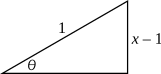
\(\text {Let} \ \ x-1=\sin \theta \ \Rightarrow \ x=1+\sin \theta\)

\(\dfrac{dx}{d \theta}=\cos \theta \ \Rightarrow \ dx=\cos \theta \, d \theta\)

  \(I\) \(=\displaystyle \int \frac{2(1+\sin \theta)^2}{\sqrt{1-\sin ^2 \theta}} \cdot \cos \theta \, d \theta\)
    \(=2 \displaystyle \int \frac{1+2 \sin \theta+\sin ^2 \theta}{\cos \theta} \cdot \cos \theta \, d \theta\)
    \(=2 \displaystyle \int 1+2 \sin \theta+\frac{1}{2}(1-\cos (2 \theta)) \, d \theta\)
    \(=\displaystyle \int 2+4 \sin \theta+1-\cos (2 \theta) \, d \theta\)
    \(=\displaystyle \int 3+4 \sin \theta-\cos (2 \theta) \, d \theta\)
    \(=3 \theta-4 \cos \theta-\dfrac{1}{2} \sin (2 \theta)+c\)
    \(=3 \theta-4 \cos \theta-\sin \theta \cos \theta+c\)


\(\Rightarrow \cos \theta=\sqrt{1^2-(x-1)^2}=\sqrt{2x-x^2}\)
 

\(\therefore I=3 \sin ^{-1}(x-1)-4 \sqrt{2x-x^2}-(x-1) \sqrt{2x-x^2}+c\)

Filed Under: Substitution and Harder Integration Tagged With: Band 5, smc-1057-10-Trig, smc-1057-60-Substitution not given

Calculus, EXT2 C1 2022 SPEC1 9

Given that  `f^{\prime}(x)=\frac{\cos (2 x)}{\sin ^3(2 x)}`  and  `f((pi)/(8))=(3)/(4)`, find `f(x)`.   (4 marks)

--- 9 WORK AREA LINES (style=lined) ---

Show Answers Only

`f(x)=\frac{-1}{4 \sin ^2(2 x)}+\frac{5}{4}=-\frac{1}{4} \text{cosec}^2(2 x)+\frac{5}{4}`

Show Worked Solution

`text{Let}\ \ u=sin(2x)\ \ =>\ \ {du}/{dx}=2cos(2x)`

`\int \frac{\cos (2 x)}{\sin ^3(2 x)} d x` `=\frac{1}{2} \int \frac{d u}{u^3}`  
  `= -\frac{1}{4} u^{-2}+c`  
  `=-\frac{1}{4} \ xx \frac{1}{\sin ^2(2 x)}+c`  

 
`text{When}\ \ x = pi/8:`

`-\frac{1}{4} \cdot \frac{1}{(\frac{1}{sqrt{2}})^2}+c` `=\frac{3}{4}`  
`-\frac{1}{4} \cdot 2+c` `=\frac{3}{4}`  
`\Rightarrow c` `=\frac{3}{4}+\frac{2}{4}=5/4`  

 
`:. \  f(x)=\frac{-1}{4 \sin ^2(2 x)}+\frac{5}{4}=-\frac{1}{4} \text{cosec}^2(2 x)+\frac{5}{4}`


♦ Mean mark 50%.

Filed Under: Substitution and Harder Integration Tagged With: Band 5, smc-1057-10-Trig, smc-1057-60-Substitution not given

Calculus, EXT2 C1 2022 HSC 15c

Using the substitution  `x=tan^(2)theta`, evaluate

          `int_(0)^(1)sin^(-1)sqrt((x)/(1+x))\ dx`  (4 marks)

--- 10 WORK AREA LINES (style=lined) ---

Show Answers Only

`pi/2-1`

Show Worked Solution

`x=tan^(2)theta`

`dx/(d theta)=2sec^2theta\ tantheta\ \ =>\ \ dx=2sec^2theta\ tantheta\ d theta`

`text{When}\ x=0, \ theta=0`

`text{When}\ x=1, \ theta=pi/4`


Mean mark 55%.
`sin^(-1)sqrt((x)/(1+x))` `=sin^(-1)sqrt((tan^(2)theta)/(1+tan^(2)theta))`  
  `=sin^(-1)sqrt((tan^(2)theta)/(text{sec}^(2)theta))`  
  `=sin^(-1)sqrt((sin^(2)theta))`  
  `=sin^(-1)(sintheta)`  
  `=theta`  


`int_(0)^(1)sin^(-1)sqrt((x)/(1+x))\ dx=int_(0)^(pi/4)\ theta xx 2sec^2theta\ tantheta\ d theta`
 

`text{Integrating by parts:}`

`u` `=theta` `u′` `=1`
`v′` `=2tan theta\ sec^2 theta` `v` `=tan^(2)theta`

 
`int_(0)^(pi/4)\ theta xx 2sec^2theta\ tantheta\ d theta`

`=[theta\ tan^(2)theta]_0^(pi/4)-int_0^(pi/4)tan^(2)theta\ d theta`

`=(pi/4 xx 1 -0)-int sec^(2)theta-1\ d theta`

`=pi/4-[tan theta-theta]_0^(pi/4)`

`=pi/4-[(1-pi/4)-0]`

`=pi/2-1`

Filed Under: Substitution and Harder Integration Tagged With: Band 4, smc-1055-30-Trig, smc-1057-10-Trig, smc-1057-50-Substitution given, smc-5134-30-Trig

Calculus, EXT2 C1 2022 HSC 11f

Using the substitution  `t=tan\ x/2`, find

`int(dx)/(1+cos x-sin x)`  (3 marks)

--- 8 WORK AREA LINES (style=lined) ---


Show Answers Only

`-lnabs(1-tan(x/2))+C`

Show Worked Solution

`text(Let)\ \ t = tan\ x/2, \ cos\ x = (1-t^2)/(1 + t^2), \ sin\ x=(2t)/(1+t^2)`

`dt = 1/2 sec^2\ x/2\ dx \ => \ d x = (2\ dt)/(sec^2\ x/2) = 2/(1 + t^2)\ dt`

`text{I}` `= int(dx)/(1+cos x-sin x)`  
  `=int 1/(1+(1-t^2)/(1 + t^2)-(2t)/(1 + t^2)) *2/(1 + t^2)\ dt`  
  `=int 2/(1+t^2+1-t^2-2t)\ dt`  
  `=int 1/(1-t)\ dt`  
  `=-ln abs(1-t)+C`  
  `=-lnabs(1-tan(x/2))+C`  

Filed Under: Substitution and Harder Integration, Trig Integration Tagged With: Band 3, smc-1057-10-Trig, smc-1057-50-Substitution given, smc-1193-20-t = tan theta/2

Calculus, EXT2 C1 2022 HSC 4 MC

Of the following expressions, which one need NOT contain a term involving a logarithm in its anti-derivative?

  1. `(x+2)/(x^(2)+4x+5)`
  2. `(x+2)/(x^(2)-4x-5)`
  3. `(x-1)/(x^(3)-x^(2)+x-1)`
  4. `(x+1)/(x^(3)-x^(2)+x-1)`
Show Answers Only

`C`

Show Worked Solution

`text{Consider the denominator of}\ C:`

`x^(3)-x^(2)+x-1` `=x^2(x-1)+(x-1)`  
  `=(x^2+1)(x-1)`  

 
`(x-1)/(x^(3)-x^(2)+x-1)=(x-1)/((x^2+1)(x-1))=1/(x^2+1)`

`int 1/(x^2+1)\ dx=tan^(-1)(x)+c`

`=>C`

Filed Under: Substitution and Harder Integration, Trig Integration Tagged With: Band 4, smc-1057-10-Trig, smc-1057-20-Logs, smc-1193-15-tan

Calculus, EXT2 C2 2020 SPEC2 11 MC

With a suitable substitution  `int_(pi/4)^(pi/3) (sec^2(x))/(sec^2(x) - 3 tan(x) + 1)\ dx`  can be expressed as

  1. `int_1^(1/sqrt3) (1/(u - 1) - 1/(u - 2))\ du`
  2. `int_1^(sqrt3) (1/(u - 2) - 1/(u - 1))\ du`
  3. `int_1^(sqrt3) (1/(u - 1) - 1/(u - 2))\ du`
  4. `int_(pi/4)^(pi/3) (1/(3(u - 1)) - 1/(3(u + 2)))\ du`
Show Answers Only

`B`

Show Worked Solution

`text(Let)\ \ u = tan(x)`

`(du)/(dx) = sec^2 (x) \ => \ du = sec^2(x)\ dx`

`text(When)\ `   `x = pi/3,\ u = sqrt3`
    `x = pi/4,\ u = 1`


`int_(pi/4)^(pi/3) (sec^2(x))/(sec^2(x) – 3 tan(x) + 1)\ dx`

`= int_1^(sqrt3)\ 1/(u^2 + 1 – 3u + 1)\ du`

  `= int_1^(sqrt3) 1/(u^2 – 3u + 2)\ du`
  `= int_1^(sqrt3) 1/((u – 2)(u – 1))\ du`
  `= int_1^(sqrt3) 1/(u – 2) – 1/(u – 1)\ du`

`=>B`

Filed Under: Substitution and Harder Integration Tagged With: Band 4, smc-1057-10-Trig, smc-1057-60-Substitution not given

Calculus, EXT2 C1 2005 HSC 1a

Find  `int(cos theta)/(sin^5 theta)  d theta`   (2 marks)

--- 5 WORK AREA LINES (style=lined) ---

Show Answers Only

`(-1)/(4sin^4 theta ) + C`

Show Worked Solution
`text(Let) \ u` `= sin theta `
`(du)/(d theta)` `=cos theta =>  d u = cos theta \ d theta`


`int(cos theta)/(sin^5 theta)  d theta` `= int u^-5 d u`
  `=(-1)/(4) u ^-4 + C`
  `=(-1)/(4sin^4 theta ) + C`

Filed Under: Substitution and Harder Integration Tagged With: Band 3, smc-1057-10-Trig, smc-1057-60-Substitution not given

Calculus, EXT2 C1 2017 HSC 11f

Using the substitution  `x = sin^2 theta`, or otherwise, evaluate  `int_0^(1/2) sqrt(x/(1 - x))\ dx`.  (3 marks)

--- 8 WORK AREA LINES (style=lined) ---

Show Answers Only

`pi/4 – 1/2`

Show Worked Solution

`x = sin^2 theta`

`dx = 2 sin theta cos theta\ d theta`

`text(If)\ \ x = 1/2, sin theta = 1/sqrt 2, \ theta = pi/4`

`text(If)\ \ x = 0, \ theta = 0`

`int_0^(1/2) sqrt(x/(1 – x))\ dx` `= int_0^(pi/4) sqrt ((sin^2 theta)/(1 – sin^2 theta)) xx 2 sin theta cos theta\ d theta`
  `= int_0^(pi/4) (sin theta)/(cos theta) xx 2 sin theta cos theta\ d theta`
  `= int_0^(pi/4) 2 sin^2 theta\ d theta`
  `= int_0^(pi/4) 1 – cos 2 theta\ d theta`
  `= [theta – 1/2 sin 2 theta]_0^(pi/4)`
  `= (pi/4 – 1/2 sin {:pi/2) – (0 – 0)`
  `= pi/4 – 1/2`

Filed Under: Harder Integration Examples, Substitution and Harder Integration Tagged With: Band 3, smc-1057-10-Trig, smc-1057-40-Other Functions, smc-1057-50-Substitution given

Calculus, EXT2 C1 2007 HSC 5c

  1. Write  `(x - 1) (5 - x)`  in the form  `b^2 - (x - a)^2`, where  `a`  and `b`  are real numbers.   (1 mark)

    --- 3 WORK AREA LINES (style=lined) ---

  2. Using the values of  `a`  and  `b`  found in part (i) and making the substitution  `x - a = b sin theta`, or otherwise, evaluate  
     
         ` int_1^5 sqrt ((x - 1) (5 - x))\ dx.`  (2 marks)

    --- 8 WORK AREA LINES (style=lined) ---

Show Answers Only
  1. `2^2 – (x – 3)^2`
  2. `2 pi`
Show Worked Solution
i.   `(x – 1) (5 – x)` `= 5x – x^2 -5+ x`
  `= -(x^2 – 6x + 5)`
  `= 4 – (x – 3)^2`
  `= 2^2 – (x – 3)^2`


ii.    `text(Let)\ \ x – 3` `= 2 sin theta`
  `dx` `= 2 cos theta\ d theta`


`text(When)\ \ x = 1,\ \ theta = -pi/2`

`text(When)\ \ x = 5,\ \ theta = pi/2`

`:.int_1^5 sqrt (4 – (x – 3)^2)\ dx`

`=int_((-pi)/2)^(pi/2) sqrt ((4 – 4 sin^2 theta))*2 cos theta\ d theta`
`=4 int_((-pi)/2)^(pi/2) sqrt(cos^2 theta) * cos theta\ d theta`
`=4 int_((-pi)/2)^(pi/2) cos^2 theta\ d theta`
`=2 int_((-pi)/2)^(pi/2) (1 + cos 2 theta)\ d theta`
`=2[theta + (sin 2 theta)/2]_((-pi)/2)^(pi/2)`
`=2[(pi/2 + 0) – ((-pi)/2 – 0)]`
`=2 pi`

Filed Under: Harder Integration Examples, Substitution and Harder Integration, Trig Integrals Tagged With: Band 4, smc-1057-10-Trig, smc-1057-50-Substitution given

Calculus, EXT2 C1 2012 HSC 10 MC

Without evaluating the integrals, which one of the following integrals is greater than zero?

  1. `int_(−pi/2)^(pi/2) x/(2 + cos x)\ dx`
  2. `int_(−pi)^pi x^3 sin x\ dx`
  3. `int_(−1)^1 (e^(−x^2) − 1)\ dx`
  4. `int_(−2)^2 tan^(−1)(x^3)\ dx` 
Show Answers Only

`B`

Show Worked Solution

`text{Consider (A) and (D)}`

`f(x)=-f(-x)\ \ =>\ text(ODD functions where)`

`int_(−a)^a f(x)\ dx = 0`

`text{Consider (C)}`

`e^(−x^2)<1\ \ text(for all)\ x\ \ => e^(−x^2) − 1<0`

`:. text(Its graph is below the)\ x text(-axis and any integral)`

`text(will be negative)`


`text{Consider (B)}`

`text{(B)}\ text(is an even function where,)`

`x^3 sinx>=0\ \ text(for)\ \ \ -pi<=x<=pi`

`=>B`

Filed Under: Harder Integration Examples, Substitution and Harder Integration Tagged With: Band 6, smc-1057-10-Trig, smc-1057-45-Odd/Even Functions

Calculus, EXT2 C1 2009 HSC 1e

Evaluate  `int_1^sqrt 3 1/(x^2 sqrt (1 + x^2))\ dx.`   (4 marks)

--- 8 WORK AREA LINES (style=lined) ---

Show Answers Only

`sqrt 2 – (2 sqrt 3)/3`

Show Worked Solution

`text(Let)\ \ x = tan theta,\ \ \ \ dx = sec^2 theta\ d theta`

`text(When)\ \ x = 1,\ \  theta = pi/4`

`text(When)\ \ x = sqrt 3,\ \ theta = pi/3`

`int_1^sqrt 3 1/(x^2 sqrt (1 + x^2))\ dx` `= int_(pi/4)^(pi/3) (sec^2 theta)/(tan^2 theta sqrt (1 + tan^2 theta))\ d theta`
  `= int_(pi/4)^(pi/3) (sec^2 theta)/(tan^2 theta sec theta)\ d theta`
  `= int_(pi/4)^(pi/3) (sec theta)/(tan^2 theta)\ d theta`
  `= int_(pi/4)^(pi/3) (cos^2 theta)/(cos theta sin^2 theta)\ d theta`
  `= int_(pi/4)^(pi/3) (cos theta\ d theta)/(sin^2 theta)`
  `= [-1/(sin theta)]_(pi/4)^(pi/3)`
  `= (-2/sqrt 3 + sqrt 2)`
  `= sqrt 2 – (2 sqrt 3)/3`

Filed Under: Harder Integration Examples, Substitution and Harder Integration, Trig Integrals Tagged With: Band 4, smc-1057-10-Trig, smc-1057-40-Other Functions, smc-1057-60-Substitution not given

Calculus, EXT2 C1 2010 HSC 1b

Evaluate  `int_0^(pi/4) tan\ x\ dx`.   (3 marks) 

Show Answers Only

`1/2 ln 2 \ \ text(or)\ \ ln\ sqrt2`

Show Worked Solution
`int_0^(pi/4) tan\ x\ dx` `=int_0^(pi/4) (sin\ x)/(cos\ x)\ dx`
  `=[-ln\ cos\ x]_0^(pi/4)`
  `=[-ln\ cos\ pi/4 – (-ln cos 0)]`
  `=-ln\ 1/sqrt2 + ln\ 1`
  `=ln sqrt2`
  `=1/2 ln 2`

Filed Under: Harder Integration Examples, Substitution and Harder Integration, Trig Integrals, Trig Integration Tagged With: Band 3, smc-1057-10-Trig, smc-1057-20-Logs, smc-1193-15-tan

Calculus, EXT2 C1 2011 HSC 7b

Let   `I = int_1^3 (cos^2(pi/8 x))/(x(4-x))\ dx.`

  1. Use the substitution  `u = 4-x`  to show that
     
          `I = int_1^3 (sin^2(pi/8 u))/(u(4-u))\ du.`  (2 marks)

    --- 6 WORK AREA LINES (style=lined) ---


  2. Hence, find the value of  `I`.  (3 marks)

    --- 8 WORK AREA LINES (style=lined) ---

Show Answers Only
  1. `text(Proof)\ \ text{(See Worked Solutions)}`
  2. `1/4 log_e 3`
Show Worked Solution

i.   `text(Let)\ \ u = 4-x,\ \ du = -dx,\ \ x = 4-u`

`text(When)\ \ x = 1,\ \ u = 3`

`text(When)\ \ x = 3,\ \ u = 1`

`I` `=int_1^3 (cos^2(pi/8 x))/(x(4-x))\ dx`
  `=int_3^1 (cos^2 (pi/8(4-u)))/((4-u)u) (-du)`
  `=-int_3^1 (cos^2(pi/2-pi/8 u))/((4-u)u)\ du`
  `=int_1^3 (sin^2(pi/8 u))/(u (4-u))\ du`


ii.   `text{S}text{ince}\ \ int_1^3 (cos^2(pi/8 x))/(x(4-x))\ dx = int_1^3 (sin^2(pi/8 x))/(x(4-x))\ dx`


`text(We can add the integrals such that)`

`2I` `=int_1^3 (cos^2(pi/8 x))/(x(4-x)) dx + int_1^3 (sin^2(pi/8 x))/(x(4-x)) dx`
  `=int_1^3 1/(x(4-x)) dx`


`text(Using partial fractions:)`

♦ Mean mark 36%.
`1/(x(4-x))` `=A/x+B/(4-x)`
`1` `=A(4-x)+Bx`

 
`text(When)\ \ x=0,\ \ A=1/4`

`text(When)\ \ x=0,\ \ B=1/4`

`2I` `=1/4 int_1^3 (1/x + 1/(4-x))\ dx`
  `=1/4 [log_e x-log_e (4-x)]_1^3`
  `=1/4 [log_e 3-log_e 1-(log_e 1-log_e 3)]`
  `=1/2 log_e 3`
`:.I` `=1/4 log_e 3`

Filed Under: Partial Fractions, Partial Fractions and Other Integration (SM), Substitution and Harder Integration, Trig Integrals, Trig Integration Tagged With: Band 3, Band 5, smc-1056-10-Quadratic denom, smc-1056-40-PF not given, smc-1057-10-Trig, smc-1057-50-Substitution given, smc-1193-10-sin/cos, smc-1193-40-Other trig ratios, smc-2565-10-Quadratic denom, smc-2565-60-PF not given

Copyright © 2014–2025 SmarterEd.com.au · Log in