SmarterEd

Aussie Maths & Science Teachers: Save your time with SmarterEd

  • Login
  • Get Help
  • About

Mechanics, EXT2 M1 2025 HSC 15b

A particle moves in simple harmonic motion about the origin with amplitude \(A\), and it completes two cycles per second. When it is \(\dfrac{1}{4}\) metres from the origin, its speed is half its maximum speed.

Find the maximum positive acceleration of the particle during its motion.   (4 marks)

--- 12 WORK AREA LINES (style=lined) ---
Show Answers Only

\(a_{\text{max}}=\dfrac{8 \pi^2}{\sqrt{3}}\)

Show Worked Solution

\(v^2=-n^2\left(x^2-A^2\right)\)

\(\operatorname{Period}\ (T)=\dfrac{1}{2} \ \Rightarrow \ \dfrac{2 \pi}{n}=\dfrac{1}{2} \ \Rightarrow \ n=4 \pi\)

\(\text{Max velocity occurs at}\ \  x=0:\)

   \(v_{\text{max}}^2=-(4 \pi)^2\left(0-A^2\right)=16 \pi^2 A^2\)

   \(v_{\text{max}}=\sqrt{16 \pi^2 A^2}=4 \pi A\)
 

\(\text{At} \ \ x=\dfrac{1}{4}, \ v=\dfrac{1}{2} \times 4 \pi A=2 \pi A\)

\((2 \pi A)^2\) \(=-(4 \pi)^2\left(\dfrac{1}{16}-A^2\right)\)
\(\dfrac{A^2}{4}\) \(=A^2-\dfrac{1}{16}\)
\(\dfrac{3 A^2}{4}\) \(=\dfrac{1}{16}\)
\(A^2\) \(=\dfrac{1}{12}\)
\(A\) \(=\dfrac{1}{\sqrt{12}}\)


\(\text{Max positive acceleration occurs at} \ \ x=-\dfrac{1}{\sqrt{12}}:\)

\(a_{\text{max}}=-n^2 x=-(4 \pi)^2 \times-\dfrac{1}{\sqrt{12}}=\dfrac{8 \pi^2}{\sqrt{3}}\)

Filed Under: Simple Harmonic Motion Tagged With: Band 4, Band 5, smc-1059-10-Amplitude / Period, smc-1059-31-Max Speed

Mechanics, EXT2 M1 2025 HSC 4 MC

A particle in simple harmonic motion has speed \(v \ \text{ms}^{-1}\), given by  \(v^2=-x^2+2 x+8\)  where \(x\) is the displacement from the origin in metres.

What is the amplitude of the motion?

  1. 1 m
  2. 3 m
  3. 6 m
  4. 9 m
Show Answers Only

\(B\)

Show Worked Solution

\(\text{Using} \ \ v^2=n^2\left(a^2-(x-c)^2\right):\)

\(v^2\) \(=-x^2+2 x+8\)
  \(=9-\left(x^2-2 x+1\right)\)
  \(=9-(x-1)^2\)

 
\(\therefore a^2 = 9\ \ \Rightarrow\ \ a=3\)

\(\Rightarrow B\)

Filed Under: Simple Harmonic Motion Tagged With: Band 3, smc-1059-10-Amplitude / Period

Mechanics, EXT2 M1 2024 HSC 5 MC

A particle is moving in simple harmonic motion with period 10 seconds and an amplitude of 8 m . The particle starts at the central point of motion and is initially moving to the left with a speed of \(V\) m s\(^{-1}\), where  \(V>0\).

What will be the position and velocity of the particle after 7.5 seconds?

  1. At the central point of motion with a velocity of \(V \text{ m s} ^{-1}\)
  2. At the central point of motion with a velocity of \(-V \text{ m s} ^{-1}\)
  3. 8 m to the left of the central point of motion with a velocity of \(0 \text{ m s} ^{-1}\)
  4. 8 m to the right of the central point of motion with a velocity of \(0 \text{ m s} ^{-1}\)
Show Answers Only

\(D\)

Show Worked Solution

\(T=\dfrac{2\pi}{n}=10\ \ \Rightarrow\ \ n=\dfrac{\pi}{5}\)

\(x\) \(=-8 \sin\Big(\dfrac{\pi}{5}t\Big) \)  
\(\dot{x}\) \(=-8 \cos\Big(\dfrac{\pi}{5}t\Big) \)  

 
\(\text{At}\ \ t=7.5:\)

\(x\) \(=-8 \sin\Big(\dfrac{\pi}{5}t\Big)=-8 \)  
\(\dot{x}\) \(=-8 \cos\Big(\dfrac{\pi}{5}t\Big)=0 \)  

\(\Rightarrow D\)

Filed Under: Simple Harmonic Motion Tagged With: Band 4, smc-1059-10-Amplitude / Period

Mechanics, EXT2 M1 2024 HSC 13b

A particle is moving in simple harmonic motion, described by  \(\ddot{x}=-4(x+1)\).

When the particle passes through the origin, the speed of the particle is 4 m s\(^{-1}\).

What distance does the particle travel during a full period of its motion?   (3 marks)

--- 9 WORK AREA LINES (style=lined) ---

Show Answers Only

\(4 \sqrt{5} \text{ units }\)

Show Worked Solution

  \(\ddot{x}\) \(=-4(x+1)\)
  \(\dfrac{d}{dx}\left(\dfrac{1}{2} v^2\right)\) \(=-4 x-4\)
  \(\dfrac{1}{2} v^2\) \(=\displaystyle \int-4 x-4\, d x\)
  \(\dfrac{1}{2} v^2\) \(=-2 x^2-4 x+c\)
  \(v^2\) \(=-4 x^2-8 x+2c\)

 
\(\text {When } x=0, \quad v=4\ \ \Rightarrow \ c=8\)

\(v^2=-4 x^2-8 x+16\)

\(\text {Find } x \text { when } v=0:\)

\(-4 x^2-8 x+16\) \(=0\)  
\(x^2+2 x-4\) \(=0\)  

 
\(\Rightarrow\ x=\dfrac{-2 \pm \sqrt{2^2+4 \cdot 1 \cdot 4}}{2}=-1 \pm \sqrt{5}\)

\(\Rightarrow\ \text{Amplitude}=\sqrt{5}\)

\(\therefore \text {Distance travelled in full period }=4 \sqrt{5} \text{ units }\)

Filed Under: Simple Harmonic Motion Tagged With: Band 4, smc-1059-10-Amplitude / Period, smc-1059-32-Total Distance

Mechanics, EXT2 M1 2023 HSC 11e

A particle moves in simple harmonic motion described by the equation

\( \ddot{x}=-9(x-4) . \)

Find the period and the central point of motion.  (2 marks)

Show Answers Only

\(\text{Period}\ = \dfrac{2 \pi}{3} \)

\(\text{Centre of Motion:}\ x=4 \) 

Show Worked Solution

\( \ddot{x}=-9(x-4) \)

\( \Rightarrow\ n=3,\ \ c=4 \)

\(\text{Period}\ = \dfrac{2 \pi}{3} \)

\(\text{Centre of Motion:}\ x=4 \) 

Filed Under: Simple Harmonic Motion Tagged With: Band 3, smc-1059-10-Amplitude / Period

Mechanics, EXT2 M1 2022 HSC 15b

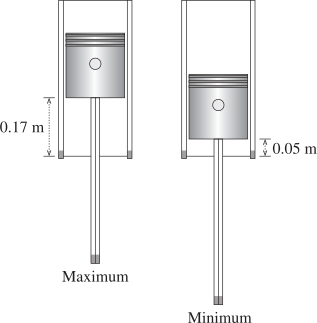
The diagrams show two positions of a single piston in the cylinder chamber of a motorcycle. The piston moves vertically, in simple harmonic motion, between a maximum height of 0.17 metres and a minimum height of 0.05 metres.


The mass of the piston is 0.8 kg. The piston completes 40 cycles per second.

What is the resultant force on the piston, in newtons, that produces the maximum acceleration of the piston? Give your answer correct to the nearest newton.  (3 marks)

--- 5 WORK AREA LINES (style=lined) ---

Show Answers Only

`text{3032 N}`

Show Worked Solution

`text{Using}\ \ ddotx=-n^2(x-b)`

`text{Centre of motion}\ (b) = 0.11`

`text{Amplitude}\ (a) = (0.17-0.05)/2=0.06\ text{m}`

`text{Period}\ (T) = 1/40=0.025\ text{sec}`

`n=(2pi)/T=80pi`

`:.ddotx=-(80pi)^2(x-0.11)`


♦ Mean mark 50%.

`ddotx_(max)\ text{occurs when}\ x=0.17\ text{or}\ 0.05`

`ddotx_(max)` `=-(80pi)^2(0.17-0.11)`  
  `=384pi^2\ text{m s}^(-2)`  


`:.F_(max)` `=mddotx`  
  `=0.8xx384pi^2`  
  `=3031.942…`  
  `=3032\ text{N (to 0 d.p.)}`  

Filed Under: Simple Harmonic Motion Tagged With: Band 5, smc-1059-10-Amplitude / Period, smc-1059-50-Real World examples

Mechanics, EXT2 M1 2021 HSC 13d

An object is moving in simple harmonic motion along the `x`-axis. The acceleration of the object is given by  `overset¨x = – 4 (x - 3)`  where `x` is its displacement from the origin, measured in metres, after `t` seconds.

Initially, the object is 5.5 metres to the right of the origin and moving towards the origin. The object has a speed of 8 m s`\ ^(-1)` as it passes through the origin.

  1. Between which two values of `x` is the particle oscillating?  (2 marks)

    --- 6 WORK AREA LINES (style=lined) ---

  2. Find the first value of `t` for which  `x = 0`,  giving the answer correct to 2 decimal places.  (2 marks)

    --- 6 WORK AREA LINES (style=lined) ---

Show Answers Only
  1. `x = -2\ \ text(and)\ \ x = 8`
  2. `0.58\ text(seconds)`
Show Worked Solution

i.   `overset¨x = -4 (x – 3)`

♦ Mean mark 47%.
`d/(dx)(1/2 v^2)` `= -4x + 12`
`1/2 v^2` `= -2x^2 + 12x + c`

 
`v = 8\ \ text(when)\ \ x = 0:`

`1/2 xx 8^2 = c \ => \ c = 32`

`1/2 v^2 = -2x^2 + 12x + 32`
 

`text(Find)\ \ x\ \ text(when)\ \ v = 0:`

`-2x^2 + 12x + 32` `= 0`
`x^2 – 6x – 16` `= 0`
`(x – 8)(x + 2)` `= 0`


`:.\ text(Particle oscillates between)\ \ x = -2\ \ text(and)\ \ x = 8`


ii.   `overset¨x = -4 (x – 3) \ => \ n = 2`

♦♦ Mean mark 24%.

`text(Amplitude = 5,  Centre of motion at)\ \ x = 3`

`x = 5 cos(2t + alpha) + 3`
 

`text(When)\ \ t = 0, x = 5.5:`

`5.5` `= 5cos alpha + 3`
`cos alpha` `= 1/2`
`alpha` `= pi/3`

  
`:. x = 5 cos(2t + pi/3) + 3`
  

`text(Find)\ \ t\ \ text(when)\ \ x= 0:`

`cos(2t + pi/3)` `= -3/5`
`2t + pi/3` `= 2.214…`
`t` `= 1/2(2.214… – pi/3)`
  `= 0.58\ text(seconds)\ \ text{(2 d.p.)}`

Filed Under: Simple Harmonic Motion Tagged With: Band 5, Band 6, smc-1059-10-Amplitude / Period

Mechanics, EXT2 M1 2020 HSC 5 MC

A particle undergoing simple harmonic motion has a maximum acceleration of 6 m/s2 and a maximum velocity of 4 m/s.
 
What is the period of the motion?

  1. `pi`
  2. `frac{2pi}{3}`
  3. `3pi`
  4. `frac{4pi}{3}`
Show Answers Only

`D`

Show Worked Solution

`ddotx = -n^2  x`

Mean mark 57%.

`text{Find} \ n :`

`ddotx_text{max} =  6 \ \ text{occurs when} \ \ x = – a`

`6 = n^2 a\ …\ (1)`
 

`v^2 = n^2 (a^2 – x^2)`

`v_text{max} = 4 \ \ text{occurs when} \ \ x = 0`

`4^2` `= n^2 (a^2-0)`  
`16` `= n^2  a^2`  
`4` `= n a\ …\ (2)`  

 
`text{Substitute} \ \ na = 4 \ \ text{from (2) into (1):}`

`6` `= 4n`
`n` `= frac{3}{2}`

 
`therefore \ text{Period} = frac{2pi}{n} = frac{4pi}{3}`

`=> \ D`

Filed Under: Simple Harmonic Motion Tagged With: Band 4, smc-1059-10-Amplitude / Period

Mechanics, EXT2* M1 2019 HSC 5 MC

A particle starts from rest, 2 metres to the right of the origin, and moves along the `x`-axis in simple harmonic motion with a period of 2 seconds.

Which equation could represent the motion of the particle?

A.     `x = 2cos pi t`

B.     `x = 2 cos 2t`

C.     `x = 2 + 2 sin pi t`

D.     `x = 2 + 2 sin 2t`

Show Answers Only

`A`

Show Worked Solution
`text(Period)` `= 2`
`(2 pi)/n` `= 2`
`n` `= pi`

 
`:.\ text(Eliminate B and D)`

♦ Mean mark 49%.
 

`text(Particle starts at rest,)`

`(dx)/(dt) = 0\ \ text(when)\ \ t = 0`

`text(Consider A:)`

`(dx)/(dt) = -2pi sin (pi xx 0) = 0`

`text(Consider C:)`

`(dx)/(dt) = 2 pi cos (pi xx 0) = 2pi`

 
`=>  A`

Filed Under: Simple Harmonic Motion Tagged With: Band 5, smc-1059-10-Amplitude / Period

Mechanics, EXT2* M1 2017 HSC 13a

A particle is moving along the `x`-axis in simple harmonic motion centred at the origin.

When  `x = 2`  the velocity of the particle is 4.

When  `x = 5`  the velocity of the particle is 3.

Find the period of the motion.  (3 marks)

--- 8 WORK AREA LINES (style=lined) ---

Show Answers Only

`2sqrt3pi`

Show Worked Solution

`text(S)text(ince motion centred at origin,)`

♦ Mean mark 42%.
`{:d/(dx):}^(1/2 v^2)` `= −n^2x`
`1/2 v^2`  `= int −n^2x\ dx`
  `= −1/2n^2x^2 + c`
 `v^2` `= c-n^2x^2`


`text(When)\ v = 4, x = 2`

`16 = c-4n^2\ …\ (1)`

`text(When)\ v = 3, x = 5`

`9 = c-25n^2\ …\ (2)`

`text(Subtract)\ (1)-(2)`

`7` `= 21n^2`
`n^2` `= 1/3`
`n` `= 1/sqrt3`

 
`:.\ text(Period)= (2pi)/n= 2sqrt3 pi`

Filed Under: Simple Harmonic Motion, Simple Harmonic Motion EXT1 Tagged With: Band 5, smc-1059-10-Amplitude / Period

Mechanics, EXT2* M1 2007 HSC 6a

A particle moves in a straight line. Its displacement, `x` metres, after `t` seconds is given by

`x = sqrt3\ sin\ 2t − cos\ 2t + 3`.

  1. Prove that the particle is moving in simple harmonic motion about  `x = 3`  by showing that   `ddot x = -4(x − 3)`.  (2 marks)

    --- 6 WORK AREA LINES (style=lined) ---

  2. What is the period of the motion?  (1 mark)

    --- 2 WORK AREA LINES (style=lined) ---

  3. Express the velocity of the particle in the form  `dotx = A\ cos\ (2t − α)`, where  `α`  is in radians.  (2 marks)

    --- 6 WORK AREA LINES (style=lined) ---

  4. Hence, or otherwise, find all times within the first  `pi`  seconds when the particle is moving at `2` metres per second in either direction.  (2 marks)

    --- 8 WORK AREA LINES (style=lined) ---

Show Answers Only
  1. `text{Proof (See Worked Solutions.)}`
  2. `pi\ text(seconds)`
  3. `dot x = 4\ cos\ (2t − pi/6)`
  4. `t = pi/4, (5pi)/12, (3pi)/4, (11pi)/12\ text(seconds.)`
Show Worked Solution

i.   `text(Show)\ \ ddot x = -4(x − 3)`

`x` `= sqrt3\ sin\ 2t − cos\ 2t + 3`
`dot x` `= 2sqrt3\ cos\ 2t + 2\ sin\ 2t`
`ddot x` `= -4sqrt3\ sin\2t + 4\ cos\ 2t`
  `= -4(sqrt3\ sin\ 2t − cos\ 2t)`
  `= -4(sqrt3\ sin\ 2t − cos\ 2t + 3 − 3)`
  `= -4(x − 3)\ \ …text(as required)`


ii.  `text(Period)\ = (2pi)/n`

`n^2 = 4 ⇒ n = 2\ \ text{(part (i))}`

`:.\ text(Period)` `= (2pi)/2`
  `= pi\ \ text(seconds)`


iii.  `text(Write)\ \ dot x = 2sqrt3\ cos\ 2t + 2\ sin\ 2t`

`text(in form)\ \ \ A\ cos\ (2t − α)`

`A(cos\ 2t\ cos\ α + sin\ 2t\ sin\ α)` `= 2sqrt3\ cos\ 2t + 2\ sin\ 2t`
`cos\ 2t\ cos\ α + sin\ 2t\ sin\ α` `= (2sqrt3)/A\ cos\ 2t + 2/A\ sin\ 2t`
`⇒ cos\ α` `= (2sqrt3)/A`
`⇒ sin\ α` `= 2/A`
`((2sqrt3)/A)^2 + (2/A)^2` `= 1`
`(2sqrt3)^2 + 2^2` `= A^2`
`:.A` `= sqrt16`
  `= 4`


`:.cos\ α` `= (2sqrt3)/4 = sqrt3/2`
`α` `= pi/6`

`:. dot x = 4\ cos\ (2t − pi/6)`


(iv)  `text(Find)\ \ t\ \ text(when)\ \ dot x = ±2`

`text(If)\ \ dot x = 2`

`4\ cos\ (2t − pi/6)` `= 2`
`cos\ (2t − pi/6)` `= 1/2`
`2t − pi/6` `= pi/3, 2pi − pi/3`
`2t` `= pi/2, (11pi)/6`
`t` `= pi/4, (11pi)/12`


`text(If)\ \ dot x = -2`

`cos\ (2t − pi/6)` `= – 1/2`
`2t − pi/6` `= (2pi)/3, (4pi)/3`
`2t` `= (5pi)/6, (3pi)/2`
`t` `= (5pi)/12, (3pi)/4`


`:.t = pi/4, (5pi)/12, (3pi)/4, (11pi)/12\ \ text(seconds.)`

Filed Under: Simple Harmonic Motion, Simple Harmonic Motion EXT1 Tagged With: Band 4, Band 5, smc-1059-10-Amplitude / Period, smc-1059-20-Prove/Identify SHM, smc-1059-40-Auxiliary Angles

Mechanics, EXT2* M1 2006 HSC 4b

A particle is undergoing simple harmonic motion on the `x`-axis about the origin. It is initially at its extreme positive position. The amplitude of the motion is 18 and the particle returns to its initial position every 5 seconds.

  1. Write down an equation for the position of the particle at time  `t`  seconds.  (2 marks)

    --- 4 WORK AREA LINES (style=lined) ---

  2. How long does the particle take to move from a rest position to the point halfway between that rest position and the equilibrium position?  (3 marks)

    --- 5 WORK AREA LINES (style=lined) ---

Show Answers Only
  1. `x = 18 cos ((2 pi)/5 t)`
  2. `5/6\ \ text(seconds)`
Show Worked Solution

i.   `text{Amplitude (A)} = 18`

♦♦♦ “Very poorly” answered (exact data unavailable).

`text(Period) = (2 pi)/n = 5`

`5n` `= 2 pi`
`n` `= (2 pi)/5`


`text(Using)\ \ x` `= A cos n t`
`x` `= 18 cos ((2 pi)/5 t)`


ii.   `text(When)\ \ t= 0,\ \ \ x = 18`

`text(Find)\ \ t\ \ text(when)\ \ x = 9`

`9` `= 18 cos ((2 pi)/5 t)`
`cos ((2 pi)/5 t)` `= 1/2`
`(2 pi)/5 t` `= pi/3`
`t` `= (5 pi)/(3 xx 2 pi)`
  `= 5/6\ \ text(seconds)`


`:.\ text(It takes the particle)\ \  5/6\ \ text(seconds to move from)`

`text(rest position and half way to equilibrium.)`

Filed Under: Simple Harmonic Motion, Simple Harmonic Motion EXT1 Tagged With: Band 5, Band 6, smc-1059-10-Amplitude / Period

Mechanics, EXT2* M1 2005 HSC 5c

A particle moves in a straight line and its position at time  `t`  is given by

`x = 5 + sqrt 3 sin3t - cos 3t.`

  1. Express  `sqrt 3 sin3t − cos 3t`  in the form  `R sin(3t - alpha)`  where  `alpha`  is in radians.  (2 marks)

    --- 6 WORK AREA LINES (style=lined) ---

  2. The particle is undergoing simple harmonic motion. Find the amplitude and the centre of the motion.  (2 marks)

    --- 3 WORK AREA LINES (style=lined) ---

  3. When does the particle first reach its maximum speed after time  `t = 0`?  (1 mark)

    --- 5 WORK AREA LINES (style=lined) ---

Show Answers Only
  1. `2 sin ( 3t – pi/6)`
  2. `text(Amplitude) = 2\ text(units),\ \ \ text(Centre of the motion at)\ \ x = 5`
  3. `pi/18`
Show Worked Solution

i.    `x = 5 + sqrt 3 sin 3t – cos 3t`

`sqrt 3 sin 3t – cos 3t` `= R sin (3t – alpha)`
  `= R sin 3t cos alpha – R cos 3t sin alpha`

 
`=> R cos alpha = sqrt 3\ \ \ \ \ R sin alpha = 1`

`R^2 = sqrt 3^2 + 1^2 = 4`

`R = 2`

`=> 2 cos alpha` `= sqrt3`
`cos alpha` `= (sqrt3)/2`
`alpha` `= pi/6`

 
`:.\ 2 sin ( 3t – pi/6) = sqrt 3 sin 3t – cos 3t`


ii.  `x` `= 5 + sqrt 3 sin 3t – cos 3t`
  `= 5 + 2 sin (3t – pi/6)`

 
`text(Amplitude) = 2\ text(units)`

`text(Centre of motion at)\ \ x = 5`


iii.  `text(Solution 1)`

`x = 5 + 2 sin (3t – pi/6)`

`dot x = 6 cos (3t – pi/6)`

 
`text(Maximum speed occurs when)`

`cos (3t – pi/6)` `= 1`
`3t – pi/6` `= 0`
`3t` `= pi/6`
`t` `= pi/18`

 
`text(Solution 2)`

`text(Maximum speed occurs at the)`

`text(centre of motion,)\ \ x = 5`

`5 + 2 sin (3t – pi/6)` `= 5`
`2 sin (3t – pi/6)` `= 0`
`sin (3t – pi/6)` `= 0`
`3t – pi/6` `= 0`
`t` `= pi/18`

Filed Under: Simple Harmonic Motion, Simple Harmonic Motion EXT1 Tagged With: Band 4, Band 5, smc-1059-10-Amplitude / Period, smc-1059-31-Max Speed, smc-1059-40-Auxiliary Angles

Mechanics, EXT2* M1 2015 HSC 13a

A particle is moving along the `x`-axis in simple harmonic motion. The displacement of the particle is `x` metres and its velocity is `v` ms`\ ^(–1)`. The parabola below shows `v^2` as a function of `x`.

2015 13a

  1. For what value(s) of `x` is the particle at rest?  (1 mark)

    --- 2 WORK AREA LINES (style=lined) ---

  2. What is the maximum speed of the particle?  (1 mark)

    --- 2 WORK AREA LINES (style=lined) ---

  3. The velocity `v` of the particle is given by the equation

         `v^2 = n^2(a^2 − (x −c)^2)`  where `a`, `c` and `n` are positive constants.


    What are the values of `a`, `c` and `n`?  (3 marks)

    --- 6 WORK AREA LINES (style=lined) ---

Show Answers Only
  1. `3\ text(or)\ 7`
  2. `V = sqrt11\ text(m/s)`
  3. `a = 2, c = 5,`
  4. `n = (sqrt11)/2`
Show Worked Solution

i.   `text(Particle is at rest when)\ v^2 = 0`

`:. x = 3\ \ text(or)\ \ 7`


ii.   `text(Maximum speed occurs when)`

`v^2` `= 11`
`v` `= sqrt11\ text(m/s)`


iii.  `v^2 = n^2(a^2 − (x − c)^2)`

♦ Mean mark 41%.

`text(Amplitude) = 2`

`:.a = 2`

`text(Centre of motion when)\ x = 5`

`:.c = 5`

`text(S)text(ince)\ \ v^2 = 11\ \ text(when)\ \ x = 5`

`11` `= n^2(2^2 − (5 − 5)^2)`
  `= 4n^2`
`n^2` `= 11/4`
`:.n`  `= sqrt11/2`

Filed Under: Simple Harmonic Motion, Simple Harmonic Motion EXT1 Tagged With: Band 3, Band 4, Band 5, smc-1059-10-Amplitude / Period, smc-1059-20-Prove/Identify SHM, smc-1059-30-At Rest, smc-1059-31-Max Speed

Mechanics, EXT2* M1 2015 HSC 9 MC

Two particles oscillate horizontally. The displacement of the first is given by  `x = 3\ sin\ 4t`  and the displacement of the second is given by  `x = a\ sin\ nt`. In one oscillation, the second particle covers twice the distance of the first particle, but in half the time.

What are the values of `a` and `n`?

  1. `a = 1.5,\ \ n = 2`
  2. `a = 1.5, \ \ n = 8`
  3. `a = 6,\ \ n = 2`
  4. `a = 6, \ \ n = 8`
Show Answers Only

`D`

Show Worked Solution
`x_1` `= 3\ sin\ 4t`
`x_2` `= a\ sin\ nt`


`x_2\ text(has twice the amplitude of)\ x_1`

`:. a = 2 xx 3 = 6`

`x_2\ text(has a period)\ (T)\ text(that is half of)\ x_1`

`T(x_1)` `= (2 pi)/n = (2pi)/4`
`:.T(x_2)` `= 1/2 xx (2 pi)/4 = (2pi)/8`
`:.n` `= 8`

 
`=> D`

Filed Under: Simple Harmonic Motion, Simple Harmonic Motion EXT1 Tagged With: Band 4, smc-1059-10-Amplitude / Period

Mechanics, EXT2* M1 2008 HSC 5b

A particle is moving in simple harmonic motion in a straight line. Its maximum speed is 2 ms–1 and its maximum acceleration is  6 ms–2.

Find the amplitude and the period of the motion.   (3 marks)

--- 7 WORK AREA LINES (style=lined) ---

Show Answers Only

`A=2/3\ text(m)`

`T=(2pi)/3\ text(sec).`

Show Worked Solution

`text(Equations of SHM)`

`x` `= A sin nt`
`dot x` `= An cos nt`
`ddot x` `= – An^2 sin nt`


`text(Given max speed)\ = 2\ text(ms)^(-1)`

`text(and)\ \ \ -1 <= cos nt <= 1`

`=> An = 2\ \ \ \ \ …\ (1)`

`text(Given)\ \ ddot x \ \ text{(max)} = 6`

`=>An^2 = 6\ \ \ \ \ …\ (2)`


`text(Substitute)\ \ n=2/A\ \ text{from (1) into (2)}`

`A * (2/A)^2` `= 6`
`4/A` `= 6`
`A` `= 2/3`


`text(Substitute)\ \ A = 2/3\ \ text(into)\ (1)`

`2/3 n` `= 2`
`n` `= 3`

 
`text(Period) = (2pi)/n = (2pi)/3\ text(sec)`

 
`:.\ text(Motion has an amplitude of)\ \ 2/3 text(m)`

`text(and a period of)\ \ (2pi)/3\ text(sec.)`

Filed Under: Simple Harmonic Motion, Simple Harmonic Motion EXT1 Tagged With: Band 5, smc-1059-10-Amplitude / Period

Mechanics, EXT2* M1 2013 HSC 12e

A particle moves along a straight line. The displacement of the particle from the origin is `x`, and its velocity is `v`. The particle is moving so that  `v^2 + 9x^2 = k`, where `k` is a constant.

Show that the particle moves in simple harmonic motion with period  `(2pi)/3`.   (2 marks)

--- 5 WORK AREA LINES (style=lined) ---

Show Answers Only

`text(Proof)\ \ text{(See Worked Solutions)}`

Show Worked Solution
`v^2 + 9x^2` `= k`
`v^2` `= k\ – 9x^2`
`1/2 v^2` `= 1/2k\ – 9/2 x^2`


`text(For SHM,)\ \ ddot x = -n^2x`

`ddot x` `= d/(dx) (1/2v^2)`
  `= -9x`
  `= -3^2 x \ \ \ text(… as required)`


`text(Period)\ (T)\ text(of SHM) = (2pi)/n`

`text(Here,)\ \ n=3`

`:.T= (2pi)/3\ \ \ text(… as required)`

Filed Under: Simple Harmonic Motion, Simple Harmonic Motion EXT1 Tagged With: Band 4, smc-1059-10-Amplitude / Period, smc-1059-20-Prove/Identify SHM

Mechanics, EXT2* M1 2012 HSC 6 MC

A particle is moving in simple harmonic motion with displacement `x`. Its velocity `v` is given by

 `v^2 = 16(9 − x^2)`.

 What is the amplitude, `A`, and the period, `T`, of the motion? 

  1. `A = 3\ \ \ text(and)\ \ \ T = pi/2` 
  2. `A = 3\ \ \ text(and)\ \ \ T = pi/4` 
  3. `A = 4\ \ \ text(and)\ \ \ T = pi/3` 
  4. `A = 4\ \ \ text(and)\ \ \ T = (2pi)/3` 
Show Answers Only

`A`

Show Worked Solution

`v^2 = 16(9 – x^2)`

`text(Find amplitude and period of motion)`

`v^2` `= n^2(A^2 – x^2)`
`A^2` `= 9`
`:.\ A` `=3,\ \ \ (A > 0)`
`n^2` `= 16`
`n` `=4,\ \ \ (n>0)`
`:. T` `= (2pi)/n`
  `= pi/2`

 
`=>  A`

Filed Under: Simple Harmonic Motion, Simple Harmonic Motion EXT1 Tagged With: Band 4, smc-1059-10-Amplitude / Period

Copyright © 2014–2025 SmarterEd.com.au · Log in