SmarterEd

Aussie Maths & Science Teachers: Save your time with SmarterEd

  • Login
  • Get Help
  • About

Mechanics, EXT2 M1 2020 SPEC2 17 MC

The velocity, `v` ms`\ ^(−1)`, of a particle at time  `t >= 0`  seconds and at position  `x >= 1`  metre from the origin is  `v = 1/x`.

The acceleration of the particle, in `text(ms)^(−2)`, when  `x = 2`  is

  1. `−1/4`
  2. `−1/8`
  3. `1/8`
  4. `1/4`
Show Answers Only

`B`

Show Worked Solution

`v = 1/x`

`a` `= v · (dv)/(dx)`
  `= 1/x · −1/(x^2)`
  `= −1/(x^3)`

 
`text(When)\ \ x = 2:`

`a = −1/(2^3) = −1/8`

`=>B`

Filed Under: Forces and Further Motion in a Straight Line, Motion Without Resistance Tagged With: Band 4, smc-1060-02-Motion as f(x), smc-1060-30-Inverse, smc-7437-10-Motion as \(\large \ f(x)\), smc-7437-70-Inverse

Mechanics, EXT2 M1 2016 HSC 15b

A particle is initially at rest at the point `B` which is `b` metres to the right of `O.`

The particle then moves in a straight line towards `O.`

For `x != 0,` the acceleration of the particle is given by  `(- mu^2)/x^2,`  where `x` is the distance from `O` and `mu` is a positive constant.

  1. Prove that  `(dx)/(dt) = -mu sqrt 2 sqrt((b-x)/(bx)).`   (2 marks)

    --- 4 WORK AREA LINES (style=lined) ---

  2. Using the substitution  `x = b cos^2 theta,` show that the time taken to reach a distance `d` metres to the right of `O` is given by
  3.    `t = (b sqrt (2b))/mu int_0^(cos^-1 sqrt (d/b)) cos^2 theta\ d theta.`   (3 marks)

    --- 8 WORK AREA LINES (style=lined) ---

  4. It can be shown that   `t = 1/mu sqrt (b/2) (sqrt(bd-d^2) + b cos^-1 sqrt (d/b)).`  (Do NOT prove this.)
  5. What is the limiting time taken for the particle to reach `O?`   (1 mark)

    --- 4 WORK AREA LINES (style=lined) ---

Show Answers Only

a.    `text(See Worked Solutions)`

b.    `text(See Worked Solutions)`

c.    `(pi(sqrtb)^3)/(2sqrt2mu)\ text(seconds)`

Show Worked Solution

a.    `a = d/dx(1/2 v^2) = −(mu^2)/(x^2)`

`1/2 v^2= int -(mu^2)/(x^2)\ dx= (mu^2)/x + c`

`text(Initially,)\ v = 0\ text(and)\ x = b\ \ =>\ \ c = -(mu^2)/b`

`v^2` `= 2mu^2(1/x-1/b)`
`v` `= −musqrt2 · sqrt(1/x-1/b)qquad(text(negative since moving to left))`
  `= −musqrt2 · sqrt((b-x)/(bx))\ …\ text(as required.)`


b.     `dx/dt` `= −musqrt2 · sqrt((b-x)/(bx))`
  `dt/dx` `= −1/(musqrt2) · sqrt((bx)/(b-x))`
  `int_0^t dt` `= −1/(musqrt2) · int_b^d sqrt((bx)/(b-x))\ dx`

 
`text(Integration by substitution:)`

`text(Let)\ \ x= bcos^2theta\ \ =>\ \ dx= −2bcosthetasintheta\ d theta`

`text(When)quadx` `= b,` `theta` `= 0`
`x` `= d,` `theta` `= cos^(−1)sqrt(d/b)`


`:. t` `= −1/(musqrt2) · int_0^(cos^(−1)sqrt(d/b))sqrt((b^2cos^2theta)/(b(1-cos^2theta))) · −2bcosthetasintheta\ d theta`
 

`= (2b)/(musqrt2) · int_0^(cos^(−1)sqrt(d/b))(sqrtb costheta)/(sintheta) · costhetasintheta\ d theta`


`= (bsqrt(2b))/mu int_0^(cos^(−1)sqrt(d/b)) cos^2theta\ d theta\ …\ text(as required)`


c.    `t = 1/mu sqrt(b/2)(sqrt(bd-d^2) + bcos^(−1)sqrt(d/b))`

`text(As)\ \ d->0,`

♦♦ Mean mark (c) 9%.
`t` `= 1/mu sqrt(b/2) (sqrt0 + bcos^(−1)0)`
  `= 1/mu sqrt(b/2) · b · pi/2`
  `= (pi(sqrtb)^3)/(2sqrt2mu)\ text(seconds)`

Filed Under: Forces and Further Motion in a Straight Line, Motion Without Resistance, Resisted Motion Tagged With: Band 4, Band 5, smc-1060-02-Motion as f(x), smc-1060-30-Inverse, smc-7437-10-Motion as \(\large \ f(x)\), smc-7437-70-Inverse

Mechanics, EXT2 M1 2006 HSC 6b

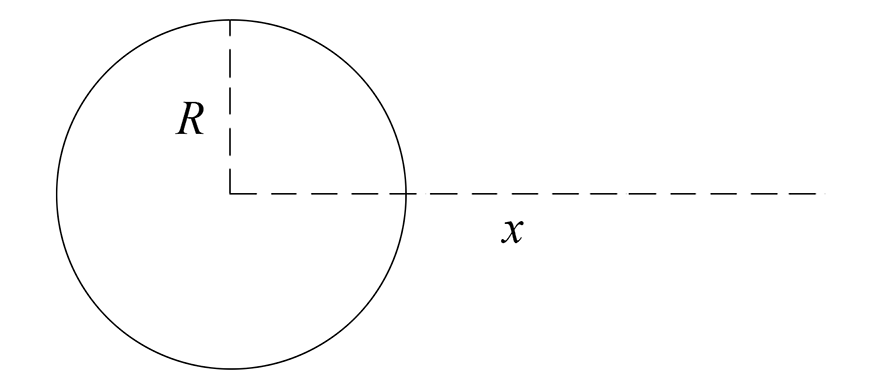
In an alien universe, the gravitational attraction between two bodies is proportional to `x^(–3)`, where `x` is the distance between their centres.

A particle is projected upward from the surface of a planet with velocity  `u`  at time  `t = 0`.  Its distance `x` from the centre of the planet satisfies the equation

`ddot x =-k/x^3.`

  1. Show that  `k =gR^3`, where `g` is the magnitude of the acceleration due to gravity at the surface of the planet and `R` is the radius of the planet.   (1 mark)

    --- 4 WORK AREA LINES (style=lined) ---

  2. Show that `v`, the velocity of the particle, is given by
  3.    `v^2 = (gR^3)/x^2-(gR-u^2).`   (3 marks)

    --- 8 WORK AREA LINES (style=lined) ---

  4. It can be shown that  `x = sqrt (R^2 + 2uRt-(gR-u^2) t^2).` (Do NOT prove this.)
  5. Show that if  `u >= sqrt (gR)`  the particle will not return to the planet.   (2 marks)

    --- 8 WORK AREA LINES (style=lined) ---

  6. If  `u < sqrt (gR)`  the particle reaches a point whose distance from the centre of the planet is `D`, and then falls back.
  7.   i.  Use the formula in part (b) to find `D` in terms of `u, R` and `g.`   (1 mark)

    --- 4 WORK AREA LINES (style=lined) ---

  8.   ii. Use the formula in part (c) to find the time taken for the particle to return to the surface of the planet in terms of `u, R` and `g.`   (1 mark)

    --- 5 WORK AREA LINES (style=lined) ---

Show Answers Only

a.    `text(Proof)\ \ text{(See Worked Solutions)}`

b.    `text(Proof)\ \ text{(See Worked Solutions)}`

c.    `text(Proof)\ \ text{(See Worked Solutions)}`

d.i   `D = sqrt ((gR^3)/(gR-u^2))`

d.ii   `(2uR)/(gR-u^2)`

Show Worked Solution
a.    

`text(When)\ x=R,\ \ ddot x =-k/(R^3)`

`text(Given)\ \ ddot x = -g\ \ text(on the surface)`

`-g ­=` `-k/R^3`
`:.k ­=` `gR^3`


b.     `ddot x` `=- (gR^3)/x^3`
  `1/2 v^2` `= int-(gR^3)/x^3\ dx`
  `1/2 v^2` `= (gR^3)/(2x^2)+c_1`
  `:.v^2` `=(gR^3)/x^2 +c_2`

 
`text(When)\ \ t=0, x=R and v=u:`

`u^2` `=(gR^3)/R^2 +c_2`
`c_2` `=u^2-gR`
`:.v^2` `=(gR^3)/x^2 +u^2-gR`
  `=(gR^3)/x^2 -(gR-u^2)`


c.    `text(Solution 1)`

`text(If)\ \ u >= sqrt (gR)\ \ text(then)\ \ u^2 >= gR`

`x` `= sqrt (R^2 + 2uRt-(gR-u^2) t^2)`
  `≥sqrt (R^2 + 2sqrt(gR)Rt-(gR-gR) t^2)`
  `≥sqrt (R^2 + 2sqrt(gR)Rt)`
  `>sqrt (R^2)\ \ \ \ (t>0)`
  `>R`


`:. x>R\ \ text(when)\ \ t>0,\ text(and the particle does not)`

`text(return to the surface of the planet.)`


`text(Solution 2)`

`v^2` `=(gR^3)/x^2 -(gR-u^2)`
  `>=(gR^3)/x^2\ \ \ \ text{(since}\ u^2 >= gR text{)}`
`v` `>=0`

 
`:.\ text(S)text(ince)\ \ v>=0,\ \ text(the particle is never moving back)`

`text(towards the planet and will never return.)`


d.i   `v^2 = (gR^3)/D^2-(gR-u^2)`

`x = D\ \ text(occurs when)\ \ v = 0`

`:.0 ­=` `(gR^3)/D^2-(gR-u^2)`
`D^2 ­=` `(gR^3)/(gR-u^2)`
`:.D ­=` `sqrt ((gR^3)/(gR-u^2))`


d.ii  `text(Find)\ \ t\ \ text(when)\ \ x = R`

`text{Using part (c)}`

`R` `=sqrt (R^2 + 2uRt-(gR-u^2) t^2)`
`R^2` `= R^2 + 2uRt-(gR-u^2) t^2`
`0` `= t(2uR-(gR-u^2)t)`
`:.t` ` = (2uR)/(gR-u^2)\ \ \ \ (t>0)`

 
`:.\ text(It takes)\ \ (2uR)/(gR-u^2)\ \ text(seconds to return to the planet.)`

Filed Under: Forces and Further Motion in a Straight Line, Motion Without Resistance, Resisted Motion Tagged With: Band 4, Band 5, smc-1060-02-Motion as f(x), smc-1060-30-Inverse, smc-7437-10-Motion as \(\large \ f(x)\), smc-7437-70-Inverse

Copyright © 2014–2026 SmarterEd.com.au · Log in