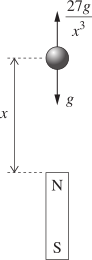
A bar magnet is held vertically. An object that is repelled by the magnet is to be dropped from directly above the magnet and will maintain a vertical trajectory. Let \(x\) be the distance of the object above the magnet. The object is subject to acceleration due to gravity, \(g\), and an acceleration due to the magnet \(\dfrac{27 g}{x^3}\), so that the total acceleration of the object is given by \(a=\dfrac{27 g}{x^3}-g\) The object is released from rest at \(x=6\). --- 8 WORK AREA LINES (style=lined) --- --- 10 WORK AREA LINES (style=lined) ---
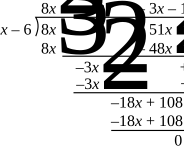
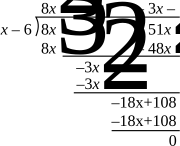
i. \(a=\dfrac{27 g}{x^3}-g\) ii. \(\text{Find \(x\) when \(v=0\):}\) \(8 x^3-51 x^2+108=(x-6)\left(8 x^2-3 x-18\right)\) \(\text{Other roots:}\)
\(\dfrac{d}{dx}(\frac{1}{2}v^{2})\)
\(= \dfrac{27g}{x^3}-g\)
\(\dfrac{1}{2} v^2\)
\(=-\dfrac{27 g}{2 x^2}-g x+c\)
\(\text{When}\ \ x=6, v=0:\)
\(0\)
\(=-\dfrac{27g}{2 \times 6^2}-6g+c\)
\(c\)
\(=\dfrac{459 g}{72}=\dfrac{51 g}{8}\)
\(\dfrac{1}{2} v^2\)
\(=-\dfrac{27 g}{2 x^2}-g x+\dfrac{51 g}{8}\)
\(v^2\)
\(=-\dfrac{27 g}{x^2}-2 g x+\dfrac{51g }{4}\)
\(=g\left(\dfrac{51}{4}-2 x-\dfrac{27}{x^2}\right)\)
\(\dfrac{51}{4}-2 x-\dfrac{27}{x^2}\)
\(=0\)
\(51 x^2-8 x^3-108\)
\(=0\)
\(8 x^3-51 x^2+108\)
\(=0\)
\(\text{Given \(x=6\) is a root:}\)
\(x\)
\(=\dfrac{3 \pm \sqrt{9-4 \cdot 8 \cdot 18}}{2 \times 8}\)
\(=\dfrac{3 \pm \sqrt{585}}{16}\)
\(=\dfrac{3+3 \sqrt{65}}{16} \quad(x>0)\)
\(=1.7 \ \text{units (1 d.p.)}\)
\(\therefore \ \text{Object next comes to rest at \(x=1.7\) units}\)
Mechanics, EXT2 M1 2020 SPEC2 17 MC
The velocity, `v` ms`\ ^(−1)`, of a particle at time `t >= 0` seconds and at position `x >= 1` metre from the origin is `v = 1/x`.
The acceleration of the particle, in `text(ms)^(−2)`, when `x = 2` is
- `−1/4`
- `−1/8`
- `1/8`
- `1/4`
Mechanics, EXT2 M1 2020 HSC 16a
Two masses, `2m` kg and `4m` kg, are attached by a light string. The string is placed over a smooth pulley as shown.
The two masses are at rest before being released and `v` is the velocity of the larger mass at time `t` seconds after they are released.
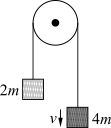
The force due to air resistance on each mass has magnitude `kv`, where `k` is a positive constant.
- Show that `frac{dv}{dt} = frac{gm-kv}{3m}`. (2 marks)
--- 6 WORK AREA LINES (style=lined) ---
- Given that `v < frac{gm}{k}`, show that when `t = frac{3m}{k} ln 2`, the velocity of the larger mass is `frac{gm}{2k}`. (3 marks)
--- 12 WORK AREA LINES (style=lined) ---
Show Worked Solution
i.
♦ Mean mark part (i) 37%.
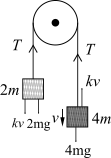
`text{Taking} \ v \ text{downwards as positive.}`
`text{Forces acting on}\ 2m\ text{mass:}`
`kv + 2 mg-T = -2m * frac{dv}{dt}\ …\ (1)`
`text{Forces acting our} \ 4m \ text{mass:}`
`4mg-kv-T = 4m * frac{dv}{dt}\ …\ (2)`
`text{Subtract:} \ (2)-(1)`
| `2 mg-2 kv` | `= 6 m * frac{dv}{dt}` |
| `:. frac{dv}{dt}` | `= frac{2mg-2 kv}{6 m}= frac{gm-kv}{3m}` |
| ii. | `frac{dv}{dt}` | `= frac{gm-kv}{3m}` |
| `frac{dt}{dv}` | `= frac{3m}{gm-kv}` | |
| `t` | `= int frac{3m}{gm-kv}\ dv-frac{3m}{k} log_e |gm-kv | + c` |
`text{When} \ \ t = 0, v = 0:`
| `0` | `= -frac{3m}{k} log_e \ | gm | + c` |
| `c` | `= frac{3m}{k} log_e \ | gm | ` |
| `t` | `= frac{3m}{k} log_e \ | gm | \-frac{3m}{k} log_e \ | gm -kv |` |
| `= frac{3m}{k} log_e \ | frac{mg}{gm-kv} |` |
`text{Find} \ v\ \ text{when} \ t = frac{3m}{k} log_e 2 :`
| `frac{3m}{k} log_e 2` | `= frac{3m}{k} log_e | frac{gm}{gm-kv} |` |
| `2` | `= frac{gm}{gm-kv}` |
| `2gm-2kv` | `= gm` |
| `2kv` | `= gm` |
| `therefore \ v` | `= frac{gm}{2k}` |
Mechanics, EXT2 M1 2016 HSC 15b
A particle is initially at rest at the point `B` which is `b` metres to the right of `O.`
The particle then moves in a straight line towards `O.`
For `x != 0,` the acceleration of the particle is given by `(- mu^2)/x^2,` where `x` is the distance from `O` and `mu` is a positive constant.
- Prove that `(dx)/(dt) = -mu sqrt 2 sqrt((b-x)/(bx)).` (2 marks)
--- 4 WORK AREA LINES (style=lined) ---
- Using the substitution `x = b cos^2 theta,` show that the time taken to reach a distance `d` metres to the right of `O` is given by
- `t = (b sqrt (2b))/mu int_0^(cos^-1 sqrt (d/b)) cos^2 theta\ d theta.` (3 marks)
--- 8 WORK AREA LINES (style=lined) ---
- It can be shown that `t = 1/mu sqrt (b/2) (sqrt(bd-d^2) + b cos^-1 sqrt (d/b)).` (Do NOT prove this.)
- What is the limiting time taken for the particle to reach `O?` (1 mark)
--- 4 WORK AREA LINES (style=lined) ---
Mechanics, EXT2 M1 2006 HSC 6b
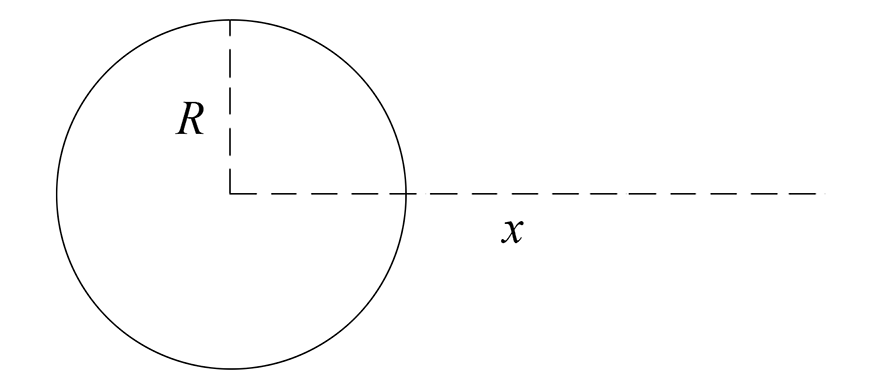
In an alien universe, the gravitational attraction between two bodies is proportional to `x^(–3)`, where `x` is the distance between their centres.
A particle is projected upward from the surface of a planet with velocity `u` at time `t = 0`. Its distance `x` from the centre of the planet satisfies the equation
`ddot x =-k/x^3.`
- Show that `k =gR^3`, where `g` is the magnitude of the acceleration due to gravity at the surface of the planet and `R` is the radius of the planet. (1 mark)
--- 4 WORK AREA LINES (style=lined) ---
- Show that `v`, the velocity of the particle, is given by
- `v^2 = (gR^3)/x^2-(gR-u^2).` (3 marks)
--- 8 WORK AREA LINES (style=lined) ---
- It can be shown that `x = sqrt (R^2 + 2uRt-(gR-u^2) t^2).` (Do NOT prove this.)
- Show that if `u >= sqrt (gR)` the particle will not return to the planet. (2 marks)
--- 8 WORK AREA LINES (style=lined) ---
- If `u < sqrt (gR)` the particle reaches a point whose distance from the centre of the planet is `D`, and then falls back.
- i. Use the formula in part (b) to find `D` in terms of `u, R` and `g.` (1 mark)
--- 4 WORK AREA LINES (style=lined) ---
- ii. Use the formula in part (c) to find the time taken for the particle to return to the surface of the planet in terms of `u, R` and `g.` (1 mark)
--- 5 WORK AREA LINES (style=lined) ---
Show Worked Solution
| a. |
 |
`text(When)\ x=R,\ \ ddot x =-k/(R^3)`
`text(Given)\ \ ddot x = -g\ \ text(on the surface)`
| `-g =` | `-k/R^3` |
| `:.k =` | `gR^3` |
| b. | `ddot x` | `=- (gR^3)/x^3` |
| `1/2 v^2` | `= int-(gR^3)/x^3\ dx` | |
| `1/2 v^2` | `= (gR^3)/(2x^2)+c_1` | |
| `:.v^2` | `=(gR^3)/x^2 +c_2` |
`text(When)\ \ t=0, x=R and v=u:`
| `u^2` | `=(gR^3)/R^2 +c_2` |
| `c_2` | `=u^2-gR` |
| `:.v^2` | `=(gR^3)/x^2 +u^2-gR` |
| `=(gR^3)/x^2 -(gR-u^2)` |
c. `text(Solution 1)`
`text(If)\ \ u >= sqrt (gR)\ \ text(then)\ \ u^2 >= gR`
| `x` | `= sqrt (R^2 + 2uRt-(gR-u^2) t^2)` |
| `≥sqrt (R^2 + 2sqrt(gR)Rt-(gR-gR) t^2)` | |
| `≥sqrt (R^2 + 2sqrt(gR)Rt)` | |
| `>sqrt (R^2)\ \ \ \ (t>0)` | |
| `>R` |
`:. x>R\ \ text(when)\ \ t>0,\ text(and the particle does not)`
`text(return to the surface of the planet.)`
`text(Solution 2)`
| `v^2` | `=(gR^3)/x^2 -(gR-u^2)` |
| `>=(gR^3)/x^2\ \ \ \ text{(since}\ u^2 >= gR text{)}` | |
| `v` | `>=0` |
`:.\ text(S)text(ince)\ \ v>=0,\ \ text(the particle is never moving back)`
`text(towards the planet and will never return.)`
d.i `v^2 = (gR^3)/D^2-(gR-u^2)`
`x = D\ \ text(occurs when)\ \ v = 0`
| `:.0 =` | `(gR^3)/D^2-(gR-u^2)` |
| `D^2 =` | `(gR^3)/(gR-u^2)` |
| `:.D =` | `sqrt ((gR^3)/(gR-u^2))` |
d.ii `text(Find)\ \ t\ \ text(when)\ \ x = R`
`text{Using part (c)}`
| `R` | `=sqrt (R^2 + 2uRt-(gR-u^2) t^2)` |
| `R^2` | `= R^2 + 2uRt-(gR-u^2) t^2` |
| `0` | `= t(2uR-(gR-u^2)t)` |
| `:.t` | ` = (2uR)/(gR-u^2)\ \ \ \ (t>0)` |
`:.\ text(It takes)\ \ (2uR)/(gR-u^2)\ \ text(seconds to return to the planet.)`