SmarterEd

Aussie Maths & Science Teachers: Save your time with SmarterEd

  • Login
  • Get Help
  • About

Mechanics, EXT2 M1 2023 HSC 14c

A projectile of mass \(M\) kg is launched vertically upwards from the origin with an initial speed \(v_0\) m s\(^{-1}\). The acceleration due to gravity is \( {g}\) ms\(^{-2}\).

The projectile experiences a resistive force of magnitude \(kMv^2\) newtons, where \(k\) is a positive constant and \(v\) is the speed of the projectile at time \(t\) seconds.

  1. The maximum height reached by the particle is \(H\) metres.
  2. Show that  \(H=\dfrac{1}{2 k} \ln \left(\dfrac{k v_0{ }^2+g}{g}\right)\).  (3 marks)

    --- 8 WORK AREA LINES (style=lined) ---

  3. When the projectile lands on the ground, its speed is \(v_1 \text{m} \ \text{s}^{-1}\), where \(v_1\) is less than the magnitude of the terminal velocity.
  4. Show that  \(g\left(v_0^2-v_1^2\right)=k v_0^2 v_1^2\).  (3 marks)

    --- 10 WORK AREA LINES (style=lined) ---
Show Answers Only
  1. \(\text{See Worked Solution}\)
  2. \(\text{See Worked Solution}\)
Show Worked Solution

i.    \(\text{Taking up as positive:}\)

\(M\ddot x\) \(=-Mg-kMv^2\)  
\(\ddot x\) \(=-g-kv^2\)  
\(v \cdot \dfrac{dv}{dx}\) \(=-(g+kv^2) \)  
\(\dfrac{dv}{dx}\) \(=-\dfrac{g+kv^2}{v} \)  
\(\dfrac{dx}{dv}\) \(=-\dfrac{v}{g+kv^2} \)  
\(x\) \(=-\dfrac{1}{2k} \displaystyle \int \dfrac{2kv}{g+kv^2}\, dv \)  
  \(=-\dfrac{1}{2k} \ln |g+kv^2|+c \)  

 
\(\text{When}\ \ x=o, \ v=v_0: \)

\(c=\dfrac{1}{2k} \ln |g+kv_0^2| \)

\(x\) \(=\dfrac{1}{2k} \ln |g+kv_0^2|-\dfrac{1}{2k} \ln |g+kv^2| \)  
  \(=\dfrac{1}{2k} \ln \Bigg{|} \dfrac{g+kv_0^2}{g+kv^2} \Bigg{|} \)  

 
\(\text{When}\ \ v=0, x=H: \)

\(H=\dfrac{1}{2k} \ln \Bigg{(} \dfrac{g+kv_0^2}{g} \Bigg{)},\ \ \ \ (k>0) \)
  

ii.   \(\text{When projectile travels downward:} \)

\(M \ddot x\) \(=Mg-kMv^2\)  
\(\ddot x\) \(=g-kv^2\)  
\(v \cdot \dfrac{dv}{dx}\) \(=g-kv^2\)  
\(\dfrac{dx}{dv}\) \(=\dfrac{v}{g-kv^2}\)  
\(x\) \(=-\dfrac{1}{2k} \displaystyle \int \dfrac{-2kv}{g-kv^2}\,dv \)  
  \(=-\dfrac{1}{2k}  \ln|g-kv^2|+c \)  

 
\(\text{When}\ \ x=0, \ v=0: \)

\(c=\dfrac{1}{2k} \ln g \)

\(x=\dfrac{1}{2k} \ln \Bigg{|} \dfrac{g}{g-kv^2} \Bigg{|} \)
 

\(\text{When}\ \ x=H, \ v=v_1: \)

\(\dfrac{1}{2k} \ln \Bigg{(} \dfrac{g+kv_0^2}{g} \Bigg{)}\) \(=\dfrac{1}{2k} \ln \Bigg{|} \dfrac{g}{g-kv_1^2} \Bigg{|} \)  
\(\dfrac{g+kv_0^2}{g} \) \(=\dfrac{g}{g-kv_1^2} \)  
\(g^2\) \(=(g+kv_0^2)(g-kv_1^2) \)  
\(g^2\) \(=g^2-gkv_1^2+gkv_0^2-k^2v_0^2v_1^2 \)  
\(gkv_0^2-gkv_1^2 \) \(=k^2v_0^2v_1^2 \)  
\(gk(v_0^2-v_1^2) \) \(=k^2v_0^2 v_1^2 \)  
\(g(v_0^2-v_1^2) \) \(=kv_0^2v_1^2 \)  
♦♦ Mean mark (ii) 31%.

Filed Under: Resisted Motion Tagged With: Band 3, Band 5, smc-1061-05-Projectile Motion, smc-1061-20-R ~ v^2, smc-1061-50-Max Height

Mechanics, EXT2 M1 2023 HSC 13c

A particle of mass 1 kg is projected from the origin with speed 40 m s\( ^{-1}\) at an angle 30° to the horizontal plane.

  1. Use the information above to show that the initial velocity of the particle is
  2.     \(\mathbf{v}(0)={\displaystyle\left(\begin{array}{cc}20 \sqrt{3} \\ 20\end{array}\right)} \).   (1 mark)

    --- 6 WORK AREA LINES (style=lined) ---

The forces acting on the particle are gravity and air resistance. The air resistance is proportional to the velocity vector with a constant of proportionality 4 . Let the acceleration due to gravity be 10 m s \( ^{-2}\).

The position vector of the particle, at time \(t\) seconds after the particle is projected, is \(\mathbf{r}(t)\) and the velocity vector is \(\mathbf{v}(t)\).
 

  1. Show that  \(\mathbf{v}(t)={\displaystyle \left(\begin{array}{cc}20 \sqrt{3} e^{-4 t} \\ \dfrac{45}{2} e^{-4 t}-\dfrac{5}{2}\end{array}\right)}\)  (3 marks)

    --- 12 WORK AREA LINES (style=lined) ---

  2. Show that  \(\mathbf{r}(t)=\left(\begin{array}{c}5 \sqrt{3}\left(1-e^{-4 t}\right) \\ \dfrac{45}{8}\left(1-e^{-4 t}\right)-\dfrac{5}{2} t\end{array}\right)\)  (2 marks)

    --- 10 WORK AREA LINES (style=lined) ---
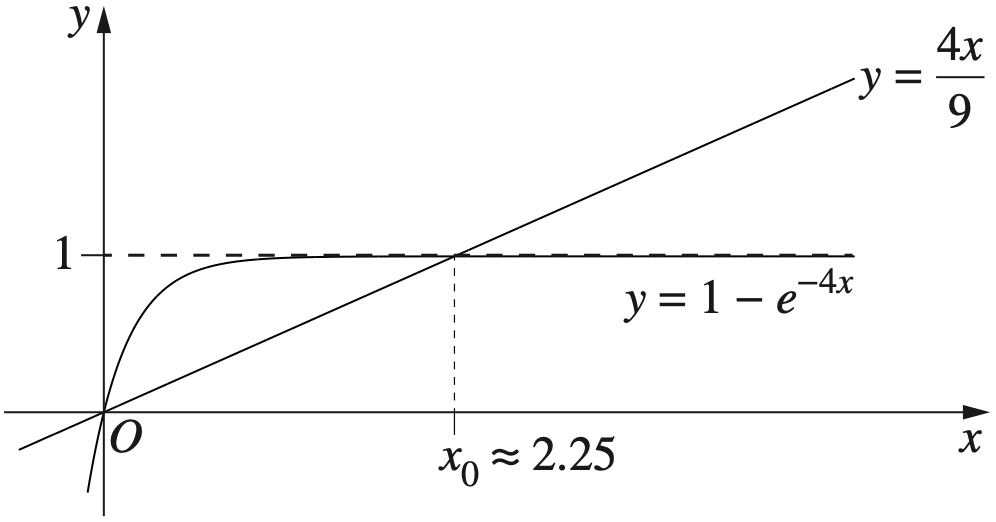
  3. The graphs  \(y=1-e^{-4 x}\)  and  \(y=\dfrac{4 x}{9}\) are given in the diagram below.
     
     
  4. Using the diagram, find the horizontal range of the particle, giving your answer rounded to one decimal place.  (2 marks)

    --- 7 WORK AREA LINES (style=lined) ---

Show Answers Only

  1. \(\text{Proof (See Worked Solutions)}\)
  2. \(\text{Proof (See Worked Solutions)}\)
  3. \(\text{Proof (See Worked Solutions)}\)
  4. \(8.7\ \text{metres}\)

Show Worked Solution

i. 

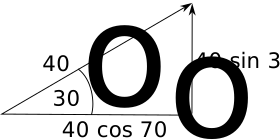
\(\underset{\sim}{v}(0)={\displaystyle\left(\begin{array}{cc} 40 \cos\ 30° \\ 40 \sin\ 30°\end{array}\right)} = {\displaystyle\left(\begin{array}{cc} 40 \times \frac{\sqrt3}{2} \\ 40 \times \frac{1}{2}\end{array}\right)}  = {\displaystyle\left(\begin{array}{cc}20 \sqrt{3} \\ 20\end{array}\right)} \)
 

ii.   \(\text{Air resistance:} \)

\(\underset{\sim}{F} = -4\underset{\sim}{v} = {\displaystyle\left(\begin{array}{cc} -4\dot{x} \\ -4\dot{y} \end{array}\right)} \)

\(\text{Horizontally:}\)

\(1 \times \ddot{x} \) \(=-4 \dot{x} \)  
\(\dfrac{d\dot{x}}{dt}\) \(=-4\dot{x}\)  
\(\dfrac{dt}{d\dot{x}}\) \(= -\dfrac{1}{4\dot{x}} \)  
\(t\) \(=-\dfrac{1}{4} \displaystyle \int \dfrac{1}{\dot{x}} \ d\dot{x} \)  
\(-4t\) \(=\ln |\dot{x}|+c \)  

 
\(\text{When}\ \ t=0, \ \dot{x}=20\sqrt3 \ \ \Rightarrow\ \ c=-\ln{20\sqrt3} \)

\(-4t\) \(=\ln|\dot{x}|-\ln 20\sqrt3 \)  
\(-4t\) \(=\ln\Bigg{|}\dfrac{\dot{x}}{20\sqrt{3}} \Bigg{|} \)  
\(\dfrac{\dot{x}}{20\sqrt{3}} \) \(=e^{-4t} \)  
\(\dot{x}\) \(=20\sqrt{3}e^{-4t}\)  

 
\(\text{Vertically:} \)

\(1 \times \ddot{y} \) \(=-1 \times 10-4 \dot{y} \)  
\(\dfrac{d\dot{y}}{dt}\) \(=-(10+4\dot{y})\)  
\(\dfrac{dt}{d\dot{y}}\) \(= -\dfrac{1}{10+4\dot{y}} \)  
\(t\) \(=- \displaystyle \int \dfrac{1}{10+4\dot{y}} \ d\dot{y} \)  
\(-4t\) \(=- \displaystyle \int \dfrac{4}{10+4\dot{y}} \ d\dot{y} \)  
\(-4t\) \(=\ln |10+4\dot{y}|+c \)  

 
\(\text{When}\ \ t=0, \ \dot{y}=20 \ \ \Rightarrow\ \ c=-\ln{90} \)

\(-4t\) \(=\ln|10+4\dot{y}|-\ln 90 \)  
\(-4t\) \(=\ln\Bigg{|}\dfrac{10+4\dot{y}}{\ln{90}} \Bigg{|} \)  
\(\dfrac{10+4\dot{y}}{90} \) \(=e^{-4t} \)  
\(4\dot{y}\) \(=90e^{-4t}-10\)  
\(\dot{y}\) \(=\dfrac{45}{2} e^{-4t}-\dfrac{5}{2} \)  

 
\(\therefore \underset{\sim}v={\displaystyle \left(\begin{array}{cc}20 \sqrt{3} e^{-4 t} \\ \dfrac{45}{2} e^{-4 t}-\dfrac{5}{2}\end{array}\right)}\) 

 
iii.
   \(\text{Horizontally:}\)

\(x\) \(= \displaystyle \int \dot{x}\ dx\)  
  \(= \displaystyle \int 20\sqrt3 e^{-4t}\ dt \)  
  \(=-5\sqrt3 e^{-4t}+c \)  

 
\(\text{When}\ \ t=0, \ x=0\ \ \Rightarrow\ \ c=5\sqrt3 \)

\(x\) \(=5\sqrt3-5\sqrt3 e^{-4t} \)  
  \(=5\sqrt3(1-e^{-4t}) \)  

 
\(\text{Vertically:}\)

\(y\) \(= \displaystyle \int \dot{y}\ dx\)  
  \(= \displaystyle \int \dfrac{45}{2} e^{-4t}-\dfrac{5}{2}\ dt \)  
  \(=-\dfrac{45}{8}e^{-4t}-\dfrac{5}{2}t+c \)  

 
\(\text{When}\ \ t=0, \ y=0\ \ \Rightarrow\ \ c= \dfrac{45}{8} \)

\(y\) \(=\dfrac{45}{8}-\dfrac{45}{8} e^{-4t}-\dfrac{5}{2}t \)  
  \(=\dfrac{45}{8}(1-e^{-4t})-\dfrac{5}{2} \)  

 
\(\therefore \underset{\sim}{r}=\left(\begin{array}{c}5 \sqrt{3}\left(1-e^{-4 t}\right) \\ \dfrac{45}{8}\left(1-e^{-4 t}\right)-\dfrac{5}{2} t\end{array}\right)\)
 

iv.   \(\text{Range}\ \Rightarrow\ \text{Find}\ \ t\ \ \text{when}\ \ y=0: \)

\(\dfrac{45}{8}(1-e^{-4t})-\dfrac{5}{2}t \) \(=0\)  
\(\dfrac{45}{8}(1-e^{-4t}) \) \(=\dfrac{5}{2}t \)  
\(1-e^{-4t}\) \(=\dfrac{4}{9}t \)  

 
\(\text{Graph shows intersection of these two graphs.}\)

\(\Rightarrow \text{Solution when}\ \ t\approx 2.25\)

\(\therefore\ \text{Range}\) \(=5\sqrt3(1-e^{(-4 \times 2.25)}) \)  
  \(=8.659…\)  
  \(=8.7\ \text{metres (to 1 d.p.)}\)  

♦ Mean mark (iv) 43%.
 

Filed Under: Resisted Motion Tagged With: Band 3, Band 4, Band 5, smc-1061-05-Projectile Motion, smc-1061-10-R ~ v, smc-1061-60-Time of Travel / Distance, smc-1061-95-Vectors

Mechanics, EXT2 M1 2022 HSC 16b

A projectile of mass `M` kg is launched vertically upwards from a horizontal plane with initial speed `v_0\ text{m s}^(-1)` which is less than 100`\ text{m s}^(-1)`. The projectile experiences a resistive force which has magnitude `0.1 M v` newtons, where `v\ text{m s}^(-1)` is the speed of the projectile. The acceleration due to gravity is 10`\ text{m s}^(-2)`.

The projectile lands on the horizontal plane 7 seconds after launch.

Find the value of `v_0`, correct to 1 decimal place.  (4 marks)

Show Answers Only

`39.1\ text{m s}^(-1)`

Show Worked Solution

`text{Motion is only vertical.}`

`Mddoty=M(-g-0.1v)`

`(dv)/(dt)` `=-(g+0.1v)`  
`(dt)/(dv)` `=- 1/(g+0.1v)`  
`t` `=-int1/(g+0.1v) dv`  
  `=-10ln abs(g+0.1v)+c`  

 
`text{When}\ \ t=0, \ v=v_0`

`=>c=10ln abs(g+0.1v_0)`


♦ Mean mark 45%.
`t` `=10ln abs(g+0.1v_0)-10ln abs(g+0.1v)`  
  `=10ln abs((g+0.1v_0)/(g+0.1v))`  
`e^(t/10)` `=(g+0.1v_0)/(g+0.1v)`  
`(g+0.1v)` `=(g+0.1v_0)*e^(- t/10)\ \ \ (text{note}\ (g+0.1v)>0\ text{as}\ v<100)`  
`0.1v` `=-g+(g+0.1v_0)*e^(- t/10)`  
`v` `=10[-g+(g+0.1v_0)*e^(- t/10)]`  

 
`y=intv\ dt=10[-g t-10(g+0.1v_0)*e^(- t/10)]+c`

`text{When}\ \ t=0, \ y=0:`

`=> \ c=100(g+0.1v_0)`

`:.y=10[-g t-10(g+0.1v_0)*e^(- t/10)]+100(g+0.1v_0)`
 

`text{Find}\ v_0,\ text{given}\ y=0\ text{at}\ t=7:`

`0` `=10[-70-10(10+0.1v_0)*e^(-0.7)]+100(10+0.1v_0)`  
`0` `=-700-100(10+0.1v_0)*e^(-0.7)+1000+10v_0`  
`0` `=-700-1000e^(-0.7)-10v_0e^(-0.7)+1000+10v_0`  
`0` `=300-1000e^(-0.7)+v_0(10-10e^(-0.7))`  
`:.v_0` `=(1000e^(-0.7)-300)/(10-10e^(-0.7))`  
  `=39.0503…`  
  `=39.1\ text{m s}^(-1)\ \ text{(to 1 d.p.)}`  

Filed Under: Resisted Motion Tagged With: Band 5, smc-1061-05-Projectile Motion, smc-1061-10-R ~ v

Mechanics, EXT2 M1 2022 HSC 8 MC

As a projectile of mass `m` kilograms travels through air, it experiences a frictional force. The magnitude of this force is proportional to the square of the speed `v` of the projectile. The constant of proportionality is the positive number `k`. The position of the particle at time `t` is denoted by `([x],[y])`. The acceleration due to gravity is `g \ text{m s}^(-2)`.

Based on Newton's laws of motion, which equation models the motion of this projectile?

  1. `([0],[-mg])+kv([overset.x],[overset.y])=m([overset{..}x],[overset{..}y])`
  2. `([0],[-mg])-kv([overset.x],[overset.y])=m([overset{..}x],[overset{..}y])`
  3. `([0],[-mg])+kv^(2)([overset.x],[overset.y])=m([overset{..}x],[overset{..}y])`
  4. `([0],[-mg])-kv^(2)([overset.x],[overset.y])=m([overset{..}x],[overset{..}y])`
Show Answers Only

`B`

Show Worked Solution

`text{Friction}\ (F)\ text{works against velocity}`

`:.\ F prop v^2\ \ =>\ \ F=-kv^2\ \ (k>0)`

`text{→ Eliminate A and C}`


♦♦♦ Mean mark 26%.

`text{S}text{ince}\ \ v=abs(((dotx),(doty))):`

`- abs(kv((dotx),(doty))) = -kv abs(((dotx),(doty)))=-kv^2`

`=>B`

Filed Under: Resisted Motion Tagged With: Band 6, smc-1061-05-Projectile Motion, smc-1061-20-R ~ v^2

Mechanics, EXT2 M1 EQ-Bank 1

A canon ball of mass 9 kilograms is dropped from the top of a castle at a height of `h` metres above the ground.

The canon ball experiences a resistance force due to air resistance equivalent to  `(v^2)/500`, where `v` is the speed of the canon ball in metres per second. Let  `g=9.8\ text(ms)^-2`  and the displacement, `x` metres at time `t` seconds, be measured in a downward direction.

  1. Show the equation of motion is given by
     
         `ddotx = g - (v^2)/4500`  (1 mark)

    --- 4 WORK AREA LINES (style=lined) ---

  2. Show, by integrating using partial fractions, that
     
         `v = 210((e^(7/75 t) - 1)/(e^(7/75 t) + 1))`  (5 marks)

    --- 12 WORK AREA LINES (style=lined) ---


  3. If the canon hits the ground after 4 seconds, calculate the height of the castle, to the nearest metre.  (3 marks)

    --- 8 WORK AREA LINES (style=lined) ---

Show Answers Only
  1. `text(See Worked Solutions)`
  2. `text(See Worked Solutions)`
  3. `78\ text(metres)`
Show Worked Solution

i.   `text(Newton’s 2nd Law:)`

`text(Net Force)` `= mddotx`
`mddotx` `= mg – (v^2)/500`
`9ddotx` `= 9g – (v^2)/500`
`ddotx` `= g – (v^2)/4500`


ii.    `(dv)/(dt)` `= g – (v^2)/4500`
    `= (44\ 100 – v^2)/4500`

 
`(dt)/(dv) = 4500/(44\ 100 – v^2)`
 

`text(Using Partial Fractions:)`

`1/(44\ 100 – v^2) = A/(210- v) + B/(210 – v)`

`A(210 – v) + B(210 + v) = 1`
 

`text(If)\ \ v = 210,`

`420B = 1 \ => \ B = 1/420`
 

`text(If)\ \ v = −210,`

`420A = 1 \ => \ A = 1/420`
 

`t` `= int 4500/(210^2 – v^2)\ dv`
  `= 4500/420 int 1/(210 + v) + 1/(210 – v)\ dv`
  `= 75/7 [ln(210 + v) – ln(210 – v)] + c`
  `= 75/7 ln((210 + v)/(210 – v)) + c`


`text(When)\ \ t = 0, v = 0:`

`0` `= 75/7 ln(210/210) + c`
`:. c` `= 0`


` t` `= 75/7 ln((210 + v)/(210 – v))`
`7/75 t` `= ln((210 + v)/(210 – v))`
`e^(7/75 t)` `= (210 + v)/(210 – v)`
`e^(7/75 t) (210 – v)` `= 210 + v`
`210e^(7/75 t) – 210` `= ve^(7/75 t) + v`
`210(e^(7/75 t) – 1)` `= v(e^(7/75 t) + 1)`
`:. v` `= 210((e^(7/75 t) – 1)/(e^(7/75 t) + 1))`


iii.    `v · (dv)/(dx)` `= (44\ 100 – v^2)/4500`
  `(dx)/(dv)` `= (4500v)/(44\ 100 – v^2)`
  `int (dx)/(dv)\ dv` `= −4500/2 int (−2v)/(44\ 100 – v^2)\ dv`
  `x` `= −2550 log_e(44\ 100 – v^2) + c`

 
`text(When)\ \ x = 0, v = 0:`

`0` `= −2250 log_e(44\ 100) + c`
`c` `= 2250 log_e(44\ 100)`
`x` `= −2250 log_e(44\ 100 – v^2) + 2250 log_e44\ 100`
  `= 2250 log_e((44\ 100)/(44\ 100 – v^2))`

 
`text(When)\ \ t = 4:`

`v` `= 210((e^(28/75) – 1)/(e^(28/75) + 1))`
  `= 38.7509…`


`:. h` `= 2250 log_e((44\ 100)/(44\ 100 – 38.751^2))`
  `= 77.94…`
  `= 78\ text(metres)`

Filed Under: Resisted Motion Tagged With: Band 3, Band 4, Band 5, smc-1061-05-Projectile Motion, smc-1061-20-R ~ v^2, smc-1061-60-Time of Travel / Distance

Mechanics, EXT2 M1 2018 HSC 14b

A falling particle experiences forces due to gravity and air resistance. The acceleration of the particle is  `g - kv^2`, where `g` and `k` are positive constants and `v` is the speed of the particle. (Do NOT prove this.)

Prove that, after falling from rest through a distance, `h`, the speed of the particle will be  `sqrt(g/k (1 - e^(−2kh)))`.  (3 marks)

--- 8 WORK AREA LINES (style=lined) ---

Show Answers Only

`text(See Worked Solutions)`

Show Worked Solution

`a = v · (dv)/(dx) = g – kv^2`

`(dv)/(dx)` `= (g – kv^2)/v`
`(dx)/(dv)` `= v/(g – kv^2)`
`x` `= int v/(g – kv^2)\ dv`
  `= −1/(2k) log_e(g – kv^2) + c`


`text(When)\ \ x = 0, v = 0`

`=> c = 1/(2k) log_e (g)`

`x` `= −1/(2k)log_e(g – kv^2) + 1/(2k) log_e g`
  `= −1/(2k) log_e ((g – kv^2)/g)`


`text(Find)\ \ v\ \ text(when)\ \ x = h:`

`log_e ((g – kv^2)/g)` `= −2kh`
`(g – kv^2)/g` `= e^(−2kh)`
`kv^2` `= g – g e^(−2kh)`
`v^2` `= g/k (1 – e^(−2kh))`
`:. v` `= sqrt(g/k (1 – e^(−2kh)))`

Filed Under: Resisted Motion, Resisted Motion Tagged With: Band 3, smc-1061-05-Projectile Motion, smc-1061-20-R ~ v^2

Mechanics, EXT2 M1 2017 HSC 13c

A particle is projected upwards from ground level with initial velocity  `1/2 sqrt(g/k)\ text(ms)^(-1)`, where `g` is the acceleration due to gravity and `k` is a positive constant. The particle moves through the air with speed  `v\ text(ms)^(-1)`  and experiences a resistive force.

The acceleration of the particle is given by  `ddot x = -g - kv^2\ text(ms)^(-2)`. Do NOT prove this.

The particle reaches a maximum height, `H`, before returning to the ground.

Using  `ddot x = v (dv)/(dx)`, or otherwise, show that  `H = 1/(2k) log_e (5/4)`  metres.  (4 marks)

Show Answers Only

`text(Proof)\ \ text{(See Worked Solutions)}`

Show Worked Solution

`ddot x = v · (dv)/(dx) = -g – kv^2`

`(dv)/(dx)` `= – (g + kv^2)/v`
`(dx)/(dv)` `= – v/(g + kv^2)`
`:. x` `= – int v/(g + kv^2)\ dv`
  `= -1/(2k) log_e (g + kv^2) + c`

 
`text(When)\ \ x = 0,\ \ v = 1/2 sqrt(g/k)`

`0` `= -1/(2k) log_e (g + k · g/(4k)) + c`
`:. c` `= 1/(2k) log_e ((5g)/4)`

 
`:. x = 1/(2k) log_e ((5g)/4) – 1/(2k) log_e (g + kv^2)`

 
`text{Max height}\ H\ text(occurs when)\ \ v = 0:`

`H` `= 1/(2k) log_e ((5g)/4) – 1/(2k) log_e g`
  `= 1/(2k) log_e ((5g)/(4g))`
  `= 1/(2k) log_e (5/4)\ text(… as required.)`

Filed Under: Resisted Motion, Resisted Motion Tagged With: Band 3, smc-1061-05-Projectile Motion, smc-1061-20-R ~ v^2, smc-1061-50-Max Height

Mechanics, EXT2 M1 2007 HSC 6b

A raindrop falls vertically from a high cloud. The distance it has fallen is given by

`x = 5 log_e ((e^(1.4 t) + e^(-1.4 t))/2)`

where `x` is in metres and `t` is the time elapsed in seconds.

  1. Show that the velocity of the raindrop, `v` metres per second, is given by
     
         `v = 7 ((e^(1.4 t) - e^(-1.4 t))/(e^(1.4 t) + e^(-1.4 t)))`  (2 marks)

    --- 3 WORK AREA LINES (style=lined) ---

  2. Hence show that  `v^2 = 49 (1 - e^(-(2x)/5)).`  (2 marks)

    --- 6 WORK AREA LINES (style=lined) ---

  3. Hence, or otherwise, show that  `ddot x = 9.8 - 0.2v^2.`  (2 marks)

    --- 5 WORK AREA LINES (style=lined) ---

  4. The physical significance of the 9.8 in part (iii) is that it represents the acceleration due to gravity.


    What is the physical significance of the term  `–0.2 v^2?`   (1 mark)

    --- 1 WORK AREA LINES (style=lined) ---

  5. Estimate the velocity at which the raindrop hits the ground.   (1 mark)

    --- 3 WORK AREA LINES (style=lined) ---

Show Answers Only
  1. `text(Proof)\ \ text{(See Worked Solutions)}`
  2. `text(Proof)\ \ text{(See Worked Solutions)}`
  3. `text(Proof)\ \ text{(See Worked Solutions)}`
  4. `-0.2v^2\ \ text(is the air resistance)`
  5. `7\ \ text(ms)^-1`
Show Worked Solution
i.    `x` `= 5 log_e ((e^(1.4t) + e^(-1.4t))/2)`
  `v=dx/dt` `= (5(1.4e^(1.4t) – 1.4e^(-1.4t)))/(e^(1.4t) + e^(-1.4t))`
    `= 7 ((e^(1.4 t) – e^(-1.4 t))/(e^(1.4 t) + e^(-1.4 t)))`


ii.    `v^2` `=49 ((e^(1.4 t) – e^(-1.4 t))/(e^(1.4 t) + e^(-1.4 t)))^2`
    `=49 ((e^(2.8 t) + e^(-2.8 t)-2)/(e^(2.8 t) + e^(-2.8 t)+2))`
    `=49 ((e^(2.8 t) + e^(-2.8 t)+2-4)/(e^(2.8 t) + e^(-2.8 t)+2))`
    `=49 (((e^(1.4t) + e^(-1.4t))^2-2^2)/((e^(1.4t) + e^(-1.4t))^2))`
    `=49 (1 – (2/(e^(1.4t) + e^(-1.4t)))^2)`


`text(S)text(ince)\ \ x` `= 5 log_e ((e^(1.4 t) + e^(-1.4 t))/2)`
`e^(x/5)` `=(e^(1.4 t) + e^(-1.4 t))/2`


`:. v^2` `=49 (1 – (e^(- x/5))^2)`
  `=49(1-e^(- (2x)/5))`


iii.   `ddotx` `=d/(dx) (1/2 v^2)`
    `=49/2 xx  2/5 xx e^(-(2x)/5)`
    `=49/5 e^(-(2x)/5)`
    `=49/5 (1- v^2/49),\ \ \ \ text{(from part (ii))}`
    `=9.8 – 0.2v^2`

 
iv.
  `-0.2v^2\ \ text(is the wind resistance acting on the rain drop.)`
 

v.   `text(Terminal velocity occurs when)\ \ ddot x=0`

`9.8 – 0.2v^2` `=0`
`v^2` `=49`
`v` `=7,\ \ \ \ (v > 0)`

 
`:.\ text(The rain drop hits the ground travelling at)\ \ 7\ \ text(ms)^-1`

Filed Under: Resisted Motion, Resisted Motion Tagged With: Band 3, Band 4, smc-1061-05-Projectile Motion, smc-1061-20-R ~ v^2, smc-1061-80-Terminal Velocity

Mechanics, EXT2 M1 2011 HSC 6a

Jac jumps out of an aeroplane and falls vertically. His velocity at time  `t`  after his parachute is opened is given by  `v(t)`, where  `v(0) = v_0`  and  `v(t)`  is positive in the downwards direction. The magnitude of the resistive force provided by the parachute is  `kv^2`, where  `k`  is a positive constant. Let  `m`  be Jac’s mass and  `g`  the acceleration due to gravity. Jac’s terminal velocity with the parachute open is  `v_T.`

Jac’s equation of motion with the parachute open is

`m (dv)/(dt) = mg - kv^2.`   (Do NOT prove this.)

  1. Explain why Jac’s terminal velocity  `v_T`  is given by  
     
         `sqrt ((mg)/k).`  (1 mark)

    --- 3 WORK AREA LINES (style=lined) ---

  2. By integrating the equation of motion, show that  `t`  and  `v`  are related by the equation
     
         `t = (v_T)/(2g) ln[((v_T + v)(v_T - v_0))/((v_T - v)(v_T + v_0))].`  (3 marks)

    --- 6 WORK AREA LINES (style=lined) ---

  3. Jac’s friend Gil also jumps out of the aeroplane and falls vertically. Jac and Gil have the same mass and identical parachutes.


    Jac opens his parachute when his speed is  `1/3 v_T.` Gil opens her parachute when her speed is  `3v_T.` Jac’s speed increases and Gil’s speed decreases, both towards  `v_T.`


    Show that in the time taken for Jac's speed to double, Gil's speed has halved.  (3 marks)

    --- 6 WORK AREA LINES (style=lined) ---

Show Answers Only
  1. `text(See Worked Solutions)`
  2. `text(Proof)\ \ text{(See Worked Solutions)}`
  3. `text(Proof)\ \ text{(See Worked Solutions)}`
Show Worked Solution

i.   `m (dv)/(dt) = mg – kv^2`

`text(As)\ \ v ->text(terminal velocity,)\ \ (dv)/(dt) -> 0`

`mg – kv_T^2` `= 0`
`v_T^2` `= (mg)/k`
`v_T` `= sqrt ((mg)/k)`


ii.  `m (dv)/(dt) = mg – kv^2`

`int_0^t dt` `=int_(v_0)^v m/(mg – kv^2)\ dv`
`t` `= m/k int_(v_0)^v (dv)/((mg)/k – v^2)\ \ \ \ text{(using}\ \ v_T^2= (mg)/k text{)}`
  `= (v_T^2)/g int_(v_0)^v (dv)/(v_T­^2 – v^2)`


♦ Mean mark part (ii) 39%.

`text(If)\ \ v_0 < v_T,\ \ text(then)\ \ v < v_T\ \ text(at all times.)`

`:. t` `=(v_T^2)/g int_(v_0)^v (dv)/(v_T­^2 – v^2)`
  `=(v_T^2)/g int_(v_0)^v (dv)/((v_T – v)(v_T + v))`
  `=(v_T^2)/(2 g v_T) int_(v_0)^v (1/((v_T – v)) + 1/((v_T + v))) dv`
  `=v_T/(2g)[-ln (v_T – v) + ln (v_T + v)]_(v_0)^v`
  `=v_T/(2g)[ln(v_T + v)-ln(v_T – v)-ln(v_T + v_0)+ln(v_T – v_0)]`
  `=v_T/(2g) ln[((v_T + v)(v_T – v_0))/((v_T – v)(v_T + v_0))]`


`text(If)\ \ v_0 > v_T,\ \ text(then)\ \ v > v_T\ \ text(at all times.)`

`text(Replace)\ \ v_T – v\ \ text(by) – (v – v_T)\ \ text(in the preceeding)`

`text(calculation, leading to the same result.)`


iii.  `text{From (ii) we have}:\ \ t = v_T/(2g) ln [((v_T + v)(v_T – v_0))/((v_T – v)(v_T + v_0))]`

`text(For Jac,)\ \ v_0 = V_T/3\ \ text(and we have to find the time)`

`text(taken for his speed to be)\ \ v = (2v_T)/3.`

`t` `=v_T/(2g) ln[((v_T + (2v_T)/3)(v_T – v_T/3))/((v_T – (2v_T)/3)(v_T + v_T/3))]`
  `=v_T/(2g) ln [(((5v_T)/3)((2v_T)/3))/((v_T/3)((4v_T)/3))]`
  `=v_T/(2g) ln[(10/9)/(4/9)]`
  `=v_T/(2g) ln (5/2)`


`text(For Gil),\ \ v_0 = 3v_T\ \ text(and we have to find)` 

♦♦♦ Mean mark part (iii) 16%.

`text(the time taken for her speed to be)\ \ v = (3v_T)/2.`

`t` `=v_T/(2g) ln [((v_T + (3v_T)/2)(v_T – 3v_T))/((v_T – (3v_T)/2)(v_T + 3v_T))]`
  `=v_T/(2g) ln [(((5v_T)/2)(-2v_T))/((-v_T/2)(4v_T))]`
  `=v_T/(2g) ln [(-5)/-2]`
  `=v_T/(2g) ln (5/2)`


`:.\ text(The time taken for Jac’s speed to double is)`

`text(the same as it takes for Gil’s speed to halve.)`

Filed Under: Resisted Motion, Resisted Motion Tagged With: Band 3, Band 5, Band 6, smc-1061-05-Projectile Motion, smc-1061-20-R ~ v^2, smc-1061-70-Newton's Law, smc-1061-80-Terminal Velocity, smc-1061-90-Parachutist

Mechanics, EXT2 M1 2013 HSC 15d

A ball of mass `m` is projected vertically into the air from the ground with initial velocity  `u`. After reaching the maximum height `H` it falls back to the ground. While in the air, the ball experiences a resistive force `kv^2`, where `v` is the velocity of the ball and `k` is a constant.

The equation of motion when the ball falls can be written as

`m dot v = mg-kv^2.`      (Do NOT prove this.)

  1. Show that the terminal velocity  `v_T` of the ball when it falls is
  2.    `sqrt ((mg)/k).`  (1 mark)

    --- 4 WORK AREA LINES (style=lined) ---

  3. Show that when the ball goes up, the maximum height  `H`  is
  4.    `H = (v_T^2)/(2g) ln (1 + u^2/(v_T^2)).`  (3 marks)

    --- 8 WORK AREA LINES (style=lined) ---

  5. When the ball falls from height  `H`  it hits the ground with velocity  `w`.
  6. Show that  `1/w^2 = 1/u^2 + 1/(v_T^2).`  (2 marks)

    --- 6 WORK AREA LINES (style=lined) ---

Show Answers Only
  1. `text(Proof)\ \ text{(See Worked Solutions)}`
  2. `text(Proof)\ \ text{(See Worked Solutions)}`
  3. `text(Proof)\ \ text{(See Worked Solutions)}`
Show Worked Solution

i.  `m dot v = mg-kv^2`

`t = 0,\ \ \ v = 0,\ \ \ x = 0\ \ \ text(Ball falling)`

`text{For terminal velocity}\ \(v_T),\ \ \  dot v = 0`

`v_T^2` `= (mg)/k`
`:.v_T` `= sqrt ((mg)/k)`


ii.  `text(When the ball rises),\ \ m dot v = -mg-kv^2`

♦ Mean mark 43%.


MARKER’S COMMENT: More than half of students incorrectly wrote the equation to solve as `m dot v=mg-kv^2!`
`text(Using)\ \ dot v` `= v (dv)/(dx)`
`mv (dv)/(dx)` `= -mg-kv^2`
`dx` `=(-mv)/(mg + kv^2) dv` 
`int_0^H dx` `= -int_u^0 (mv)/(mg + kv^2) dv`
`[x]_0^H` `= -m/(2k) [log_e (mg + kv^2)]_u^0`
`H` `= -m/(2k) (log_e (mg)-log_e (mg + ku^2))`
  `= m/(2k) log_e ((mg + ku^2)/(mg))`
  `= m/(2k) log_e (1 + (ku^2)/(mg))\ \ \ \ text{(using}\ \ k = (mg)/v_T^2 text{)}`
`:.H` `=(v_T^2)/(2g) log_e (1 + u^2/(v_T^2))`


iii.  `text(When the ball falls),\ \ m dot v = mg-kv^2`

♦♦ Mean mark 14%.
`mv (dv)/(dx)` `= mg-kv^2`
`dx` `=(mv)/(mg-kv^2) dv` 


`int_0^H dx` `= int_0^w (mv)/(mg-kv^2)dv`
`[x]_0^H` ` =-m/(2k)[log_e (mg-kv^2)]_0^w`
`H` `= -m/(2k) (log_e (mg-kw^2)-log_e (mg))`
  `= -m/(2k) log_e ((mg-kw^2)/(mg))`
  `= -m/(2k) log_e (1-(kw^2)/(mg))\ \ \ \ text{(using}\ \ k = (mg)/v_T^2 text{)}`
`H` `=-(v_T^2)/(2g) log_e (1-w^2/(v_T^2))`
  `=-(v_T^2)/(2g) log_e ((v_T^2-w^2)/(v_T^2))`
  `=(v_T^2)/(2g) log_e ((v_T^2)/(v_T^2-w^2))`


`text{Using part (ii):}`

`(v_T^2)/(2g) log_e ((v_T^2)/(v_T^2-w^2))` `=(v_T^2)/(2g) log_e (1 + u^2/(v_T^2))`
`(v_T^2)/(v_T^2-w^2)` `=(v_T^2 + u^2)/(v_T^2)`
`(v_T^2 + u^2)(v_T^2-w^2)` `=v_T^4`
`v_T^4-v_T^2 w^2+v_T^2 u^2-w^2 u^2` `=v_T^4`
`v_T^2 w^2+w^2 u^2` `=v_T^2 u^2`
`(v_T^2 w^2)/(v_T^2w^2u^2)+(w^2 u^2)/(v_T^2w^2u^2)` `=(v_T^2 u^2)/(v_T^2w^2u^2)`
`:.1/u^2 + 1/(v_T^2)` `=1/w^2`

Filed Under: Resisted Motion, Resisted Motion Tagged With: Band 3, Band 5, Band 6, smc-1061-05-Projectile Motion, smc-1061-20-R ~ v^2, smc-1061-50-Max Height, smc-1061-70-Newton's Law

Copyright © 2014–2025 SmarterEd.com.au · Log in