SmarterEd

Aussie Maths & Science Teachers: Save your time with SmarterEd

  • Login
  • Get Help
  • About

Mechanics, EXT2 M1 2022 HSC 12c

A particle with mass 1 kg is moving along the `x`-axis. Initially, the particle is at the origin and has speed `u` m s-1 to the right. The particle experiences a resistive force of magnitude  `v+3 v^2`  newtons, where `v` m s-1 is the speed of the particle after `t` seconds. The particle is never at rest.

  1. Show that  `(dv)/(dx)=-(1+3v)`  (1 mark)

    --- 3 WORK AREA LINES (style=lined) ---

  2. Hence, or otherwise, find `x` as a function of `v`.  (2 marks)

    --- 5 WORK AREA LINES (style=lined) ---
Show Answers Only
  1. `text{Proof (See Worked Solutions)}`
  2. `x=1/3 ln((1+3u)/(1+3v))`
Show Worked Solution

i.   `F=m ddotx=ddotx\ \ (m=1)`

`ddotx` `=-(v+3v^2)`  
`v*(dv)/(dx)` `=-(v+3v^2)`  
`:. (dv)/(dx)` `=-(1+3v)\ \ text{… as required}`  


ii.   `(dx)/(dv)` `=- 1/(1+3v)`
  `x` `=-int1/(1+3v)\ dv`
    `=-1/3 ln(1+3v)+c`

 
`text{When}\ \ t=0, \ v=u\ \ =>\ \ c=1/3 ln(1+3u)`

`:.x` `=1/3 ln(1+3u)-1/3 ln(1+3v)`  
  `=1/3 ln((1+3u)/(1+3v))`  

Filed Under: Resisted Motion Tagged With: Band 3, smc-1061-06-Planes/Inclined Planes, smc-1061-20-R ~ v^2, smc-1061-70-Newton's Law

Mechanics, EXT2 M1 2021 SPEC2 15

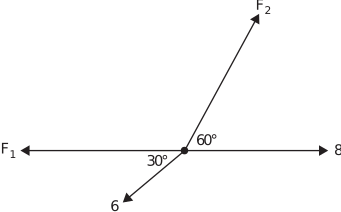
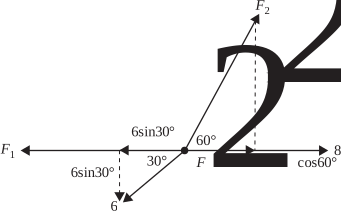
The diagram below shows a stationary body being acted on by four forces whose magnitudes are in newtons. The force of magnitude `F_1` newtons acts in the opposite direction to the force of magnitude 8 N.
 

Calculate the value of `F_1` in newtons.   (3 marks)

--- 6 WORK AREA LINES (style=lined) ---

Show Answers Only

`8 – 2sqrt3\ \ text(N)`

Show Worked Solution

`text(Resolve forces vertically:)`

`F_2sin60^@` `= 6sin30^@`
`F_2 sqrt3/2` `= 6 xx 1/2`
`F_2` `= 6/sqrt3`
  `= 2sqrt3`

 
`text(Resolve forces horizontally:)`

`F_1 + 6cos30^@` `= 2sqrt3 cos60^@ + 8`
`F_1 + 3sqrt3` `= sqrt3 + 8`
`F_1` `= 8 – 2sqrt3\ \ text(N)`

Filed Under: Resisted Motion Tagged With: Band 4, smc-1061-06-Planes/Inclined Planes, smc-1061-70-Newton's Law

Mechanics, EXT2 M1 2021 HSC 14b

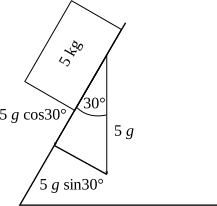
An object of mass 5 kg is on a slope that is inclined at an angle of 60° to the horizontal. The acceleration due to gravity is `g\ text(m s)^(-2)`  and the velocity of the object down the slope is `v\ text(m s)^(-1)`.

As well as the force due to gravity, the object is acted on by two forces, one of magnitude `2v` newtons and one of magnitude `2v^2` newtons, both acting up the slope.

  1. Show that the resultant force down the slope is  `(5sqrt3)/2 g - 2v - 2v^2`  newtons.  (2 marks)

    --- 8 WORK AREA LINES (style=lined) ---

  2. There is one value of `v` such that the object will slide down the slope at a constant speed.
  3. Find this value of `v` in `text(m s)^(-1)`, correct to 1 decimal place, given that  `g = 10`.  (2 marks)

    --- 6 WORK AREA LINES (style=lined) ---

Show Answers Only
  1. `text(See Worked Solutions)`
  2. `4.2\ \ text(ms)^-1`
Show Worked Solution

i.   

`F_s` `=\ text(force down slope)`
  `= 5g cos30 – 2v^2 – 2v`
  `= 5g · sqrt3/2 – 2v^2 – 2v`
  `= (5sqrt3)/2 g – 2v^2 – 2v`


ii.   `text(Constant speed occurs if)\ \ a = 0`

`F_s = ma = 0`

`2v^2 + 2v – (5sqrt3)/2 xx 10` `= 0`
`2v^2 + 2v – 25sqrt3` `= 0`


`v` `= (-2 + sqrt(2^2 + 4 · 2 · 25sqrt3))/(2 xx 2)`
  `= (-2 + sqrt(4 + 200sqrt3))/4`
  `= (-1 + sqrt(1 + 50 sqrt3))/2`
  `= 4.179…`
  `= 4.2\ \ text(ms)^-1\ text{(1 d.p.)}`

Filed Under: Resisted Motion Tagged With: Band 3, Band 4, smc-1061-06-Planes/Inclined Planes, smc-1061-20-R ~ v^2, smc-1061-80-Terminal Velocity

Mechanics, EXT2 M1 2020 HSC 12a

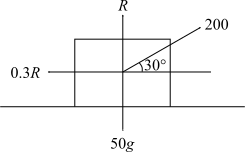
A 50-kilogram box is initially at rest. The box is pulled along the ground with a force of 200 newtons at an angle of 30° to the horizontal. The box experiences a resistive force of  `0.3R`  newtons, where `R` is the normal force, as shown in the diagram.
 
Take the acceleration `g` due to gravity to be 10m/s2.
 

  1. By resolving the forces vertically, show that  `R =400`.   (2 marks)

    --- 5 WORK AREA LINES (style=lined) ---
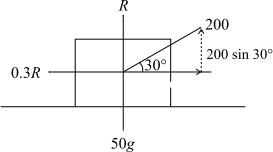
  2. Show that the net force horizontally is approximately 53.2 newtons.  (2 marks)

    --- 4 WORK AREA LINES (style=lined) ---

  3. Find the velocity of the box after the first three seconds.  (2 marks)

    --- 6 WORK AREA LINES (style=lined) ---

Show Answers Only
  1. `text{See Worked Solutions}`
  2. `text{See Worked Solutions}`
  3. `3.19 \ text{ms}^-1`
Show Worked Solution

i.   

`text{Resolving forces vertically:}`

`R + 200 \ sin 30^@` `= 50g`
`R + 200 xx frac{1}{2}` `= 50 xx 10`
`R + 100` `= 500`
`therefore \ R` `= 400 \ text(N)`


ii.    `text{Resolving forces horizontally:}`

`text{Net Force}` `= 200 \ cos 30^@ – 0.3 R`
  `= 200 xx frac{sqrt3}{2} – 0.3 xx 400`
  `= 100 sqrt3 – 120`
  `= 53.2 \ text{N (to 1 d. p.)}`


iii.    `F` `=ma`
  `50 a` `=100 sqrt300 – 120`
  `a` `= frac{100 sqrt3 – 120}{50}\ text(ms)^(-2)`

 
`text{Initially} \ \ u = 0,`

`v` `= u + at`
`v_(t=3)` `= 0 + frac{100 sqrt3 – 120}{50} xx 3`
  `= 3.1923 \ …`
  `= 3.19 \ text{ms}^-1 \ text{(to 2 d.p.)}`

Filed Under: Resisted Motion Tagged With: Band 3, Band 4, smc-1061-06-Planes/Inclined Planes, smc-1061-30-R ~ c, smc-1061-70-Newton's Law

Mechanics, EXT2 M1 EQ-Bank 3

A car and its driver has a mass of 1200 kilograms and is travelling at 90 km/h.

Calculate the magnitude of the uniform breaking force, in Newtons, required to bring the car to a stop in 40 metres.   (3 marks)

--- 8 WORK AREA LINES (style=lined) ---

Show Answers Only

`9375\ text(N)`

Show Worked Solution

`text(Let)\ \ k =\ text{Uniform breaking force (constant)}`

`text(Newton’s 2nd law:)`

`F = mddotx` `= −k`
`1200ddotx` `= −k`
`ddotx` `= −k/1200`
`v · (dv)/(dx)` `= −k/1200`
`(dv)/(dx)` `= −k/(1200v)`
`(dx)/(dv)` `= −1200/k v`
`x` `= −1200/k intv\ dv`
  `= −600/k v^2 + C`

 
`text(When)\ \ x = 0, v = (90\ 000)/(60 xx 60) = 25\ text(ms)^(−1):`

`0 = −600/k  · 25^2 + C`

`C = (375\ 000)/k`

`x = (375\ 000)/k – 600/k v^2`


`text(When)\ \ x = 40, v = 0:`

`40 = (375\ 000)/k`

`:. k = 9375\ text(N)`

Filed Under: Resisted Motion Tagged With: Band 4, smc-1061-06-Planes/Inclined Planes, smc-1061-30-R ~ other, smc-1061-70-Newton's Law

Mechanics, EXT2 M1 EQ-Bank 2

A particle with mass `m` moves horizontally against a resistance force `F`, equal to  `mv(1 + v^2)`  where `v` is the particle's velocity.

Initially, the particle is travelling in a positive direction from the origin at velocity `T`.

  1. Show that the particle's displacement from the origin, `x`, can be expressed as
     
         `x = tan^(-1)((T - v)/(1 + Tv))`  (2 marks)

    --- 6 WORK AREA LINES (style=lined) ---


  2. Show that the time, `t`, when the particle is travelling at velocity `v`, is given by
     
         `t = 1/2 log_e ((T^2(1 + v^2))/(v^2(1 + T^2)))`  (4 marks)

    --- 8 WORK AREA LINES (style=lined) ---


  3. Express `v^2` as a function of `t`, and hence find the limiting values of `x` and `v`.  (2 marks)

    --- 6 WORK AREA LINES (style=lined) ---

Show Answers Only
  1. `text(See Worked Solutions)`
  2. `text(See Worked Solutions)“
  3. `v -> 0, \ x -> tan^(−1)T`
Show Worked Solution

i.   `text(Newton’s 2nd law:)`

`F = mddotx = −mv(1 + v^2)`

`v · (dv)/(dx)` `= −v(1 + v^2)`
`(dv)/(dx)` `= −(1 + v^2)`
`(dx)/(dv)` `= −1/(1 + v^2)`
`x` `= −int 1/(1 + v^2)\ dv`
  `= −tan^(−1) v + C`


`text(When)\ \ x = 0, v = T:`

`C = tan^(−1)T`

`x = tan^(−1)T – tan^(−1)v`
 

`text(Let)\ \ x = A – B`

`A = tan^(−1) T \ => \ T = tan A`

`B = tan^(−1)v \ => \ v = tan B`

`tan x` `= tan(A – B)`
  `= (tan A – tan B)/(1 + tan A tan B)`
  `= (T – v)/(1 + Tv)`
`:. x` `= tan^(−1)((T – v)/(1 + Tv))`


ii.   `text(Using)\ \ ddotx = (dv)/(dt):`

`(dv)/(dt) = −1/(v(1 + v^2))`

`t = −int 1/(v(1 + v^2)) dv`
 

`text(Using Partial Fractions):`

`1/(v(1 + v^2)) = A/v + (Bv + C)/(1 + v^2)`

`A(1 + v^2) + (Bv + C)v = 1`

`A = 1`

`(A + B)v^2` `= 0`   `=> `    `B` `= −1`
`Cv` `= 0`   `=> `    `C` `= 0`


`t` `= −int 1/v\ dv + int v/(1 + v^2)\ dv`
  `= −log_e v + 1/2 int(2v)/(1 + v^2)\ dv`
  `= −log_e v + 1/2 log_e (1 + v^2) + C`
  `= −1/2 log_e v^2 + 1/2 log_e (1 + v^2) + C`
  `= 1/2 log_e ((1 + v^2)/(v^2)) + C`


`text(When)\ \ t = 0, v = T:`

`C = −1/2 log_e ((1 + T^2)/(T^2))`
 

`:. t` `= 1/2 log_e ((1 + v^2)/(v^2)) – 1/2 log_e((1 + T^2)/(T^2))`
  `= 1/2 log_e (((1 + v^2)/(v^2))/((1 + T^2)/(T^2)))`
  `= 1/2 log_e ((T^2(1 + v^2))/(v^2(1 + T^2)))`


iii. `t` `= 1/2 log_e ((T^2(1 + v^2))/(v^2(1 + T^2)))`
  `e^(2t)` `= (T^2(1 + v^2))/(v^2(1 + T^2))`
  `1 + v^2` `= (e^(2t)v^2(1 + T^2))/(T^2)`
  `1` `= v^2((e^(2t)(1 + T^2))/(T^2) – 1)`
  `1` `= v^2((e^(2t)(1 + T^2) – T^2)/(T^2))`
  `:. v^2` `= (T^2)/(e^(2t)(1 + T^2) – T^2)`

 
`text(As)\ \ t -> ∞:`

`v^2 -> 0, \ v -> 0`

`x = tan^(−1)T – tan^(−1)v`

`x -> tan^(−1)T`

Filed Under: Resisted Motion Tagged With: Band 4, Band 5, Band 6, smc-1061-06-Planes/Inclined Planes, smc-1061-20-R ~ v^2, smc-1061-70-Newton's Law

Mechanics, EXT2 M1 2014 HSC 14c

A high speed train of mass `m` starts from rest and moves along a straight track. At time `t` hours, the distance travelled by the train from its starting point is `x` km, and its velocity is `v` km/h.

The train is driven by a constant force  `F`  in the forward direction. The resistive force in the opposite direction is  `Kv^2`, where  `K`  is a positive constant. The terminal velocity of the train is 300 km/h.

  1. Show that the equation of motion for the train is
     
         `m ddot x = F[1 − (v/300)^2]`.  (2 marks)

    --- 6 WORK AREA LINES (style=lined) ---

  2. Find, in terms of  `F`  and  `m`, the time it takes the train to reach a velocity of 200 km/h.  (4 marks)

    --- 10 WORK AREA LINES (style=lined) ---

Show Answers Only
  1. `text{Proof (See Worked Solutions)}`
  2. `(150 m ln5)/F`
Show Worked Solution

i.   `m ddot x = F – Kv^2,\ \ v_T = 300`

`text(At)\ \ v_T,\ \ ddotx=0`

`m(0)` `=F-K(300^2)`
`=>K` `=F/300^2`
`:. m ddot x` `= F – F/300^2 v^2`
  `=F[1 − (v/300)^2]\ \ \ text(… as required)`


ii. `m*(dv)/(dt)` `= F[1 − (v/(300))^2]`
  `(dv)/(1-(v/300)^2)` `=F/m\ dt`
  `(dv)/(300^2-v^2)` `=F/(300^2 m)\ dt`
  `dt` `=(300^2 m)/F xx (dv)/(300^2-v^2)`


`int_0^t dt` `=(300 m)/F  int_0^200  300/((300+v)(300-v))\ dv` 
 `:. t` `=(300 m)/F  int_0^200  (1/2)/(300+v) + (1/2)/(300-v)\ dv`
  `=(150 m)/F [ln(300+v) – ln(300-v)]_0^200`
  `=(150 m)/F [ln ((300+v)/(300-v))]_0^200`
  `=(150 m)/F  (ln5 – ln1)`
  `=(150 m ln5)/F`

Filed Under: Resisted Motion, Resisted Motion Tagged With: Band 4, smc-1061-06-Planes/Inclined Planes, smc-1061-20-R ~ v^2, smc-1061-70-Newton's Law

Copyright © 2014–2025 SmarterEd.com.au · Log in