SmarterEd

Aussie Maths & Science Teachers: Save your time with SmarterEd

  • Login
  • Get Help
  • About

Mechanics, EXT2 M1 2022 HSC 10 MC

A particle is moving vertically in a resistive medium under the influence of gravity. The resistive force is proportional to the velocity of the particle.

The initial speed of the particle is NOT zero.

Which of the following statements about the motion of the particle is always true?

  1. If the particle is initially moving downwards, then its speed will increase.
  2. If the particle is initially moving downwards, then its speed will decrease.
  3. If the particle is initially moving upwards, then its speed will eventually approach a terminal speed.
  4. If the particle is initially moving upwards, then its speed will not eventually approach a terminal speed.
Show Answers Only

`C`

Show Worked Solution

`text{Case 1: particle moving downwards}`

`ddotx=g-kv\ \ (k>0)`

`text{Terminal velocity occurs when}\ \ ddotx=0\ \ =>\ \ v=g/k`

`text{Whether the particle’s speed increases, decreases or stays}`

`text{constant depends on whether}\ \ v_o<=g/k.`

`→\ text{Eliminate A and B.}`


♦ Mean mark 42%.

`text{Case 2: particle moving upwards}`

`ddotx=-g-kv\ \ (k>0)`

`text{→ Acceleration of gravity and resistance against motion}`

`text{→ Particle will eventually hit a peak and then move downwards}`

`text{→ Once moving downwards}\ \ ddotx=g-kv\ \ (k>0)`

`text{→ Particle will hit terminal velocity (see Case 1)}`

`=>C`

Filed Under: Resisted Motion Tagged With: Band 5, smc-1061-10-R ~ v, smc-1061-80-Terminal Velocity

Mechanics, EXT2 M1 2021 HSC 14b

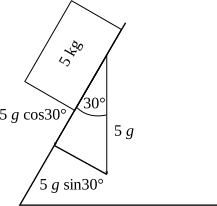
An object of mass 5 kg is on a slope that is inclined at an angle of 60° to the horizontal. The acceleration due to gravity is `g\ text(m s)^(-2)`  and the velocity of the object down the slope is `v\ text(m s)^(-1)`.

As well as the force due to gravity, the object is acted on by two forces, one of magnitude `2v` newtons and one of magnitude `2v^2` newtons, both acting up the slope.

  1. Show that the resultant force down the slope is  `(5sqrt3)/2 g - 2v - 2v^2`  newtons.  (2 marks)

    --- 8 WORK AREA LINES (style=lined) ---

  2. There is one value of `v` such that the object will slide down the slope at a constant speed.
  3. Find this value of `v` in `text(m s)^(-1)`, correct to 1 decimal place, given that  `g = 10`.  (2 marks)

    --- 6 WORK AREA LINES (style=lined) ---

Show Answers Only
  1. `text(See Worked Solutions)`
  2. `4.2\ \ text(ms)^-1`
Show Worked Solution

i.   

`F_s` `=\ text(force down slope)`
  `= 5g cos30 – 2v^2 – 2v`
  `= 5g · sqrt3/2 – 2v^2 – 2v`
  `= (5sqrt3)/2 g – 2v^2 – 2v`


ii.   `text(Constant speed occurs if)\ \ a = 0`

`F_s = ma = 0`

`2v^2 + 2v – (5sqrt3)/2 xx 10` `= 0`
`2v^2 + 2v – 25sqrt3` `= 0`


`v` `= (-2 + sqrt(2^2 + 4 · 2 · 25sqrt3))/(2 xx 2)`
  `= (-2 + sqrt(4 + 200sqrt3))/4`
  `= (-1 + sqrt(1 + 50 sqrt3))/2`
  `= 4.179…`
  `= 4.2\ \ text(ms)^-1\ text{(1 d.p.)}`

Filed Under: Resisted Motion Tagged With: Band 3, Band 4, smc-1061-06-Planes/Inclined Planes, smc-1061-20-R ~ v^2, smc-1061-80-Terminal Velocity

Mechanics, EXT2 M1 2019 HSC 14b

A parachutist jumps from a plane, falls freely for a short time and then opens the parachute. Let t be the time in seconds after the parachute opens, `x(t)`  be the distance in metres travelled after the parachute opens, and  `v(t)`  be the velocity of the parachutist in `text(ms)^(-1)`.

The acceleration of the parachutist after the parachute opens is given by

`ddot x = g - kv,`

where `g\ text(ms)^(-2)` is the acceleration due to gravity and `k` is a positive constant.

  1. With an open parachute the parachutist has a terminal velocity of  `w\ text(ms)^(-1)`.


    Show that  `w = g/k`.  (1 mark)

    --- 2 WORK AREA LINES (style=lined) ---

    At the time the parachute opens, the speed of descent is `1.6 w\ text(ms)^(-1)`.

  2. Show that it takes  `1/k log_e 6`  seconds to slow down to a speed of `1.1w\ text(ms)^(-1)`.  (4 marks)

    --- 10 WORK AREA LINES (style=lined) ---

  3. Let  `D`  be the distance the parachutist travels between opening the parachute and reaching the speed `1.1w\ text(ms)^(-1)`.


    Show that  `D = g/k^2 (1/2 + log_e 6)`.  (3 marks)

    --- 8 WORK AREA LINES (style=lined) ---

Show Answers Only
  1. `text(Proof)\ text{(See Worked Solutions)}`
  2. `text(Proof)\ text{(See Worked Solutions)}`
  3. `text(Proof)\ text{(See Worked Solutions)}`
Show Worked Solution

i.   `v_T=w\ \  text(when)\ \ ddot x = 0`

`0` `= g – kw`
`w` `= g/k`


ii.   `text(Show)\ \ t = 1/k log_e 6\ \ text(when)\ \ v = 1.1w`

`(dv)/(dt)` `= g – kv`
`(dt)/(dv)` `= 1/(g – kv)`
`t` `= int 1/(g – kv)\ dv`
  `= -1/k ln(g – kv) + C`

 
`text(When)\ \ t = 0,\ \ v = 1.6w`

`0` `= -1/k ln(g – 1.6 kw) + C`
`C` `= 1/k ln(g – 1.6 kw)`
`t` `= 1/k ln (g – 1.6kw) – 1/k ln(g – kv)`
  `= 1/k ln((g – 1.6 kw)/(g – kv))`

 
`text(Find)\ \ t\ \ text(when)\ \ v = 1.1w`

`t` `= 1/k ln((g – 1.6 k xx g/k)/(g – 1.1k xx g/k))`
  `=1/k ln((g – 1.6 g)/(g – 1.1g))`
  `=1/k((-0.6g)/(-0.1g))`
  `= 1/k ln 6`


iii.    `v ⋅ (dv)/(dx)` `= g – kv`
  `(dv)/(dx)` `= (g – kv)/v`
  `(dx)/(dv)` `= v/(g – kv)`
  `x` `= int v/(g – kv)\ dv`
    `= 1/k int (kv)/(g – kv)\ dv`
    `= -1/k int 1 – g/(g – kv)\ dv`


`:. D` `= -1/k int_(1.6w)^(1.1w) 1 – g/(g – kv)\ dv`
  `= 1/k int_(1.1w)^(1.6w) 1 – g/(g – kv)\ dv`
  `= 1/k[v + g/k ln (g – kv)]_(1.1w)^(1.6w)`
  `= g/k^2[(kv)/g + ln (g – kv)]_(1.1w)^(1.6w)`
  `= g/k^2[((1.6kw)/g + ln (g – 1.6kw)) – ((1.1 kw)/g + ln (g – 1.1kw))]`
  `= g/k^2[1.6 + ln ((g – 1.6kw)/(g – 1.1kw)) – 1.1]`
  `= g/k^2(0.5 + ln 6)`

Filed Under: Resisted Motion Tagged With: Band 3, Band 4, smc-1061-10-R ~ v, smc-1061-60-Time of Travel / Distance, smc-1061-80-Terminal Velocity, smc-1061-90-Parachutist

Mechanics, EXT2 M1 2015 HSC 15a

A particle  `A` of unit mass travels horizontally through a viscous medium. When  `t = 0`, the particle is at point  `O`  with initial speed  `u`. The resistance on particle  `A`  due to the medium is  `kv^2`, where  `v`  is the velocity of the particle at time  `t`  and  `k`  is a positive constant.

When  `t = 0`, a second particle  `B`  of equal mass is projected vertically upwards from  `O`  with the same initial speed  `u`  through the same medium. It experiences both a gravitational force and a resistance due to the medium. The resistance on particle  `B`  is  `kw^2`, where  `w`  is the velocity of the particle  `B`  at time  `t`. The acceleration due to gravity is  `g`.

  1. Show that the velocity  `v`  of particle  `A`  is given by  
     
         `1/v = kt + 1/u.`  (2 marks)

    --- 6 WORK AREA LINES (style=lined) ---

  2. By considering the velocity  `w`  of particle  `B`, show that
     
         `t = 1/sqrt(gk) (tan^-1(u sqrt(k/g)) - tan^-1 (w sqrt(k/g))).`  (3 marks)

    --- 8 WORK AREA LINES (style=lined) ---

  3. Show that the velocity  `V`  of particle  `A`  when particle  `B`  is at rest is given by
     
         `1/V = 1/u + sqrt(k/g) tan^-1 (u sqrt (k/g)).`  (1 mark)

    --- 2 WORK AREA LINES (style=lined) ---

  4. Hence, if  `u`  is very large, explain why  
     
         `V ~~ 2/pi sqrt(g/k).`  (1 mark)

    --- 4 WORK AREA LINES (style=lined) ---

Show Answers Only
  1. `text(Proof)\ \ text{(See Worked Solutions)}`
  2. `text(Proof)\ \ text{(See Worked Solutions)}`
  3. `text(Proof)\ \ text{(See Worked Solutions)}`
  4. `text(See Worked Solutions)`
Show Worked Solution

i.   `text(Particle)\ A:`

`ddot x` `= -kv^2`
`(dv)/(dt)` `= -kv^2`
`(dt)/(dv)` `=- 1/(kv^2)`
`t` `= -1/k int 1/v^2\ dv`
`-kt` `= -1/v + c`
`text(When)\ \ t=0,\ \ v=u\ \ \ \ =>c=1/u`
`-kt` `= -1/v + 1/u`
`:.1/v` `= kt + 1/u`


ii.   `text(Particle)\ B:`

`ddot x` `= -g – kw^2`
`(dw)/(dt)` `= -g – kw^2`
`(dt)/(dw)`   `=-1/(g + kw^2)`
`t`   `= – int (dw)/(g + kw^2)`
   `= -1/k int (dw)/(g/k + w^2)`
   `= -1/k xx 1/sqrt (g/k) tan^-1(w/sqrt (g/k)) + c`
  `= -1/sqrt (gk)\ tan^-1 ((sqrt k w)/sqrt g) + c`


`text(When)\ \ t = 0,\ \ w = u`

`=>c= 1/sqrt (gk) tan^-1 ((sqrt k u)/sqrt g)`

`:. t` `= -1/sqrt (gk) tan^-1 ((sqrt k w)/sqrt g) + 1/sqrt (gk) tan^-1 ((sqrt k u)/sqrt g)`
  `=1/sqrt (gk) (tan^-1 (u sqrt(k/g)) – 1/sqrt (gk) tan^-1 (w sqrt (k/g)))`


iii.   `B\ \ text(at rest when)\ \ w = 0`

`t = 1/sqrt (gk) (tan^-1 (u sqrt (k/g)))`

`:.1/V` `= k xx 1/sqrt(gk) tan^-1 (u sqrt (k/g)) + 1/u,\ \ \ \ \ text{(part (i))}`
  `= 1/u + sqrt(k/g) tan^-1 (u sqrt (k/g))`


iv.   `1/V = 1/u + sqrt (k/g) tan^-1 (u sqrt (k/g))`

`text(As)\ \ u -> oo,\ \ tan^-1 (u sqrt (k/g)) -> pi/2`

`:.\ text(If)\ \ u\ \ text(is very large,)`

`1/V` `~~ 0 + sqrt (k/g) xx pi/2`
`:.V` `~~ 2/pi sqrt (g/k)`

Filed Under: Resisted Motion, Resisted Motion Tagged With: Band 4, smc-1061-07-Resistive medium, smc-1061-20-R ~ v^2, smc-1061-80-Terminal Velocity

Mechanics, EXT2 M1 2007 HSC 6b

A raindrop falls vertically from a high cloud. The distance it has fallen is given by

`x = 5 log_e ((e^(1.4 t) + e^(-1.4 t))/2)`

where `x` is in metres and `t` is the time elapsed in seconds.

  1. Show that the velocity of the raindrop, `v` metres per second, is given by
     
         `v = 7 ((e^(1.4 t) - e^(-1.4 t))/(e^(1.4 t) + e^(-1.4 t)))`  (2 marks)

    --- 3 WORK AREA LINES (style=lined) ---

  2. Hence show that  `v^2 = 49 (1 - e^(-(2x)/5)).`  (2 marks)

    --- 6 WORK AREA LINES (style=lined) ---

  3. Hence, or otherwise, show that  `ddot x = 9.8 - 0.2v^2.`  (2 marks)

    --- 5 WORK AREA LINES (style=lined) ---

  4. The physical significance of the 9.8 in part (iii) is that it represents the acceleration due to gravity.


    What is the physical significance of the term  `–0.2 v^2?`   (1 mark)

    --- 1 WORK AREA LINES (style=lined) ---

  5. Estimate the velocity at which the raindrop hits the ground.   (1 mark)

    --- 3 WORK AREA LINES (style=lined) ---

Show Answers Only
  1. `text(Proof)\ \ text{(See Worked Solutions)}`
  2. `text(Proof)\ \ text{(See Worked Solutions)}`
  3. `text(Proof)\ \ text{(See Worked Solutions)}`
  4. `-0.2v^2\ \ text(is the air resistance)`
  5. `7\ \ text(ms)^-1`
Show Worked Solution
i.    `x` `= 5 log_e ((e^(1.4t) + e^(-1.4t))/2)`
  `v=dx/dt` `= (5(1.4e^(1.4t) – 1.4e^(-1.4t)))/(e^(1.4t) + e^(-1.4t))`
    `= 7 ((e^(1.4 t) – e^(-1.4 t))/(e^(1.4 t) + e^(-1.4 t)))`


ii.    `v^2` `=49 ((e^(1.4 t) – e^(-1.4 t))/(e^(1.4 t) + e^(-1.4 t)))^2`
    `=49 ((e^(2.8 t) + e^(-2.8 t)-2)/(e^(2.8 t) + e^(-2.8 t)+2))`
    `=49 ((e^(2.8 t) + e^(-2.8 t)+2-4)/(e^(2.8 t) + e^(-2.8 t)+2))`
    `=49 (((e^(1.4t) + e^(-1.4t))^2-2^2)/((e^(1.4t) + e^(-1.4t))^2))`
    `=49 (1 – (2/(e^(1.4t) + e^(-1.4t)))^2)`


`text(S)text(ince)\ \ x` `= 5 log_e ((e^(1.4 t) + e^(-1.4 t))/2)`
`e^(x/5)` `=(e^(1.4 t) + e^(-1.4 t))/2`


`:. v^2` `=49 (1 – (e^(- x/5))^2)`
  `=49(1-e^(- (2x)/5))`


iii.   `ddotx` `=d/(dx) (1/2 v^2)`
    `=49/2 xx  2/5 xx e^(-(2x)/5)`
    `=49/5 e^(-(2x)/5)`
    `=49/5 (1- v^2/49),\ \ \ \ text{(from part (ii))}`
    `=9.8 – 0.2v^2`

 
iv.
  `-0.2v^2\ \ text(is the wind resistance acting on the rain drop.)`
 

v.   `text(Terminal velocity occurs when)\ \ ddot x=0`

`9.8 – 0.2v^2` `=0`
`v^2` `=49`
`v` `=7,\ \ \ \ (v > 0)`

 
`:.\ text(The rain drop hits the ground travelling at)\ \ 7\ \ text(ms)^-1`

Filed Under: Resisted Motion, Resisted Motion Tagged With: Band 3, Band 4, smc-1061-05-Projectile Motion, smc-1061-20-R ~ v^2, smc-1061-80-Terminal Velocity

Mechanics, EXT2 M1 2011 HSC 6a

Jac jumps out of an aeroplane and falls vertically. His velocity at time  `t`  after his parachute is opened is given by  `v(t)`, where  `v(0) = v_0`  and  `v(t)`  is positive in the downwards direction. The magnitude of the resistive force provided by the parachute is  `kv^2`, where  `k`  is a positive constant. Let  `m`  be Jac’s mass and  `g`  the acceleration due to gravity. Jac’s terminal velocity with the parachute open is  `v_T.`

Jac’s equation of motion with the parachute open is

`m (dv)/(dt) = mg - kv^2.`   (Do NOT prove this.)

  1. Explain why Jac’s terminal velocity  `v_T`  is given by  
     
         `sqrt ((mg)/k).`  (1 mark)

    --- 3 WORK AREA LINES (style=lined) ---

  2. By integrating the equation of motion, show that  `t`  and  `v`  are related by the equation
     
         `t = (v_T)/(2g) ln[((v_T + v)(v_T - v_0))/((v_T - v)(v_T + v_0))].`  (3 marks)

    --- 6 WORK AREA LINES (style=lined) ---

  3. Jac’s friend Gil also jumps out of the aeroplane and falls vertically. Jac and Gil have the same mass and identical parachutes.


    Jac opens his parachute when his speed is  `1/3 v_T.` Gil opens her parachute when her speed is  `3v_T.` Jac’s speed increases and Gil’s speed decreases, both towards  `v_T.`


    Show that in the time taken for Jac's speed to double, Gil's speed has halved.  (3 marks)

    --- 6 WORK AREA LINES (style=lined) ---

Show Answers Only
  1. `text(See Worked Solutions)`
  2. `text(Proof)\ \ text{(See Worked Solutions)}`
  3. `text(Proof)\ \ text{(See Worked Solutions)}`
Show Worked Solution

i.   `m (dv)/(dt) = mg – kv^2`

`text(As)\ \ v ->text(terminal velocity,)\ \ (dv)/(dt) -> 0`

`mg – kv_T^2` `= 0`
`v_T^2` `= (mg)/k`
`v_T` `= sqrt ((mg)/k)`


ii.  `m (dv)/(dt) = mg – kv^2`

`int_0^t dt` `=int_(v_0)^v m/(mg – kv^2)\ dv`
`t` `= m/k int_(v_0)^v (dv)/((mg)/k – v^2)\ \ \ \ text{(using}\ \ v_T^2= (mg)/k text{)}`
  `= (v_T^2)/g int_(v_0)^v (dv)/(v_T­^2 – v^2)`


♦ Mean mark part (ii) 39%.

`text(If)\ \ v_0 < v_T,\ \ text(then)\ \ v < v_T\ \ text(at all times.)`

`:. t` `=(v_T^2)/g int_(v_0)^v (dv)/(v_T­^2 – v^2)`
  `=(v_T^2)/g int_(v_0)^v (dv)/((v_T – v)(v_T + v))`
  `=(v_T^2)/(2 g v_T) int_(v_0)^v (1/((v_T – v)) + 1/((v_T + v))) dv`
  `=v_T/(2g)[-ln (v_T – v) + ln (v_T + v)]_(v_0)^v`
  `=v_T/(2g)[ln(v_T + v)-ln(v_T – v)-ln(v_T + v_0)+ln(v_T – v_0)]`
  `=v_T/(2g) ln[((v_T + v)(v_T – v_0))/((v_T – v)(v_T + v_0))]`


`text(If)\ \ v_0 > v_T,\ \ text(then)\ \ v > v_T\ \ text(at all times.)`

`text(Replace)\ \ v_T – v\ \ text(by) – (v – v_T)\ \ text(in the preceeding)`

`text(calculation, leading to the same result.)`


iii.  `text{From (ii) we have}:\ \ t = v_T/(2g) ln [((v_T + v)(v_T – v_0))/((v_T – v)(v_T + v_0))]`

`text(For Jac,)\ \ v_0 = V_T/3\ \ text(and we have to find the time)`

`text(taken for his speed to be)\ \ v = (2v_T)/3.`

`t` `=v_T/(2g) ln[((v_T + (2v_T)/3)(v_T – v_T/3))/((v_T – (2v_T)/3)(v_T + v_T/3))]`
  `=v_T/(2g) ln [(((5v_T)/3)((2v_T)/3))/((v_T/3)((4v_T)/3))]`
  `=v_T/(2g) ln[(10/9)/(4/9)]`
  `=v_T/(2g) ln (5/2)`


`text(For Gil),\ \ v_0 = 3v_T\ \ text(and we have to find)` 

♦♦♦ Mean mark part (iii) 16%.

`text(the time taken for her speed to be)\ \ v = (3v_T)/2.`

`t` `=v_T/(2g) ln [((v_T + (3v_T)/2)(v_T – 3v_T))/((v_T – (3v_T)/2)(v_T + 3v_T))]`
  `=v_T/(2g) ln [(((5v_T)/2)(-2v_T))/((-v_T/2)(4v_T))]`
  `=v_T/(2g) ln [(-5)/-2]`
  `=v_T/(2g) ln (5/2)`


`:.\ text(The time taken for Jac’s speed to double is)`

`text(the same as it takes for Gil’s speed to halve.)`

Filed Under: Resisted Motion, Resisted Motion Tagged With: Band 3, Band 5, Band 6, smc-1061-05-Projectile Motion, smc-1061-20-R ~ v^2, smc-1061-70-Newton's Law, smc-1061-80-Terminal Velocity, smc-1061-90-Parachutist

Copyright © 2014–2025 SmarterEd.com.au · Log in