SmarterEd

Aussie Maths & Science Teachers: Save your time with SmarterEd

  • Login
  • Get Help
  • About

Mechanics, EXT2* M1 2019 HSC 13c

Two objects are projected from the same point on a horizontal surface. Object 1 is projected with an initial velocity of  `20\ text(ms)^(-1)` directed at an angle of  `pi/3`  to the horizontal. Object 2 is projected 2 seconds later.

The equations of motion of an object projected from the origin with initial velocity `v` at an angle `theta` to the `x`-axis are

`x = vt cos theta`

`y = -4.9t^2 + vt sin theta`,

where  `t`  is the time after the projection of the object. Do NOT prove these equations.

  1. Show that Object 1 will land at a distance  `(100 sqrt 3)/4.9` m from the point of projection.  (2 marks)

    --- 8 WORK AREA LINES (style=lined) ---

  2. The two objects hit the horizontal plane at the same place and time.


    Find the initial speed and the angle of projection of Object 2, giving your answer correct to 1 decimal place.  (3 marks)

    --- 10 WORK AREA LINES (style=lined) ---

Show Answers Only
  1. `text(Proof)\ text{(See Worked Solutions)}`
  2. `24.2\ text(ms)^(-1)`
Show Worked Solution

a.   `text(Object 1:)`

`x` `= 20t cos\ pi/3`
  `= 10t`
`y` `= -4.9t^2 + 20t sin\ pi/3`
  `= -4.9t^2 + 10 sqrt 3 t`

 
`text(Let)\ \ t_1 = text{time of flight (Object 1)}`

`-4.9t_1^2 + 10 sqrt 3 t_1` `= 0`
`t_1(-4.9t_1 + 10 sqrt 3)` `= 0`
`4.9t_1` `= 10 sqrt 3\ \ (t >= 0)`
`t_1` `= (10 sqrt 3)/4.9`

 
`text(Find)\ \ x\ \ text(when)\ \ t_1 = (10 sqrt 3)/4.9:`

`x` `= 10 xx (10 sqrt 3)/4.9`
  `= (100 sqrt 3)/4.9\ text(… as required)`


(ii)   `text{Time of flight (Object 2)}= (10 sqrt 3)/4.9 – 2`

♦ Mean mark 42%.

`text(Range)` `= (100 sqrt 3)/4.9`
`(100 sqrt 3)/4.9` `= v((10 sqrt 3)/4.9 – 2) cos theta`
`v cos theta` `= (100 sqrt 3)/4.9 xx 4.9/(10 sqrt 3 – 9.8)`
`v cos theta` `= (100 sqrt 3)/(10 sqrt 3 – 9.8) \ \ \ …\ (1)`


`0` `= -4.9t^2 + vt sin theta`
`0` `= -4.9 xx ((10 sqrt 3)/4.9 – 2)^2 + v((10 sqrt 3)/4.9 – 2) sin theta`
`0` `= -4.9((10 sqrt 3 – 9.8)/4.9) + v sin theta`
`v sin theta` `= 10 sqrt 3 – 9.8 \ \ \ …\ (2)`

 
`(2) ÷ (1)`

`tan theta` `= (10 sqrt 3 – 9.8) xx (10 sqrt 3 – 9.8)/(100 sqrt 3)`
  `= 0.3265…`
`:. theta` `= 18.1^@\ text{(1 d.p.)}`

 
`text{Substitute into (2)}`

`:.v` `= (10 sqrt 3 – 9.8) /(sin 18.1^@)`
  `= 24.206`
  `= 24.2\ text(ms)^(-1)\ text{(1 d.p.)}`

Filed Under: Projectile Motion Tagged With: Band 3, Band 5, smc-1062-10-Range/Time of Flight, smc-1062-40-Initial Angle/Speed, smc-1062-90-Projectiles Collide

Mechanics, EXT2* M1 2019 HSC 13d

The point  `O`  is on a sloping plane that forms an angle of 45° to the horizontal. A particle is projected from the point  `O`. The particle hits a point  `A`  on the sloping plane as shown in the diagram.


The equation of the line  `OA`  is  `y = -x`. The equations of motion of the particle are

`x = 18t`

`y = 18 sqrt(3t) - 5t^2,`

where  `t`  is the time in seconds after projection. Do NOT prove these equations.

  1. Find the distance  `OA`  between the point of projection and the point where the particle hits the sloping plane.  (2 marks)

    --- 6 WORK AREA LINES (style=lined) ---

  2. What is the size of the acute angle that the path of the particle makes with the sloping plane as the particle hits the point  `A`?  (3 marks)

    --- 8 WORK AREA LINES (style=lined) ---

Show Answers Only
  1. `(324(sqrt 2 + sqrt 6))/5\ text(units)`
  2. `30^@`
Show Worked Solution
i.    `x` `= 18t`
  `y` `= 18 sqrt 3 t – 5t^2`

 
`text(Particle hits slope when)\ \ y = -x`

`18 sqrt 3 t – 5t^2` `= -18t`
`5t^2 – 18t – 18 sqrt3 t` `= 0`
`t(5t – 18 – 18 sqrt 3)` `= 0`
`5t – 18 – 18 sqrt 3` `= 0`
`5t` `= 18 + 18 sqrt 3`
`t` `= (18 + 18 sqrt 3)/5`

 
`text(When)\ t = (18 + 18 sqrt 3)/5,`

`x = 18 xx ((18 + 18 sqrt 3)/5)`

`text{Using Pythagoras (isosceles Δ):}`

`OA` `= sqrt(2 xx 18^2 xx((18 + 18 sqrt 3)/5)^2)`
  `= sqrt 2 xx 18 xx ((18 + 18 sqrt 3)/5)`
  `= (324(sqrt 2 + sqrt 6))/5\ text(units)`


ii.    `x` `= 18t => dot x = 18`
  `y` `= 18 sqrt 3 t – 5t^2 => dot y = 18 sqrt 3 – 10t`

 
`text(When)\ \ t = (18 + 18 sqrt 3)/5,`

`dot y` `= 18 sqrt 3 – 10 ((18 + 18 sqrt 3)/5)`
  `= 18 sqrt 3 – 36 – 36 sqrt 3`
  `= -18 sqrt 3 – 36`
  `= -18(sqrt 3 + 2)`


`text(Find angle with the horizontal at impact:)`

♦ Mean mark part (ii) 39%.


`tan theta` `= (18(sqrt 3 + 2))/18`
  `= sqrt 3 + 2`
`theta` `= tan^(-1)(sqrt 3 + 2)`
  `= 75^@`

 
`:.\ text(Angle made with the slope)`

`= 75 – 45`

`= 30^@`

Filed Under: Projectile Motion Tagged With: Band 4, Band 5, smc-1062-10-Range/Time of Flight, smc-1062-50-Angle of Trajectory/Impact, smc-1062-70-Sloped Landing

Mechanics, EXT2* M1 2018 HSC 13c

An object is projected from the origin with an initial velocity of  `V` at an angle  `theta`  to the horizontal. The equations of motion of the object are

`x(t)` `= Vt cos theta`
`y(t)` `= Vt sin theta - (g t^2)/2.`  (Do NOT prove this.)


  1. Show that when the object is projected at an angle  `theta`, the horizontal range is


         `V^2/g sin 2 theta`  (2 marks)

    --- 6 WORK AREA LINES (style=lined) ---

  2. Show that when the object is projected at an angle  `pi/2 - theta`, the horizontal range is also 


         `V^2/g sin 2 theta`.  (1 mark)

    --- 3 WORK AREA LINES (style=lined) ---

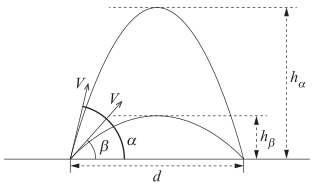
  3. The object is projected with initial velocity `V` to reach a horizontal distance `d`, which is less than the maximum possible horizontal range. There are two angles at which the object can be projected in order to travel that horizontal distance before landing.


    Let these angles be `alpha`  and  `beta`, where  `beta = pi/2 - alpha.`


    Let  `h_alpha`  be the maximum height reached by the object when projected at the angle `alpha` to the horizontal.


    Let  `h_beta`  be the maximum height reached by the object when projected at the angle `beta` to the horizontal.


    Show that the average of the two heights, `(h_alpha + h_beta)/2`, depends only on `V` and `g`.  (3 marks)

    --- 9 WORK AREA LINES (style=lined) ---

Show Answers Only
  1. `text(Proof)\ \ text{(See Worked Solutions)}`
  2. `text(Proof)\ \ text{(See Worked Solutions)}`
  3. `text(Proof)\ \ text{(See Worked Solutions)}`
Show Worked Solution

i.    `text(Horizontal range occurs when)\ \ y = 0`

`Vt sin theta – (g t^2)/2` `= 0`
`V sin theta – (g t)/2` `= 0`
`t` `= (2V sin theta)/g`

 
`text(Find)\ \ x\ \ text(when)\ \ t=(2V sin theta)/g :`

`x` `= Vt cos theta`
  `= V((2V sin theta)/g) cos theta`
  `= (V^2 * 2sin theta cos theta)/g`
  `= V^2/g sin 2 theta\ \ \ text(.. as required)`


ii.  `text(Find)\ \ x\ \ text(when)\ \ theta = (pi/2 – theta):`

`x` `= V^2/g sin 2 (pi/2 – theta)`
  `= V^2/g underbrace {sin (pi – 2 theta)}_{text(Using)\ \ sin (pi-theta) = sin theta}`
  `= V^2/g sin 2 theta\ \ \ text(.. as required)`


iii.  `text(Highest point → half way through the flight.)`

`=> h_alpha\ \ text(occurs when)\ \ t=(V sin alpha)/g\ \ text{(by symmetry)}`
  

`:. h_alpha` `= V((V sin alpha)/g) sin alpha – g/2 ((V sin alpha)/g)^2`
  `= (V^2 sin^2 alpha)/g – g/2 ((V^2 sin^2 alpha)/g^2)`
  `= (V^2 sin^2 alpha)/g – (V^2 sin^2 alpha)/(2g)`
  `= (V^2 sin^2 alpha)/(2g)`


`text(Similarly,)\ \ h_beta = (V^2 sin^2 beta)/(2g)`

♦ Mean mark 44%.
 

`:. (h_alpha + h_beta)/2` `= 1/2 ((V^2 sin^2 alpha)/(2g) + (V^2 sin^2 beta)/(2g))`
  `= V^2/(4g) (sin^2 alpha + underbrace{sin^2 beta}_{text(Using)\ \ beta= pi/2 -alpha})`
  `= V^2/(4g) (sin^2 alpha + sin^2(pi/2 – alpha)) `
  `= V^2/(4g) (sin^2 alpha + cos^2 alpha)`
  `= V^2/(4g)`

 
`:. text(The average height depends only on)\ V\ text(or)\ g.`

Filed Under: Projectile Motion, Projectile Motion EXT1 Tagged With: Band 3, Band 4, Band 5, smc-1062-10-Range/Time of Flight, smc-1062-20-Max Height

Mechanics, EXT2* M1 2017 HSC 13c

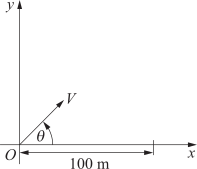
A golfer hits a golf ball with initial speed `V\ text(ms)^(−1)` at an angle `theta` to the horizontal. The golf ball is hit from one side of a lake and must have a horizontal range of 100 m or more to avoid landing in the lake.


Neglecting the effects of air resistance, the equations describing the motion of the ball are

`x = Vt costheta`

`y = Vt sintheta - 1/2 g t^2`,

where `t` is the time in seconds after the ball is hit and `g` is the acceleration due to gravity in `text(ms)^(−2)`. Do NOT prove these equations.

  1. Show that the horizontal range of the golf ball is
     
         `(V^2sin 2theta)/g` metres.  (2 marks)

    --- 5 WORK AREA LINES (style=lined) ---

  2. Show that if  `V^2 < 100 g`  then the horizontal range of the ball is less than 100 m.  (1 mark)

    --- 2 WORK AREA LINES (style=lined) ---

It is now given that  `V^2 = 200 g`  and that the horizontal range of the ball is 100 m or more.

  1. Show that  `pi/12 <= theta <= (5pi)/12`.  (2 marks)

    --- 4 WORK AREA LINES (style=lined) ---

  2. Find the greatest height the ball can achieve.  (2 marks)

    --- 6 WORK AREA LINES (style=lined) ---

Show Answers Only
  1. `text(See Worked Solution)`
  2. `text(See Worked Solution)`
  3. `text(See Worked Solution)`
  4. `25(2 – sqrt 3)\ text(metres)`
Show Worked Solution

i.   `text(Find)\ \ t\ \ text(when)\ \ y = 0:`

`1/2 g t^2` `= Vtsintheta`
`1/2 g t` `= Vsintheta`
`t` `= (2Vsintheta)/g`


`text(Horizontal range)\ (x)\ text(when)\ \ t = (2Vsintheta)/g :`

`x` `= V · (2Vsintheta)/g costheta`
  `= (V^2 2sintheta costheta)/g`
  `= (V^2sin2theta)/g\ … text(as required)`


ii.   `text(If)\ \ V^2 < 100 g`

♦ Mean mark 44%.
`x` `< (100 g sin2theta)/g`
`x` `< 100 sin2theta`


`text(S)text(ince)\ −1 <= 2theta <= 1,`

`x < 100\ text(metres)`


iii.   `V^2 = 200g,\ \ x >= 100`

`(200 g · sin2theta)/g` `>= 100`
`sin2theta` `>= 1/2`

`:. pi/6 <= 2theta <= (5pi)/6`

`:. pi/12 <= theta <= (5pi)/12\ …\ text(as required)`


iv.   `text(Max height occurs when)`

♦♦ Mean mark 35%.
`t` `= 1/2 xx text(time of flight)`
  `= (Vsintheta)/g`

 
`text(Find)\ \ y\ \ text(when)\ \ t = (Vsintheta)/g`

`y` `= V · (Vsintheta)/g · sintheta – 1/2 g ((Vsintheta)/g)^2`
  `= (V^2 sin^2theta)/g – 1/2 · (V^2 sin^2 theta)/g`
  `= (V^2 sin^2theta)/(2g)`


`text(Max height when)\ theta = (5pi)/12\ (text(steepest angle)), V^2 = 200 g\ (text(given))`

`y_text(max)` `= (200 g · sin^2 ((5pi)/12))/(2g)`
  `= 100 sin^2 ((5pi)/12)`
  `= 50(1 – cos((5pi)/6))`
  `= 50(1 + sqrt3/2)`
  `= 25(2 + sqrt 3)\ text(metres)`

Filed Under: Projectile Motion, Projectile Motion EXT1 Tagged With: Band 4, Band 5, Band 6, smc-1062-10-Range/Time of Flight, smc-1062-20-Max Height, smc-1062-40-Initial Angle/Speed

Mechanics, EXT2* M1 2016 HSC 13b

The trajectory of a projectile fired with speed  `u\ text(ms)^-1`  at an angle  `theta`  to the horizontal is represented by the parametric equations

`x = utcostheta`   and   `y = utsintheta - 5t^2`,

where `t` is the time in seconds.

  1. Prove that the greatest height reached by the projectile is  `(u^2 sin^2 theta)/20`.  (2 marks)

    --- 5 WORK AREA LINES (style=lined) ---

A ball is thrown from a point `20\ text(m)` above the horizontal ground. It is thrown with speed `30\ text(ms)^-1` at an angle of `30^@` to the horizontal. At its highest point the ball hits a wall, as shown in the diagram.
 

     ext1-2016-hsc-q13
 

  1. Show that the ball hits the wall at a height of `125/4\ text(m)` above the ground.  (2 marks)

    --- 4 WORK AREA LINES (style=lined) ---

The ball then rebounds horizontally from the wall with speed `10\ text(ms)^-1`. You may assume that the acceleration due to gravity is `10\ text(ms)^-2`.

  1. How long does it take the ball to reach the ground after it rebounds from the wall?  (2 marks)

    --- 6 WORK AREA LINES (style=lined) ---

  2. How far from the wall is the ball when it hits the ground?  (1 mark)

    --- 2 WORK AREA LINES (style=lined) ---

Show Answers Only
  1. `text(Proof)\ \ text{(See Worked Solutions)}`
  2. `text(Proof)\ \ text{(See Worked Solutions)}`
  3. `2.5\ text(seconds)`
  4. `25\ text(m)`
Show Worked Solution
i.    `y` `= u t sin theta – 5t^2`
  `y prime` `= u sin theta – 10t`


`text(Maximum height when)\ \ y prime = 0`

`10 t` `= u sin theta`
`t` `= (u sin theta)/10`


`:.\ text(Maximum height)`

`= u ((u sin theta)/10) · sin theta – 5 ((u sin theta)/10)^2`

`= (u^2 sin^2 theta)/10 – (u^2 sin^2 theta)/20`

`= (u^2 sin^2 theta)/20\ text(… as required)`


ii.   `text{Using part (i)},`

`text(Height that ball hits wall)`

`= (30^2 · (sin 30)^2)/20 + 20`

`= (30^2 · (1/2)^2)/20 + 20`

`= 11 1/4 + 20`

`= 125/4\ text(m … as required)`


♦♦ Mean mark part (iii) 35%.
iii.   ext1-hsc-2016-13bi
`y ″` `= -10`
`y prime` `= -10 t`
`y` `= 125/4 – 5t^2`


`text(Ball hits ground when)\ \ y = 0,`

MARKER’S COMMENT: Many students struggled to solve: `5t^2=125/4`.
`5t^2` `= 125/4`
`t^2` `= 25/4`
`:. t` `= 5/2,\ \ t > 0`


`:.\ text(It takes the ball 2.5 seconds to hit the ground.)`


iv.   `text(Distance from wall)`

♦ Mean mark 43%.

`= 2.5 xx 10`

`= 25\ text(m)`

Filed Under: Projectile Motion, Projectile Motion EXT1 Tagged With: Band 3, Band 4, Band 5, smc-1062-10-Range/Time of Flight, smc-1062-20-Max Height, smc-1062-95-Hit Wall

Mechanics, EXT2* M1 2007 HSC 7b

A small paintball is fired from the origin with initial velocity `14` metres per second towards an eight-metre high barrier. The origin is at ground level, `10` metres from the base of the barrier.

The equations of motion are

`x = 14t\ cos\ theta`

`y = 14t\ sin\ theta – 4.9t^2`

where  `theta`  is the angle to the horizontal at which the paintball is fired and  `t`  is the time in seconds. (Do NOT prove these equations of motion)
 

  1. Show that the equation of trajectory of the paintball is
     
         `y = mx − ((1 + m^2)/40)x^2`, where  `m = tan\ theta`.  (2 mark)

    --- 6 WORK AREA LINES (style=lined) ---

  2. Show that the paintball hits the barrier at height  `h`  metres when
     
         `m = 2 ± sqrt(3 − 0.4h)`.


    Hence determine the maximum value of  `h`.  (2 marks)

    --- 8 WORK AREA LINES (style=lined) ---

  3. There is a large hole in the barrier. The bottom of the hole is `3.9` metres above the ground and the top of the hole is `5.9` metres above the ground. The paintball passes through the hole if  `m`  is in one of two intervals. One interval is  `2.8 ≤ m ≤ 3.2`.


    Find the other interval.  (2 marks)

    --- 8 WORK AREA LINES (style=lined) ---

  4. Show that, if the paintball passes through the hole, the range is 
     
         `(40m)/(1 + m^2)\ \ text(metres.)`
     
    Hence find the widths of the two intervals in which the paintball can land at ground level on the other side of the barrier.  (3 marks)

    --- 10 WORK AREA LINES (style=lined) ---

Show Answers Only
  1. `text{Proof (See Worked Solutions)}`
  2. `text{Proof (See Worked Solutions)}`
  3. `0.8 ≤ m ≤ 1.2`
  4. `text{1.3 m  (to 1 d.p.)  and  0.5 m  (to 1 d.p.)}`
Show Worked Solution
i.    `x` `= 14t\ cos\ theta` `\ \ …\ (1)`
  `y` `= 14t\ sin\ theta-4.9t^2` `\ \ …\ (2)`


`text(Substitute)\ \ t = x/(14\ cos\ theta)\ \ text{from (1) into (2)}`

`y` `= 14(x/(14\ cos\ theta))\ sin\ theta − 4.9(x/(14\ cos\ theta))^2`
  `= x\ tan\ theta − (4.9/(14^2))((x^2)/(cos^2\ theta))`
  `= x\ tan\ theta − (x^2)/40\ sec^2\ theta`
  `= x\ tan\ theta − (x^2)/40(1 + tan^2\ theta)`
  `= mx − ((1 + m^2)/40)x^2\ \ \ \ \ (text(Given)\ \ m = tan\ theta)`


ii.  `text(Show paintball hits at)\ \ h\ \ text(when)`

`m = 2 ± sqrt(3 − 0.4h)`

`text(i.e.)\ \ y = h\ \ text(when)\ \ x = 10`

`10m − ((1 + m^2)/40) · 10^2` `= h`
`10m − 5/2(1 + m^2)` `= h`
`20m − 5 − 5m^2` `= 2h`
`5m^2 − 20m + 2h + 5` `= 0`


`text(Using the quadratic formula)`

`m` `=(20 ± sqrt((-20)^2 − 4 · 5 · (2h + 5)))/(2 · 5)`
  `= (20 ± sqrt(400 − 40h −100))/10`
  `= (20 ± sqrt(300 − 40h))/10`
  `= (20 ± 10sqrt(3 − 0.4h))/10`
  `= 2 ± sqrt(3 − 0.4h)\ \ \ text(… as required)`


`text(Find maximum)\ \ h`

`sqrt(3 − 0.4h)` `≥ 0`
`3 − 0.4h` `≥ 0`
`0.4h` `≤ 3`
`h` `≤ 7.5`


`:.\ text(Maximum)\ \ h = 7.5\ text(m)`


iii.   EXT1 2007 7bi

`text{Using part (ii)}`

`text(When)\ \ h = 3.9`

`m` `= 2 ± sqrt(3 − 0.4(3.9))`
  `= 2 ± sqrt(1.44)`
  `= 2 ± 1.2`
  `= 3.2\ \ text(or)\ \ 0.8`


`text(When)\ \ h = 5.9`

`m` `= 2 ± sqrt(3 − 0.4(5.9))`
  `= 2 ± sqrt(0.64)`
  `= 2 ± 0.8`
  `= 2.8\ \ text(or)\ \ 1.2`


`:.\ text(The other interval is)\ \ \ 0.8 ≤ m ≤ 1.2`


iv.  `text(Find)\ \ x\ \ text(when)\ \ y = 0`

`mx − ((1 + m^2)/40)x^2` `= 0`
`x[m − ((1 + m^2)/40)x]` `= 0`
`((1 + m^2)/40)x` `= m,\ \  \ \ x ≠ 0`
`:. x` `= (40m)/(1 + m^2)\ \ …\ text(as required)`


`text(Consider the interval)\ \ \ 2.8 ≤ m ≤ 3.2`

`text(When)\ \ m = 2.8`

`=> x = (40(2.8))/(1 + 2.8^2) = 12.669…\ text(m)`

`text(When)\ \ m = 3.2`

`=>x = (40(3.2))/(1 + 3.2^2) = 11.387…\ text(m)`


`:.\ text(Landing width interval)`

`= 12.669… − 11.387…`

`= 1.281…`

`= 1.3\ text(m)\ \ text{to 1 d.p.}`


`text(Consider the interval)\ \ \ 0.8 ≤ m ≤ 1.2`

`text(When)\ \ m = 0.8`

`=>x = (40(0.8))/(1 + 0.8^2) = 19.512…\ text(m)`

`text(When)\ \ m = 1.2`

`=>x = (40(1.2))/(1 + 1.2^2) = 19.672…`


`text(S)text(ince interval includes)\ \ m = 1\ \ text(where the)`

`text(paintball has maximum range.)`

`x_(text(max)) = (40(1))/(1 + 1^2) = 20\ text(m)`


`:.\ text(Landing width interval)`

`= 20 − 19.512…`

`= 0.487…`

`= 0.5\ text(m)\ \ \ text{(to 1 d.p.)}`

Filed Under: Projectile Motion, Projectile Motion EXT1 Tagged With: Band 4, Band 5, Band 6, smc-1062-10-Range/Time of Flight, smc-1062-40-Initial Angle/Speed, smc-1062-80-Cartesian, smc-1062-95-Hit Wall

Mechanics, EXT2* M1 2004 HSC 6b

A fire hose is at ground level on a horizontal plane. Water is projected from the hose. The angle of projection, `theta`, is allowed to vary. The speed of the water as it leaves the hose, `v` metres per second, remains constant. You may assume that if the origin is taken to be the point of projection, the path of the water is given by the parametric equations

`x = vt\ cos\ theta`

`y = vt\ sin\ theta − 1/2 g t^2`

where  `g\ text(ms)^(−2)`  is the acceleration due to gravity.  (Do NOT prove this.)

  1. Show that the water returns to ground level at a distance`(v^2\ sin\ 2theta)/g`  metres from the point of projection.   (2 marks)

    --- 6 WORK AREA LINES (style=lined) ---

This fire hose is now aimed at a 20 metre high thin wall from a point of projection at ground level 40 metres from the base of the wall. It is known that when the angle  `theta`  is 15°, the water just reaches the base of the wall.  
 

Calculus in the Physical World, EXT1 2004 HSC 6b
 

  1. Show that  `v^2 = 80g`.  (1 mark)

    --- 3 WORK AREA LINES (style=lined) ---

  2. Show that the cartesian equation of the path of the water is given by
     
         `y = x\ tan\ theta − (x^2\ sec^2\ theta)/160`.  (2 marks)

    --- 6 WORK AREA LINES (style=lined) ---

  3. Show that the water just clears the top of the wall if
     
         `tan^2\ theta − 4\ tan\ theta + 3 = 0`.  (2 marks)

    --- 6 WORK AREA LINES (style=lined) ---

  4. Find all values of  `theta`  for which the water hits the front of the wall.  (2 marks)

    --- 10 WORK AREA LINES (style=lined) ---

Show Answers Only
  1. `text(See Worked Solutions)`
  2. `text(See Worked Solutions)`
  3. `text(See Worked Solutions)`
  4. `text(See Worked Solutions)`
  5. `15^@ ≤ theta ≤ 45^@ \ \ text(and)\ \ 71.6^@ ≤ theta ≤ 75^@`
Show Worked Solution
i.    `x` `= vt\ cos\ theta`
  `y` `= vt\ sin\ theta − 1/2 g t^2`


`text(Find)\ \ t\ \ text(when)\ \ y = 0`

`vt\ sin\ theta − 1/2 g t^2` `= 0`
`t(v\ sin\ theta − 1/2 g t)` `= 0`
`v\ sin\ theta − 1/2 g t` `= 0, \ \ t ≠ 0`
`1/2 g t` `= v\ sin\ theta`
`t` `= (2v\ sin\ theta)/g`


`text(Find)\ \ x\ \ text(when)\ \ t = (2v\ sin\ theta)/g`

`x` `= v · (2v\ sin\ theta)/g\ cos\ theta`
  `= (v^2 · \ 2\ sin\ theta\ cos\ theta)/g`
  `= (v^2\ sin\ 2theta)/g`


`:.\ text(When)\ \ x = (v^2\ sin\ 2theta)/g,\ \ \text(the water returns)`

`text(to ground level  … as required.)`


ii.   `text(Show)\ \ v^2 = 80\ text(g)`

`text(When)\ \ theta = 15^@, \ x = 40`

`text{From part (i)}`

`40` `= (v^2\ sin\ 30^@)/g`
`v^2 xx 1/2` `= 40g`
`v^2` `= 80g\ \ \ …text(as required)`


iii.  `text(Show)\ \ y = x\ tan\ theta − (x^2\ sec^2\ theta)/160`

`x` `= vt\ cos\ theta`
`:.t` `= x/(v\ cos\ theta)`


`text(Substitute into)`

`y` `= vt\ sin\ theta − 1/2 g t^2`
  `= v · x/(v\ cos\ theta) · sin\ theta −1/2 g  (x/(v\ cos\ theta))^2`
  `= x\ tan\ theta − 1/2  g (x^2/(v^2\ cos^2\ theta))`
  `= x\ tan\ theta − 1/2  g · x^2/(80g\ cos^2\ theta)`
  `= x\ tan\ theta − (x^2\ sec^2\ theta)/160\ \ \ …text(as required.)`


iv.   `text(Water clears the top if)\ \ y = 20\ \ text(when)\ \ x = 40`

`text{Substitute into equation from (iii)}`

`40\ tan\ theta − (40^2\ sec^2\ theta)/160` `= 20`
`40\ tan\ theta − 10\ sec^2\ theta` `= 20`
`40\ tan\ theta − 10(1 + tan^2\ theta)` `= 20`
`40\ tan\ theta − 10 − 10\ tan^2\ theta` `= 20`
`10\ tan^2\ theta − 40\ tan\ theta\ + 30` `= 0`
`tan^2\ theta − 4\ tan\ theta + 3` `= 0\ \ \ text(… as required)`


v.   

Calculus in the Physical World, EXT1 2004 HSC 6b Answer

`text(Water hits the bottom of the wall when)`

`x = 40\ \ text(and)\ \ y = 0`

`40\ tan\ theta − (40^2\ sec^2\ theta)/160` `= 0`
`40\ tan\ theta − 10\ sec^2\ theta` `= 0`
`4\ tan\ theta − (1 + tan^2\ theta)` `= 0`
`tan^2\ theta − 4\ tan\ theta + 1` `= 0`


`text(Using the quadratic formula)`

`tan\ theta` `= (+4 ± sqrt(16 − 4 · 1 · 1))/ (2 xx 1)`
  `= (4 ± sqrt12)/2`
  `= 2 ± sqrt3`
`theta` `= 15^@\ \ text(or)\ \ 75^@`


`text(Water hits the top of the wall when)`

`x = 40\ text(and)\ \ y = 20`

`tan^2\ theta − 4\ tan\ theta + 3` `= 0\ \ \ text{from (iv)}`
`(tan\ theta − 1)(tan\ theta − 3)` `= 0`
`tan\ theta` `= 1` `text(or)` `tan\ theta` `= 3`
`theta` `= 45^@`   `theta` `= tan^(−1)\ 3`
        `= 71.565…`
        `= 71.6^@\ \ \text{(to 1 d.p.)}`


`:.\ text(Following the motion of the water as)\ \ theta\ \ text(increases,)`

`text(water hits the wall when)`

`15^@ ≤ theta ≤ 45^@` `\ text(and)`
`71.6^@ ≤ theta ≤ 75^@`  

Filed Under: Projectile Motion, Projectile Motion EXT1 Tagged With: Band 3, Band 4, Band 5, Band 6, smc-1062-10-Range/Time of Flight, smc-1062-40-Initial Angle/Speed, smc-1062-80-Cartesian, smc-1062-95-Hit Wall

Mechanics, EXT2* M1 2015 HSC 14a

A projectile is fired from the origin `O` with initial velocity `V` m s`\ ^(−1)` at an angle `theta` to the horizontal. The equations of motion are given by

`x = Vt\ cos\ theta, \ y = Vt\ sin\ theta − 1/2 g t^2`.    (Do NOT prove this)
 

Calculus in the Physical World, EXT1 2015 HSC 14a
 

  1. Show that the horizontal range of the projectile is
     
         `(V^2\ sin\ 2theta)/g`.  (2 marks)

    --- 6 WORK AREA LINES (style=lined) ---

A particular projectile is fired so that  `theta = pi/3`.

  1. Find the angle that this projectile makes with the horizontal when
     
         `t = (2V)/(sqrt3\ g)`.  (2 marks)

    --- 8 WORK AREA LINES (style=lined) ---


  2. State whether this projectile is travelling upwards or downwards when
     
          `t = (2V)/(sqrt3\ g)`. Justify your answer.  (1 mark)

    --- 2 WORK AREA LINES (style=lined) ---

Show Answers Only
  1. `text(See Worked Solutions.)`
  2. `30^@`
  3. `text(Downwards)`
Show Worked Solution

i.   `text(Show range is)\ \ (V^2\ sin\ 2theta)/g`

`x` `= Vt\ cos\ theta`
`y` `= Vt\ sin\ theta − 1/2 g t^2`

 
`text(Horizontal range occurs when)\ \ y = 0`

`Vt\ sin\ theta − 1/2 g t^2` `= 0`
`t(V\ sin\ theta − 1/2 g t)` `= 0`
`:.V\ sin\ theta − 1/2 g t` `= 0`
`1/2 g t` `= V\ sin\ theta`
`t` `= (2V\ sin\ theta)/g`

 
`text(Find)\ \ x\ \ text(when)\ \ t = (2V\ sin\ theta)/g`

`x` `= V · (2V\ sin\ theta)/g · cos\ theta`
  `= (V^2\ sin\ 2theta)/g\ \ …\ text(as required)`


♦♦ Mean mark part (ii) 28%.
ii.    `x` `= Vt\ cos\ theta`
  `dot x` `= V\ cos\ theta`
  `y` `= Vt\ sin\ theta − 1/2 g t^2`
  `dot y` `= V\ sin\ theta − g t`


`text(When)\ \ t = (2V)/(sqrt3\ g)\ \ text(and)\ \ theta = pi/3`

`dot x` `= V\ cos\ pi/3 = V/2`
`dot y` `= V\ sin\ pi/3 − g\ (2V)/(sqrt3\ g)`
  `= (sqrt3V)/2 − (2V)/sqrt3`
  `= (sqrt3(sqrt3V) − 2 xx 2V)/(2sqrt3)`
  `= -V/(2sqrt3)`

Calculus in the Physical World, EXT1 2015 HSC 14a Answer

`text(Let)\ alpha =\ text(Angle of projectile with the horizontal)`

`tan\ α` `=(|\ doty\ |) / dotx`
  `= (V/(2sqrt3))/(V/2)`
  `= V/(2sqrt3) xx 2/V`
  `= 1/sqrt3`
`:.α` `= 30^@`

 
`:.\ text(When)\ \ t = (2V)/(sqrt3\ g),\ text(the projectile makes)`

`text(a)\ \ 30^@\ \ text(angle with the horizontal.)`


iii.  `text(When)\ t = (2V)/(sqrt3\ g)`

♦♦ Mean mark part (iii) 31%.

`dot y = −V/(2sqrt3)`

`text(The negative value of)\ \ dot y\ \ text(indicates that)`

`text(the particle is travelling downwards.)`

Filed Under: Projectile Motion, Projectile Motion EXT1 Tagged With: Band 3, Band 5, smc-1062-10-Range/Time of Flight, smc-1062-50-Angle of Trajectory/Impact

Mechanics, EXT2* M1 2014 HSC 14a

The take-off point `O` on a ski jump is located at the top of a downslope. The angle between the downslope and the horizontal is  `pi/4`.  A skier takes off from `O` with velocity `V` m s−1 at an angle `theta` to the horizontal, where  `0 <= theta < pi/2`.  The skier lands on the downslope at some point `P`, a distance `D` metres from `O`.
 

2014 14a
 

The flight path of the skier is given by

`x = Vtcos theta,\ y = -1/2 g t^2 + Vt sin theta`,      (Do NOT prove this.)

where  `t`  is the time in seconds after take-off.

  1. Show that the cartesian equation of the flight path of the skier is given by
     
         `y =  x tan theta - (gx^2)/(2V^2) sec^2 theta`.   (2 marks)

    --- 5 WORK AREA LINES (style=lined) ---

  2. Show that  
     
         `D = 2 sqrt 2 (V^2)/(g) cos theta (cos theta + sin theta)`.   (3 marks)

    --- 8 WORK AREA LINES (style=lined) ---

  3. Show that  
     
         `(dD)/(d theta) = 2 sqrt 2 (V^2)/(g) (cos 2 theta - sin 2 theta)`.   (2 marks)

    --- 4 WORK AREA LINES (style=lined) ---

  4. Show that `D` has a maximum value and find the value of `theta` for which this occurs.   (3 marks)

    --- 9 WORK AREA LINES (style=lined) ---

Show Answers Only
  1. `text(Proof)\ \ text{(See Worked Solutions)}`
  2. `text(Proof)\ \ text{(See Worked Solutions)}`
  3. `text(Proof)\ \ text{(See Worked Solutions)}`
  4. `text(Proof)\ \ text{(See Worked Solutions)}`
Show Worked Solution

i.  `text(Show)\ \ y = x tan theta – (gx^2)/(2V^2) sec^2 theta`

`x` `= Vt cos theta`
`t` `= x/(V cos theta)\ \ \ …\ text{(1)}`

`text(Subst)\ text{(1)}\ text(into)\ y = -1/2 g t^2 + Vt sin theta`

`y` `= -1/2 g (x/(Vcostheta))^2 + V sin theta (x/(Vcostheta))`
  `= (-gx^2)/(2V^2 cos^2 theta) + x * (sin theta)/(cos theta)`
  `= x tan theta – (gx^2)/(2V^2) sec^2 theta\ \ \ text(… as required.)`


ii.  `text(Show)\ D = 2 sqrt 2 (V^2)/g\ cos theta (cos theta + sin theta)`

♦♦ Mean mark 28%
MARKER’S COMMENT: The key to finding `P` and solving for `D` is to realise you need the intersection of the Cartesian equation in (i) and the line `y=–x`.

`text(S)text(ince)\ P\ text(lies on line)\ y = -x`

`-x` `=x tan theta – (gx^2)/(2V^2) sec^2 theta`
`-1` `=tan theta – (gx)/(2V^2) sec^2 theta`
`(gx)/(2V^2) sec^2 theta` `= tan theta + 1`
`x (g/(2V^2))` `=(sin theta)/(cos theta) * cos^2 theta + 1 * cos^2 theta`
`x` `=(2V^2)/g\ (sin theta cos theta + cos^2 theta)`
  `=(2V^2)/g\ cos theta (cos theta + sin theta)`


`text(Given that)\ \ cos(pi/4)` `= x/D = 1/sqrt2`
`text(i.e.)\ \ D` `= sqrt 2 x`

 
`:.\ D = 2 sqrt 2 (V^2)/g\ cos theta (cos theta + sin theta)`

`text(… as required.)`


iii.  `text(Show)\ (dD)/(d theta) = 2 sqrt 2 (V^2)/g\ (cos 2 theta – sin 2 theta)`

`D` `= 2 sqrt 2 (V^2)/g\ (cos^2 theta + cos theta sin theta)`
`(dD)/(d theta)` `= 2 sqrt 2 (V^2)/g\ [2cos theta (–sin theta) + cos theta cos theta + (– sin theta) sin theta]`
  `= 2 sqrt 2 (V^2)/(g) [(cos^2 theta – sin^2 theta) – 2 sin theta cos theta]`
  `= 2 sqrt 2 (V^2)/g\ (cos 2 theta – sin 2 theta)\ \ \ text(… as required)`


iv.  `text(Max/min when)\ (dD)/(d theta) = 0`

♦ Mean mark 47%
IMPORTANT: Note that students can attempt every part of this question, even if they couldn’t successfully prove earlier parts.
`2 sqrt 2 (V^2)/g\ (cos 2 theta – sin 2 theta)` `= 0`
`cos 2 theta – sin 2 theta` `= 0`
`sin 2 theta` `= cos 2 theta`
`tan 2 theta` `= 1`
`2 theta` `= pi/4`
`theta` `= pi/8`
`(d^2D)/(d theta^2)` `= 2 sqrt 2 (V^2)/g\ [-2 sin 2theta – 2 cos 2 theta]`
  `= 4 sqrt 2 (V^2)/g\ (-sin 2 theta – cos 2 theta)`


`text(When)\ \ theta = pi/8:`

`(d^2 D)/(d theta^2)` `= 4 sqrt 2 (V^2)/g\ (- sin (pi/4) – cos (pi/4))`
  `= 4 sqrt 2 (V^2)/g\ (- 1/sqrt2 – 1/sqrt2) < 0`
  ` =>\ text(MAX)`


`:.\ D\ text(has a maximum value when)\ theta = pi/8`

Filed Under: Projectile Motion, Projectile Motion EXT1 Tagged With: Band 3, Band 4, Band 5, smc-1062-10-Range/Time of Flight, smc-1062-40-Initial Angle/Speed, smc-1062-70-Sloped Landing, smc-1062-80-Cartesian

Mechanics, EXT2* M1 2012 HSC 14b

A firework is fired from `O`, on level ground, with velocity `70` metres per second at an angle of inclination  `theta`. The equations of motion of the firework are

 `x = 70t cos theta\ \ \ \ `and`\ \ \ y = 70t sin theta\ – 4.9t^2`. (Do NOT prove this.) 

The firework explodes when it reaches its maximum height.
 

2012 14b
 

  1. Show that the firework explodes at a height of  `250 sin^2 theta`  metres.   (2 marks)

    --- 6 WORK AREA LINES (style=lined) ---

  2. Show that the firework explodes at a horizontal distance of  `250 sin 2 theta`  metres from  `O`.    (1 mark)

    --- 4 WORK AREA LINES (style=lined) ---

  3. For best viewing, the firework must explode at a horizontal distance between 125 m and 180 m from `O`, and at least 150 m above the ground.


    For what values of  `theta`  will this occur?   (3 mark)

    --- 8 WORK AREA LINES (style=lined) ---

Show Answers Only
  1. `text(Proof)\ \ text{(See Worked Solutions)}`
  2. `text(Proof)\ \ text{(See Worked Solutions)}`
  3. `66.97^@… <= theta <= 75^@\ text(for best viewing)`
Show Worked Solution

i.   `text(Show max height is)\ 250 sin^2 theta\ text(metres)`

`text(Firework explodes at max height)`

`text(Find)\ \ t\ \ text(when)\ dot y = 0`

`y = 70t sin theta\ – 4.9t^2`

`dot y = 70 sin theta\ – 9.8t`
 

`text(When)\ \ dot y = 0`

`70 sin theta\ – 9.8t` `= 0`
`9.8t` `=70 sin theta`
`t` `= 70/9.8 sin theta`


`:.\ y_max` `= 70 * 70/9.8 sin theta * sin theta\ – 4.9 * (70^2)/(9.8^2) sin^2 theta`
  `= 500 sin^2 theta\ – 250 sin^2 theta`
  `= 250 sin^2 theta\ text(metres)\ \ \ \ \ text(… as required)`


ii.  `x = 70t cos theta`

`text(At)\ \ t = 70/9.8 sin theta`

`x` `= 70 * 70/9.8 sin theta cos theta`
  `= 250 * 2 sin theta cos theta`
  `= 250 sin 2 theta\ text(metres)\ \ \ \ \ text(… as required)`


iii.  `text(Best viewing when)`

♦♦ Mean mark 28%
MARKER’S COMMENT: Many students ignored the findings in earlier parts and tried unsuccessfully to solve inequalities that still contained `t`.

`125 <= x <= 180\ \ text(and)\ \ y >= 150`

`text(S)text(ince)\ x = 250 sin 2 theta`

`125` `<= 250 sin 2 theta <= 180`
`1/2` `<= sin 2 theta <= 18/25`


`text(In the 1st quadrant)`

`30^@ <= 2 theta <= 46.054…^@`

`15^@ <= theta <= 23.0^@`

`text(In the 2nd quadrant)`

`133.94…^@` `<= 2 theta <= 150^@`
`67.0^@` `<= theta <= 75^@`

 
`text{Using part (i)}`

`text(When)\ theta = 23.0^@`

`y_(max)` `= 250 xx sin^2 23.0^@`
  `~~ 38 < 150text(m)`

 
`=> text(“Highest” max height for)\ \ 15°<=theta<=23.0\ \ text(does not satisfy.)`

 
`text(When)\ theta = 67.0…^@`

`y_text(max)` `= 250 xx sin^2 67.0^@`
  `~~ 212 > 150 text(m)`


`=> text(“Lowest” max height for)\ \ 67°<=theta<=75°\ \ text(satisfies.)`

`:.\ 67.0^@ <= theta <= 75^@\ text( for best viewing)`.

Filed Under: Projectile Motion, Projectile Motion EXT1 Tagged With: Band 4, Band 5, smc-1062-10-Range/Time of Flight, smc-1062-20-Max Height, smc-1062-40-Initial Angle/Speed

Mechanics, EXT2* M1 2009 HSC 6a

Two points, `A` and `B`,  are on cliff tops on either side of a deep valley. Let `h` and `R` be the vertical and horizontal distances between `A` and `B` as shown in the diagram. The angle of elevation of `B` from `A` is  `theta`,  so that  `theta=tan^-1(h/R)`.
 

2009 6a
 

At time `t=0`,  projectiles are fired simultaneously from `A` and `B`.  The projectile from `A` is aimed at `B`, and has initial speed `U` at an angle of  `theta`  above the horizontal. The projectile from `B` is aimed at `A` and has initial speed `V` at an angle  `theta`  below the horizontal.

The equations of motion for the projectile from `A` are

`x_1=Utcos theta`   and   `y_1=Utsin theta-1/2 g t^2`,

and the equations for the motion of the projectile from `B` are

`x_2=R-Vtcos theta`   and   `y_2=h-Vtsin theta-1/2 g t^2`,     (DO NOT prove these equations.)

  1. Let `T` be the time at which  `x_1=x_2`.
     
    Show that  `T=R/((U+V)\ cos theta)`.   (1 mark)

    --- 3 WORK AREA LINES (style=lined) ---

  2. Show that the projectiles collide.    (2 marks)

    --- 6 WORK AREA LINES (style=lined) ---

  3. If the projectiles collide on the line  `x=lambdaR`,  where  `0<lambda<1`,  show that
     
         `V=(1/lambda-1)U`.    (1 mark)

    --- 6 WORK AREA LINES (style=lined) ---

Show Answers Only
  1. `text{Proof  (See Worked Solutions)}` 
  2. `text{Proof  (See Worked Solutions)}`
  3. `text{Proof  (See Worked Solutions)}`
Show Worked Solution

i.   `text(Let)\ \ x_1=x_2\ \ text(at)\ \ t=T`

`UTcos theta` `=R-VTcos theta`
`UTcos theta+VTcos theta` `=R`
`Tcos theta\ (U+V)` `=R`

 
 `:. T=R/((U+V)\ cos theta)\ \ text(… as required)`


ii.   `text(If particles collide,)\ \  y_1=y_2\ \ text(at)\ \ t=T`

♦♦♦ Mean mark data not available although “few” students were able to complete this part.
MARKER’S COMMENT: Better responses showed  `y_1=y_2`,  or  `y_1-y_2=0`  which eliminated  `–½ g t^2`  from the algebra. Substituting `tan theta=h//R` was a key element in completing this proof.
`y_1` `=UTsin theta-1/2 g T^2`
  `=(UR sin theta)/((U+V)\ cos theta)-1/2 g T^2`
`y_2` `=h-VTsin theta-1/2 g T^2`
  `=Rtan theta-(VR sin theta)/((U+V)\ cos theta)-1/2 g T^2`
  `=R(((sin theta/cos theta)(U+V) cos theta-V sin theta)/((U+V)\ cos theta))-1/2 g T^2`
  `=R/((U+V)\ cos theta)(Usin theta+Vsin theta-Vsin theta)-1/2 g T^2`
  `=(UR sin theta)/((U+V)\ cos theta)-1/2 g T^2`
  `=y_1`


`:.\ text(Particles collide since)\  y_1=y_2\ text(at)\ t=T`.


iii.  `text(Particles collide on line)\ \ x=lambdaR,\ text(i.e.  where)\ \ t=T`

MARKER’S COMMENT: Students must show sufficient working in proofs to convince markers they have derived the answer themselves.
`lambdaR` `=UTcos theta`
  `=U R/((U+V)\ cos theta)cos theta`
  `=(UR)/((U+V))`
`(U+V)(lambdaR)` `=UR`
`U+V` `=(UR)/(lambdaR)`
`V` `=U/lambda-U`
  `=(1/lambda-1)U\ \ text(… as required)`

Filed Under: Projectile Motion, Projectile Motion EXT1 Tagged With: Band 4, Band 5, Band 6, smc-1062-10-Range/Time of Flight, smc-1062-40-Initial Angle/Speed, smc-1062-90-Projectiles Collide

Mechanics, EXT2* M1 2011 HSC 6b

The diagram shows the trajectory of a ball thrown horizontally, at speed `v` m/s, from the top of a tower `h` metres above the ground level.
 

2011 6b
 

The ball strikes the ground at an angle of  45°, `d` metres from the base of the tower, as shown in the diagram. The equations describing the trajectory of the ball are

`x=vt`   and   `y=h-1/2 g t^2`,    (DO NOT prove this)

where `g` is the acceleration due to gravity, and `t` is time in seconds.

  1. Prove that the ball strikes the ground at time  
     
         `t=sqrt((2h)/(g))`  seconds.    (1 mark)

    --- 3 WORK AREA LINES (style=lined) ---

  2. Hence, or otherwise, show that  `d=2h`.    (2 marks)

    --- 7 WORK AREA LINES (style=lined) ---

Show Answers Only
  1. `text{Proof  (See Worked Solutions)}` 
  2. `text{Proof  (See Worked Solutions)}`
Show Worked Solution

i.   `text(Show)\ \ y=0\ \ text(when)\ t=sqrt((2h)/g)\ \ text(seconds:)`

`0` `=h-1/2 g t^2`
`1/2 g t^2` `=h`
`t^2` `=(2h)/g`
`:.t` `=sqrt((2h)/g)\ \ text(seconds,)\ \ t>=0\ \ text(… as required)`


ii.   `text(Show that)\ d=2h`

`x=vt\ \ \ \ =>\ \ \ dotx=v`

`y=h-1/2 g t^2\ \ \ \ =>\ \ \ doty=-g t`

`text(At)\ t=sqrt((2h)/g)`,

`doty` `=-gxxsqrt((2h)/g)`
  `=-sqrt(2gh)`


`text(S)text(ince the ball strikes the ground at)\ 45^@,\ text(we know)`

♦♦ Mean mark 33%
STRATEGY: The key to unlocking this proof is understanding that `tan theta`, where  `theta` is the angle of trajectory at impact of a projectile, equals  `|\ doty\ |/dotx`.
`tan45^@=` `|\ doty\ |/dotx`
`1=` `sqrt(2gh)/v`
`v=` `sqrt(2gh)`

 
`text(S)text(ince)\ \ x=d=vt\ \ text(when)\ \ t=sqrt((2h)/g)`

`d` `=sqrt(2gh)xxsqrt((2h)/g)`
  `=sqrt((2h)^2)`
  `=2h\ \ text( … as required)`

Filed Under: Projectile Motion, Projectile Motion EXT1 Tagged With: Band 3, Band 5, smc-1062-10-Range/Time of Flight, smc-1062-50-Angle of Trajectory/Impact

Copyright © 2014–2025 SmarterEd.com.au · Log in